In Ontario, U-turns are legal only when you can see at least 150 metres in both directions and there are no signs prohibiting them. If your view is blocked or a posted sign says no, you can't make the turn.
You're probably here because this rule feels more confusing than it should. Maybe you're studying for the G1 and keep seeing mixed answers online. Maybe you picture a wide intersection, an empty road, and wonder, “So can I turn around here or not?” That uncertainty is common, especially for first-time drivers.
Ontario's U-turn rules trip people up because the answer isn't yes or no. A U-turn can be legal in one spot and illegal a few metres later because of visibility, road design, or signs. The G1 test likes that kind of detail.
This guide treats the topic the way a driving instructor would. Start with the core rule. Learn the places where the answer is always no. Then learn how test questions try to catch you when you assume too much from a green light, a wide road, or an open intersection.
Can I Make a U-Turn Here An Introduction
You miss your turn, your phone map reroutes, and now you need to go back. Ahead, there's a broad intersection and barely any traffic. Your first thought is simple. Turn around and fix it. Your second thought is the one that matters on the G1. Is that legal?
That moment is where many new drivers freeze. They know U-turns aren't always banned, but they also know they aren't always allowed. The problem is that beginner study guides often list rules without showing how they feel in a real driving moment.
Think about two similar situations. In the first, you're on a straight road with a clear view far ahead and no sign banning U-turns. In the second, the road rises slightly, and you can't tell what's coming over the crest. Both places might feel “open enough,” but only one gives you the sightline the law expects.
A good G1 habit is to stop asking, “Is there enough space for my car?” and start asking, “Can I clearly see enough road for this to be safe?”
That shift in thinking helps with both the written test and real driving. The test often hides the right answer inside a simple idea. Safety comes before convenience.
Here's the reassuring part. Once you know the rule that controls almost every Ontario U-turn question, the topic gets much easier. Most confusion disappears when you work from one checkpoint first and only then think about signs, intersections, or special road layouts.
The Golden Rule of Ontario U-Turns
The most important part of the U turn rules in Ontario is the visibility rule. If you remember only one thing for the G1, remember this. You must be able to see at least 150 metres in both directions before making a U-turn.
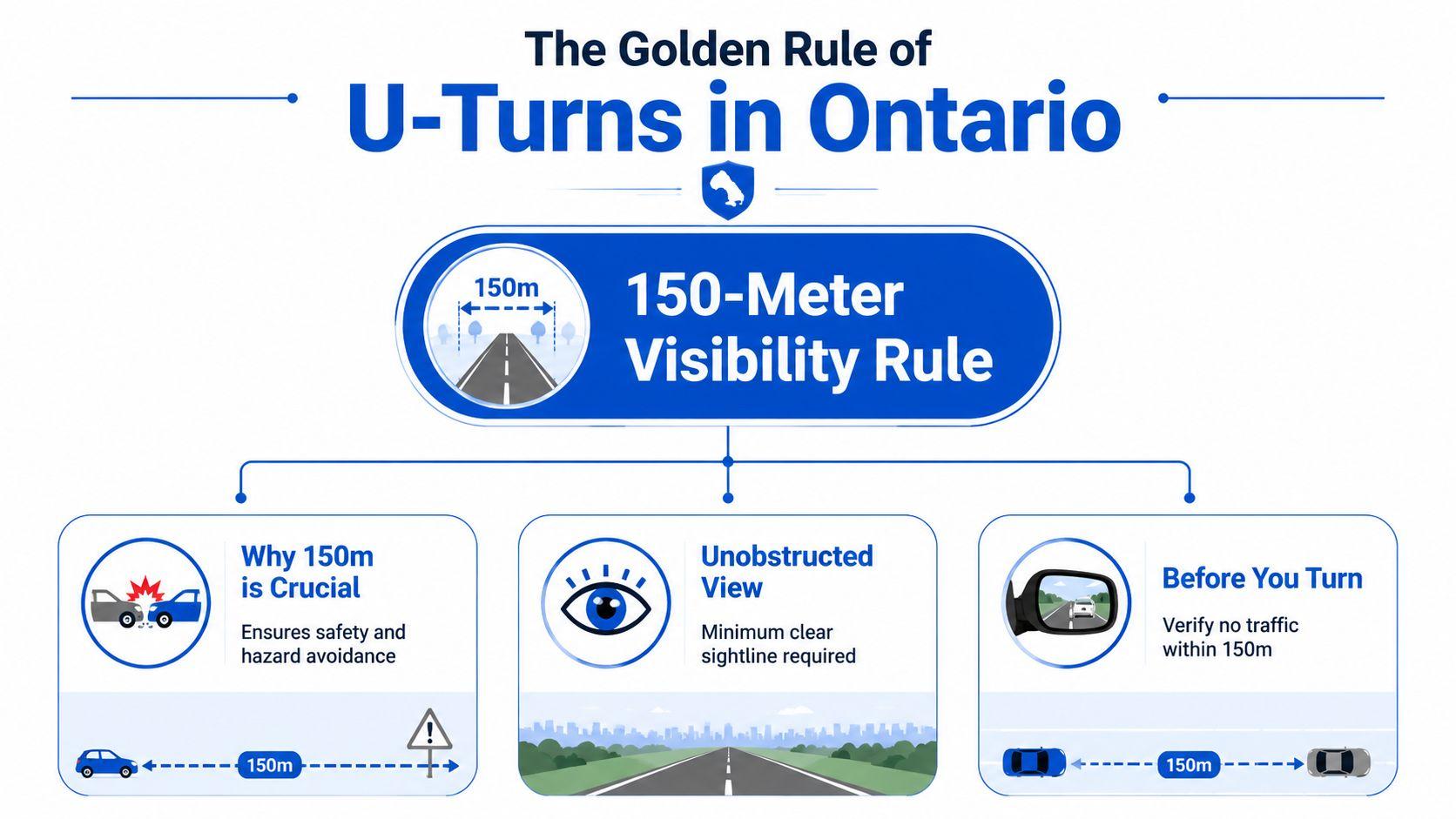
Ontario treats U-turns as something drivers may do only when conditions are clearly safe. According to Section 143 guidance discussed with the Ontario Highway Traffic Act rule details, a driver must never make a U-turn unless they can see 150 metres in both directions, and breaking that rule can bring a $110 fine and two demerit points.
Why 150 metres matters
For a new driver, 150 metres can feel abstract. A simple way to remember it is this. It's a long, uninterrupted sightline. If the road bends, rises, dips, or has anything blocking your view, you probably shouldn't be turning.
The G1 won't ask you to measure road distance with perfect precision. It wants to know whether you understand the principle. If you can't clearly see far enough in both directions, the legal answer is no.
A good mental checklist is short:
- See both ways clearly: Your view can't be blocked by a curve, parked vehicles, a hill, a bridge structure, or anything else.
- Check for posted signs: Even with a clear road, a sign can still make the turn illegal.
- Think before the wheel moves: If you're unsure, don't commit to the turn.
A rule you can actually remember
Many learners get stuck because they try to memorise every exception first. That's backwards. Start with the default safety check. Wide road, open view, no sign, no forbidden location. Then a U-turn may be legal.
If you want a broader review of road behaviour that often appears with these questions, this Ontario road rules study guide is a useful companion for practice.
Practical rule: If the road doesn't give you a long, clear, confident view in both directions, treat the U-turn as illegal and keep driving until you find a safer place.
When U-Turns Are Always Illegal in Ontario
This is the section to memorise for test day. Some locations are automatic no-go zones. If a question places you in one of these spots, don't overthink it.
Curves and hilltops
A U-turn is illegal on a curve and on the crest of a hilltop. The reason is simple. You can't reliably see traffic approaching soon enough.
These are classic G1 traps because the road might look empty for a second. That doesn't matter if the road shape hides approaching vehicles. When visibility is compromised by the road itself, the turn is not legal.
Railway crossings
You can't make a U-turn on or near a railway crossing. Trains, barriers, road markings, and limited escape space make this a dangerous place to reverse direction.
For the G1, treat railway crossings as one of the easiest “never here” answers on the test. Even if the crossing looks quiet, it isn't a place to turn around.
Bridges and tunnels
A U-turn is also illegal near a bridge or tunnel that blocks your view. This catches learners because they focus on road width and forget that structures can hide traffic.
Bridges and tunnels reduce what you can see. The law cares about that sightline problem, not whether you think you can swing the car around.
No U-turn signs
A posted sign settles the issue immediately. If there's a No U-turn sign, you can't make one there.
This sounds obvious, but the G1 may word the question in a way that tempts you to ignore the sign because the road is wide or empty. Don't. A posted prohibition overrides your personal judgement about whether it feels safe.
Here's a clean study table you can review quickly before a practice test.
Location Type U-Turn Status Key Condition Straight open road Might be legal Clear sightline and no prohibiting sign Intersection Might be legal Must still be safe and not prohibited Curve Never legal Visibility is blocked by road shape Hilltop crest Never legal Oncoming traffic may be hidden Railway crossing area Never legal Unsafe location Bridge or tunnel area with blocked view Never legal Structure limits visibility Posted No U-turn location Never legal Sign prohibits the manoeuvre
A fast way to remember the illegal locations is to group them by cause:
- Blocked by the road: Curve or hilltop.
- Blocked by infrastructure: Bridge or tunnel.
- Blocked by law or signs: Railway area or No U-turn sign.
If a test question includes the words curve, hill, railway crossing, bridge, tunnel, or posted sign, slow down. Those words are often the whole answer.
How to Execute a Safe and Legal U-Turn
Knowing where a U-turn is allowed is only half the skill. The other half is doing it in a way that stays calm, smooth, and controlled.
A simple memory tool helps here. Think Scan, Signal, Position, Turn.
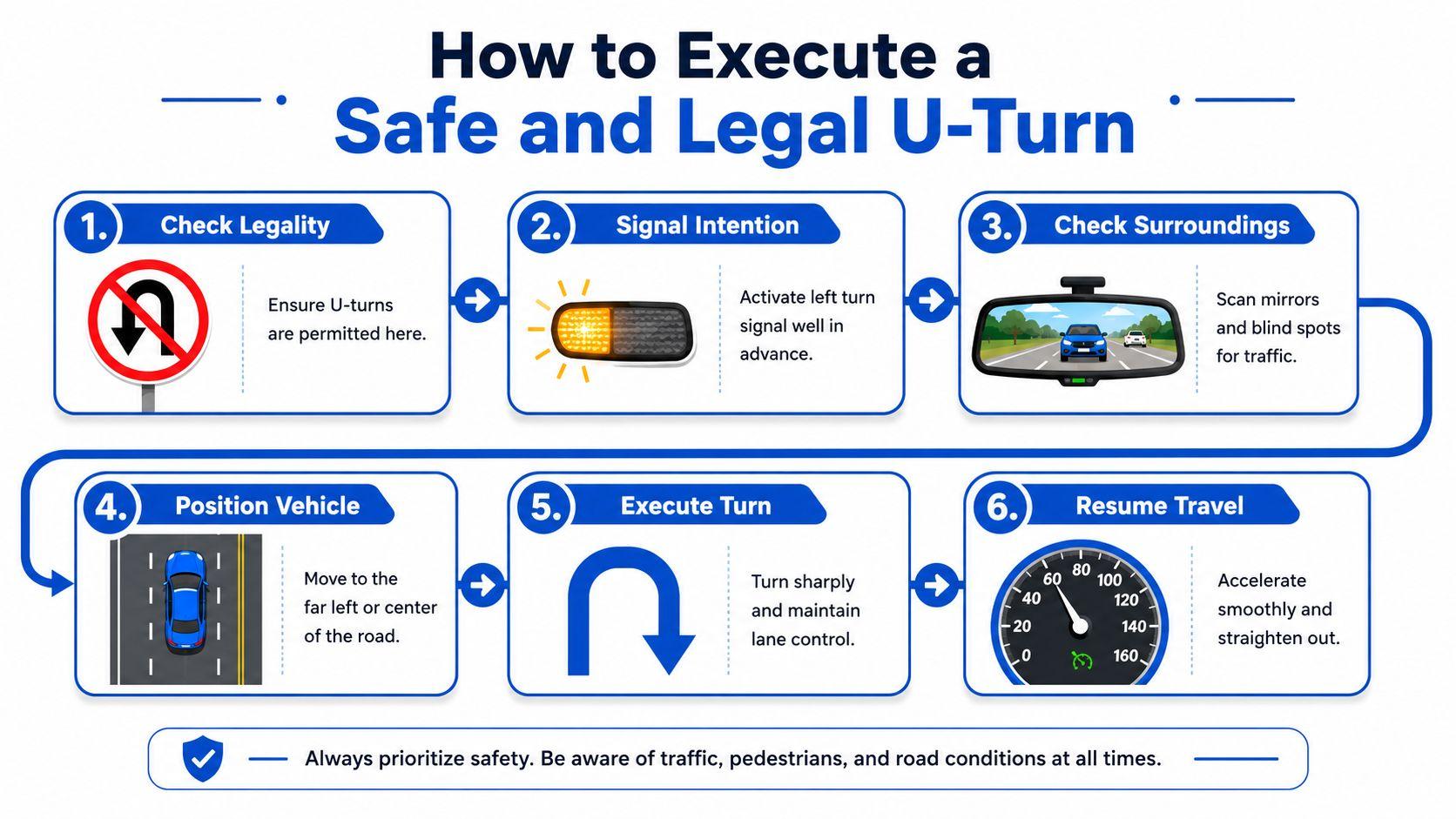
A simple memory tool
- Scan
Look well ahead and behind. Check mirrors, check for approaching traffic, and make sure the location itself is legal. - Signal
Let other drivers know what you're about to do. A U-turn surprises people when it's done suddenly. - Position
Set the car up properly before turning. Good positioning gives you more control and a tighter arc. - Turn
Commit only when the road is clear. Turn smoothly and finish in the correct lane with the car straightened out.
What the Ministry recommends
Ontario driving instruction guidance says the Ministry recommends a two-step method. First, signal right and move to the far right of your lane to create more turning space. Then signal left, turn the wheel sharply, and complete the turn only when traffic is clear in both directions. The same guidance says that in a 60 km/h zone, a safe sight distance is at least 20 seconds per direction. You can read that in this Ontario U-turn driving method explanation.
This video gives a helpful visual example of the manoeuvre in motion.
Two common mistakes show up again and again with beginners:
- Turning too early: This creates a wide, messy path and can place your car poorly after the turn.
- Focusing only ahead: Drivers also need to watch the sides, mirrors, and the full traffic picture.
Keep the wheel movement deliberate. A rushed U-turn is usually a sloppy U-turn.
Navigating U-Turns in Special Situations
Real roads don't always look like the clean examples in study books. The law may stay the same, but your decision changes depending on the setting. As a result, many G1 learners lose marks. They assume a green light, a median opening, or a big city street automatically means yes.
Intersections with traffic lights
A green light doesn't automatically give you permission to make a U-turn. It only tells you that the signal is allowing movement through the intersection.
You still need to decide whether the U-turn itself is legal and safe. Ask the same questions you'd ask anywhere else. Is there a posted sign banning it? Do you have enough visibility? Will your turn interfere with other traffic?
A test question may say “You have a green light” to distract you from the actual issue.
Multi-lane city roads
Wide urban roads often tempt new drivers because they look forgiving. More pavement doesn't always mean a legal or smart U-turn.
On multi-lane roads, traffic can approach from farther lanes than you first notice. Drivers may also be changing speed, turning, or entering from side streets. That's why judging a U-turn on a city arterial road takes more than noticing one empty lane.
A good companion topic here is right-of-way. If you're reviewing how other vehicles affect your decision-making, this Ontario right-of-way guide fits naturally with U-turn practice.
Median breaks and divided roads
Median openings create one of the most misunderstood situations in Ontario. Drivers often see a gap in the median and assume it exists for any turning movement they want.
That assumption can get you into trouble. A median break may allow certain movements, but you still have to judge whether a U-turn is safe, lawful, and compatible with the flow of traffic. If the opening places you in conflict with approaching vehicles or forces an awkward manoeuvre, it may not be appropriate.
Use this decision lens when you see a special road layout:
- Road design first: Does the layout naturally support a smooth turn, or would the car cut across traffic awkwardly?
- Traffic flow next: Would your manoeuvre force approaching drivers to react to you?
- Signs last: A sign can settle the issue immediately, but the absence of a sign doesn't automatically mean the turn is wise.
On the G1, “there is an opening” is not the same thing as “the turn is permitted.”
Tricky Scenarios and G1 Test Questions
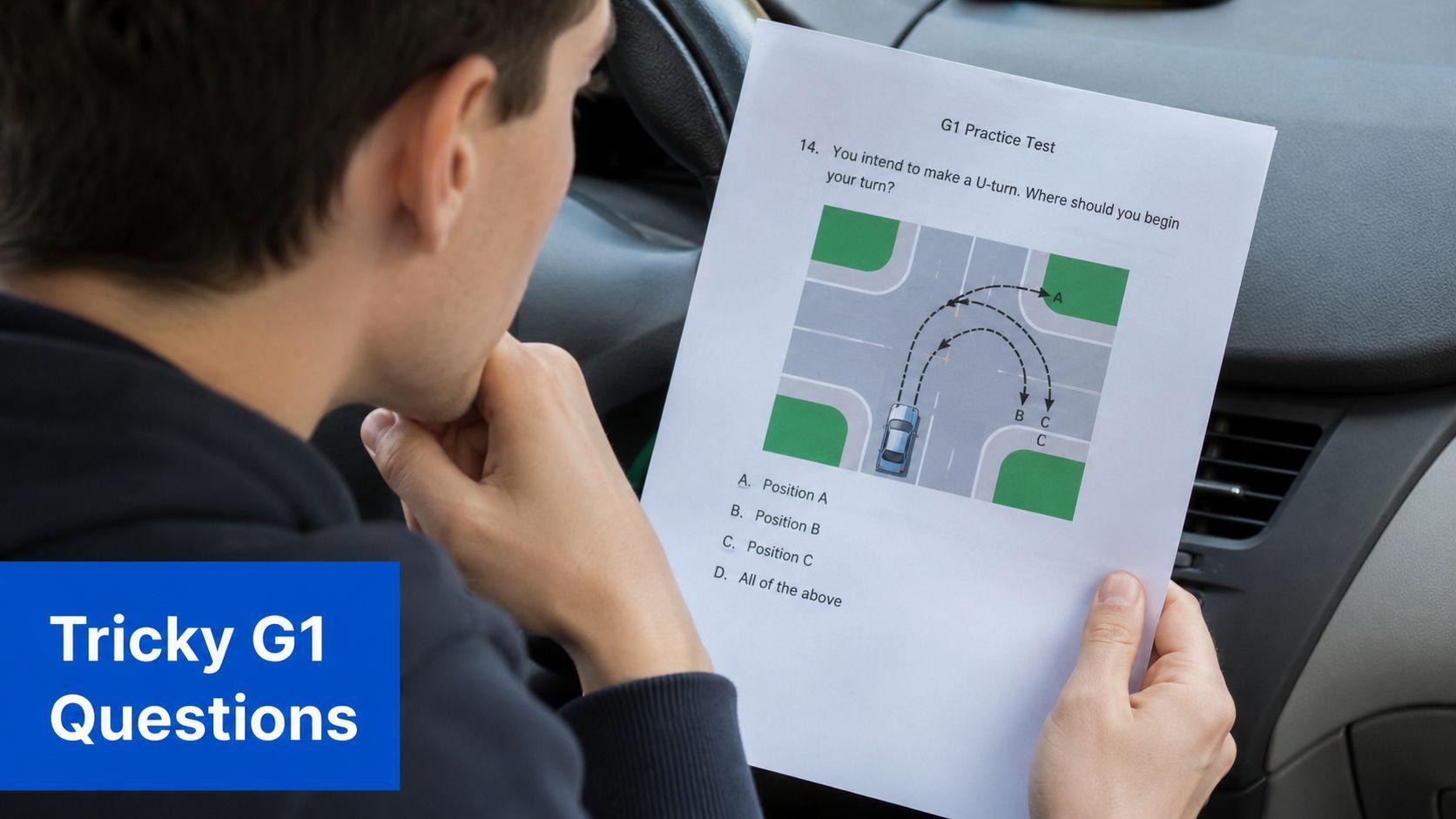
You are halfway through a practice question. The road looks open, the light is green, and the answer choice says nothing about a sign. That is exactly where many G1 test-takers get trapped. U-turn questions often reward the student who slows down, spots the missing detail, and chooses the safest answer instead of the fastest one.
Roundabouts
Roundabouts cause confusion because students look for a rule written in the same format as curves, hills, railway crossings, and bridges. On the G1, that approach can lead you off course.
A roundabout works like a one-direction circle with controlled entry and continuous flow. You yield before entering, travel counter-clockwise, and follow the lane path through. A U-turn cuts against that design. Even if a question tries to make the area sound calm or empty, the safe test answer is the same. Do not make a U-turn in a roundabout.
One-way to two-way confusion
This is another favourite test setup. A learner sees a one-way street and assumes a U-turn might be fine if the road is wide and there is no traffic nearby.
For the G1, treat that as a warning sign. A U-turn is not just a left turn with more steering. It fully reverses your direction, which means you can end up facing traffic patterns, lane rules, or road markings the question has not clearly made safe. If the wording leaves gaps, do not fill them with optimistic guesses.
How the G1 hides the trick
Many U-turn questions are really reading tests. The exam often gives you one detail that feels helpful, then waits to see if you mistake it for permission.
Watch for these common patterns:
- “At an intersection with a green light”
A green light tells you traffic may move. It does not automatically approve a U-turn. - “On a road with no visible traffic”
An empty road right now does not answer the legal question. It also does not prove you have the sight distance needed. - “At a median opening”
A gap in the road layout is not the same as a green light for any manoeuvre you want. - “In a roundabout”
Mark this as a no.
A helpful memory rule is simple. On the G1, convenience never beats design, signs, and safety.
If you want more practice spotting these wording traps, review these common Ontario driving test questions.
The strongest G1 answer is usually the one that assumes less, checks the road setup, and chooses the safer interpretation.
Penalties Fines and Demerit Points
Consequences matter because they force you to treat this as more than a test topic. Ontario's U-turn rules are built around safety, and the penalties reflect that.
According to an Ontario traffic flow study discussing illegal U-turn enforcement, the standard penalty for an illegal U-turn under Section 143 is a $110 fine and two demerit points. The same source notes that where a specific sign prohibits the turn, the fine can be $105, and observed illegal U-turns were very rare at 0.27%, which suggests most drivers comply with the rules.
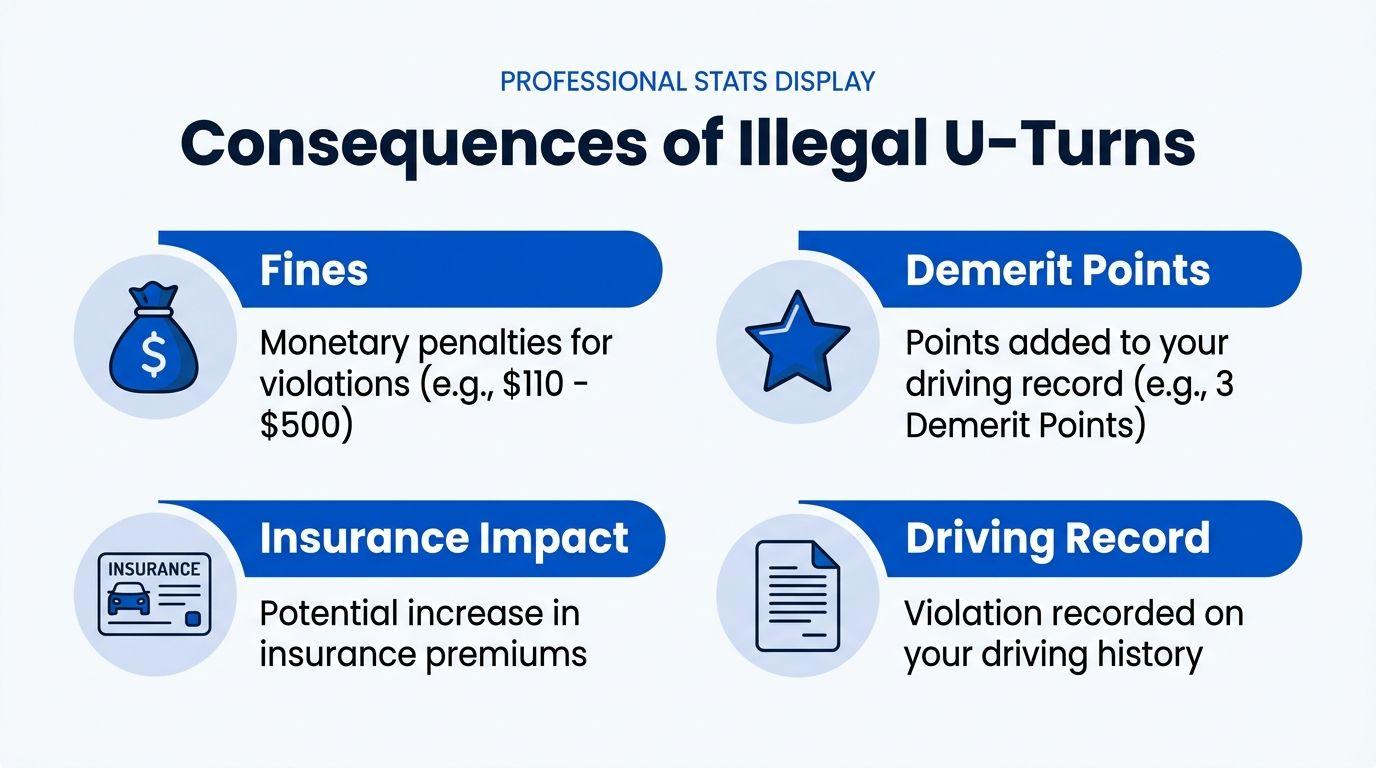
That low rate is a useful reminder for learners. Most drivers don't treat a U-turn as a casual shortcut. They treat it as a manoeuvre that has to be clearly legal first.
For the G1, the best summary is simple:
- Know the visibility rule
- Memorise the automatic no-go locations
- Don't assume an intersection or roundabout gives permission
- Respect posted signs every time
If you want more Ontario G1 practice in the same plain-language style, G1ready.ca is a practical place to study. It offers free practice tests, targeted rule-based quizzes, and exam-style questions that help you turn tricky topics like U-turns into easy marks on test day.