You're probably here because this rule still feels fuzzy in real life. You see painted lines on the road, maybe a flashing light, maybe just a person waiting at the curb, and suddenly a simple G1 question turns into hesitation.
That hesitation matters. On the test, it can cost you the right answer. On the road, it can put someone at risk.
The good news is that Ontario's pedestrian crossing rules become much easier once you separate pedestrian crossovers, school crossings, crosswalks at intersections, and situations controlled by traffic lights. Most confusion comes from treating them all as the same thing. They aren't.
Why Pedestrian Rules Are Critical for Your G1 Test
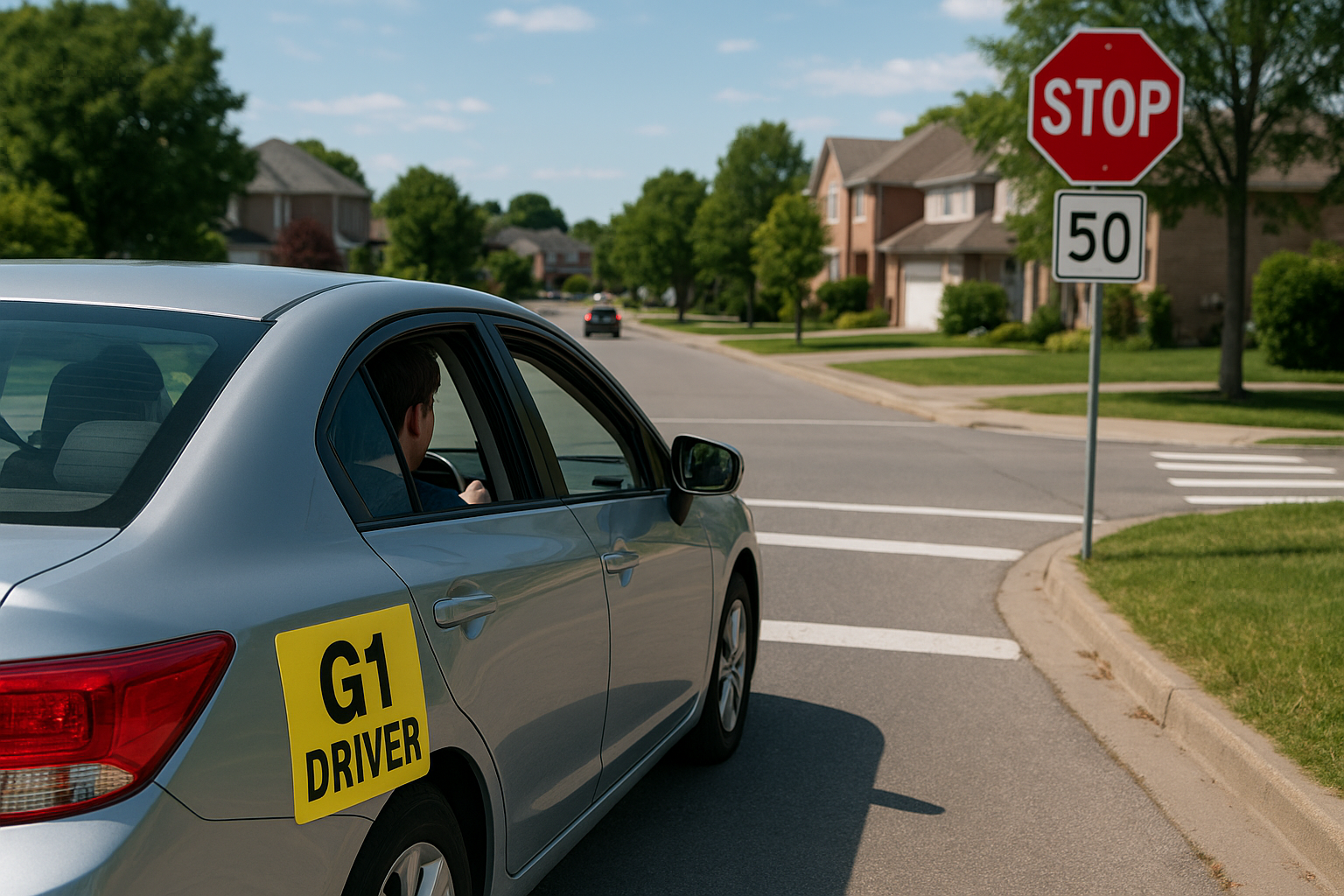
A common G1 mistake starts like this. You're driving toward an intersection, a pedestrian is standing near the corner, and you're trying to decide whether you need to stop fully or just slow down. If you don't know what kind of crossing you're looking at, you'll guess. That's exactly what the test is designed to expose.
Ontario puts heavy attention on this topic because yielding errors are not small errors. A City of London pedestrian crossover safety page citing Ontario data states that a 2020 Ontario Ministry of Transportation safety report indicated roughly 16% of all fatal collisions and 21% of serious injury collisions involving pedestrians happened at or near marked crosswalks, crossovers, or school crossings. The same page says over 10,000 tickets for failing to yield were issued province-wide between 2018 and 2020.
Those numbers explain why these questions show up so often. Ontario wants new drivers to build the habit early: scan ahead, identify the crossing type, and act before you're too close to react calmly.
Practical rule: If you're unsure what kind of pedestrian crossing you're approaching, your first job is to slow down and identify the signs, signals, and pavement markings before you decide to proceed.
This isn't just memory work. It's pattern recognition. A confident G1 student sees a ladder-style marking and knows the rule is different from a normal intersection crosswalk. A cautious learner also practises scenario questions until the response becomes automatic, which is why many students use Ontario driving test questions for extra review.
A licence test rewards the driver who can stay calm under uncertainty. Pedestrian rules are one of the fastest ways to show that calm decision-making.
Decoding Ontario's Pedestrian Crossings
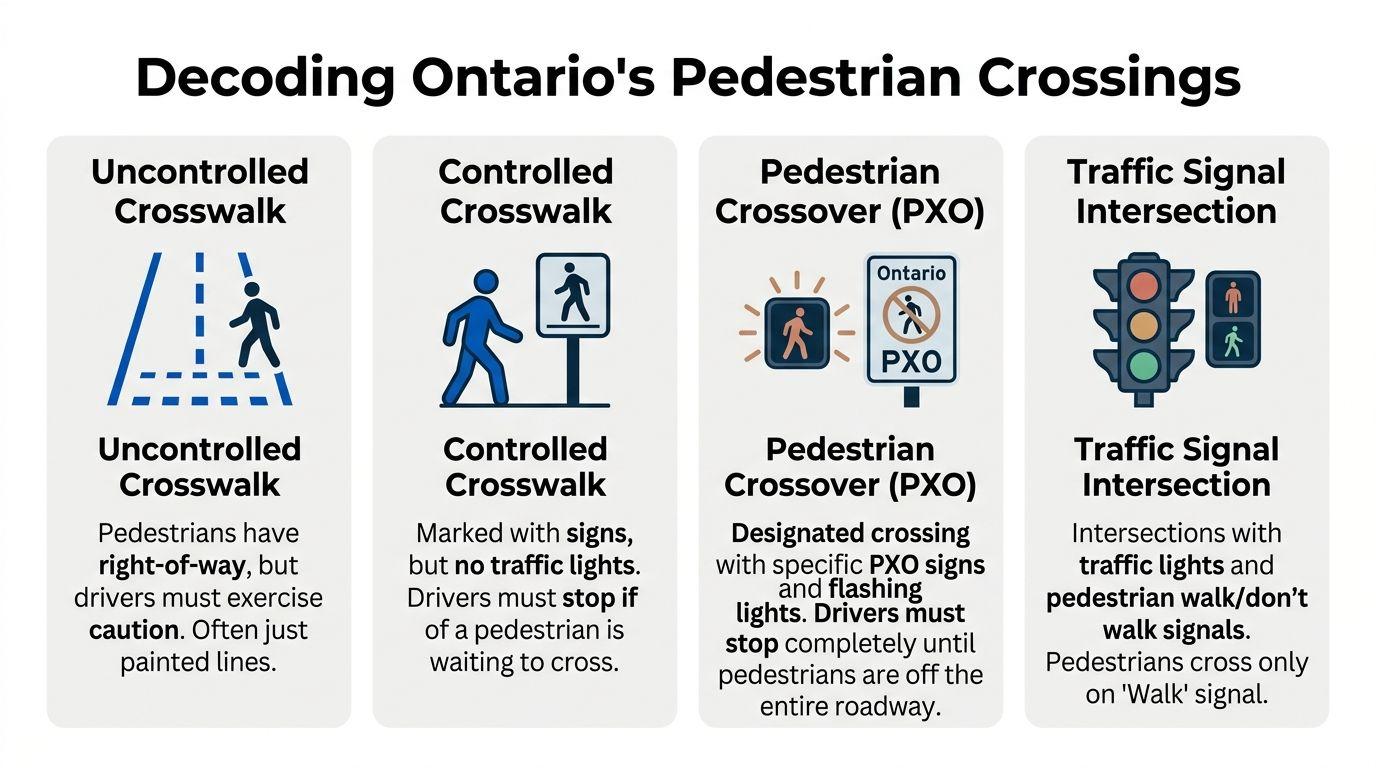
The phrase pedestrian crossing rules Ontario sounds simple until you realise there are different crossing types with different driver duties. Painted lines alone don't tell the whole story. The sign, the location, and the traffic control all matter.
The crossing type changes your duty
Ontario introduced the modern pedestrian crossover system in 2015, and these locations require drivers to stop for pedestrians. They're marked by specific “Stop for Pedestrians” signs and ladder-style pavement markings, and over 1,100 had been installed across the province as of 2023 according to Toronto's pedestrian crossover information page.
That matters because a pedestrian crossover, often called a PXO, is not just a regular crosswalk with extra paint. It's a standardised treatment with a clear stop requirement.
Here's the easiest way to separate the main crossing types:
- Pedestrian crossover PXO: Look for the official signs and the distinct ladder-style markings. The full stop rule applies most strongly and is most testable at these locations.
- School crossing: These also carry a clear stop expectation for drivers when pedestrians are crossing or about to cross.
- Standard marked crosswalk at an intersection: These are often found where roads meet, sometimes with stop signs or traffic lights. Your duty depends on the traffic control in place.
- Unmarked crosswalk: At many intersections, the crossing legally exists even without painted lines. New drivers often forget this.
How to identify each one fast
A smart test-day habit is to scan in this order:
- Look high first. Are there traffic lights, pedestrian signals, school crossing signs, or PXO signs?
- Look down second. Are the pavement markings plain lines or ladder-style markings?
- Look at placement. Is it mid-block or at an intersection?
- Look for a waiting pedestrian. The person's position changes your next move.
A lot of wrong answers come from one assumption: “all marked crossings work the same way.” They don't.
If you want to train your eye for the visual differences, study the official sign shapes and common road markings together. A focused review of Ontario road signs for the test helps because many pedestrian questions are really sign-recognition questions in disguise.
Use this quick comparison:
Crossing type What you'll notice first Driver takeaway Pedestrian crossover PXO sign and ladder-style markings Be ready to stop fully School crossing School crossing indicators, often near schools Expect children and stop as required Intersection crosswalk Corner location, may have signals or stop signs Follow the intersection controls and yield properly Unmarked crosswalk No paint, but the intersection still creates a crossing area Don't assume “no paint” means “no pedestrian right-of-way”
When students get this distinction clear, the whole topic becomes easier. You're no longer memorising random rules. You're matching the road design to the legal duty.
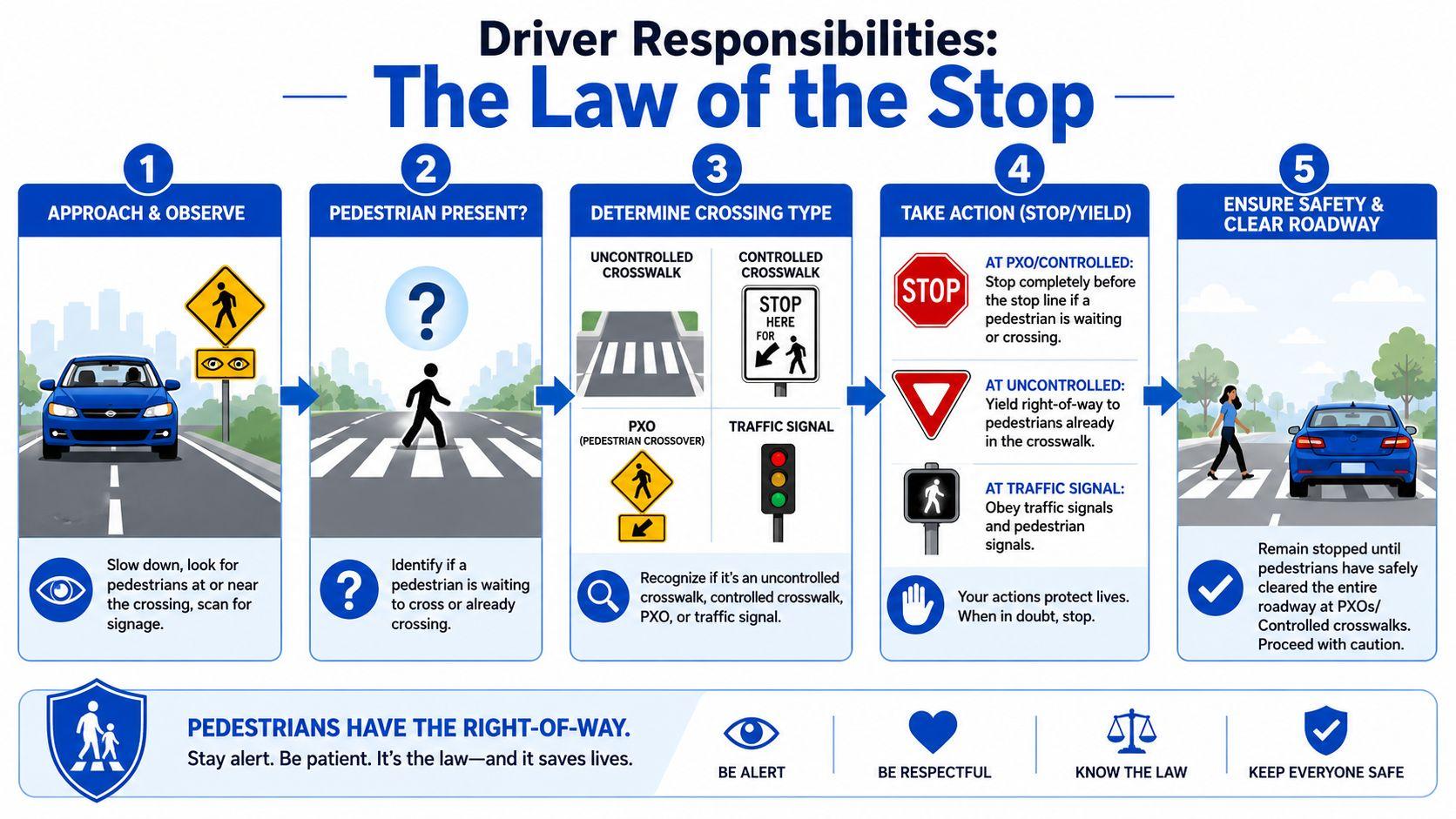
Driver Responsibilities The Law of the Stop
The biggest mistake at pedestrian crossings isn't speeding through. It's the half-decision. Drivers see someone waiting, tap the brakes, roll forward, then hope the situation sorts itself out. Ontario law expects something more definite.
What you must do at a PXO
At a designated pedestrian crossover, drivers must come to a complete stop when a pedestrian is waiting or within the crossover, and must yield the entire width of the roadway until the pedestrian is safely on the sidewalk. Ontario also states that failing to do this can lead to a fine of up to $1,000 and 4 demerit points on the Ontario pedestrian crossover and school crossing rules page.
That gives you a simple exam rule: slowing down is not enough at a PXO.
A practical perspective:
- See the PXO early: Scan for the sign and the ladder markings.
- Cover the brake: Don't wait until you're close.
- Stop completely: Wheels fully stopped, not creeping.
- Wait until the pedestrian has cleared the full roadway: Not just your lane.
- Proceed only when the crossing is fully clear and safe.
Here's a visual explanation that helps many new drivers understand the timing and positioning:
How this differs from a standard crosswalk
G1 questions frequently attempt to trip you up regarding this point. A standard crosswalk at an intersection may be controlled by traffic lights, stop signs, or the general right-of-way rules at the corner. You still have to yield properly to pedestrians, especially when turning, but the exact stopping pattern depends on that intersection control.
For example, if you're turning right on green and a pedestrian is crossing legally in front of you, you must yield. If you're at a PXO, the rule is more specific and more absolute: stop and remain stopped until the pedestrian has safely cleared the roadway.
“If you can't tell whether it's a crossover or a regular intersection crosswalk, don't guess. Look for the sign first.”
A simple decision routine
Use this routine every time you approach a possible pedestrian crossing:
- Scan the road edge and signs. Don't focus only on vehicles ahead.
- Classify the crossing. PXO, school crossing, or intersection crosswalk.
- Check for intent. Is the pedestrian already crossing, or clearly waiting to enter?
- Apply the correct rule. Stop fully where required. Yield where required.
- Move only after the legal condition is met. Not when you feel impatient, and not when the pedestrian merely passes your bumper.
For students working on right-of-way confusion, Ontario G1 right-of-way rules are useful because pedestrian questions often overlap with turning, stopping, and intersection judgment.
Pedestrian Rights and Responsibilities A Two-Way Street
Drivers carry the heavier responsibility because the vehicle creates the greater risk. Still, safe crossings work best when pedestrians also follow predictable rules.
What pedestrians are expected to do
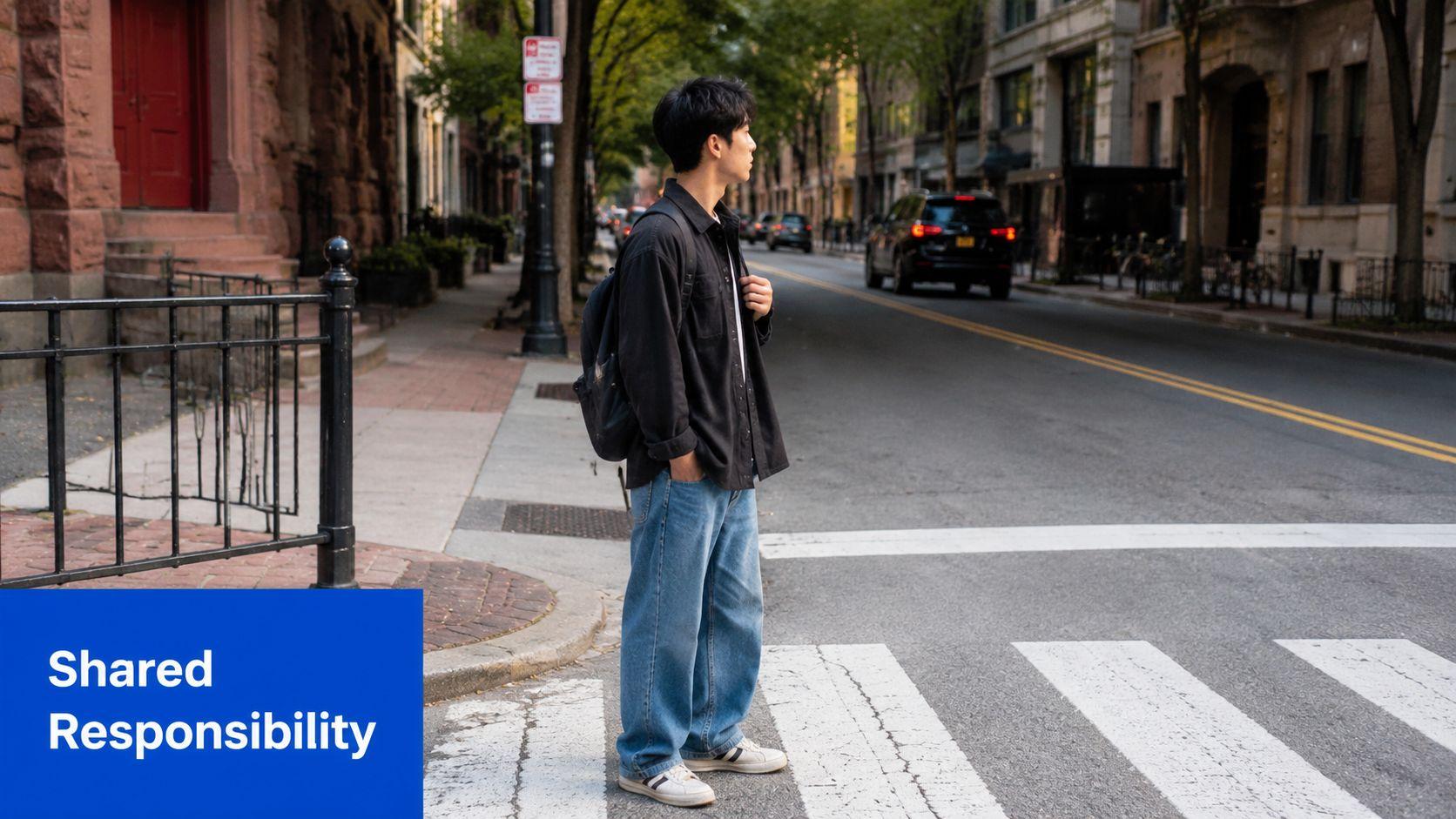
Pedestrians should use designated crossing areas when available, obey pedestrian signals at signalised intersections, and avoid stepping suddenly into a vehicle's path when a driver can't reasonably stop in time. For a G1 student, this matters because you're expected to understand not only your duty, but also what a pedestrian is likely supposed to do.
That helps with prediction. A person waiting at the curb near a school crossing may enter soon. A person facing away from the road may just be standing there. A driver shouldn't rely on that assumption, but should observe carefully.
Helpful pedestrian habits include:
- Use the proper crossing location: Cross at intersections, school crossings, or crossovers whenever possible.
- Follow the signals: A “Walk” signal changes how traffic should expect movement.
- Make yourself visible: Eye contact and clear body positioning help drivers recognise intent.
- Avoid sudden movement: Stepping out late gives drivers less time to react safely.
What drivers should assume
A careful driver assumes people can be unpredictable, especially children, seniors, and people using mobility devices. That means you shouldn't drive based only on what a pedestrian should do. You should drive based on what they might do next.
Defensive driving habit: Treat every pedestrian near a crossing as a possible hazard until you've confirmed your path is clear and your legal duty has been satisfied.
This mindset reduces panic. Instead of reacting at the last second, you're already prepared to stop, yield, or wait.
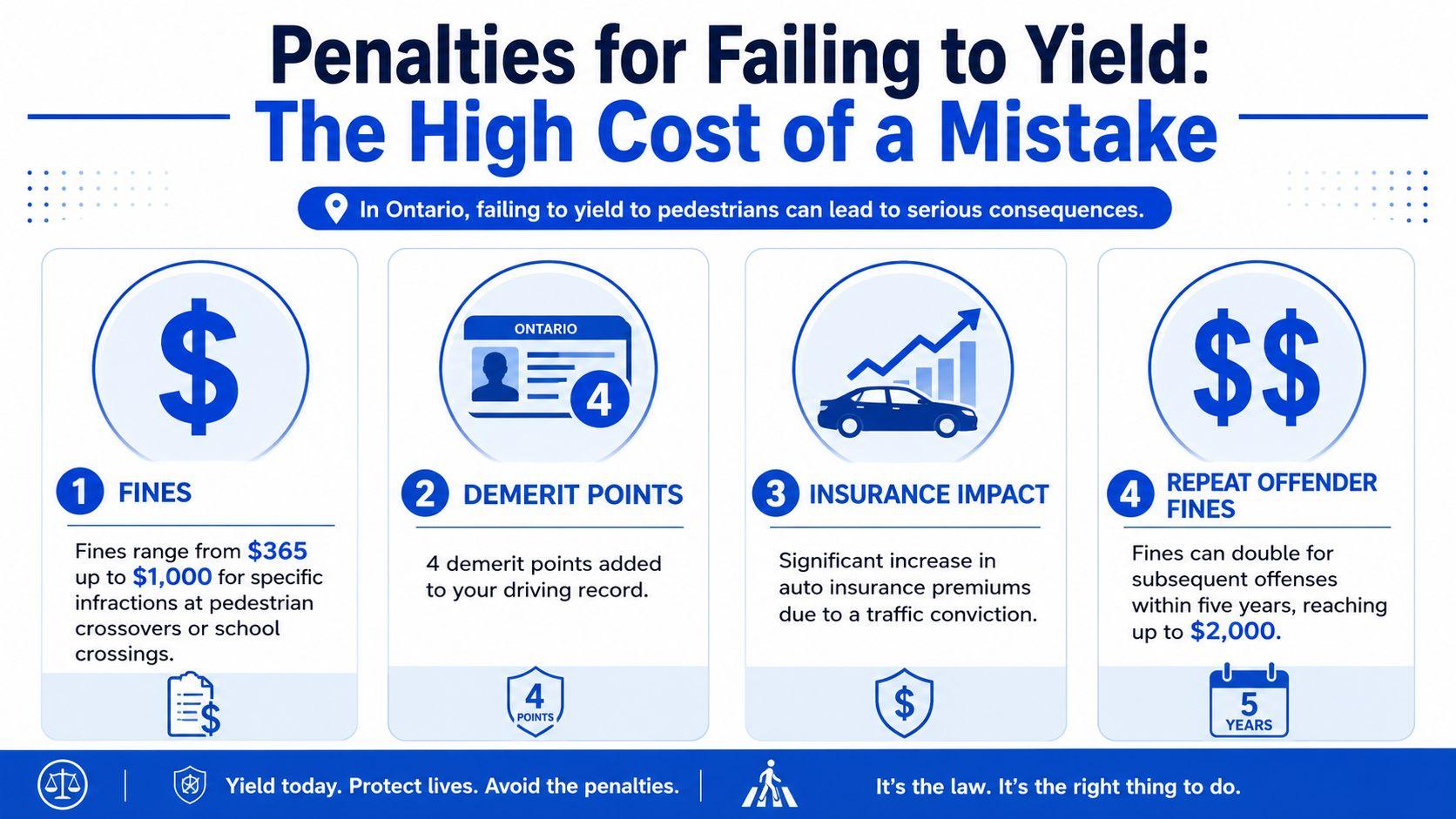
Penalties for Failing to Yield The High Cost of a Mistake
A lot of learners remember pedestrian rules better once they understand the consequences. Ontario treats these offences seriously because they involve vulnerable road users and often happen in places where drivers should already be alert.
What the penalties mean for a new driver
For failing to yield at a pedestrian crossover or school crossing, Ontario penalties can be up to $1,000 with four demerit points, and those penalties are doubled in designated Community Safety Zones. That makes these areas especially important near schools and public spaces.
For a new driver, the message is straightforward. This isn't the kind of offence you brush off as a minor mistake. It can affect your licence record, your confidence, and the way you approach every crossing after that.
A rolling stop at a crossover can feel small from inside the car. Legally and safely, it isn't small at all.
Ontario penalties for failing to yield to pedestrians
Here's a clean study table to remember the basics:
Offence Fine Range Demerit Points Notes Failing to yield at a pedestrian crossover Up to $1,000 4 Driver must stop and yield the entire roadway until the pedestrian is safely on the sidewalk Failing to yield at a school crossing Up to $1,000 4 High-risk locations often involve children Offence in a Community Safety Zone Penalties are doubled 4 Applies in designated zones near schools and public areas
Notice what the table does and doesn't say. It gives you the firm numbers Ontario clearly states for crossovers and school crossings. It doesn't claim exact insurance increases or recent offence totals beyond the Ontario figures already noted earlier, because those details aren't consistently published in one simple learner-facing rule set.
That's also why your safest approach is the simplest one. If you see a pedestrian crossover or school crossing, stop fully, wait properly, and remove any doubt.
Test Your Knowledge G1 Style Practice Questions
Reading rules helps. Answering questions under pressure is what reveals whether you know them.
Practice questions
1) You approach a pedestrian crossover with ladder-style markings. A pedestrian is waiting at the edge to cross. What must you do?
A. Slow down and continue if they haven't stepped out
B. Honk and proceed with caution
C. Stop completely and wait until the pedestrian has safely cleared the roadway
D. Drive through if your lane is clear
Correct answer: C
A PXO requires a full stop when a pedestrian is waiting or within the crossover. This is one of the most tested distinctions.
2) You're turning right at an intersection on a green light, and a pedestrian is crossing legally in front of you. What must you do?
A. Continue because you have the green light
B. Yield to the pedestrian before turning
C. Turn if you think you can clear the intersection first
D. Only stop if a crossing guard is present
Correct answer: B
A green light doesn't cancel the pedestrian's right-of-way when they're crossing legally in your path.
3) What visual clue most strongly suggests a pedestrian crossover rather than a regular crosswalk?
A. A nearby bus stop
B. A painted stop line alone
C. Official “Stop for Pedestrians” signage and ladder-style markings
D. A corner curb
Correct answer: C
Those features are the clearest identifiers of a PXO.
4) At a pedestrian crossover, when can you proceed after stopping for a pedestrian?
A. Once the pedestrian leaves your lane
B. Once the pedestrian reaches the centre of the road
C. Once the pedestrian waves you through
D. Once the pedestrian has safely cleared the roadway
Correct answer: D
That “entire roadway” idea is one of the biggest points students miss.
5) What happens to penalties in a Community Safety Zone for this type of offence?
A. They disappear for first-time drivers
B. They are reduced if traffic is light
C. They are doubled
D. They only apply at night
Correct answer: C
That's why zones near schools deserve extra caution.
How to use these questions
If you missed any of those, don't just memorise the answer. Work backwards and ask what clue you ignored. Was it the sign, the location, or the difference between “yield” and “stop completely”?
One practical study method is to keep a short list of confusion pairs:
- PXO vs intersection crosswalk
- Yield vs full stop
- Pedestrian in your lane vs pedestrian clearing the whole roadway
- Green light for you vs right-of-way for the pedestrian
That's where one focused study tool can help. G1ready.ca offers practice exams, targeted quizzes, and explanations that let learners drill specific rule categories instead of only taking random mixed tests.
Your Safe Driving Checklist for Pedestrian Crossings
Before your G1 test, and before every drive, keep this checklist in your head:
- Scan early: Look for signs, signals, and pavement markings before you reach the crossing.
- Identify the type: Don't treat every crossing the same. A PXO has its own rule.
- Recognise the PXO clues: Watch for the “Stop for Pedestrians” sign and ladder-style markings.
- Stop fully where required: At pedestrian crossovers and school crossings, hesitation or rolling forward can put you in the wrong.
- Wait properly: At a PXO, stay stopped until the pedestrian has safely cleared the roadway.
- Yield when turning: A green light doesn't give you permission to cut off a pedestrian crossing legally.
- Expect unpredictability: Children, seniors, and distracted walkers may act suddenly.
- Respect Community Safety Zones: The legal consequences are tougher there, and the safety stakes are higher.
Confidence comes from knowing exactly what you're looking at and exactly what the law expects. That's the primary key to mastering pedestrian crossing rules in Ontario.
If you want more structured practice before test day, G1ready.ca offers Ontario-focused G1 study tools, including practice exams and topic-based quizzes that help you review right-of-way, road signs, and common crossing scenarios at your own pace.