
The all traffic must turn left sign is a mandatory regulatory sign. It legally requires every approaching vehicle to turn left, so drivers must not continue straight or turn right.
You're approaching an unfamiliar Ontario intersection during a driving lesson. A blue circular sign shows a white arrow pointing sharply left, and the lane seems to continue forward. A new driver may instinctively follow the road, but that choice would ignore the sign. The arrow is giving a direction, not making a suggestion.
For G1 learners, this sign matters because recognizing its category is more useful than memorizing its appearance alone. You need to know whether a sign commands a movement, prohibits a movement, or applies only to a particular lane. You also need to check whether a supplementary plate, pavement marking, lane position, or traffic signal changes how the instruction applies.
Introduction to the All Traffic Must Turn Left Sign
At the approach to a channelized intersection, you may see traffic divided by a raised island, construction barrier, or narrow median. The road ahead appears open, but the sign tells you that every vehicle using that approach must follow the leftward path. If you continue straight or turn right, you haven't just chosen a less preferred route. You've disobeyed a regulatory direction.
Ontario treats lane-use control signs as mandatory direction signs. The Official MTO Driver's Handbook explains that these signs tell drivers which direction they must travel, including situations where one lane must turn left while adjacent lanes have different permitted movements.
The sign can appear in G1 questions because it tests several skills at once:
- Recognition: Can you identify a mandatory direction sign?
- Interpretation: Do you understand that “must turn” is different from “may turn”?
- Scope: Does the instruction apply to every lane or only a marked lane?
- Compliance: Can you follow the sign even when the road layout seems to offer another option?
Practical rule: Read the sign before you read your instinct. The road's shape may look as though it permits straight travel, but a regulatory sign controls what you're allowed to do.
This guide separates the three ideas learners most often mix up: a mandatory all-traffic direction, a prohibition such as no right turn, and a lane-specific instruction. It also deals with time restrictions, signal phases, correct lane position, yielding, and the difference between a solid green light and a protected left-turn arrow.
What the Sign Looks Like and How to Recognize It
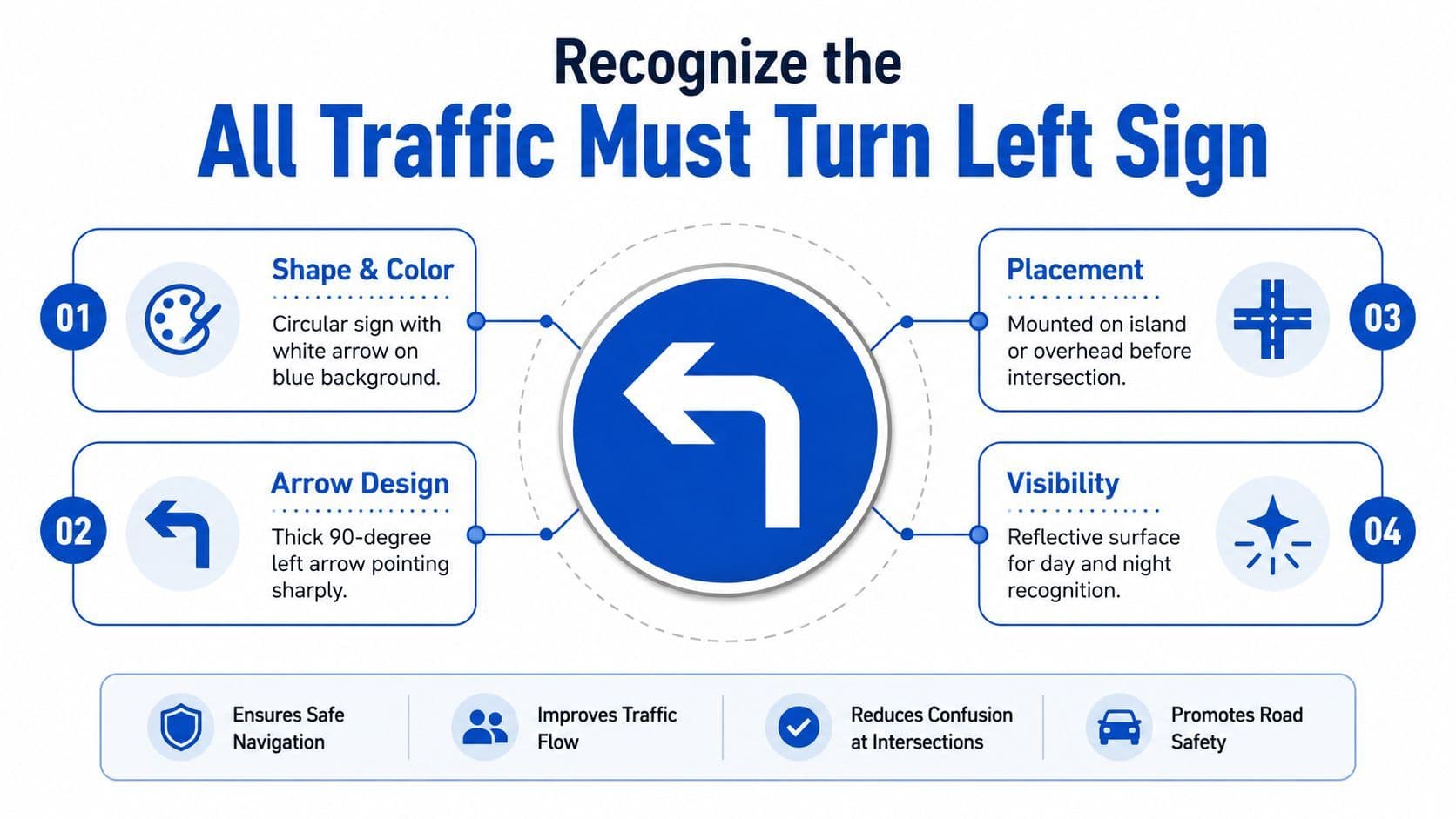
Start with the sign's visual category. The all traffic must turn left sign is generally a circular blue regulatory sign with a white arrow pointing left. The colour and shape signal that the sign controls road use rather than warning you about a hazard ahead.
The arrow is usually bold and sharply directed to the left, often forming a clear right-angle movement. Don't confuse this with a curved directional arrow that may show a route or bend in the road. On a mandatory sign, the arrow represents the movement you must make.
Use a quick visual sequence
When you see a sign in a G1 image or on the road, check it in this order:
- Shape: Is it circular rather than diamond-shaped? A diamond commonly warns about conditions, while this circular sign gives a regulatory instruction.
- Colour: Is the background blue with a contrasting white arrow? That combination points toward a required movement.
- Arrow: Does the arrow point directly left without a slash or cross-out symbol? A plain arrow commands the direction. A crossed or slashed arrow belongs to a prohibition category.
- Placement: Is it mounted before a junction, on a traffic island, or above the approach? Its position helps you prepare before reaching the point where the road forces the movement.
Signs may be mounted on a roadside post, attached to a central island, or displayed overhead where lane separation makes the instruction easier to see. A reflective surface helps the sign remain visible in changing light, but you still need to scan ahead rather than wait until you're beside it.
For a broader review of Ontario regulatory signs, use this Ontario road signs study guide. Focus on the sign's command, not just its colour. The key question is, “What movement must I make from this approach?”
Legal Meaning and Why You Must Obey It in Ontario
The sign carries legal force in Ontario. It isn't an advisory recommendation such as a route preference or a reminder to drive carefully. It's a regulatory control device, which means the driver must follow the movement shown unless another lawful control changes the application.
Ontario's MTO handbook describes lane-use control signs as signs that tell drivers the direction they must travel. Its example explains that a driver in one lane may be required to turn left while other lanes receive different movement instructions. That distinction is important because the words “all traffic” indicate a broad approach instruction, while a lane-use sign may apply only to vehicles in the marked lane.
The Ontario Highway Traffic Act reinforces the legal rule that drivers must obey prescribed signs forbidding a left turn, right turn, through movement, or a combination of those movements at an intersection. A sign that requires a left turn therefore overrides the default expectation that a driver may continue through an intersection when the road appears open.
Why the dimensions matter
Ontario's sign regulations prescribe physical standards for turn-control signs. A sign restricting a left turn must be at least 90 centimetres high and 60 centimetres wide, and certain no-left-turn signs at signalized intersections erected on or after September 1, 1998, must meet that same minimum standard, as described in the MTO handbook sign guidance.
For no-left-turn signs, Ontario regulations also specify a minimum of 60 centimetres high by 60 centimetres wide, with the signalized-intersection standard increasing to 90 centimetres by 60 centimetres for qualifying signs. These prescribed dimensions show that turn signs belong to an organised legal system, not an informal collection of driver suggestions.
Disobeying the sign can be treated as failing to obey a regulatory sign. In practical terms, a driver who goes straight or turns right after seeing an all-traffic-left instruction has ignored the control governing that approach.
How This Sign Differs From Related Turn Signs
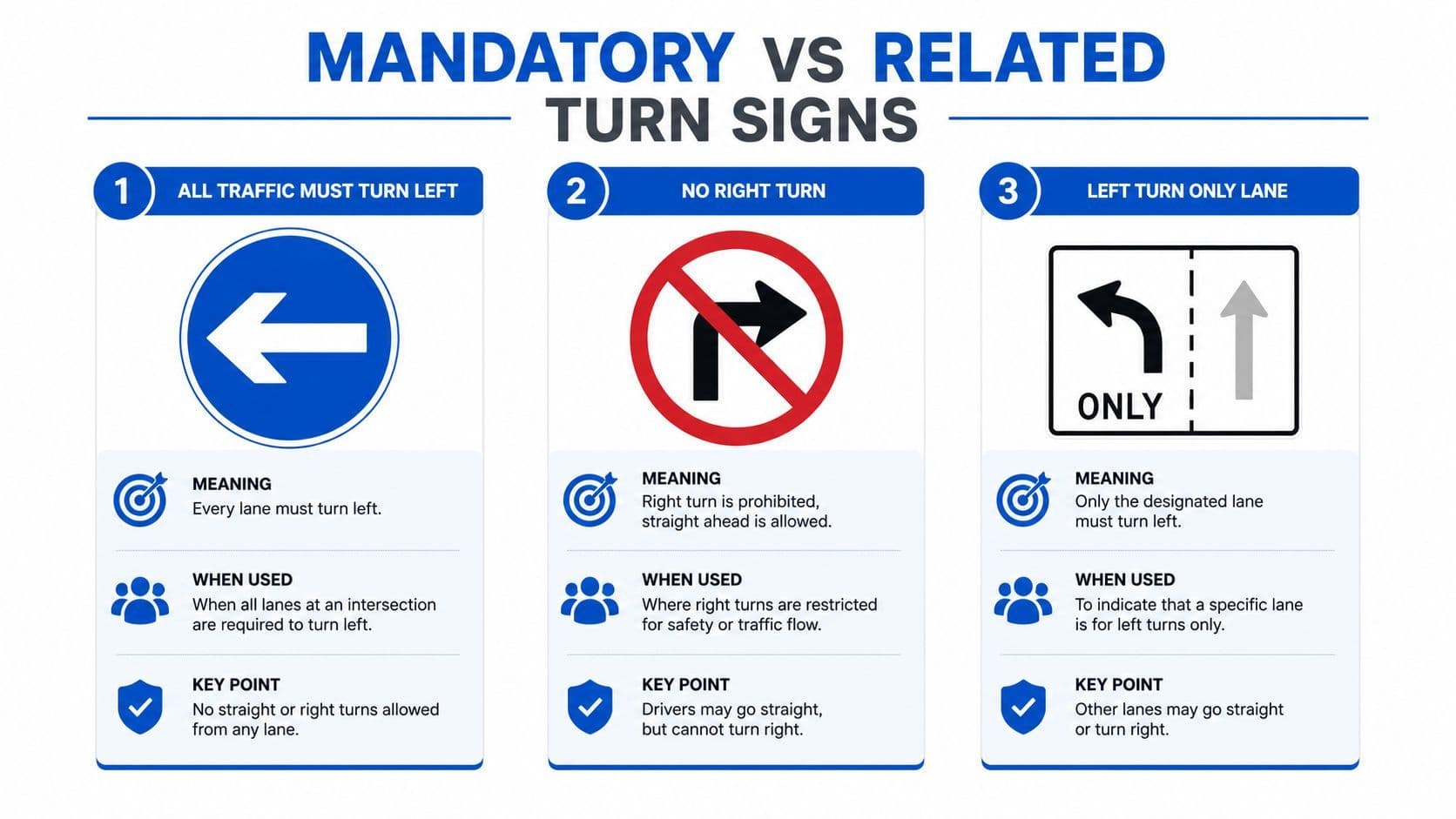
The most useful G1 distinction is between mandatory direction, prohibition, and lane-specific instruction. These signs may all appear near an intersection, but they answer different questions.
Mandatory direction
An all traffic must turn left sign tells the affected vehicles what they must do. If the instruction applies to the whole approach, every vehicle must turn left. Going straight isn't an alternative, and turning right isn't permitted because the driver prefers that route.
This is different from a general left-turn-only lane sign. A lane-use instruction may require vehicles in one lane to turn left while vehicles in another lane continue straight or turn right.
Prohibition
A no-right-turn sign tells you what you must not do. It prohibits a right turn, but it doesn't automatically require a left turn. Depending on the other signs, signals, and markings, straight travel may still be permitted.
The same logic applies to a no-left-turn sign. It prevents a left movement, but it doesn't by itself tell you whether to proceed straight or turn right.
Lane-specific instruction
A lane-use sign applies to the lane identified by its arrow, position, or pavement marking. Ontario's handbook explains that lane-use signs above or on the pavement tell drivers which direction they must travel. Look up before the intersection and check the markings beneath your vehicle.
Sign Type What It Commands Applies To Mandatory direction Requires the shown movement, such as turning left Every affected vehicle or approach, depending on the sign and layout Prohibition Forbids a movement, such as turning right Drivers who would otherwise make the prohibited movement Lane use sign Requires or permits specific movements from designated lanes Vehicles in the marked or signed lane
A useful test-taking question is: Does the sign tell me what to do, what not to do, or which lane controls my movement? “All traffic must turn left” is a command. “No right turn” is a prohibition. “Left turn only” above one lane is a lane-specific instruction unless the surrounding signs clearly extend it to the entire approach.
Where You Will Encounter This Sign in Ontario
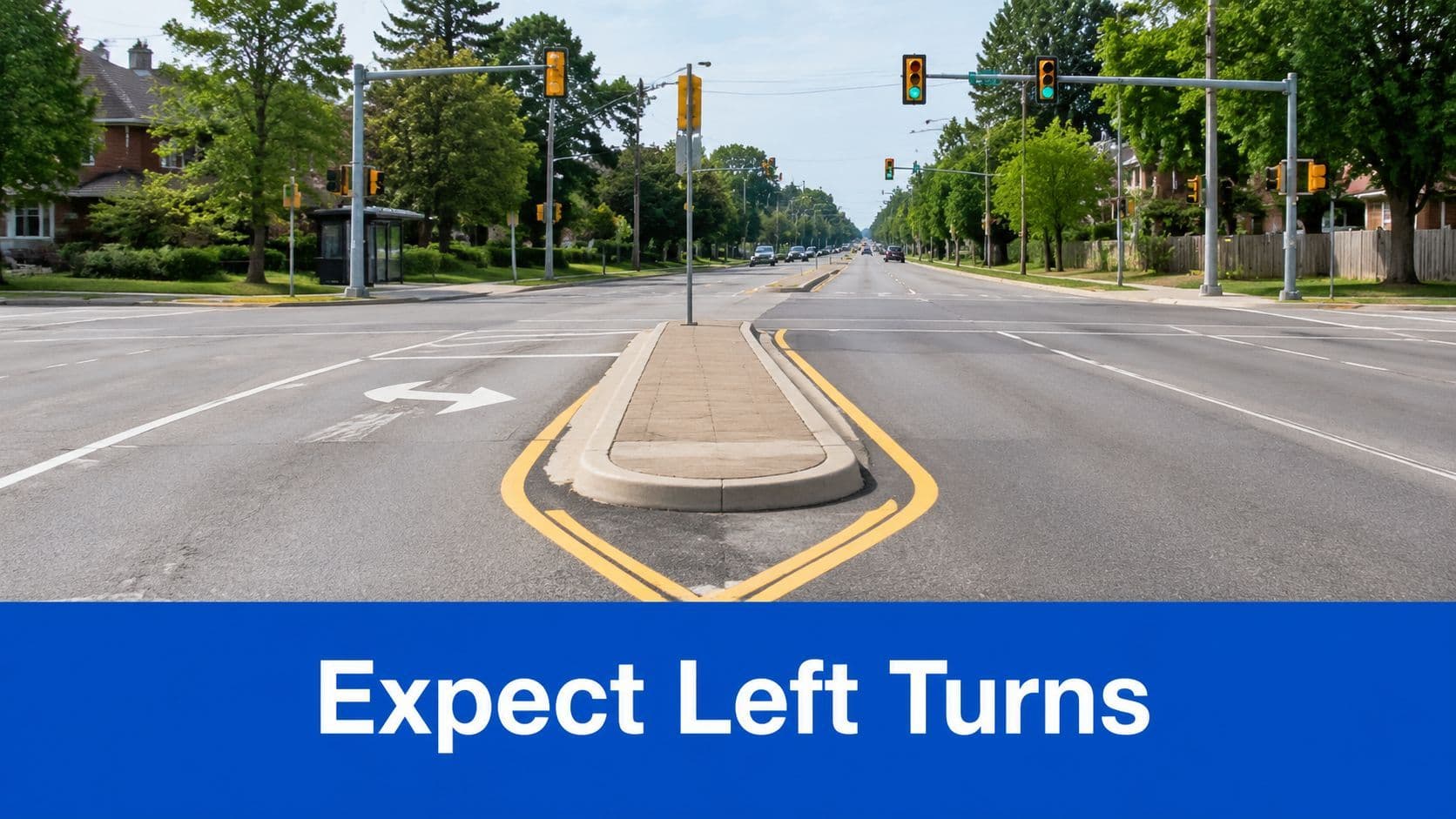
Traffic engineers use mandatory left-turn controls when the normal path through an intersection needs to change. The sign may direct vehicles around a channelized island, away from a restricted through movement, or into a temporary route created by construction.
A central traffic island is a common setting. As you approach, the island may block the straight path, while the sign confirms that the intended movement is to the left. Even when the physical layout seems obvious, the sign remains the legal instruction and helps drivers decide early.
Common road situations
- Channelized intersections: A raised island funnels vehicles into a particular path and separates conflicting movements.
- One-way conversions: A road may redirect traffic into another one-way street rather than allow a direct through movement.
- Construction areas: Barriers can close the usual lane, and a temporary sign can direct all vehicles left around the work area.
- Restricted through routes: A municipality may prevent straight travel at a junction to manage turning conflicts, access, or signal operation.
Before entering the intersection, scan for signs on both sides of the approach and overhead. Then check the pavement. Arrows painted in lanes can add detail that a roadside sign doesn't provide, especially where one lane turns left and an adjacent lane has another movement.
Read the whole approach
Don't focus on the blue circle alone. Look for supplementary plates, lane arrows, temporary devices, traffic lights, and pedestrians crossing the path of your turn. The sign tells you the required direction, but you still need to position the vehicle properly and obey the signal controlling when you may proceed.
A learner who notices the sign early can reduce speed smoothly, check mirrors, signal, and choose the correct path. A learner who sees it at the last moment may brake abruptly or change lanes unsafely. Early observation is part of obeying the sign safely.
When the Rule Applies and Key Exceptions to Know
The word “must” is strong, but it doesn't mean you can ignore the rest of the approach. Ontario's regulatory framework recognises signs that restrict a left turn only during the times shown, and the MTO handbook explains that lane-use signs may apply to particular lanes rather than the entire intersection.
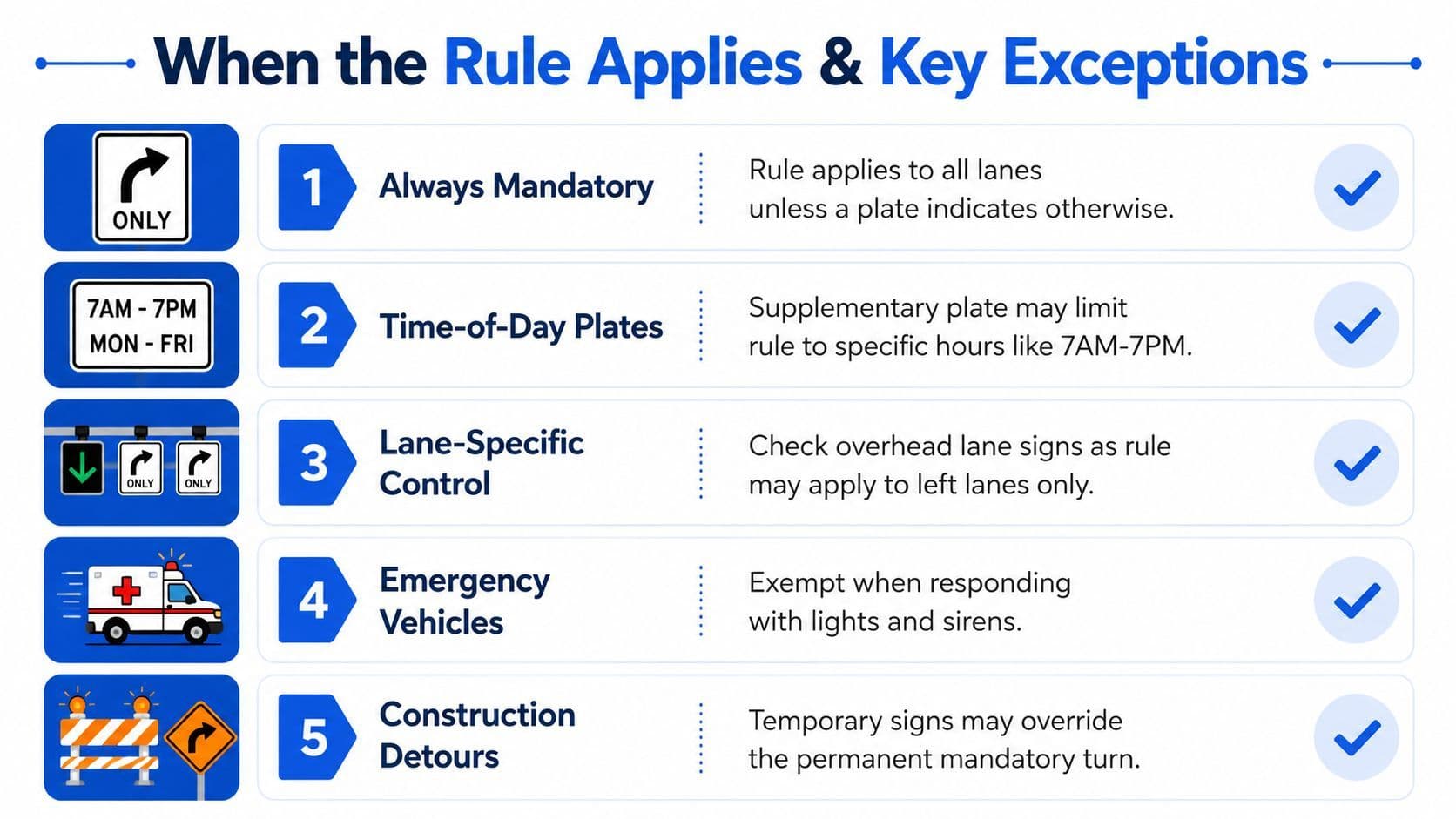
Check the sign's scope
Before treating the instruction as universal, inspect the complete sign assembly:
- Supplementary time plate: A plate may state when a restriction or direction applies. If the plate limits the instruction to particular hours, read those hours before deciding what movement is allowed.
- Lane position: An overhead sign or pavement arrow may control only a designated lane. A left-turn instruction over the left lane doesn't automatically change the movement available from every adjacent lane.
- Temporary control: Construction signs and barriers can redirect traffic from the permanent road arrangement. Follow the temporary direction where it governs the active work area.
- Emergency response: Emergency vehicles operating under their applicable response conditions may have exemptions that ordinary drivers don't have. A learner should never treat an emergency exception as permission to ignore a sign during normal driving.
Signal phases add another layer. A left-turn instruction doesn't automatically mean you may turn whenever the light is green. Ontario's handbook says that a left-turn green arrow shown with a red light permits drivers in the left-turn lane to turn left. Opposing through traffic and right-turning traffic will usually face red indications during that protected movement.
With a regular green light, the driver turning left must still yield to approaching traffic and pedestrians in or approaching the path. A protected arrow changes the signal control, but it doesn't remove the need to observe the intersection.
Read the complete control: Direction, lane, time plate, pavement marking, and signal phase can work together. Never rely on the arrow alone.
How to Execute the Mandatory Left Turn Safely
Once the sign requires a left turn, prepare early. Ontario's handbook says that unless signs or pavement markings indicate otherwise, a left turn should begin and end in the far-left lane for your direction.
Use this sequence:
- Signal before positioning. Activate the left signal well before the movement could affect another vehicle. Ontario law requires a driver intending to turn left to signal when the movement may affect another vehicle, and the signal must be plainly visible to affected drivers.
- Move when clear. Check mirrors and blind spots, then move into the required left-turn lane when it's safe. Don't cross a solid lane boundary or force another driver to brake.
- Approach under control. Reduce speed smoothly and look beyond the vehicle ahead. A vehicle may be stopped at the island or stop line even when the signal is changing.
- Yield at an ordinary green. At an intersection, a driver turning left must wait for approaching traffic to pass or turn and for pedestrians in or approaching the path to cross, as stated in the Ontario traffic-lights guidance.
- Turn into the proper lane. Complete the movement into the far-left lane of the road you're entering unless signs or pavement markings direct otherwise. Avoid cutting across lanes.
- Follow the signal phase. A green left-turn arrow authorizes the movement from the left-turn lane, while a standard green light requires the appropriate yield.
Ontario's Highway Traffic Act also describes the hand-and-arm signal for a left turn as extending the hand and arm horizontally beyond the left side of the vehicle. Mechanical or electrical signals must be visible and understandable from the front and rear at a distance of 30 metres, with night visibility requirements set by law, as outlined in this Ontario signalling reference.
For the full manoeuvre, review these Ontario left-turn rules. The sign determines direction, but safe execution still depends on position, signal, observation, yield, and control.
Quick Reference and G1 Practice Questions
Use this compact mental card when you're revising:
- Meaning: Every affected vehicle must turn left.
- Forbidden movements: Do not continue straight or turn right where the sign governs the approach.
- Category: Mandatory regulatory direction sign.
- Check before moving: Lane arrows, pavement markings, supplementary plates, temporary signs, and the traffic signal.
- At a normal green: Yield to approaching traffic and pedestrians before completing the turn.
- At a green arrow: Turn from the designated lane while continuing to watch the intersection.
Test yourself
Question: You see a blue circular sign with a white left arrow before an intersection. What should you do?
A. Turn left only if you want to
B. Continue straight if the light is green
C. Turn left as required by the sign
D. Turn right after checking for traffic
Answer: C. The sign gives a mandatory direction. A green light doesn't cancel the posted instruction.
Question: A no-right-turn sign is posted, but no all-traffic-left sign appears. What does the no-right-turn sign mean?
A. You must turn left
B. You must stop
C. You may not turn right
D. You may only continue straight
Answer: C. A prohibition tells you what movement is forbidden. It doesn't automatically require a left turn or establish every other permitted movement.
Question: A left-turn arrow appears above one lane, while adjacent lanes show different arrows. Who must turn left?
A. Every vehicle on the road
B. Only vehicles in the designated lane
C. Only vehicles behind the sign
D. No vehicles until the light turns red
Answer: B. Lane-use instructions apply according to the lane identified by the sign and pavement markings.
For more practice distinguishing regulatory signs, lane movements, and yielding situations, use these Ontario traffic rules questions. Read each option carefully. G1 questions often test whether you understand the sign's scope, not whether you can recognise an arrow.
G1ready.ca offers free, registration-free Ontario practice exams, targeted quizzes, mixed tests, and a G1 exam simulator with immediate explanations and hints. Visit G1ready.ca to practise mandatory turn signs, left-turn rules, and related traffic-control questions before test day.


