You've probably done some version of this already. You open the Ontario Driver's Handbook, read a few pages, hit a wall of signs, right-of-way rules, lane markings, and exceptions, then wonder how anyone remembers all of it. After that, you try practice questions, get a few wrong, and start thinking the G1 is mostly a memory test.
It isn't.
The learners who do well on traffic rules questions usually aren't the ones trying to cram every line into memory. They're the ones who understand the logic behind the questions. They know what the test is really asking. They can look at a sign, an intersection, or a right-of-way scenario and work backward from the rule to the safest action.
Your Path to Passing the G1 Starts Here
Most learners make the same mistake at the beginning. They treat every page of the handbook as if it deserves equal attention, so they study in a flat, unfocused way. That usually leads to overload, not understanding.
A better approach is to sort traffic rules questions into a few clear buckets. First, there's the visual language of the road: signs, symbols, shapes, and markings. Then there's driver behaviour: who yields, when to stop, where to park, how to respond to conditions. Finally, there's judgment: how to apply a rule when the situation isn't perfectly tidy.
That last part is where many people get stuck. They know a rule in isolation, but the test adds a wrinkle. Maybe visibility is blocked. Maybe there's no sign. Maybe two vehicles arrive together. Maybe a yield sign appears where people expect a full stop.
Practical rule: Don't ask, “What answer do they want?” Ask, “What action makes the road safer and follows the rule?”
When you study that way, the questions stop feeling random. You begin to recognise patterns. A red circle with a slash means a prohibition. A solid line means a legal restriction. A yield sign doesn't automatically mean stop. An uncontrolled intersection isn't solved by guessing who looks more confident.
Use a simple mental routine when you practise:
- Identify the category: Is this a sign question, a road rule question, or a right-of-way scenario?
- Find the control: What is controlling the situation. A sign, a light, a marking, or the absence of all of them?
- Choose the safest lawful action: The G1 test rewards the answer that matches both the rule and safe driving behaviour.
That's the frame to carry through every practice session. It helps you learn faster, and it prepares you for the road, not just the test room.
Deconstructing the G1 Knowledge Test
Ontario's written licensing step exists for a reason. The province's graduated licensing model was introduced in 1994, and it requires new drivers to pass a written knowledge exam on road signs and traffic rules before they can move forward in the licensing process, as described in this overview of graduated licensing history. That makes rule knowledge a gatekeeping skill, not a side topic.
Why the written test matters
The test checks whether you can recognise legal instructions and apply them before you ever drive alone. That's why traffic rules questions often feel stricter than everyday driving conversations. The wording is precise because the road is precise. A sign doesn't “kind of” prohibit a turn. A marking doesn't “sort of” allow passing.
Think of the exam as two types of understanding working together:
Part of your knowledge What it tests Why it matters Recognition Signs, symbols, markings You must react quickly on real roads Application Right-of-way, stopping, yielding, legal duties You must choose the correct action in motion
Learners often lean too heavily in one direction. Some memorise signs but struggle with scenario questions. Others understand broad safety ideas but miss detail-based sign wording. Both gaps matter.
How to divide your study time
Instead of reading passively for long stretches, study in short focused blocks with a purpose. One session might centre on signs and markings. Another might centre on intersection logic. A third might review every mistake you made the day before.
A useful pattern looks like this:
- Start narrow: Pick one category such as signs, pavement markings, or right-of-way.
- Practise actively: Answer questions before rereading explanations.
- Review the reason: Don't move on until you can explain why the correct answer is correct.
- Re-test the weak spot: If you missed a category twice, return to it deliberately.
The written test rewards clarity. If you can explain a rule in plain language, you're much more likely to answer correctly under pressure.
This is also why random memorisation tends to fail. The G1 isn't asking whether you've seen a phrase before. It's asking whether you understand what drivers are legally required to do.
Mastering Road Sign Questions
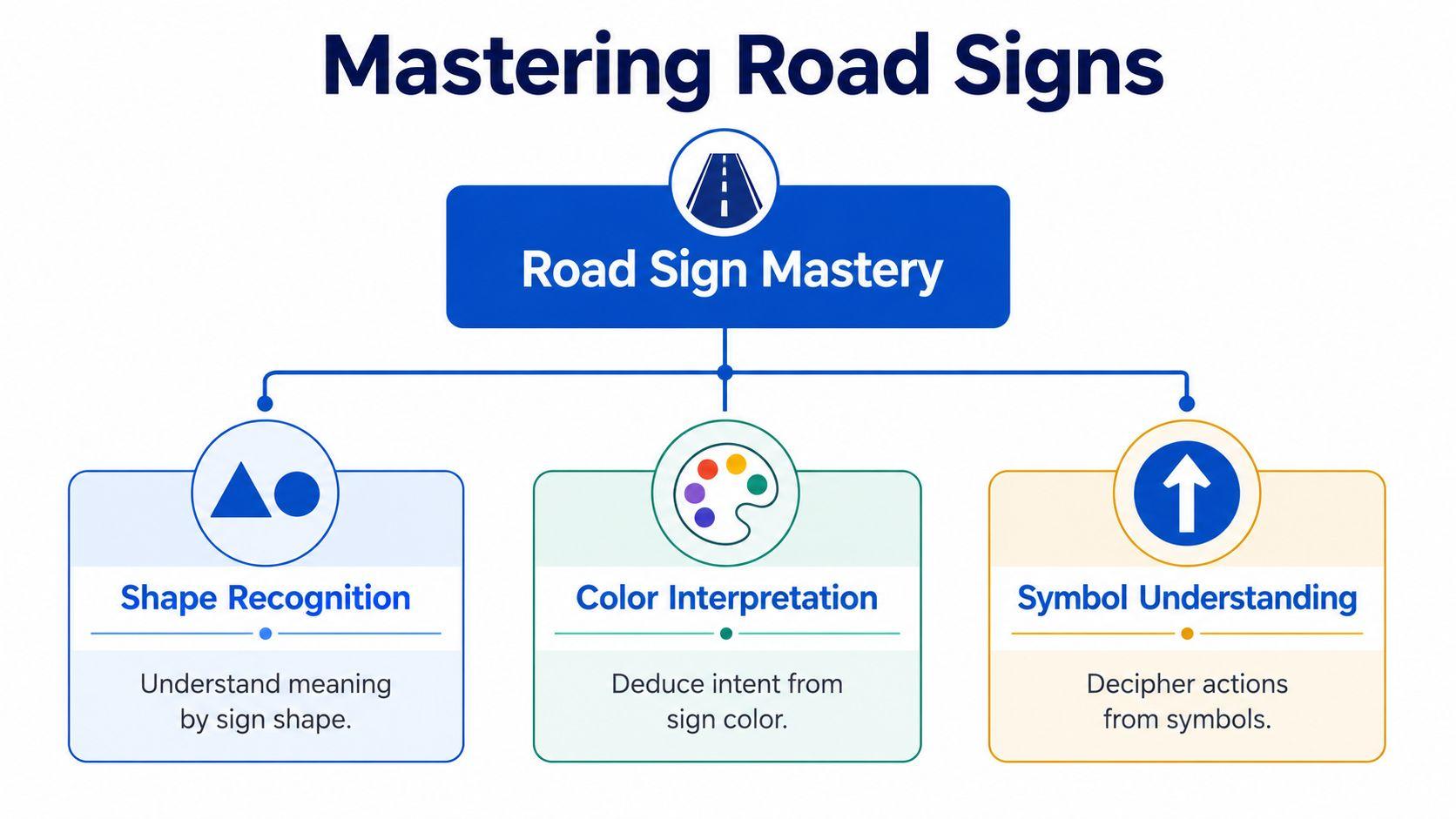
Road sign questions become easier when you stop treating each sign as a separate flashcard. Signs work like a language. Shape, colour, and symbol each carry part of the message.
Read the sign like a sentence
Start with the broadest clue first. Ask what family the sign belongs to before you try naming it exactly. That gives you a strong first guess even if you don't remember the exact wording.
For many learners, this order works well:
- Shape first: What kind of sign does this look like?
- Colour next: Is it warning you, regulating you, or guiding you?
- Symbol last: What exact action or hazard is shown?
That approach is more reliable than staring at the symbol and hoping memory kicks in.
The three families of signs
Regulatory signs are the law. They tell you what you must do or must not do. Ontario-relevant traffic control rules treat these as enforceable legal instructions. A red circle with a slash prohibits a manoeuvre, and pavement markings such as solid lines can legally restrict passing, as explained in this traffic control chapter on signs, lights, and pavement markings.
Warning signs alert you to something ahead. These are less about command and more about preparation. They tell you to slow down mentally before you need to slow down physically.
Informational signs guide you. They help with route awareness, lane use, destinations, and services. They matter on the test because they check whether you can read the road environment, not just obey direct commands.
Here's the memory shortcut I teach students:
- Law signs tell you what's allowed
- Warning signs tell you what's coming
- Information signs tell you where you are going
A common trap is to recognise a sign but miss the action tied to it. The test may show a prohibition sign and ask what manoeuvre is forbidden. Or it may show a lane marking and ask whether passing is legal. In both cases, the key is the same. Translate the visual cue into a legal action.
If a sign or marking changes what you may legally do, the question isn't about opinion. It's about permission.
If you want more focused review on this category, the Ontario road signs guide is useful for drilling sign families and visual recognition patterns.
Acing Rules of the Road Questions
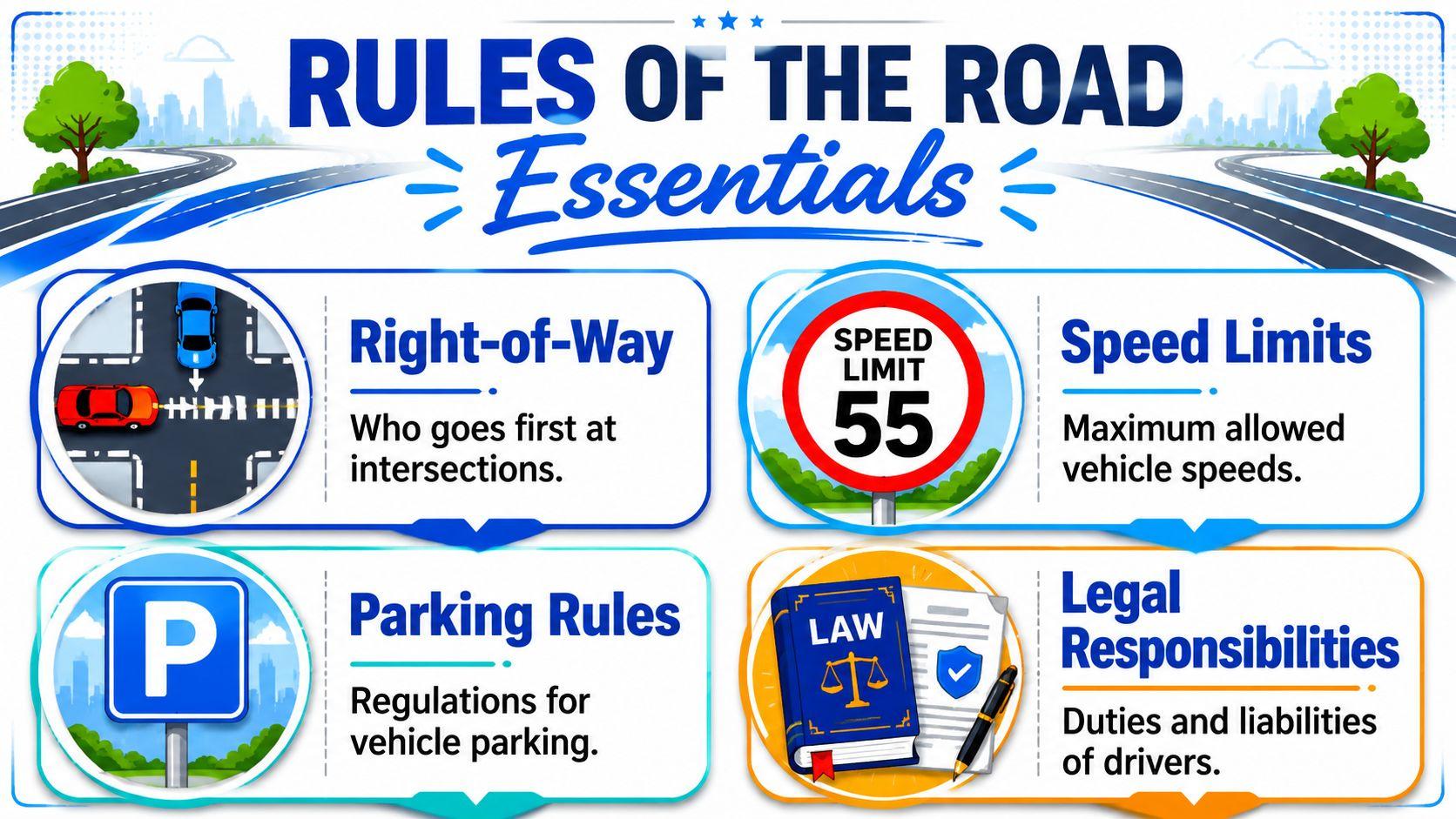
Rules of the road questions test behaviour in motion. That's why they often feel harder than sign questions. You're not just identifying something. You're deciding what a driver should do.
Right of way is about responsibility
The phrase “right-of-way” causes confusion because learners hear it as permission. On the test, it's better to think of it as priority with caution. Even when a rule favours your movement, you still have to watch for conflict and avoid creating danger.
That's why the safest answer often wins over the most aggressive interpretation. If a pedestrian is involved, if visibility is poor, or if another road user may already be in the conflict area, the correct response usually includes slowing, checking, and yielding when necessary.
Use this order when solving right-of-way problems:
- Vulnerable road users first: Check for pedestrians and bicyclists.
- Traffic controls second: Signs, signals, and markings come next.
- Arrival and position last: If there's no control, then timing and direction matter.
Uncontrolled and blind intersections
This is one of the most misunderstood areas in traffic rules questions. At an uncontrolled intersection, there may be no stop sign and no yield sign. At a blind intersection, your view may be blocked by buildings, parked cars, or road shape. That means the challenge is not just priority. It's uncertainty.
For uncontrolled intersections where vehicles arrive at the same time, the rule is to yield to the vehicle on your right. But that rule is secondary to checking for and yielding to pedestrians and bicyclists, as described in the California driver handbook discussion of right-of-way and uncontrolled intersections. The deeper skill being tested is risk management.
Here's a practical method:
- Reduce speed early. If sight lines are poor, don't roll in at normal speed.
- Scan left, right, and ahead. Don't fixate on cars only.
- Check for pedestrians and bicyclists first.
- If another vehicle arrives first, let it go.
- If arrival is simultaneous, yield to the vehicle on your right.
At a blind or uncontrolled intersection, the smartest driver isn't the quickest. It's the one who buys time to see clearly.
Many learners get this wrong because they search for a single magic phrase. There isn't one. The test wants the safest lawful sequence of decisions. If you want more examples in this category, the Ontario road rules guide is a practical place to review common right-of-way situations.
Sample Questions with Step by Step Breakdowns
You learn fastest when you slow the question down and separate the facts from the distraction. That's how an instructor reads traffic rules questions, and it's how you should practise too.

Question one roundabout entry
Question: You approach a roundabout with a yield sign. There's traffic already circulating, but then a safe opening appears. Must you come to a complete stop before entering?
How to solve it:
First, identify the control. It's a yield, not a stop sign and not a red light.
Second, ask what the yield requires. At roundabouts, approaching drivers must yield to circulating traffic, but they are not required to stop if the path is clear, as shown in this roundabout driving explanation.
Third, remove the trap. Many learners think every yield means “stop first, then go.” That's wrong. A yield means give way to traffic with priority. If a safe gap exists, you may continue without stopping.
Correct thinking:
Yield if needed. Stop only if traffic conditions require it.
Question two uncontrolled intersection
Question: Two vehicles arrive at an uncontrolled intersection at the same time. There are no signs. Who goes first?
Look for missing details before jumping to an answer. Is there a pedestrian? A bicyclist? Blocked visibility? If the question includes any vulnerable road user, that changes the decision.
If none of those are present and arrival is simultaneous, yield to the vehicle on your right. The trap here is that learners often answer “the larger vehicle” or “the vehicle going straight.” Those aren't the deciding factors in this setup.
Use this short checklist:
- No signs or signals
- Same arrival time
- No pedestrian or bicyclist changing priority
- Yield to the vehicle on the right
That's a clean example of a rule that sounds simple but depends on reading every word carefully.
Here's a visual walkthrough if you want to see more question styles and pacing before test day.
Question three pavement marking trap
Question: You are driving beside a solid centre line. Is passing permitted?
Sometimes, students overthink. They start imagining road width, traffic speed, or whether they personally feel comfortable passing. But the question is legal, not emotional.
A solid line means the marking itself restricts the manoeuvre. The visual control answers the question. If the test is asking about legality, trust the marking before your personal judgment.
Common trap: When a question gives you a sign or marking, that visual clue usually carries more authority than the story wrapped around it.
This same method works across most practice sets:
Step What to ask Why it helps 1 What is controlling this situation? Finds the key rule fast 2 Is this about law, hazard, or guidance? Narrows the answer type 3 What action is safest and legal? Filters out tempting distractors
If you want to rehearse this method with mixed scenarios, the Ontario G1 practice test collection gives you a place to test whether you're missing sign logic, right-of-way logic, or both.
Build a Smarter Study Strategy with G1ready.ca
You finish a mixed practice test and score decently, but the misses are scattered. One question is a sign. Another is right-of-way. Another looks easy until the wording trips you. That kind of result can fool you into studying everything again, even though the actual problem is usually more specific.
Good G1 preparation works like diagnosing a driving mistake on the road. If a learner turns too wide, you do not reteach the entire handbook. You identify the exact habit that caused the error, then practise that skill on purpose.
Start with a baseline, then sort mistakes by type
Begin with one realistic mixed test done under test-like conditions. Answer steadily. Avoid checking rules midway. You want a clear picture of what you know without help.
Then sort your wrong answers into categories. That step matters because different mistakes come from different gaps in understanding.
- Missed sign questions usually point to weak visual recognition. Go back to shape, colour, and symbol patterns.
- Missed right-of-way questions often mean the order of decisions is unclear. Practise who goes first, who yields, and what changes at controlled versus uncontrolled intersections.
- Missed wording traps usually mean you noticed the story before the rule. Train yourself to find the controlling clue first, such as a sign, pavement marking, traffic light, or key phrase.
G1ready.ca can help with that kind of targeted review. Its practice exams, topic quizzes, diagnostic test, marathon mode, and exam simulator let learners separate knowledge problems from reading errors and rushing. The value is not just more questions. It is the ability to see a pattern in your misses and respond with the right kind of practice.
Use mistakes as study material
A wrong answer is not just something to correct. It is a clue.
Many learners read the explanation, accept it, and move on too fast. A better habit is to turn each mistake into a short lesson for yourself:
- Write the rule in plain language.
- Identify the trigger you missed. It might be a yield sign, a solid line, or the fact that no signs controlled the intersection.
- Do one similar question again the same day.
- Test that rule again later, after a break.
That process builds a stronger memory because you are connecting the rule, the visual clue, and the decision. It also helps with commonly misunderstood situations, especially uncontrolled intersections, where students often guess instead of following a clear order.
Parents helping teen drivers can use the same method. Newcomers learning Ontario rules can too. Once you label the mistake correctly, study becomes simpler. You are no longer doing random repetition. You are fixing the part of your decision-making that broke down.
Pass Your G1 with Confidence Not Memorization
The strongest way to prepare for traffic rules questions is to stop treating them as isolated trivia. They follow patterns. Signs communicate through shape, colour, and symbol. Road rules questions test action, not just recognition. Right-of-way questions reward calm judgment and careful reading.
If you remember only one thing, remember this: the test is asking what a safe, lawful driver should do next.
That mindset changes everything. You won't freeze as easily when a question adds a twist. You won't depend on shaky memory alone. You'll have a process. Identify the control. Read the situation carefully. Choose the safest legal action.
That's how confident learners prepare. They don't chase perfect memorisation. They build understanding they can use in a test room, at an intersection, in a roundabout, and on any road where quick decisions matter.
Keep practising, but practise with intention. Review your misses. Slow down on the questions that feel tricky. Learn the rule behind the answer. Once that clicks, the G1 starts to feel much more manageable.
If you want a practical place to keep working on these concepts, G1ready.ca lets you practise Ontario-style questions, review explanations, and focus on the categories that still trip you up.