Most advice about the easiest G2 road test in Ontario starts and ends with a list of towns. That's incomplete.
Location matters, but it doesn't work like a cheat code. The same test standards apply across Ontario, yet results still vary by centre because traffic density, route complexity, and local driving conditions change the experience. Independent analysis has also pointed out that lower-failure centres tend to be in less dense communities, while harder centres cluster in the GTA, which is why just asking for the “best” centre misses the fundamental question of fit for the driver and their practice environment (analysis of Ontario test-centre patterns).
What works better is a two-part strategy. Pick a DriveTest centre that feels like the roads you already know, then train the exact skills the examiner scores. That combination does more for your pass chances than chasing a distant booking because someone online called it “easy.”
Rethinking the Easiest G2 Road Test
The wrong question is, “Which centre is easiest?” The better question is, “Where can I drive most predictably under test pressure?”
That shift matters because many learners book based on rankings alone, then show up to unfamiliar roads, unfamiliar speed patterns, and intersections they haven't practised. A quieter town can feel easier on paper and still feel harder if you learned in dense traffic and freeze when the route looks different from what you expect.
Practical rule: Easy is usually the centre where your practice habits transfer cleanly.
A driver who learned in suburban streets with moderate traffic often does better at a centre with similar lane layouts, stop frequency, and turn patterns. A driver who practised mainly in heavy urban flow may lose rhythm in a place that feels too different, especially if they start overthinking every instruction.
Here's the part many people miss. Pass rates describe recorded outcomes, not personal readiness. They tell you that some centres are less punishing than others in real-world conditions. They don't tell you whether you will perform better there.
Use this definition instead:
- Easy means familiar traffic language. You already know how fast traffic tends to move, how aggressive lane changes feel, and how intersections unfold.
- Easy means fewer surprises. You've seen similar merge points, school zones, residential streets, and parking setups before.
- Easy means repeatable execution. You can perform the required maneuvers without needing extra mental effort to decode the road itself.
That's why the strongest strategy isn't hunting for a magical centre. It's reducing variables. If the roads feel normal and your maneuvers are drilled, the test gets easier fast.
How to Strategically Choose Your DriveTest Centre
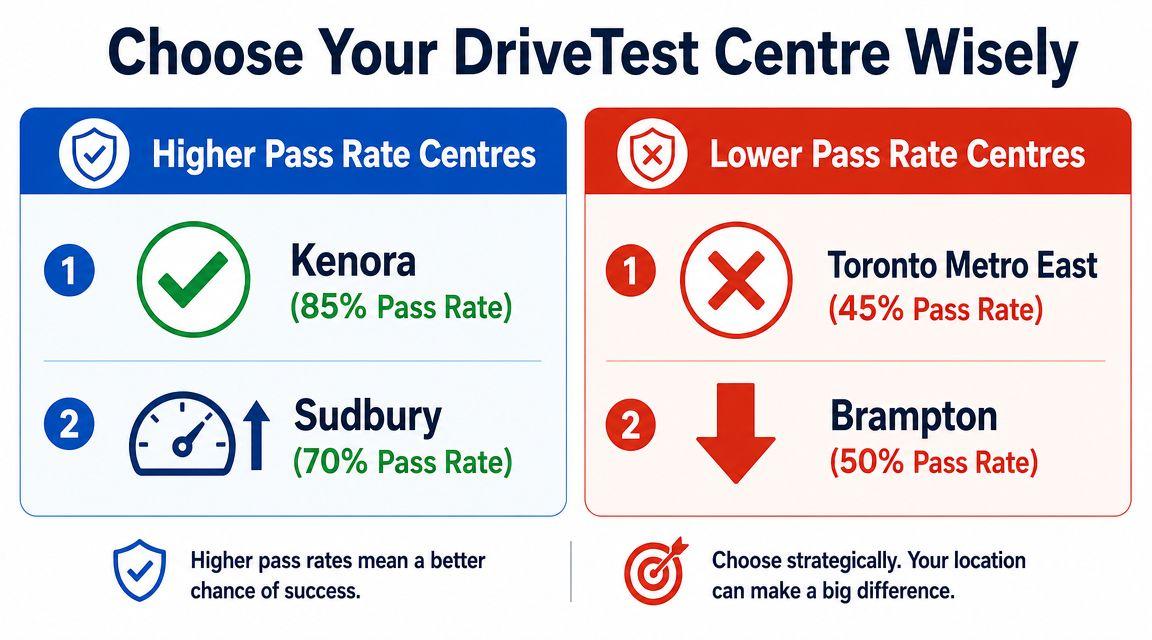
The data does show large gaps between centres. One Ontario pass-rate listing reports Kenora at 93%, Sault Ste. Marie at 89%, Sudbury at 86%, Dryden at 81%, and Winchester at 80%, while Brampton is listed at 47%, a spread of 46 percentage points between some of the easiest and hardest centres (Ontario G2 pass-rate listing).
That gap is real. It's also where many learners make a bad decision. They stop at the ranking and ignore the road environment that created it.
Start with the pass-rate spread, then ask why
Higher-pass centres are often in lower-population areas. Lower-pass centres are more often tied to busy GTA conditions. That usually means more congestion, more complicated lane decisions, tighter timing, and more pressure from surrounding drivers.
A high-pass centre can help if those local conditions match how you've been practising. It can hurt if getting there means you spend more energy adapting than driving.
Use pass-rate data as a filter, not as the final answer.
Use a practical selection framework
I'd narrow the choice with three questions.
- Does the traffic match your practice? If you learned in calmer regional roads, a smaller centre may suit you. If you learned near busy multilane roads, a centre with similar pressure may be the safer pick.
- Is the route complexity manageable?
Watch for awkward merges, heavy commercial traffic, confusing lane markings, and intersections that force quick decisions. Those features matter more than reputation. - What is the true cost of going farther?
Travel time, extra stress, unfamiliar roads, and the chance of needing another day off all matter. If you're still comparing options, it helps to understand the broader Ontario road test booking process before you commit to a far-away centre.
A centre is only “easier” if it lowers your workload, not if it adds a road trip to your nerves.
DriveTest Centre Profile Comparison
Factor Rural/Small Town Centre (e.g., Bancroft, Kenora) Urban/GTA Centre (e.g., Brampton, Downsview) Traffic density Usually lighter and more predictable Often heavier and less forgiving Route pressure Fewer rapid decisions in close succession More lane changes, congestion, and timing pressure Familiarity advantage Strong if you practised in similar conditions Strong if you regularly drive urban routes Travel trade-off Can add stress if far from home Easier logistics if nearby Best fit for Learners used to simpler road patterns Learners comfortable with busier traffic flow
The smartest booking usually isn't the highest-pass centre in Ontario. It's the centre where your practice and the local road environment line up.
Mastering the G2 Test Maneuvers Examiners Score
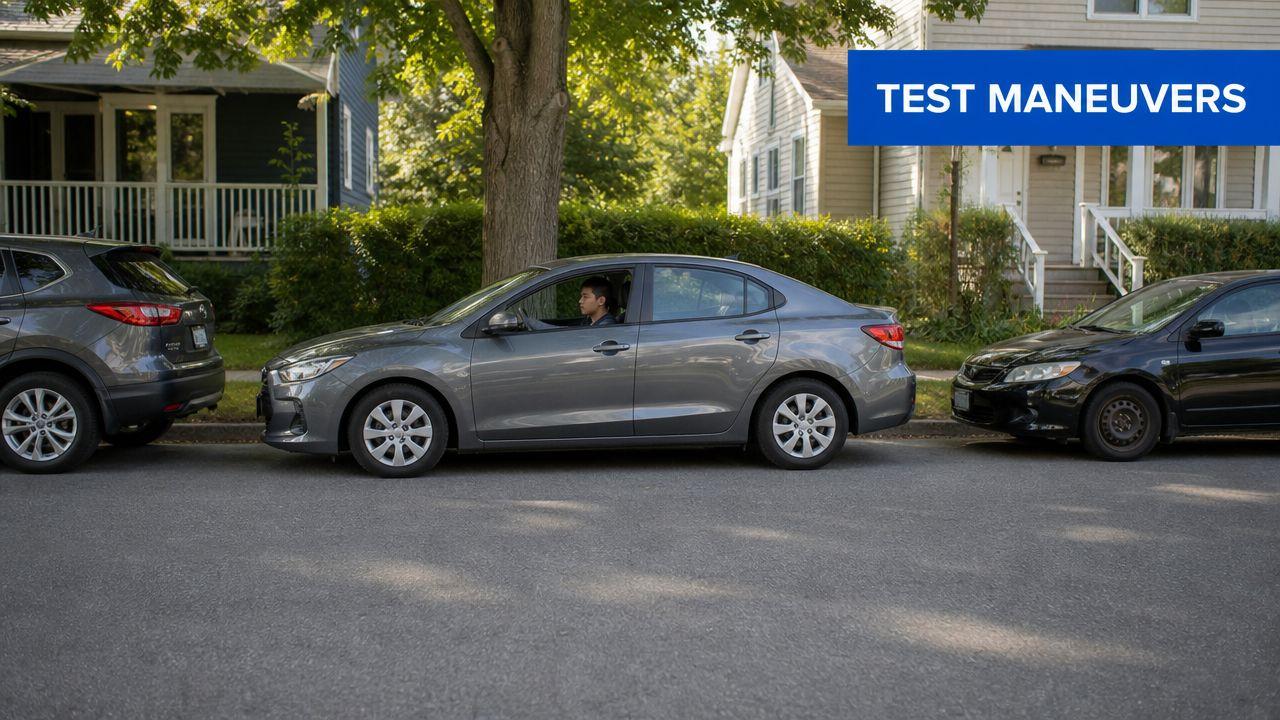
The G2 road test is short. Ontario guidance says it's about 20 minutes and focuses on specific skills such as parallel parking, pulling over and starting from the curb, turns, and three-point turns, with clear failure conditions like hitting the curb, blocking traffic, or missing mirror and blind-spot checks (Ontario G2 test skill breakdown).
That changes how you should practise. General driving time helps, but it isn't enough on its own. You need to rehearse the exact sequences that appear on the examiner's scorecard.
Train the scorecard, not your confidence alone
A lot of learners tell themselves they're “pretty good” because they can drive around town without trouble. Under test conditions, that doesn't mean much unless the basics are automatic.
Build practice around fixed drills:
- Parallel parking: Use the same setup points each time. Finish without touching the curb and without rushing the final correction.
- Pull over and re-enter traffic: Stop smoothly, position the car properly, then restart only after mirror checks, signal, and a clear shoulder check.
- Three-point turns: Keep the movement controlled. Don't mount the curb. Don't let the car drift sloppily during steering changes.
- Turns and lane changes: Examiners want a visible routine. Mirror, signal, shoulder check, then move.
A focused practice guide on parallel parking for the Ontario driving test can help if that one maneuver keeps breaking your rhythm.
The maneuvers that need repetition
Treat each maneuver like a checklist, not a vibe.
For turns, train yourself to slow early, choose the correct lane, scan the intersection, and finish in control. For curbside stops, make the whole sequence deliberate. Pull over neatly, secure the vehicle, then prepare to move with proper checks instead of guessing.
Smooth wins. Fast only helps if it stays safe and controlled.
For parking and low-speed work, don't just repeat until it looks okay. Repeat until it looks the same every time. Consistency is what lowers stress on test day.
Don't ignore the highway requirement
The official handbook also says the Level Two test includes an expressway-driving component, and candidates must sign a Declaration of Highway Driving Experience based on recent practice on roads with speed limits of at least 80 km/h in the prior three months. The same guidance also sets positioning tolerances such as stopping not more than 30 centimetres from the curb when pulling over, and notes a retake usually costs $53.75 (official Ontario Level Two road test requirements).
That means two things.
First, highway readiness isn't optional. If your merges are hesitant, your speed control is inconsistent, or your mirror and shoulder checks disappear under pressure, fix that before you book. Second, tiny positioning errors still matter in the low-speed part of the test, so don't let your parking practice get lazy.
Avoiding Automatic Fails and Common Point Deductions
Learners usually fail for one of two reasons. They make one serious safety mistake, or they stack smaller errors until the drive no longer looks controlled.
The examiner doesn't need perfection. The examiner needs to trust that you won't create risk when things get busy.
What examiners notice immediately
The fastest way to lose a test is to do something that shows poor judgement around safety.
Watch these closely:
- Incomplete stops: A rolling stop tells the examiner you're guessing instead of controlling the vehicle.
- Unsafe lane changes: Signalling without checking properly, moving abruptly, or drifting into a lane too early creates instant concern.
- Curb or object contact: If you hit the curb during parking or a turn, you've shown poor vehicle control.
- Weak highway behaviour: If you haven't built enough recent high-speed practice, the merge, speed maintenance, and lane discipline can fall apart. The G2 test requirements in Ontario are worth reviewing before test day so you know what's expected, especially around highway readiness.
Most failures don't come from one nervous moment. They come from a habit that shows up at the worst time.
Mistakes that drain your score quietly
Other errors may not end the test on the spot, but they add up.
A few that show up often in practice sessions:
- Silent checks: You looked with your eyes, but your head barely moved. If the examiner can't see the blind-spot check, don't assume they'll give you credit for it.
- Poor speed management: Driving too fast is obvious, but driving too slowly for conditions also signals uncertainty.
- Late braking and sloppy positioning: If the car enters turns wide, stops unevenly, or floats inside the lane, your control looks inconsistent.
- Hesitation that blocks flow: Caution is good. Freezing when it's clearly your turn is not.
Clean these up by using one habit during practice: narrate the routine out loud. “Mirror, signal, shoulder check.” “Full stop, scan left-right-left.” “Pull over, straighten, stop.” The words help lock in the order.
Your G2 Test Day Game Plan
A good test day is boring. Nothing is rushed, nothing is forgotten, and nothing is left for the last minute.
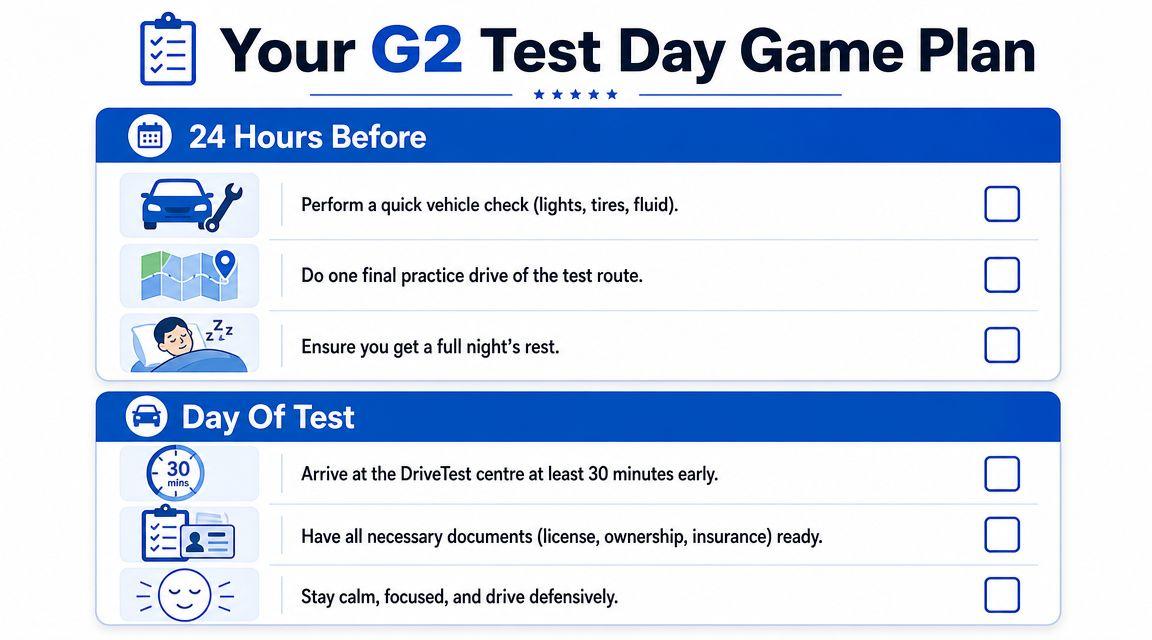
That matters because the test itself is short, and a retake costs $53.75. Ontario-focused guidance also notes that many learners are better off choosing a nearby centre with familiar traffic rather than spending more time and hassle chasing a statistically easier one far away (Ontario G2 test logistics and retake cost).
The day before
Keep the final prep light and specific.
- Check the car: Make sure the basics are working and the vehicle is clean and easy to inspect.
- Run key maneuvers once more: Parallel park, curb stop, lane changes, and turns. Don't do a marathon session.
- Know the route to the centre: Remove any guesswork around arrival.
- Protect your sleep: Tired drivers overcorrect, brake late, and miss checks.
If you're still early in the licensing process and need to sharpen road-rule knowledge before moving toward road testing, one practical option is G1ready.ca, which offers Ontario G1 practice exams and targeted quizzes based on the handbook.
At the centre and in the car
Have your documents ready before you join the line. Set the seat, mirrors, and wheel position exactly how you practised. Don't make “small” adjustments after the examiner has already started giving instructions.
Use this mental sequence once the drive begins:
- Listen fully before reacting.
- Scan early before every turn, lane change, or stop.
- Make the checks visible with clear head movement.
- Finish each maneuver cleanly before thinking about the next one.
Calm drivers don't drive slowly. They drive in order.
If something minor goes wrong, keep going. One imperfect turn doesn't fail a test. Panicking after it often does.
Pass Your G2 with Confidence Not Chance
Ontario pass-rate patterns do show why this topic keeps coming up. A 2026 compilation cited centres such as Bancroft at 89%, Belleville at 78%, and Brantford at 71% for G2, while Brampton shows a 53% failure rate, meaning 47% pass. The same comparison notes that a driver testing in Kenora at 93% has nearly double the pass probability of someone testing in Brampton at 47% (Ontario G2 centre comparisons).
Those numbers matter. They just don't replace strategy.
The easiest G2 road test in Ontario usually isn't a secret town. It's the test you've prepared for in the right environment, with the right habits, and without adding unnecessary stress. Choose a centre that fits your practice. Drill the actual scored maneuvers. Make your checks obvious. Treat highway readiness and curb positioning like test items, not side details.
That's what works.
When drivers stop hunting for shortcuts and start training for the scorecard, the road test feels more manageable. Not because the system changed, but because they did.
If you're preparing for the Ontario licensing process from the beginning, G1ready.ca gives you a practical way to build the road-rule knowledge that supports every step after the G1, with practice tests, targeted quizzes, and a simulator aligned to the Ontario handbook.