You're doing G1 practice questions, feeling good, then one bicycle question derails everything.
A cyclist reaches a four-way stop at the same time as a car. Do they follow the same right-of-way rules? If a driver passes a bike, who has to leave space? If a teen rides without a helmet, who gets fined? These are exactly the kinds of details that make new drivers second-guess themselves.
That confusion is normal. Ontario's cycling laws can sound simple until you try to apply them to a real street, a practice test, or a busy intersection with cars, bikes, pedestrians, and turning traffic all moving at once. What most first-time G1 students need isn't more legal wording. They need plain-language rules they can easily remember.
This guide turns the Highway Traffic Act into everyday driving logic. You'll learn what cyclists are allowed to do, what they must do, what drivers must do around them, and which bicycle rules show up in common G1-style situations. If you understand the road from both sides, you're much more likely to answer test questions correctly and make calm decisions once you start driving.
Introduction
A student once told me their practice test felt easy until one bicycle question changed everything. The question asked whether a cyclist had to stop at a stop sign the same way a car does. They hesitated, guessed, and got it wrong. Then they started doubting every road-sharing question after that.
That happens because many new drivers tend to treat bicycles like a separate category, somewhere between a pedestrian and a car. On Ontario roads, that mindset causes mistakes. A cyclist may move more slowly than a car, but the law still treats them as a road user with defined rights and duties.
The best way to remember bicycle rules in Ontario is to stop seeing them as “extra” rules. Most of them are normal road rules applied to a bicycle. Once that clicks, a lot of G1 questions become easier.
Cyclist questions on the G1 test often look complicated because they test whether you understand road-sharing, not just memorisation.
Your Bicycle Is a Vehicle Core Rights and Responsibilities
The most useful rule to remember is this: a bicycle is treated as a vehicle on the road. That means a cyclist isn't just someone casually moving beside traffic. They're part of traffic.
A cyclist has the right to use the roadway. A cyclist also has duties that come with that right. They must follow traffic signals, stop where required, and behave predictably so other road users can respond safely.
Ontario bicycle laws make more sense once you start from that one principle. If you want a broader refresher on shared road behaviour, this guide to Ontario road rules for G1 learners helps connect the same logic across cars, bicycles, and pedestrians.
What this means at a stop sign or red light
If a cyclist approaches a stop sign, the stop sign applies to them. If a cyclist reaches a red light, the red light applies to them. The law doesn't create a separate “lighter version” of traffic control just because the vehicle has pedals.
That matters for G1 questions because the wording often tries to distract you. A test might mention a bike lane, a helmet, or a slow-moving cyclist, but the core answer still comes back to standard road control.
Here's the clean mental model:
- Stop signs: A cyclist must stop and yield according to normal right-of-way rules.
- Traffic lights: A cyclist must obey green, yellow, and red signals like other road users.
- Lane use: A cyclist can lawfully occupy road space and isn't automatically expected to disappear to the curb.
- Responsibility: A cyclist must ride in a way that follows the same traffic framework drivers are tested on.
Why new drivers get this wrong
Many beginners mix up cyclists and pedestrians. That leads to incorrect assumptions such as “a cyclist can cross any way they want” or “a cyclist doesn't need to obey the same signs because they're more vulnerable.”
That's not how you should think about it during the G1 test.
Practical rule: If the person is riding the bicycle on the road, start by asking yourself, “What would apply if this were any other vehicle?” Then look for any bicycle-specific exception.
A cyclist's rights matter too. Drivers should expect cyclists to be present, visible, and legally using the road. That mindset helps you answer test questions more accurately and helps you drive with less frustration once you're licensed.
Mandatory Equipment for Ontario Cyclists
A G1 question might describe a child riding at dusk on a bike with no bell, no reflector, and no helmet. That sounds like three separate details, but the test is really checking one skill. Can you spot missing legal equipment the same way you would notice a car with broken lights or faulty brakes?
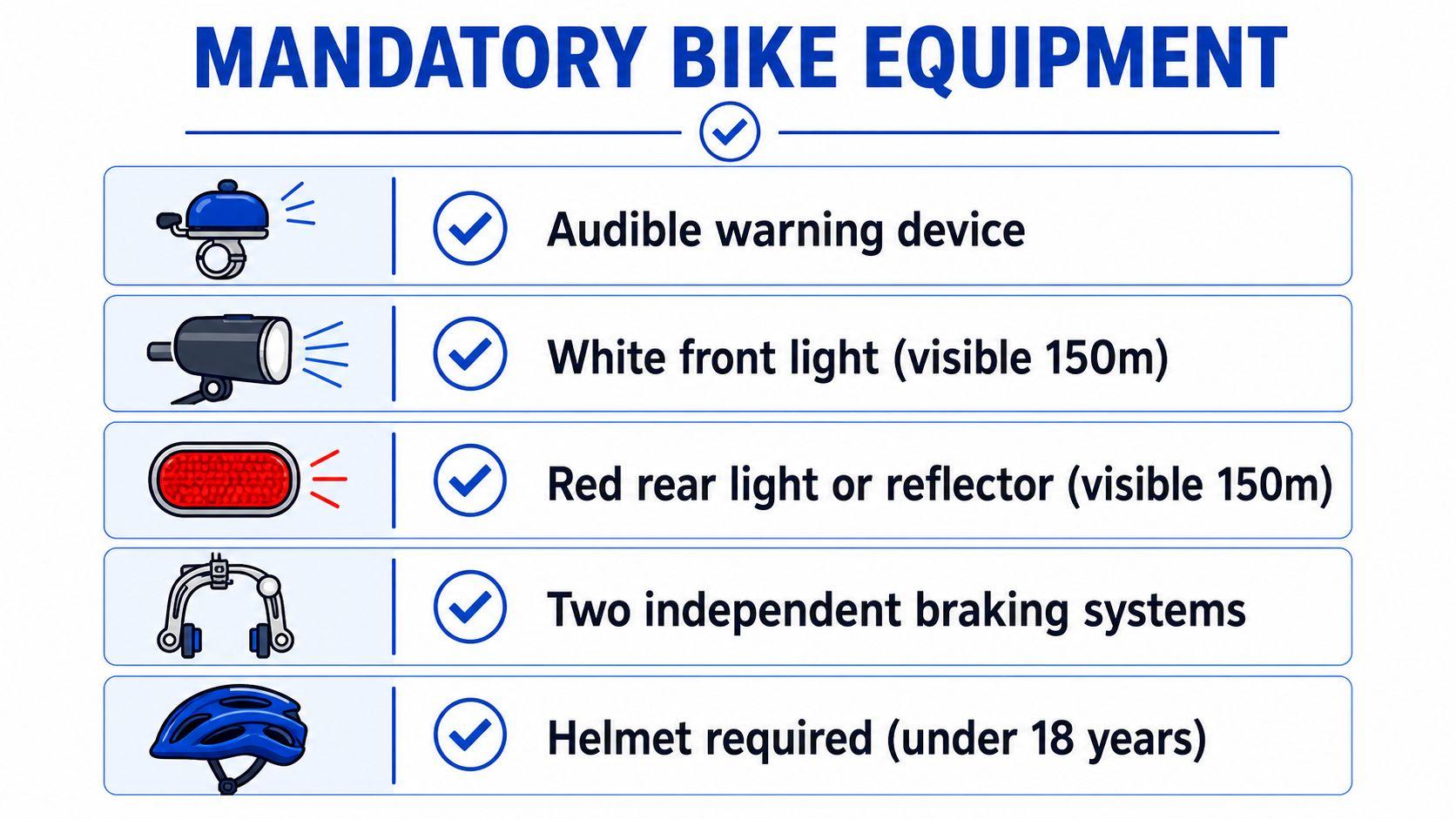
For new drivers, this topic is one of the more straightforward parts of bicycle rules in Ontario. The Highway Traffic Act sets out a few basic equipment requirements, and G1 questions often turn them into simple right-or-wrong scenarios. If required equipment is missing or not working, treat that as a legal problem, not a minor detail.
What the law requires on the bike
Ontario requires a bicycle used on the road to have a working bell or horn, plus front and rear reflectors. A bike that is missing this equipment, or has equipment that does not work, can lead to a fine.
Remember, these aren't cosmetic add-ons. Each one addresses a predictable road risk.
Equipment Why it matters Bell or horn Helps the cyclist warn others before a conflict develops Front reflector Helps make the bicycle noticeable from the front Rear reflector Helps drivers approaching from behind detect the bike
A bell or horn works like a bicycle's quick warning signal. It gives the rider a legal, simple way to say, “I'm here,” before a close pass, sidewalk crossing, or path conflict turns into a collision.
Reflectors solve a different problem. Drivers do not just need to look. They need to recognize what they are seeing early enough to react. That is why G1 questions may mention low light, cluttered streets, or a rider who is hard to notice. If a reflector is missing, the bike is less visible when visibility matters most.
One detail learners often miss is the word working. A cracked reflector, a missing rear reflector, or a bell that does not ring should all raise the same red flag on the test. The bike is not properly equipped.
If you want help connecting visibility rules with signs and lane markings that show up in G1 questions, this guide to Ontario road signs for the G1 test can help.
Helmet rules that often confuse families
Helmet questions test two things at once. They check whether you know the rider's age rule, and whether you know when an adult is also legally responsible.
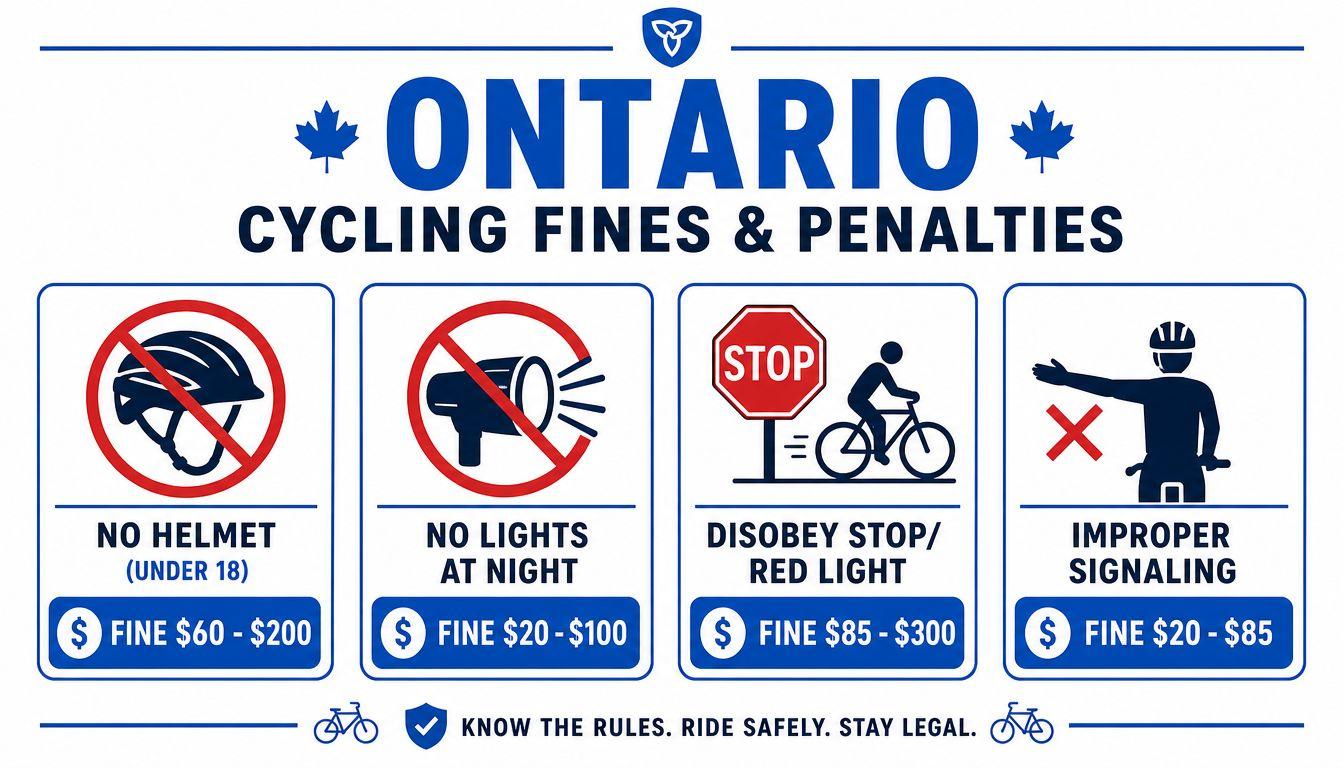
In Ontario, cyclists under 18 must wear an approved bicycle helmet. For children under 16, a parent or guardian is responsible for making sure the child wears one. Failing to follow that rule can lead to a fine, as noted earlier.
The easiest way to remember it is to split the rule in two:
- Under 18: the rider must wear an approved helmet.
- Under 16: the parent or guardian also has legal responsibility.
Many families remember only the first half. The G1 test may obscure the underlying issue within the age detail. If the rider is 15, the question is not only about whether a helmet is required. It may also be testing whether the adult can be held responsible.
A helmet question on the G1 test usually checks whether you know the age cutoff and who is accountable, not whether helmets are generally a good idea.
You may also see e-bike questions. Ontario rules require e-bike operators to be at least 16 years of age, and they must wear a properly fitted helmet. E-bikes must also have working pedals, a motor of no more than 500 watts, and power assistance that cuts out at 32 km/h, according to Ontario e-bike rules described here.
A quick equipment check you can remember
Use this short mental checklist when a bicycle equipment question appears:
- Can the bike warn others? It should have a working bell or horn.
- Can the bike be noticed? It should have the required front and rear reflectors.
- Does the rider need a helmet by law? If the rider is under 18, yes.
- Is a parent or guardian also responsible? Yes, if the child is under 16.
- Is it an e-bike? If so, check the age, helmet, pedals, motor power, and speed cutoff.
That gives you a clean way to answer G1-style questions. Start with the equipment on the bike, then check the rider's age, then look for any e-bike detail that changes the rule.
On the Road Positioning Signaling and Bike Lanes
Where should a cyclist ride? New drivers often assume the answer is “as far right as possible, all the time.” Real road use is more nuanced than that.
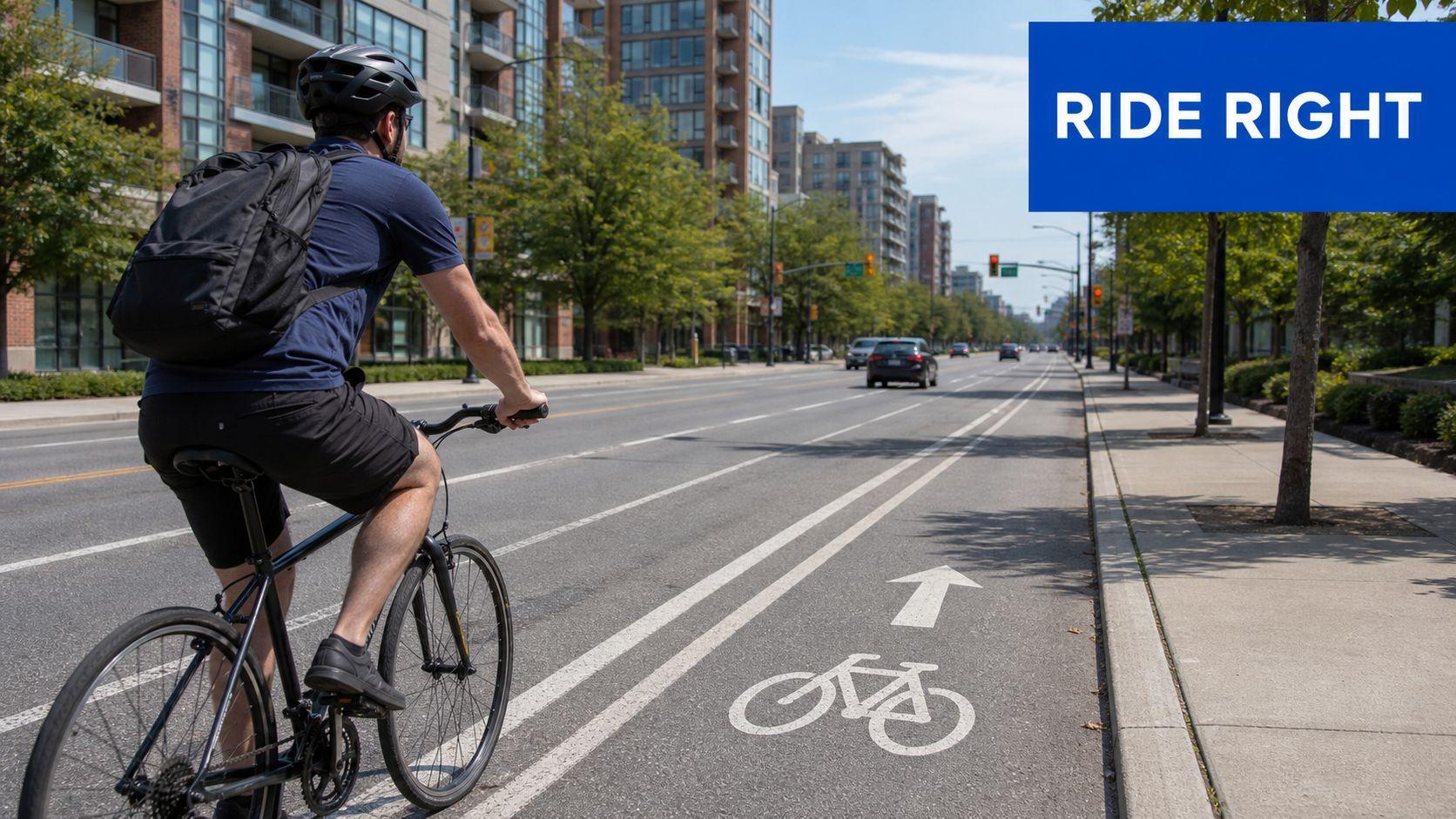
A cyclist generally rides on the roadway in a position that is safe and predictable. Sometimes that's closer to the right side. Sometimes the cyclist needs more room to avoid parked-car doors, rough pavement, debris, puddles, or a dangerous squeeze near the curb.
If you're studying road sharing, this review of Ontario road signs that affect lane use and movement can help you connect bike lane markings and general lane-control signs.
Where a cyclist should ride
Think of road position as communication. A cyclist's placement tells drivers what space is usable and what isn't.
For example, if there are parked cars along the curb, hugging the edge can be risky. A car door can open into the cyclist's path with almost no warning. In that situation, a cyclist may ride farther out so drivers understand that passing space is limited.
That doesn't mean cyclists can drift unpredictably. Good positioning is steady, visible, and intentional.
A useful driver mindset is this:
- Near the right side when practical: This is common on open stretches with safe space.
- Farther into the lane when needed: This can happen near hazards, narrow lanes, or turns.
- In a bike lane when one exists: If a designated lane is present, expect cyclists to use it, but keep watching for places where they may need to merge around obstacles.
When you see a cyclist riding farther from the curb, don't assume they're breaking the rules. Ask what hazard they may be avoiding.
Bike lanes help organise movement, but they don't remove the need for awareness. Drivers still need to check mirrors, look before turning, and avoid cutting across a cyclist's path.
Hand signals work like turn signals
Cyclists don't have electronic blinkers, so they communicate with hand signals. For a G1 student, the easiest way to remember them is to compare them to a car's indicators and brake lights.
A left turn signal tells others the cyclist plans to move left. A right turn signal tells others the cyclist plans to move right. A stop signal warns that speed is about to drop. The exact arm position matters less than the purpose when you're answering many test questions: the cyclist is required to communicate intention clearly and early.
Here are the situations where hand signals matter most:
- Before a turn: A cyclist should signal before changing direction.
- Before moving out: If leaving the curb side or going around an obstacle, signalling helps drivers anticipate that movement.
- Before slowing or stopping: This reduces surprise for anyone behind them.
As a driver, you shouldn't expect perfect signalling every time. A cyclist may need both hands for steering or braking on a rough surface. But on the test, when the question asks what a cyclist should do, the correct idea is usually to signal intentions clearly and ride predictably.
Sharing the Road Intersections Passing and Special Zones
You are driving toward a green light, planning to turn right. A cyclist is riding straight through the intersection beside the curb. This is the kind of moment G1 questions love, because it tests whether you know the rule or just react to what feels convenient.
Intersections are where G1 mistakes happen
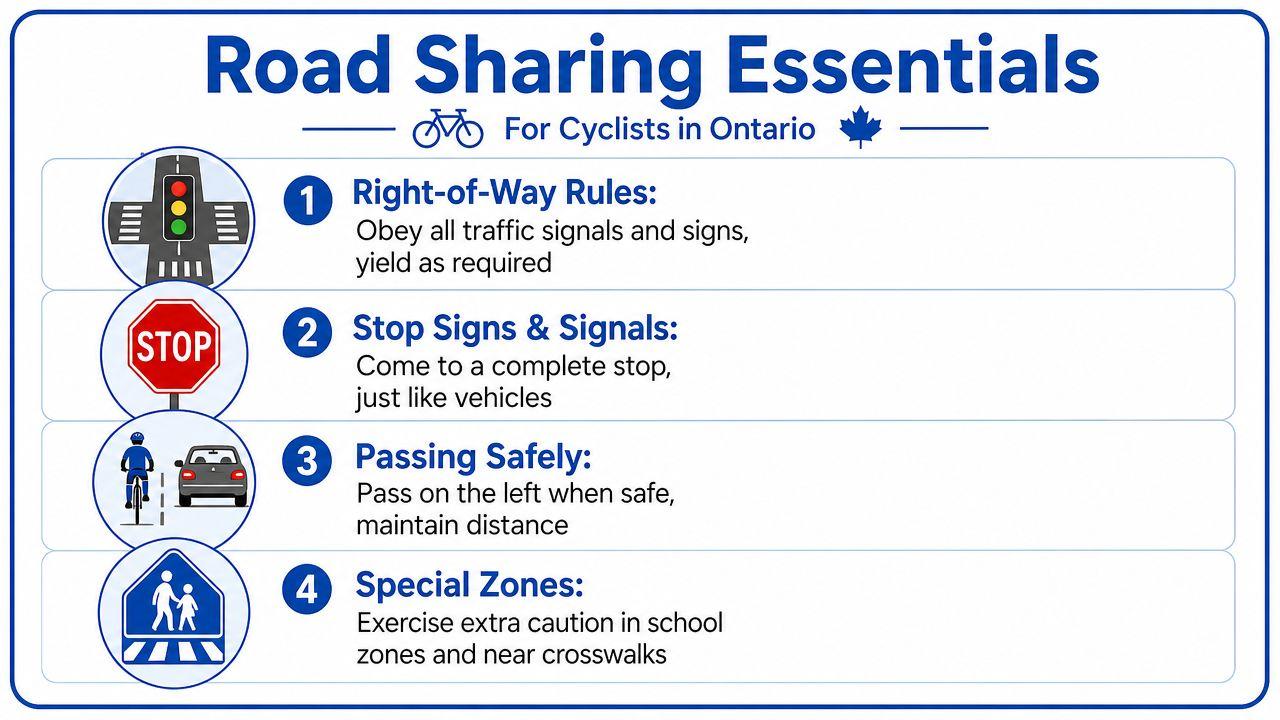
At an intersection, a bicycle is part of normal traffic. The rider must obey stop signs, traffic lights, and right-of-way rules the same way a driver does. For test purposes, the safest habit is simple: treat the cyclist as another vehicle, not as a pedestrian unless they have dismounted and are walking.
That clears up a lot of confusion.
A cyclist at a four-way stop follows the same order as everyone else. First to stop goes first. If two road users arrive together, the usual right-of-way rules still apply. Size does not decide priority.
New drivers often miss these intersection traps:
- assuming a bicycle can roll through a stop sign because it is smaller and easier to stop
- assuming a rider can switch between vehicle rules and pedestrian rules while still riding
- forgetting that a driver turning left or right must watch for a cyclist continuing straight through the intersection
A good mental model is to treat the bicycle like a small car with less protection. It belongs in traffic, but it is much easier to miss. That is why G1 questions often focus on turning conflicts. If you are turning and a cyclist is going straight, check mirrors, scan your blind spot, and make sure you are not cutting across the rider's path. If you want to practise that kind of scenario, these Ontario driving test questions that include shared-road situations are useful.
The one-metre passing rule in plain English
Ontario drivers must leave at least one metre when passing a cyclist, where practical, according to the Ontario Driver's Handbook page on sharing the road with other users. On the G1 test, the key point is who carries that duty. The driver doing the passing is responsible for leaving that space.
Cyclists still have to ride lawfully, but they are not the ones responsible for creating the one-metre gap for a passing car. That misunderstanding causes bad test answers and unsafe real-world decisions. A driver may think, "the cyclist should move over for me." The law puts the burden on the person overtaking.
Here is the practical lesson. If there is not enough room to pass safely, wait.
That matters near parked cars, storm drains, rough pavement, and other edge hazards. A cyclist may ride a bit farther from the curb to avoid a door opening or a wheel-catching crack. On a test, that road position should not be treated as disobedience. It is often the safer line.
Special zones require more patience
Some places demand extra caution because the rider's safest path may not look obvious at first glance.
Toronto streetcar tracks are a good example. Bicycle tires can get caught in rails, especially during turns or shallow crossings. A rider may shift position before crossing so the bike meets the track at a safer angle. As a driver, give that rider time and space instead of squeezing past.
Use extra care in places like these:
- Intersections with rails: a cyclist may adjust sideways before crossing
- Roads with parked cars: a rider may leave extra space to avoid an opening door
- Narrow lanes: a driver may need to wait behind rather than force a close pass
- School zones and community safety zones: expect slower speeds, more scanning, and less room for mistakes
The pattern behind all of these situations is the same. The bicycle may need a little more road space for a few seconds to stay safe. A patient driver prevents the conflict before it starts.
For G1 purposes, remember the rule behind the scenario. At intersections, bicycles follow vehicle rules. When passing, drivers leave the one-metre gap. In special zones, do not assume the cyclist's safest line will hug the curb.
Fines Penalties and Common G1 Test Questions
Here, road rules become memorable. Once a rule is tied to a consequence or a realistic question, it tends to stick.
What the G1 test expects you to know
The Ontario G1 written knowledge test has 40 random questions, split into 20 on road signs and 20 on rules of the road. You need at least 16 correct in each section to pass, as explained in this Ontario G1 test overview.
That format matters because bicycle questions usually appear in the rules section. They're often mixed in with right-of-way, lane use, safety equipment, and shared-road situations. If you miss too many of these, they can pull down the section you need to pass.
If you want extra practice with that style of scenario, these Ontario driving test questions are useful for spotting patterns in how road-rule questions are asked.
Practice questions with explanations
1. A cyclist reaches a stop sign. What must they do?
A) Slow down only
B) Stop only if a car is coming
C) Obey the stop sign like other vehicles
D) Move onto the sidewalk
Correct answer: C
A bicycle is treated as a vehicle on the road, so the stop sign applies. The rider must stop and follow right-of-way rules.
2. When a driver passes a cyclist in Ontario, who must leave one metre of space where practical?
A) The cyclist
B) The driver
C) Both equally
D) Neither if traffic is heavy
Correct answer: B
The passing duty falls on the motor vehicle driver. This is a classic trick question because many learners think the cyclist must create the gap.
3. A 15-year-old rides without a helmet. Which answer is most accurate?
A) Helmets are optional on bicycles
B) Only adults are fined
C) Riders under 18 must wear a helmet, and a parent or guardian is responsible for children under 16
D) The rule applies only to e-bikes
Correct answer: C
This combines the age rule with parental responsibility. On the G1, these combined-rule questions are common.
4. A bike is missing a bell and proper reflectors. What should you assume on the test?
A) That's allowed during daytime only
B) The bike lacks required safety equipment
C) Only reflectors matter
D) The bell is optional if the rider shouts
Correct answer: B
Ontario requires functional safety equipment including a bell or horn and front and rear reflectors.
The fastest way to answer cyclist questions is to ask who has the legal duty, what traffic control applies, and whether the bike is properly equipped.
Conclusion
A common G1 scenario goes like this: you approach an intersection, a cyclist is ahead of you, and the question asks who must stop, who can use the lane, or who must leave space. If you start with one rule, the answer gets much easier. A bicycle on the road is a vehicle.
That rule works like a key for many test questions. It explains why cyclists must obey stop signs and traffic lights, why they can legally occupy road space, and why drivers must treat them as part of normal traffic flow. Once you see the bike as traffic, not as something separate from traffic, a lot of tricky wording loses its power.
For real driving and for the G1, keep a simple checklist in mind. Ask what duty applies, who has the right-of-way, and what each road user should do next to stay predictable and safe. That approach helps you sort through common misconceptions, especially in questions designed to make new drivers second-guess themselves.
The goal is not only to memorize rules. It is to understand how the Highway Traffic Act shows up in everyday situations on Ontario roads. That confidence helps when a test question is awkwardly worded and helps even more when you meet a cyclist at a stop sign, during a turn, or on a narrow street.
Learn the rule, see the pattern, and your decisions get calmer and clearer.
If you want a simple way to practise Ontario road-rule questions before test day, G1ready.ca offers free G1 practice tests built around the structure of the exam, with clear explanations that help you fix mistakes quickly and study with more confidence.