You're sitting at a downtown light for your first supervised drive, hands tight on the wheel, and the light turns green. A bus pulls away on your right, a cyclist rolls forward beside you, and someone is still crossing late in front of you. Nothing here is hard to operate. Everything is hard to watch at once. That's what city drivers in Ottawa have to learn first, and it's why the Ontario rules you study for your G1 matter on real streets, not just on test day.
Why Driving in Ottawa Demands Full Attention
Your first solo feeling drive through the core usually teaches the same lesson. Steering feels manageable. Judging what everyone else will do next doesn't. You need to check the signal, the crossing, the bike lane, the turning car and the gap ahead, all before you move.
Ottawa's record shows why that scanning habit matters. The province reported 47,660 reportable collisions on City of Ottawa roadways between 2017 and 2020, including 95 fatal collisions, in its Ottawa Fatal Collision Review Committee collision summary. Before pandemic travel dropped, the city averaged slightly more than 13,000 reportable collisions per year between 2017 and 2019.
Driver Behaviour Sits at the Centre
Motor vehicle occupants were involved in 94.7% of all reportable collisions in that same Ottawa review. That number tells a new driver something useful. Most crashes aren't mysterious mechanical events. They involve ordinary drivers making ordinary errors at intersections, in lanes and around other road users.
The habits that prevent those errors are specific:
- Right-of-way first: Know who should go, then confirm the other driver is yielding.
- Speed management: Match speed to sightlines and surface, not only to the posted limit.
- Observation before movement: Check mirrors, blind spots and crossings before you turn or change lanes.
- Lane discipline: Hold a predictable position so buses, cyclists and turning drivers can read your intentions.
Distraction weakens every one of those habits. Ottawa Public Health found only 71% of Ottawa adult drivers reported never using a handheld cell phone while driving, based on data in its Ottawa road safety data summary. Among Ottawa high school student drivers, 71% reported they did not send or read a text message or email while driving during the previous year.
Instructor habit: Look where a conflict could come from, not only where your car is pointed. The danger at an Ottawa intersection usually enters from the side.
That mindset also covers impairment and seatbelts. Ottawa Public Health reported 98% of adult drivers aged 16 or older said they always wore a seatbelt, yet 15% of high school student drivers had driven within an hour of using cannabis. Rules about phones, alcohol, cannabis and belts aren't side topics for the knowledge test. They're daily decisions that shape whether a routine trip stays routine. Learn them as safety rules first. The test answers become easier after that.
Handling Roundabouts, Transit Stops and Pedestrian Crossings
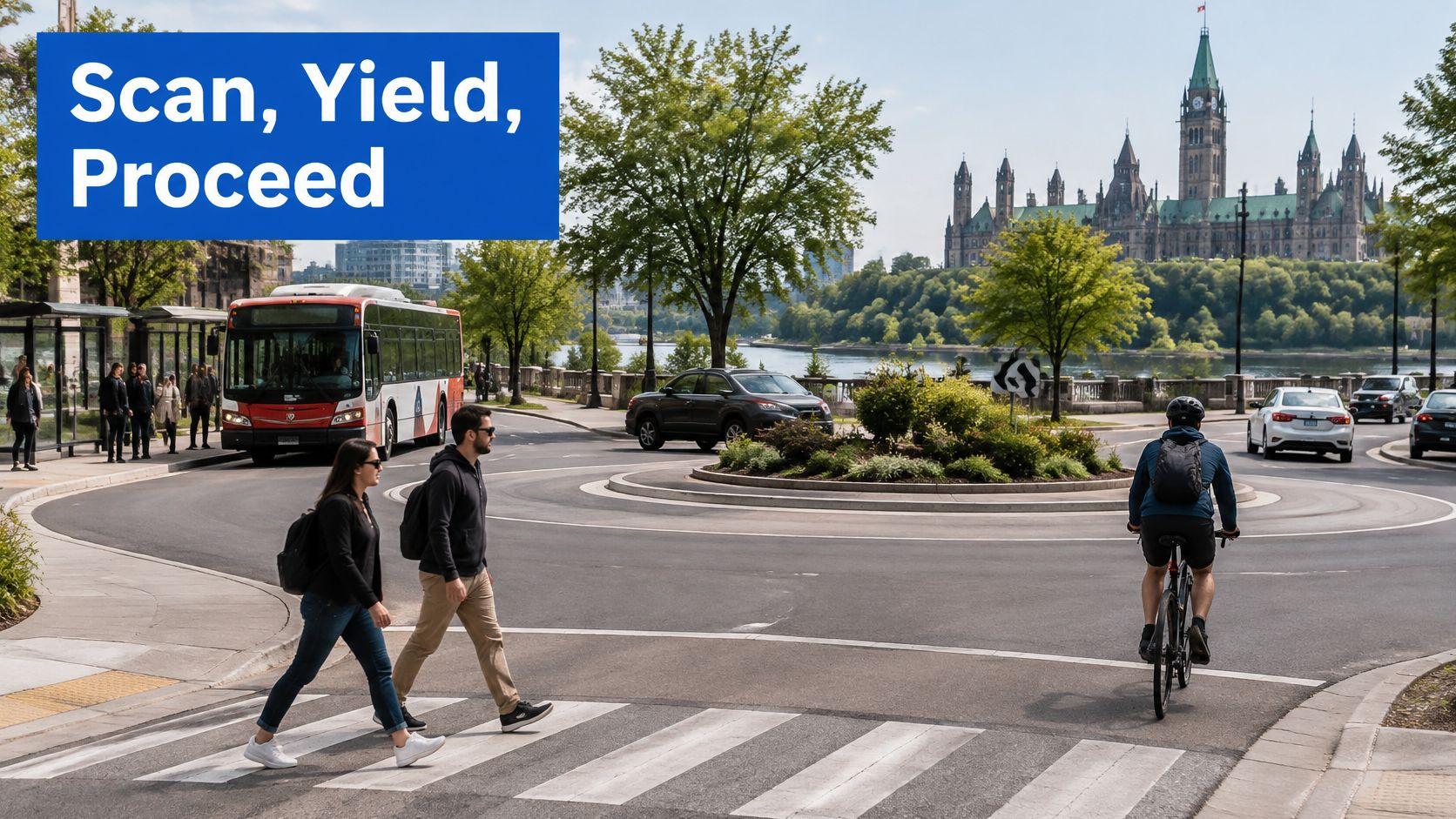
Shared space is where new drivers feel rushed. A roundabout, a bus stop and a crosswalk can appear within one short block, and each one asks you to yield to someone different. Use the same order every time. Slow early, choose your lane, scan for people, then judge vehicles.
A Repeatable Roundabout Routine
Start before the yield line. Read the signs and lane markings on approach, because your exit determines your lane position. Don't make that decision while you're already entering.
At the entry, look left for traffic already circulating and check the crossing in front of you. Pedestrians and cyclists may be crossing the entry or exit legs even when the vehicle gap looks clear. Enter only when you can do so without forcing someone inside the roundabout to brake. If the gap makes you think, "I can probably make it," wait. Probably isn't a margin.
Inside the roundabout, keep your speed steady and your lane position clean. Watch for a driver beside you who may exit across your path. Signal your exit, check the crossing on that exit leg, and leave without stopping in the circle unless you must yield to a pedestrian. Reviewing Ontario roundabout rules and yielding practice before you drive one helps you rehearse that order without pressure from cars behind you.
- Approach: Pick the correct lane early and reduce speed before the curve tightens.
- Entry: Yield to circulating traffic, then check the entry crossing again.
- Exit: Signal, scan the exit crossing, and watch for a cyclist continuing through beside you.
Buses Hide People, Then Move
A stopped transit bus is a moving wall with doors. Treat it that way. Passengers may step down and cross in front of the bus or walk quickly toward a connecting stop. You may not see them until they're past the front bumper.
Ease off as you approach a bus at a stop and leave lateral space if your lane allows it. Watch the bus driver's signals and the front wheels. A left signal and wheels turning out tell you the bus is preparing to re-enter traffic. Don't race to beat that pull-out. A sudden squeeze helps nobody, and a passenger may still be near the curb.
If you can't see past a stopped bus, assume someone is about to appear from behind it. Slow down until your view proves otherwise.
Crossings Need a Second Look
At marked crosswalks, scan curb to curb, not only the painted lines. Look for a pedestrian hidden by a parked SUV, a child lower than a hood line, or a person approaching fast from a transit shelter. Mid-block crossings demand the same care because drivers often relax between intersections.
Turning creates the sharpest conflict. Before a right turn, check the crosswalk, the bike lane and your right blind spot in that order, then check the crosswalk again as you begin to roll. Before a left turn, separate the tasks. Judge oncoming traffic first, then clear the far crosswalk before you commit. A green light gives you permission to proceed when it's safe. It doesn't clear the crossing for you.
Practise these scenes mentally before your test. Say the checks out loud during supervised drives. "Crossing clear, bike lane clear, gap clear." It sounds basic. Under pressure, basic is what holds.
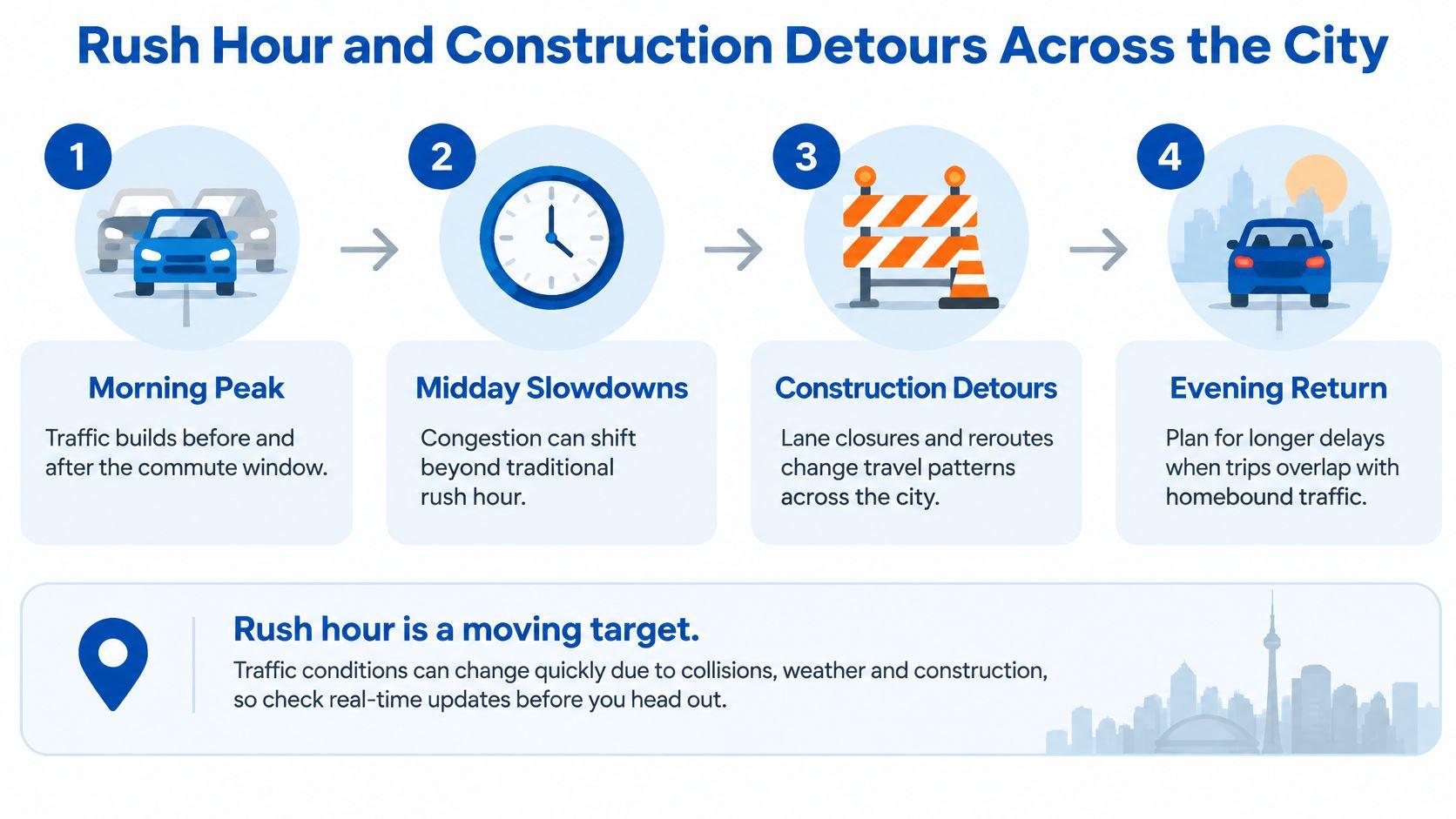
Rush Hour and Construction Detours Across the City
A familiar route can change by the time you drive home. You leave on a street you know, then cones push traffic left, a ramp closes, and your navigation app still insists on the old line. For city drivers in Ottawa, that mismatch is now part of normal driving, not an exception.
Recent CBC reporting described congestion extending beyond rush hour because of Highway 417 overpass construction, return-to-office travel, population growth and closures near Bronson and Carling avenues, in its October 2025 report on Ottawa traffic spreading beyond rush hour. The construction discussed in that report was expected to continue through the end of that year. Plan for delay outside the traditional peaks.
Don't Enter a Box You Can't Leave
Queues cause the most avoidable trouble. Your light turns green, traffic ahead moves a few metres, and the driver behind you expects you to fill the intersection. Don't. If you can't clear the far side, stop before the crosswalk and wait. A blocked box traps turning traffic, blocks pedestrians and leaves you exposed when the cross traffic gets its green.
Watch two or three vehicles ahead, not only the bumper in front of you. Brake lights rippling through a queue tell you the line isn't flowing. Hold back even if another driver waves you forward. The wave doesn't create space on the far side.
Temporary Instructions Beat Old Habits
Construction zones change the visual language of a road. Old paint may point one way while barrels, temporary signs and a flag person point another. Follow the temporary traffic control in front of you. It reflects the road as it exists today. Your app may not.
Near a short construction ramp, start your merge decision early. Signal, match the speed of the lane you're joining as conditions allow, and make one smooth move into a real gap. Don't stop at the end of a short ramp unless traffic leaves you no safe choice, and don't force your way in beside a truck that can't see you. If the gap closes, back off and take the next one. Missing an exit is cheaper than a sideswipe.
Lane shifts need the same patience. Follow the temporary line through the shift and resist straightening toward the old alignment. Keep extra space beside barriers because other drivers often drift when the road narrows. Studying Ontario construction zone speed limit guidance helps separate the permanent speed rule from a reduced temporary limit posted for road work.
- Signs conflict with your app: Obey the sign, cone line and flag person, then let the route recalculate.
- Queue fills the intersection: Wait behind the stop line until your exit space is open.
- Detour feels unfamiliar: Slow down, follow detour markers, and don't make a late turn from the wrong lane.
The fastest route on a screen may send you into a tight merge, a blocked side street or a lane that disappears. Choose the route you can read clearly. Arriving a little later with space around your car is the better trade.
Winter Roads and Following Distance for New Drivers
Intersection rankings get attention because they're easy to list. Ice deserves more of a beginner's attention because it changes every decision on every street. Steering, braking and scanning all get harder at the same time, often in the dark and with snow narrowing the lane.
Police data reported for 2025 recorded 707 collisions attributed to slippery or icy conditions in Ottawa, according to CTV News reporting on Ottawa police collision data for 2025. The same reporting said Ottawa had 19,345 collisions through December 13, 2025, including 21 fatal collisions. Winter surface risk isn't a footnote for local learners.
Buy Time With Space
Following distance is your main winter tool. On a dry road, a late reaction may still leave room to brake. On ice, that same delay uses up distance your tires can't recover. Open a larger gap early, before the first slippery corner tests you.
Brake early and gently. Hard braking asks for grip the surface may not have. Ease off the accelerator first, let speed fall, then brake in a straight line where possible. If you need to turn, do most of your slowing before you steer. Combining sharp steering with firm braking on a polished intersection is how a car keeps sliding straight.
Read the surface as you drive. A shiny patch in a shaded lane, a glossy strip near a stop line and slush pushed into the wheel tracks all deserve caution. Bridges, ramps and exposed corners can feel different from the road you just left. You won't always identify black ice by sight. That's the point. Drive as if a low-grip patch could be waiting where traffic repeatedly stops and starts.
A manoeuvre can be legal and still be a bad winter decision. The speed limit doesn't promise that the surface can support that speed.
People Are Harder to See in Snow
Snowbanks shrink sightlines at crossings and driveways. A pedestrian in dark winter clothing may appear from behind a bank with little warning. Slow more than feels necessary when your view is cut. Your stopping ability is worse at exactly the moment your view is worse.
Turning across a bike lane needs a deliberate shoulder check. Snow and slush can push a cyclist toward the clearer part of the road, and painted lanes may be partly hidden. Check your mirror, check your blind spot, then look again along the curb before you turn. Don't assume winter ends cycling in Ottawa. It doesn't.
Leave extra room beside parked cars too. Doors open into narrowed lanes, and people step around snowbanks to reach the road. If the space feels too tight to pass safely, wait for a wider section. New drivers often think winter skill means recovering from a slide. The stronger skill is avoiding the speed and spacing choices that create one.
Parking Limits and Learner Rules on City Streets
Parking errors catch learners during calm moments. You finish a practice drive, find a space near home and stop too close to a driveway or intersection. Ottawa's municipal limits are specific, so learn the distances as numbers, not guesses.
The City's Traffic Services Catalogue says parking is prohibited within 9 metres of an intersection, within 3 metres of a fire hydrant and within 1.5 metres of a driveway, in its City of Ottawa Traffic Services Catalogue parking rules. Time limits also apply on many streets unless another rule governs that location.
Ottawa Parking Distance and Time Limits
Situation Limit Parking near an intersection Not within 9 metres Parking near a fire hydrant Not within 3 metres Parking near a driveway Not within 1.5 metres Weekdays, 7 a.m. to 7 p.m. No more than three hours, unless another rule applies Weekends and holidays, 7 a.m. to 7 p.m. No more than six hours, unless another rule applies
Those are municipal rules for Ottawa streets. They apply to fully licensed drivers as well as learners. A posted sign can impose a different limit for a particular street or period, so read the sign where you stop instead of relying on the general rule. Comparing the local limits with broader Ontario parking rules for learner drivers can help you keep city bylaws separate from provincial test rules.
Provincial G1 Conditions Follow You Everywhere in Ontario
Your G1 conditions come from Ontario, not the City of Ottawa. You must drive with a qualified accompanying driver who has at least four years of driving experience, holds a full licence for the vehicle and sits beside you, under Ontario's G1 conditions for new drivers. That person isn't a passenger you can place in the back seat.
Ontario also prohibits G1 driving between midnight and 5 a.m. and requires a zero blood-alcohol level. Every passenger must wear a properly working seatbelt. These restrictions apply whether you're practising on a quiet Ottawa side street or driving elsewhere in the province.
Before any of that supervised practice begins, an applicant must be at least 16 years old, pass a vision test and pass a knowledge test on road rules and traffic signs, as set out in Ontario's official handbook guidance on getting a driver's licence. Passing moves you into Level One of graduated licensing with a Class G1 licence.
Keep the categories straight. Ottawa tells you where and how long you may park on its streets. Ontario tells you when, with whom and under what conditions you may drive as a G1 holder. Confusing those two layers leads to mistakes on practice questions and on the road.
Building a G1 Practice Plan That Matches Ottawa Roads
Reading the handbook once feels productive. It doesn't prove you can apply a rule when a question describes a blocked intersection, a cyclist beside a turning car or a temporary sign in a work zone. Build your study plan around decisions Ottawa asks you to make.
Start with the highest consequence topics. Ontario reported more than 30,000 collisions involving distracted or inattentive drivers in 2022, producing nearly 11,000 injuries and 100 fatalities, according to Ontario's distracted driving safety guidance. Put distraction, impairment, graduated licensing, right-of-way, speed and vulnerable road users near the front of your plan.
Compare the Three Study Methods Honestly
Reading the official handbook from start to finish gives you the source rules in context. It's the right foundation. Its weakness is passivity. You can recognise a rule on the page and still miss it when the wording changes.
Topic quizzes fix a narrower problem. A signs quiz isolates sign recall. A right-of-way quiz forces repeated decisions about yielding. Use them after a diagnostic shows where you're weak. The risk is comfort. Seeing the same question again can build recognition without proving recall, so say the rule out loud before you look at the choices.
Timed mixed simulations build endurance and expose careless reading. They also show whether you can switch from a parking distance to a pedestrian crossing to a construction sign without losing focus. Don't start here. A full simulation before you've repaired basic gaps mostly rehearses guessing.

Use a Diagnostic and Measurable Gates
Begin with one mixed baseline test and don't review while you write it. Mark every error as knowledge, interpretation or careless reading. Then calculate topic accuracy as correct answers divided by attempts. That simple log tells you what to study next.
Use clear readiness gates. Aim for at least 85% on untimed topic tests, then 90% or higher on mixed tests, and require 90% on two consecutive topic quizzes before you move into full simulations. Those thresholds are study benchmarks, not official pass marks. They keep you from calling yourself ready after one lucky run.
Ottawa's serious collision pattern should shape your final gate. The City reported 598 fatal or major injury collisions from 2019 to 2023, with pedestrians involved in 26% and cyclists in 10%, in its 2023 Ottawa road safety monitoring report. Before test day, complete at least three timed simulations at 90% or higher on different question sets, with no repeated errors on pedestrian priority, cyclist clearance or intersection right-of-way.
G1ready.ca fits that sequence as a free, registration-free practice platform with mirrored exam questions, immediate feedback and hints, progress tracking and mobile access. Use it for the diagnostic, the topic repair work and the timed simulations, but return to the handbook rule whenever you miss the same item twice. Take a diagnostic today, log each error by type, and schedule your first topic quiz on the rule that gave you the most trouble.
Start your Ottawa focused preparation with a free diagnostic, topic quizzes and timed G1 simulations that give immediate feedback, hints and progress tracking on your phone or computer. Build your score topic by topic, fix repeated right-of-way and pedestrian errors, and visit G1ready.ca to begin your first practice session today.