
You know the feeling. You pull over where the curb looks clear, the sign seems harmless, and you're back five minutes later staring at a ticket under the wiper. That's the part that frustrates new drivers, because parking rules Ontario aren't one simple curb rule, they're a mix of provincial law, city bylaws, and whatever the sign says right there at the spot.
For G1 learners, that mix is exactly why parking questions feel slippery. A lane can look open and still be illegal if the sign, timing, distance, or road position is wrong. Once you learn how Ontario treats parking, you start reading streets the way a calm instructor does, one clue at a time.
Why Ontario Parking Rules Are Trickier Than They Look
A student driver once told me they had “parked perfectly” near a downtown curb, then came back to find a ticket. The spot was fine on one side of the block, but the next stretch had a different sign, a different limit, and a different restriction. That happens often in Ontario, because parking law does not work on guesswork.
One street can hold several rules at once
Ontario parking usually comes from three layers at the same time. The province sets the baseline, municipalities add local bylaws, and posted signs control the exact space in front of you. In Toronto, an unsigned maximum 3-hour parking limit applies on public roads unless a sign says otherwise, and permit, class-reserved, and time-limited spaces can be enforced through the sign itself, as shown in the city's Toronto parking regulations.
That is why two vehicles parked a few metres apart can face different outcomes. One driver reads the curb, another reads the sign, and only one returns to a clean windshield.
Practical rule: if the curb looks open but the sign says something else, the sign wins.
Why this matters on the G1 exam
The G1 test is not asking you to memorise every municipal quirk. It checks whether you can look at a road scene and spot the details that make parking legal or illegal. Distance, direction, signage, and road position matter more than a casual “it seems fine” judgement.
A new driver may know how to park a car and still miss the rule because the answer depends on where the vehicle sits relative to the roadway, not just whether it fits. Parents helping teens often see the same mistake. Students focus on steering and forget the legal frame around the spot.
This guide is for the learner who wants the plain-English version. It starts with the rules that apply everywhere, then moves into signs, distances, special cases, enforcement, and G1-style practice so test-day questions feel familiar instead of surprising.
The Four Foundational Rules Every Driver Must Know
A lot of Ontario parking mistakes start with a simple assumption. The curb looks open, the car fits, so the spot must be fine. The province does not treat parking that casually. The four basics below are the rules that keep a stopped vehicle from becoming a hazard, and they are the ones students should be ready to recognize on the G1 test.
Park off the travelled roadway whenever you can
The Ontario Driver's Handbook says drivers should stay off the travelled part of the roadway whenever possible Ontario Driver's Handbook, parking along roadways. In plain English, your car should be out of the traffic lane unless there is no safe alternative.
That rule protects more than convenience. Drivers need space to pass, and road crews need room to work. A vehicle that leaves part of itself in the lane can slow traffic or create a risk for someone who is not expecting it.
Keep 125 metres of clear visibility if you must stop on-road
If parking off the roadway is not possible, the same provincial rule requires 125 metres of clear visibility in both directions Ontario Driver's Handbook, parking along roadways. A driver coming from either direction should be able to spot your vehicle early enough to react safely.
A curve in the road makes this easier to understand. If your car sits where it cannot be seen in time, another driver has less space to slow down, steer around it, or stop. Even a car parked straight can become a problem if the sightline is too short.
Don't block traffic or snow clearing
The provincial rule also says the vehicle must not interfere with traffic or snow clearing Ontario Driver's Handbook, parking along roadways. That matters year-round, but winter makes the point obvious. A vehicle that seems harmless on a clear street can become an obstacle once plows, banks of snow, and narrowed lanes enter the picture.
Students often miss this because they focus on where the car fits. The legal question is different. Can traffic still move, and can crews still do their job without working around your vehicle?
Park on the correct side on the King's Highway
Ontario Regulation 604 says that when a vehicle is parked off the roadway of the King's Highway, it must be on the right side relative to travel direction, with the left side of the vehicle parallel to the edge of the roadway Regulation 604. The wording sounds formal, but the idea is straightforward. The car should sit in the expected orientation, not angled into traffic or pointing the wrong way.
That detail shows up on tests because it checks more than memory. It tests whether you can tell when a parked vehicle is placed safely and predictably.
G1-style check: If you cannot park fully off the travelled roadway, what two things must still be true?
Answer: There must be 125 metres of clear visibility in both directions, and the vehicle must not interfere with traffic or snow clearing.
Reading Parking Signs and Curb Markings Like a Pro
A parked car can look fine from the sidewalk and still be illegal because of one small line on a sign. That is why Ontario parking rules reward careful reading, not quick guessing. A student who learns to read the sign first will usually handle the G1 parking questions with more confidence, because the exam asks you to notice the exact rule written in front of you.
Sign wording changes the legal result
A space can look identical from one block to the next, yet the legal rule can change completely once the sign changes. Toronto's parking rules show that a public road without a posted sign may still have a maximum 3-hour parking limit, while permit-only, class-reserved, and time-limited spaces follow the wording on the sign itself. If the sign says “No Parking,” that space is off-limits for parking during the posted window Toronto parking regulations.
The habit to build is simple. Do not ask whether the space looks acceptable. Ask what the sign permits, and for how long.
Curb colour is helpful, but it doesn't replace the sign
Paint on the curb can support the rule, but it does not outrank the posted sign. Yellow curb areas usually point to limited parking or no parking, while white or unmarked areas can still have time limits or permit rules. Paint is a clue, like a margin note, while the sign is the actual instruction.
That is why curb colour alone can mislead a learner. A curb may look open, but the sign can still restrict the space.
Learn signs as a checklist
A steady driver checks four things every time:
- Position. Is the car in a place where parking is allowed?
- Time. Does the posted window cover the current hour?
- Day. Does the restriction change on weekdays, weekends, or holidays?
- Duration. Is there a limit on how long you can stay?
Reading a sign works best when you treat it like a small checklist instead of hunting for one familiar word. The official test often rewards the student who notices the exact condition written on the sign, even if the wording is long or the arrows seem confusing. For more practice with the kinds of parking and information signs that show up on the road test and written exam, review this DriveTest-style sign guide.
Sign Wording What It Legally Means Common G1 Trap No Parking You can't leave the vehicle parked during the posted time Reading it as “quick stopping is fine” Permit Only Only the listed permit holder may park there Assuming any driver can use it briefly Time Limited Parking is allowed only for the posted duration Missing the clock or arrival time Unsigned Public Road Toronto's default maximum 3-hour limit may apply Assuming no sign means unlimited parking
G1-style check: If a sign says parking is allowed from 9 a.m. to 4 p.m., can you park there at 5 p.m.?
Answer: Yes, if no other restriction applies. The sign controls the legal window, and once the posted time ends, that rule ends too.
Setback Distances and Other Easily Confused Restrictions
Distance questions catch careful students off guard because the numbers seem small until you are sitting behind the wheel and trying to judge a fire hydrant, an intersection, or a crossing by eye. The safe approach is to build a mental measuring stick for the curb, then use it the same way every time.
The four distances worth memorising
Ontario's parking rules require specific clearance in common spots.
- 3 metres from a fire hydrant
- 9 metres from an intersection
- 15 metres from a signalized intersection
- 15 metres from the nearest rail of a level railway crossing
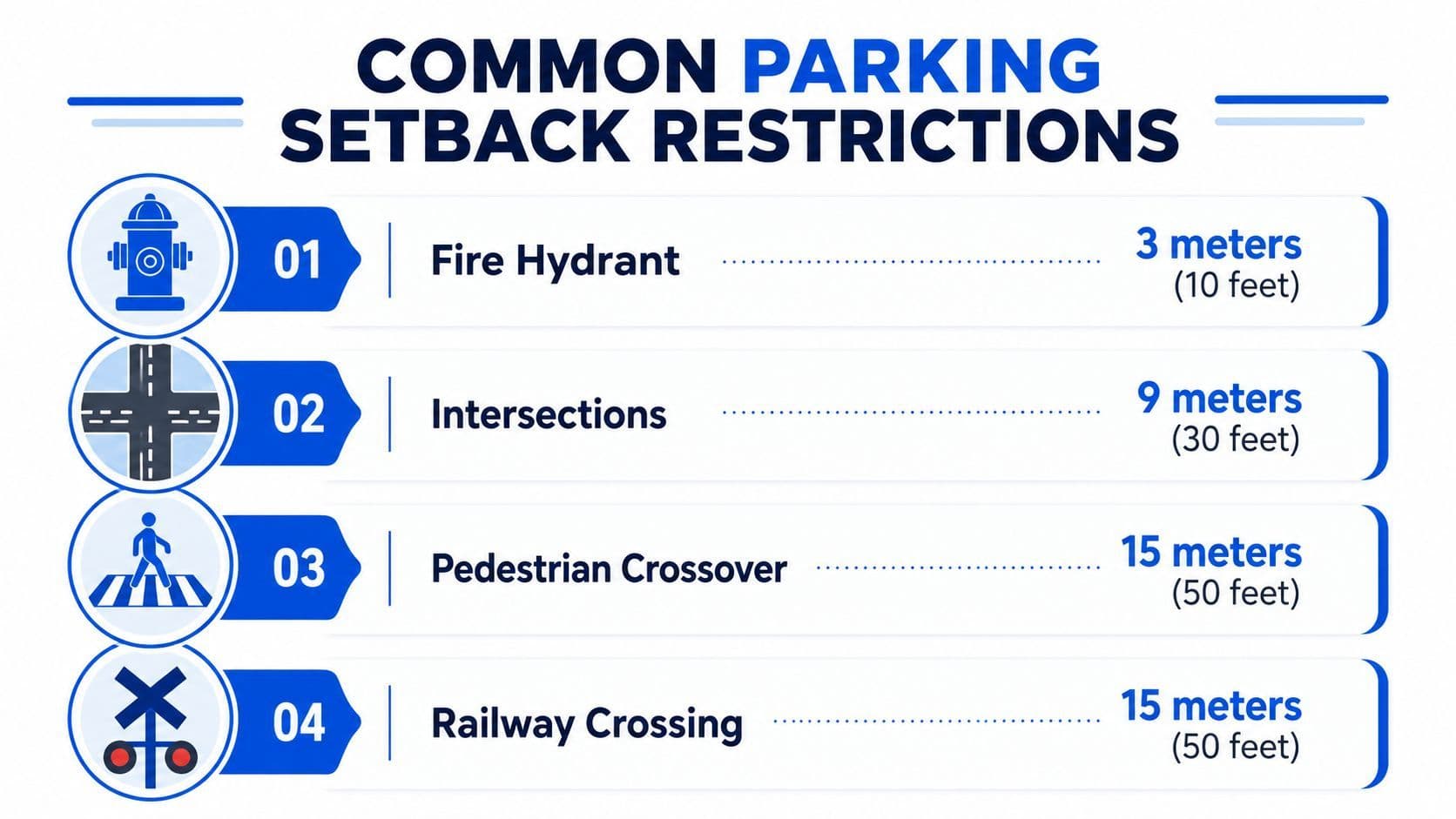
The same idea appears in the official handbook's parking guidance along roadways, and the test expects you to know the exact spacing rather than a rough guess.
Why these spaces stay clear
A hydrant needs room because emergency crews need immediate access. Intersections need clearance because turning traffic, pedestrian movement, and driver sightlines all depend on open space. A railway crossing needs extra caution because a parked car near the tracks can create a serious obstruction or confuse drivers approaching the crossing.
These numbers are not random. They protect visibility, movement, and emergency response.
Common places students mix up
Driveways, stop signs, sidewalks, boulevards, and crosswalks all tempt students to guess instead of measure. If a curb feels “far enough away,” that is not a legal standard. The exam wants the fixed rule, not your estimate.
Memory cue: hydrant, intersection, crossing. If the space is one of those, stop and check the exact clearance before you leave the car.
A practical scan helps here. Look left and right for a hydrant, then check for the corner, then notice whether the street is controlled by lights, then watch for railway equipment or markings. That quick pause is often the difference between a correct answer and a lost mark.
G1-style check: How far must you park from a fire hydrant in Ontario?
Answer: 3 metres.
Special Situations Every Ontario Driver Should Recognize
A curb can look empty and still be off limits. That is the part many drivers miss, especially when the rule involves accessibility, school safety, winter restrictions, or private property. These are the places where a quick guess turns into a ticket, because the sign or permit usually controls the space, not the amount of open pavement.
Accessible parking is not a casual exception
Accessible spaces are reserved for people with valid permits, and using one without permission can bring serious local penalties. Stratford states a $300 fine for parking in a designated accessible space without a valid permit Stratford accessible parking regulation. The point is not just the number. It shows that municipalities treat misuse of disability parking very seriously.
The clean way to remember it is simple. If a space is marked for accessible parking, it is not a backup spot for convenience, even if it looks wide, open, or easy to reach.
School zones and stopping rules demand extra caution
Near schools, drivers need to expect quick, unpredictable movement from children and crossing guards. No-stopping zones near school crossings help keep sightlines open and give pedestrians more room to move safely. If a sign or painted marking says stopping or parking is restricted, treat it as a safety rule, not a casual reminder.
This is one of the easiest places to lose marks on a test question. Students often focus on the curb and miss the sign, even though the sign is what controls the stop.
Winter, overnight, and street-cleaning restrictions change fast
Municipal rules can change during snow events or for street cleaning. Cities often post temporary no-parking signs in advance, and a vehicle left behind can be ticketed or towed. The time limit usually comes from the posted notice, so the driver has to read what is on the street instead of relying on the regular daily routine.
That matters because a space that is legal in the afternoon can be restricted later the same day. The curb does not announce the change for you.
Private property and permit-only areas still matter
Parking on private property, in a fire route, or inside a permit-only residential zone can still lead to consequences even when the area looks empty. The common mistake is assuming that no traffic means no rule. In practice, the lot owner, municipality, or permit system may control the space and decide whether your vehicle belongs there.
A painted stall, a posted sign, or a marked route usually means the space is controlled until you have confirmed otherwise. That is the same habit you want on the G1 test, read the control first, then decide whether the stop is allowed.
G1-style check: Why is an accessible parking space different from a regular open curb spot?
Answer: It is reserved for valid permit use, and misuse can lead to a significant municipal fine, such as Stratford's $300 example.
Fines, Tickets, and How Enforcement Works
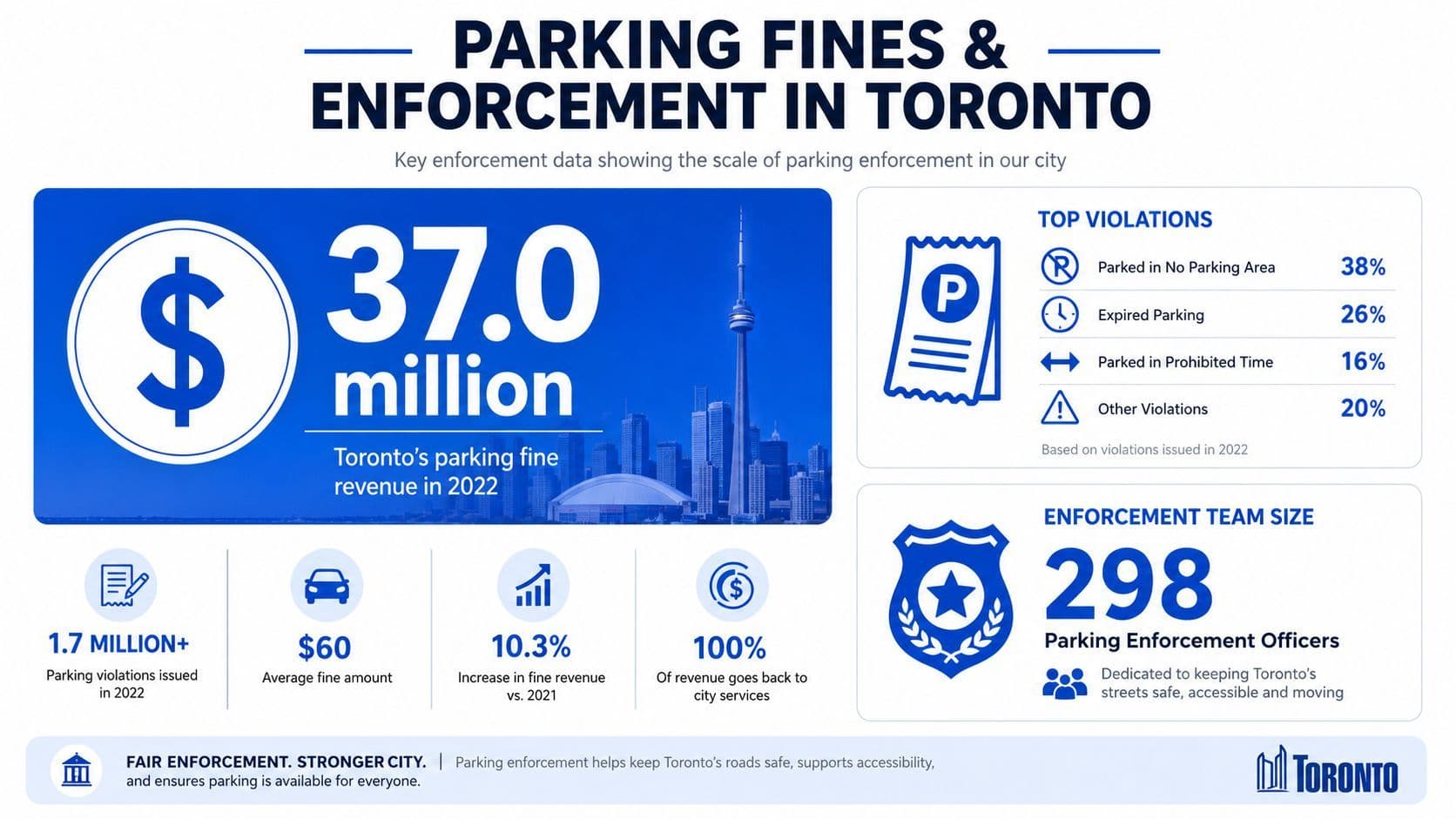
A driver can do everything right on the road and still get surprised by parking enforcement. In Ontario, tickets are part of regular municipal work, not a rare exception. Toronto's open data set covers 37.0 million tickets issued from 2008 to 2024, with $1.72 billion in total fines and an average fine of $46.39 per ticket Toronto parking enforcement system. That scale shows parking rules are monitored as part of everyday city operations.
What the enforcement data shows
Toronto's dataset also records 658 distinct infraction descriptions and 270 codes, which shows how detailed the parking system is Toronto parking enforcement system. Most fines are between $30 and $50, while only 5% exceed $100 Toronto parking enforcement system. For a student, that can look like a small mistake with a small fee. In real life, repeat that mistake a few times and the total becomes hard to ignore.
Ottawa's recent figures point in the same direction. The city issued 262,089 parking tickets in 2021, 452,202 in 2024, and 489,617 in 2025 CBC summary of Ottawa city data. Ottawa also recorded 50,786 parking-enforcement requests in 2025, compared with 42,700 in 2019, and parking-fee revenue rose 8.8% from 2024 to 2025, with on-street parking fee revenue increasing by $920,000 over that same period CBC summary of Ottawa city data.
What happens after a ticket
A parking ticket usually lists the offence, the location, and the steps for payment or dispute. If towing is involved, the cost rises because the ticket and the tow are separate consequences. Unpaid tickets can also create trouble later when you deal with renewal or other municipal processes.
The lesson for a learner is simple. A ticket is not just a paper notice on the windshield, it is a record of a rule that was already in force when the vehicle was parked.
If you want a broader road-rule refresher while you study parking tickets, this guide pairs well with Ontario demerit points explained.
Parking enforcement feels random from the driver's seat, but the city is usually applying a posted rule that was already there.
G1 Practice Questions and a Study Plan That Works
A student is stopped at the curb, the sign is small, and the clock is ticking. That is the kind of moment the G1 parking section is built around. The best way to prepare is to practise short scenarios the same way the exam presents them, with one clear rule and one detail that changes the answer. Students usually miss points when they only skim notes and never test themselves against real questions.

Five G1-style questions
- How far must you park from a fire hydrant in Ontario?
Answer: 3 metres. Anything closer blocks emergency access and can lead to a ticket. - A street has no sign and you're in Toronto. What limit may apply on a public road?
Answer: A maximum 3-hour parking limit may apply unless a posted rule says otherwise Toronto parking regulations. On the G1 test, the clue is usually the missing sign, which means you have to fall back on the local rule instead of guessing. - Can you park in a designated accessible space without a valid permit?
Answer: No. Doing that can lead to a significant fine, and the exact amount depends on the local enforcement example shown in the regulation Ontario regulation 900581. The test is checking whether you recognize that accessible spaces are protected, even when the spot looks empty. - If you must park on-road, what must still be true about visibility?
Answer: There must be 125 metres of clear visibility in both directions Ontario Driver's Handbook, parking along roadways. In plain English, you should be able to see far enough that another driver is not surprised by your parked vehicle. - Where must a vehicle be parked off the roadway of the King's Highway?
Answer: On the right side, with the left side parallel to the edge of the roadway Regulation 604. That rule often shows up as a direction question, where the exam wants you to picture the vehicle's position, not just the words of the bylaw.
A study routine that sticks
Start with the official rule set, then turn it into short daily checks. A few questions a day is enough to make distances, signs, and special situations feel familiar instead of blurry. If you want structured practice in exam format, G1ready.ca's free G1 test practice guide follows the same topic style learners use for DriveTest prep.
A good routine looks like this:
- Read one rule set. Focus on hydrants, intersections, and signs.
- Answer five mixed questions. Leave the timer out on the first pass if the wording feels new.
- Review every mistake. If you missed a sign, read the whole sign, not just the biggest word.
- Repeat the next day. Parking rules stick through repetition, not cramming.
This is not about memorizing bylaws word for word. It is about becoming the driver who notices the detail before the ticket arrives.
Quick-Reference Checklist and Final Confidence Boost
Keep this in your head before you park. Off the roadway when possible. 125 metres of clear visibility if you can't. Right side on the King's Highway. Check every sign, curb mark, and posted time. Then remember the key setbacks, 3 metres from a hydrant, 9 metres from an intersection, 15 metres from a signalized intersection, 15 metres from a railway crossing. Parking gets easier when you scan the space the same way every time.
If you want more guided practice, G1ready.ca gives Ontario learners free, registration-free practice tools that mirror the structure of the G1 test. Visit G1ready.ca and use the parking material alongside your handbook, so every curbside decision you study today feels familiar on test day.


