You've probably done some version of this already. You open the handbook, read two pages, then wonder how any of it will help when you're sitting at an intersection with cars behind you. Later, you ride with a parent, guardian, or instructor and realise the opposite problem: the road feels fast, but the rules in the book felt abstract.
That split is where many learners get stuck.
Good practice for driving isn't just test prep, and it isn't just seat time. It works better when the two support each other. You study a rule, then look for it on the road. You make a mistake in practice, then go back and review the exact rule behind it. That loop is what turns nervous guessing into calm decision-making.
Your Roadmap from Learner to Driver
A lot of new drivers think they have two separate jobs. First, pass the G1. Then, much later, learn how to drive. That sounds tidy, but it often creates extra stress because the knowledge never feels connected to the actual road.
Ontario's system was built to avoid exactly that. The province introduced graduated licensing in 1994 to help new drivers build experience in lower-risk conditions, and that matters because teen drivers have crash rates nearly 4 times those of drivers age 20 and older per mile driven, according to the IIHS teen driving research.
That's why the G1 stage exists. It's not there to slow you down for no reason. It's there to give you a controlled beginning. You learn the rules, drive under supervision, and add complexity as your judgment improves.
Practical rule: Don't treat theory and road practice as separate subjects. Treat them as one skill learned in two places.
A simple example helps. If you study right-of-way rules at four-way stops, your next practice drive should include several four-way stops. If you hesitate too long before a left turn during practice, that's your cue to go home and review gap judgment, lane positioning, and yielding rules.
This approach gives you a clear path:
- Learn the rule: Use the handbook and practice questions to understand what Ontario expects.
- Apply the rule: Go out with a qualified supervisor and look for safe chances to use it.
- Review the mistake: If something felt messy, unclear, or rushed, write it down and revisit it.
- Repeat with intention: The second or third try usually feels much calmer because your brain already knows what to watch for.
That's how confidence grows. Not from pretending you're ready for everything, but from building readiness one layer at a time.
Mastering the Rules with a Smart Study Plan
You sit down to study for the G1, answer a few random quiz questions, get some right, miss a few signs, then close the tab feeling unsure. That kind of studying feels busy, but it does not give you a clear picture of what you know, what you keep missing, or how those rules will show up once you are in the driver's seat.
A better approach is to study the way you will later drive. In order, with a purpose, and with regular review. The handbook gives you the map. Practice questions show you where you still take wrong turns.
Start with the handbook, then test yourself
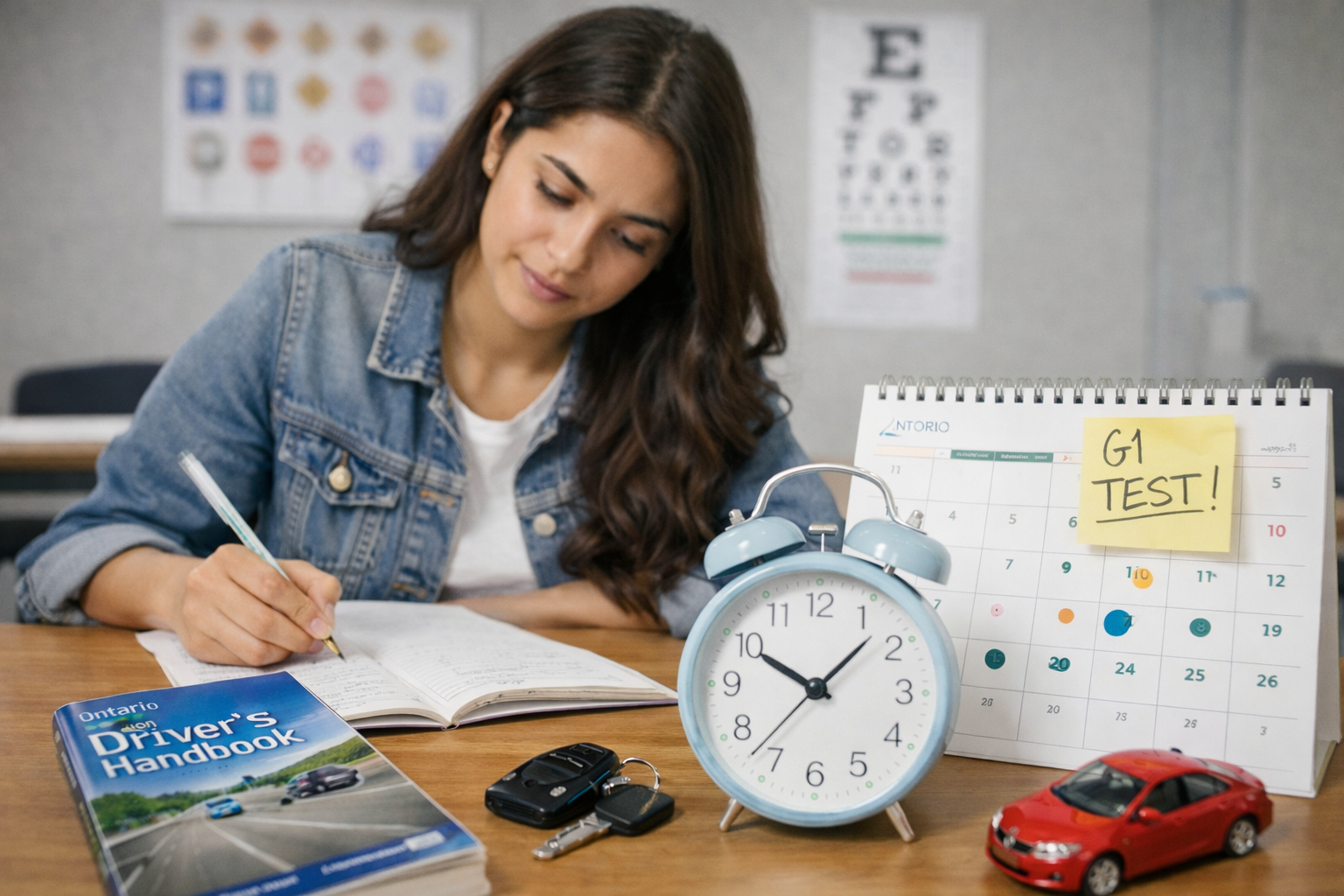
Begin with the official MTO Driver's Handbook. Read in short sessions so your brain has time to sort and store the information. One study block might focus only on road signs. Another might cover right-of-way, speed limits, and lane position.
Keep a notebook or notes app nearby. If a rule keeps slipping away, write it down in plain language. For example, instead of copying the handbook word for word, you might write, “At a four-way stop, the first vehicle to stop goes first. If two stop together, yield to the vehicle on the right.” That small step matters because understanding beats memorizing.
Then check your weak spots with one practice tool instead of jumping between several. G1ready.ca offers registration-free practice exams, topic quizzes, a diagnostic test, and an exam simulator based on the Ontario handbook. That helps you spot patterns in your mistakes and study with more direction.
Use this order:
- Read first: Learn the rule before you answer questions about it.
- Take a diagnostic test: Find the topics you miss again and again.
- Drill by topic: Focus on signs, penalties, right-of-way, or lane rules one at a time.
- Use a simulator: Practise mixed questions so you can shift between topics without losing focus.
If you want a schedule to follow, this G1 test study timeline for planning your sessions before exam day gives you a simple structure.
Use a simple weekly rhythm
Motivation comes and goes. Routine is steadier.
Try a weekly pattern like this:
- Day one: Read one handbook section and mark unfamiliar rules.
- Day two: Take a short quiz on that same section.
- Day three: Review every wrong answer and rewrite the rule in simple words.
- Day four: Do a mixed practice set.
- Day five: Rest or do a light review.
- Day six: Take a full simulation.
- Day seven: Review mistakes only. Skip cramming.
Each session has a job. Reading builds understanding. Topic practice improves recall. Full simulations help you stay calm when questions switch quickly.
Study the rules that shape your real practice
Theory works best when you tie it to actual driving situations. If you study right-of-way, connect it to intersections you will later practise with your supervisor. If you review lane markings, picture how those markings guide lane changes, turns, and safe positioning on the road.
This is also the stage to learn the rules that control your G1 practice itself. Know who can supervise you. Know where you may and may not drive. Know the restrictions that apply before the car even moves.
Those rules are not separate from road training. They are the frame around it. A learner who understands the legal limits of G1 driving can build practice sessions that are safer, calmer, and much easier to plan.
If a rule changes where, when, or with whom you can practise, learn it early and review it often.
That is the primary objective of a smart study plan. You are not only preparing to pass a knowledge test. You are building a rule book you can use on the road, one study session at a time.
Building On-Road Skills from Zero to Confident
You sit in the driver's seat for your first real practice session. Your hands are a little tight on the wheel. The car feels bigger than expected, and every sign, curb, and mirror seems to demand attention at once. That feeling is normal. Good practice for driving works best when you reduce the number of things your brain has to manage, then add new demands one layer at a time.
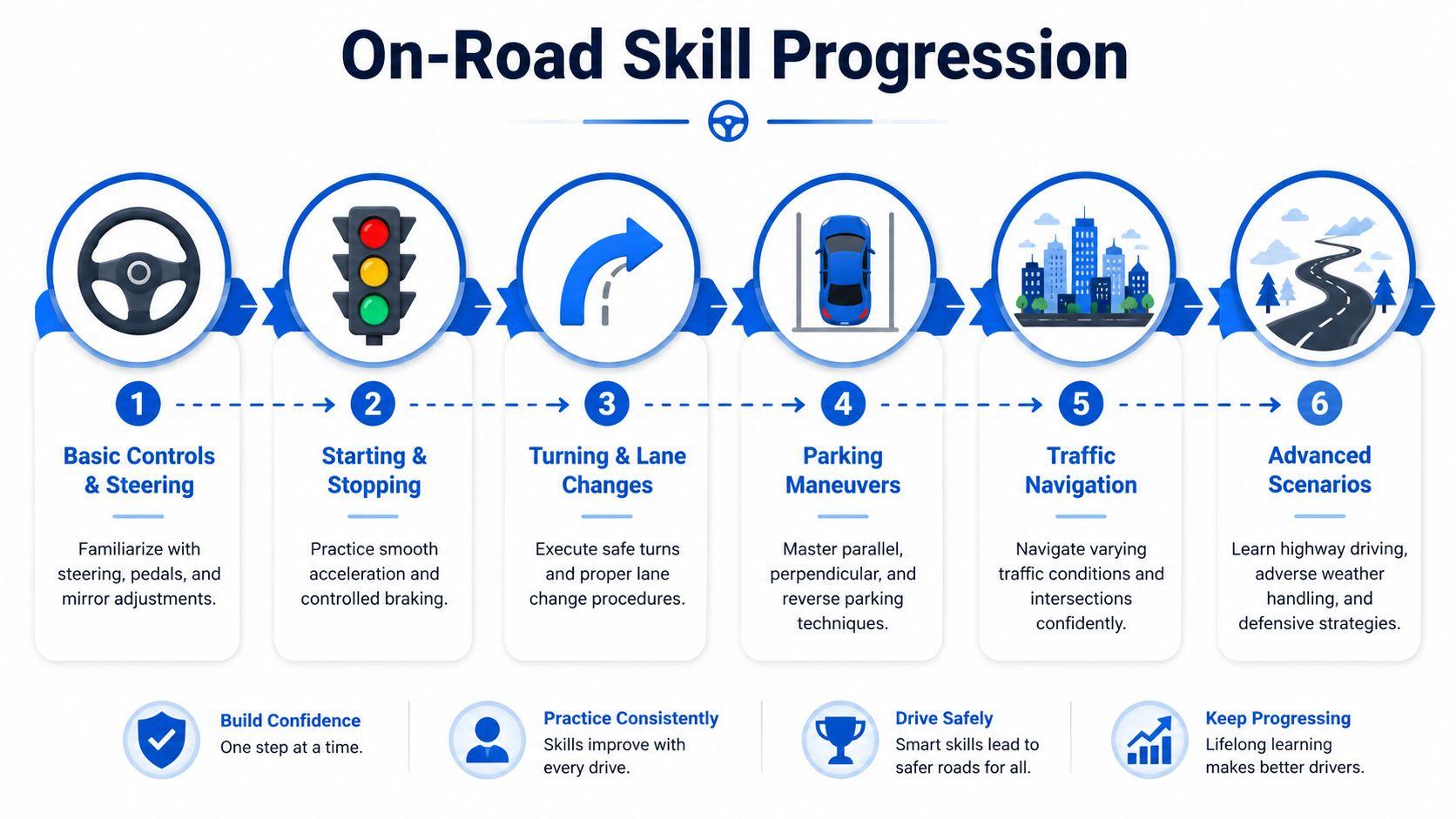
Stage one in a low-pressure space
Begin in a legal practice area with very little traffic and plenty of room. The goal here is simple. Make the car feel familiar before you ask yourself to deal with busy roads.
Start with the parts of driving that create the base for everything else:
- Seat and mirror setup: A poor setup causes late checks, awkward steering, and missed hazards.
- Smooth starts and stops: Learn how gently the car responds to the pedals.
- Steering control: Practise slow turns around fixed points or painted lines.
- Reverse movement: Back up in a straight line while checking all around the vehicle.
This stage is like learning balance before learning speed. If the car does not feel predictable at low pressure, traffic will feel harder than it needs to.
Many beginners say they know how to steer. What they usually mean is that they know how to turn the wheel. Real steering is more precise. It means keeping the car centered, letting the wheel return smoothly after a turn, and resisting the urge to overcorrect when you feel nervous.
A strong first-session goal is modest and clear. Get the car moving, stop smoothly, turn with control, and finish the session feeling calmer than when you started.
Stage two on quiet neighbourhood roads
Residential streets are where road rules begin to feel real. You are still in a lower-speed setting, but now you must combine control, observation, and decision-making.
Work on these habits:
- Stopping fully at signs
- Scanning left, centre, and right before entering intersections
- Holding steady lane position on narrower roads
- Watching for driveways, parked cars, cyclists, and pedestrians
- Turning into the correct lane without drifting wide or cutting short
New drivers often rush because silence feels uncomfortable. They want to be done with the stop, the turn, or the intersection. Slow, repeatable practice fixes that. Repetition teaches your brain that you have time.
One method helps a lot here. Say your decisions out loud.
- “I'm easing off the gas.”
- “I see the stop sign early.”
- “I'm checking both directions.”
- “I'm turning into the nearest correct lane.”
That spoken routine works like a checklist in motion. It keeps your eyes active and your timing steady. It also connects your G1 study to the road in a practical way. A rule about right-of-way feels abstract on a page. It becomes clear when you approach a real intersection and talk through who must wait and who may go.
Calm supervision matters too. The AAA Foundation summary of teen passenger risk data found that risk rises with young passengers and drops with an older adult in the vehicle, according to the AAA Foundation summary of teen passenger risk data. For a learner, that supports quiet practice sessions with one steady supervisor and very few distractions.
Stage three on busier everyday routes
Once neighbourhood driving feels consistent, move to ordinary main roads with moderate traffic. Choose routes people use every day, not the most difficult roads in your area.
At this stage, the task changes. You are no longer just controlling the car. You are reading the road early enough to make calm choices.
Skill What to practise Common beginner error Lane changes Mirror check, signal, shoulder check, smooth move Looking too briefly or drifting Traffic lights Early speed adjustment and stop decision Braking late Intersections Reading lane markings and choosing position early Last-second lane choice Speed control Holding a steady legal speed Speed creeping upward without noticing
Theory starts paying you back. If you studied lane-use signs, right-of-way rules, and speed limits carefully, busy roads feel less random. You can spot the pattern sooner. Then your practice reinforces the same rules. A lane marking you memorized becomes a decision you make in real time.
Keep parking practice structured too. Random attempts usually create frustration. A short routine with clear reference points works better, especially if you are still sorting out distance and timing. If that skill still feels messy, this parallel parking driving test guide can give you a clearer sequence to practise.
A short visual walk-through can also help before your next session:
Keep each session slightly challenging, not overwhelming. If the learner finishes exhausted and shaken, the step was too big.
Integrating Theory and Practice for Total Mastery
You answer a practice question correctly at your desk, then freeze at a real four way stop. That gap is normal. The goal is to shrink it until the rule in your head becomes a calm, repeatable action behind the wheel.
Theory and road practice work like reading sheet music and playing the instrument. Study gives names to hazards, signs, and right of way patterns. Driving practice gives those rules timing, distance, and pressure. When you combine them on purpose, learning gets easier because each side explains the other.
Turn wrong answers into driving drills
A missed quiz question is not just a study mistake. It is a clue. It tells you what to practise next on the road.
If you miss this topic in study Practise this on the road Right-of-way at uncontrolled intersections Find a quiet area with simple intersections and say out loud who should go first Lane change rules Repeat lane changes on a calm multi-lane road with early mirror, signal, and shoulder checks Speed limit awareness Drive one familiar route while naming each speed sign and adjusting smoothly School or community safety zones Go through one at a low-stress time and practise early scanning and steady speed control
This approach keeps practice focused. Instead of telling yourself to “get better at driving,” you give your brain one rule and one road situation to connect. That is how memorized facts turn into judgment.
Speed control is a good example. A learner may know the posted limit and still have trouble holding it on a downhill stretch or after traffic starts flowing faster. Studying the rule explains the target. Practising it in motion teaches foot control, scanning, and self-awareness. If you want a clear picture of how the written and road tests fit together, this guide on what to expect on G1 test day helps place each step in the full learning process.
Use road discomfort to guide your studying
The loop works in reverse too. A tense moment during a drive often points straight to the next topic you should review.
Examples:
- You hesitate at a four-way stop. Review right-of-way order, then return to a quiet area and repeat the same setup.
- You drift during lane changes. Study blind spots, mirror sequence, and lane position before the next drive.
- You brake late at lights. Review following distance and visual scanning, then practise spotting stale green lights sooner.
- You tense up on busy roads. Read the related rules, then practise that road type at a quieter hour with a simple goal.
Treat discomfort as feedback, not failure.
That shift matters. Anxiety often makes learners assume they are “bad at driving,” when, in fact, the problem is much smaller and more fixable. Maybe the rule is unclear. Maybe the road is too advanced for the current stage. Maybe the learner needs five repetitions in a calm setting before the skill starts to feel natural.
A learner who studies this way stops seeing rules as trivia. A sign becomes a cue. A lane marking becomes a positioning decision. A right-of-way question becomes a real-time plan.
That is what total mastery looks like for a beginner. Clear rules, repeated practice, and a steady link between the two.
Mental Preparation and Test Day Checklist
Nerves are normal. Nearly every new driver feels them. The goal isn't to remove nerves completely. It's to keep them from taking over your attention.
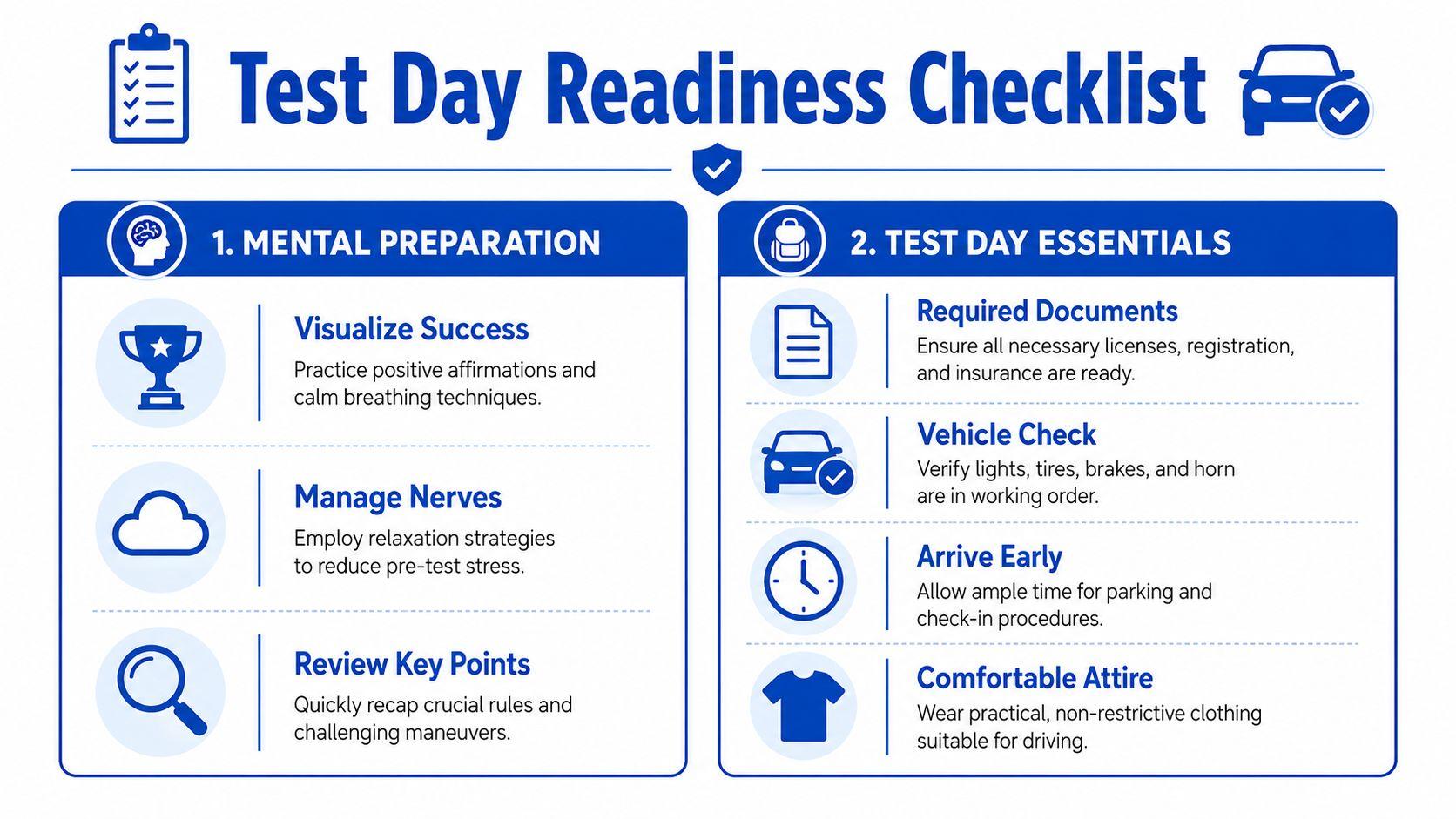
How to calm your mind before a drive or test
Start by lowering the pressure you put on yourself. You do not need a flawless drive to learn well. You need a focused one.
Try these habits:
- Use a pre-drive routine: Adjust seat, mirrors, and breathing in the same order every time.
- Name one goal only: “Today I'm practising smooth stops.” A single target keeps your mind from scattering.
- Pause after mistakes: If you miss a turn or brake too firmly, take the next safe moment to reset instead of spiralling.
- Debrief briefly: After the drive, identify one thing that improved and one thing to practise next.
You're not proving that you belong on the road. You're learning how to handle it responsibly.
Professional driving studies often use instrumented vehicles to track speed and timing. The useful takeaway for learners is to treat practice like a study: log your routes, note difficult spots, and track progress over time, as described in this EPA-reviewed driving data methodology. That habit turns vague feelings like “I'm bad at driving” into clearer observations such as “left turns across traffic still need more repetition.”
If you want a practical overview before your test, this guide to what to expect on G1 test day can help you prepare the logistics.
Your test day bag
Pack early. Don't leave documents to the last minute.
- Required ID: Bring the identification you need for the test appointment.
- Glasses or corrective lenses: If you use them for driving, bring them.
- Payment method: Make sure you have what you need for fees.
- Water and a light snack: Helpful if you're waiting or travelling across town.
- Appointment details: Keep the address and time handy.
A calm test morning often comes from a calm evening.
Your final 24-hour routine
The day before matters because it affects your attention.
Use a short checklist:
- Do a light review only: Read notes on your weakest topics. Don't cram everything.
- Avoid a draining practice session: A short, simple drive is better than an intense one.
- Lay out what you need: ID, glasses, wallet, and directions.
- Sleep properly: Tired brains miss signs, rush decisions, and forget simple details.
- Eat something steady: Don't show up hungry and jittery.
A defensive mindset helps too. Stay teachable. Stay observant. Stay slower than your panic.
Conclusion Your Journey Is Just Beginning
The strongest practice for driving doesn't come from memorising rules in isolation or from wandering through random drives and hoping confidence appears. It comes from combining the two. Study a rule. Use it on the road. Notice what felt easy and what didn't. Return to the handbook or a practice quiz with a sharper question.
That approach fits how real drivers improve.
Ontario's graduated system exists to give you time to build judgment in stages. If you use that time well, the G1 isn't just a written hurdle. It becomes the foundation for everything that follows. Your early road sessions won't feel perfect, and they don't need to. They need to be supervised, legal, structured, and reflective.
Keep your goals modest and specific. One week, you may focus on signs and intersections. Another week, it may be smooth braking and better lane position. Those small wins add up. They also lower anxiety because you stop asking, “Am I good at driving yet?” and start asking, “What exactly am I practising today?”
That's a much better question.
A safe driver is rarely the one who learned fastest. It's often the one who kept learning carefully, corrected mistakes early, and built habits on purpose. If you take that path, passing the G1 is not the end of the process. It's the point where your training becomes real.
If you want a simple place to practise Ontario road rules before test day, G1ready.ca offers free G1 practice exams, topic quizzes, and a test simulator that you can use to identify weak areas and build a steadier study routine.