
Drivers already circulating in an Ontario roundabout have the right-of-way, while entering drivers must yield and select the correct lane before joining the counter-clockwise flow. The central routine is simple: choose your movement, enter only when safe, stay in your lane, and signal right before leaving.
You may be studying for the G1 test with a diagram in front of you, or approaching a real roundabout and wondering whether the right lane, left lane, or vehicle already in the circle should guide your decision. Roundabouts become much easier when you stop treating them as one complicated manoeuvre and separate the drive into three moments: before entry, while circulating, and while exiting.
A Driver's First Look at an Ontario Roundabout
You're approaching a two-lane roundabout on a suburban Ontario road. A yellow roundabout warning sign appears ahead, painted arrows show the available movements, and a cyclist is waiting near the splitter island that separates approaching traffic from the circulating lane. You have several tasks, but they happen in a sensible order.
First, reduce your speed enough to read the approach. Look for the lane arrows and signs, then identify the exit you want. Is it the first exit to your right, the road straight ahead, or a farther exit to your left? Your intended exit determines your lane choice, subject to the markings at that particular roundabout.
Next, check your mirrors and scan the traffic already moving around the central island. Ontario's official handbook states that drivers must travel counter-clockwise, keep to the right of the central island, and yield to traffic already in the roundabout. The handbook also says drivers should avoid stopping unless stopping is necessary to prevent a collision. You can review these foundational rules in the Ontario driver road rules guide.
Instructor's reminder: The vehicle already in the circle has priority over the vehicle waiting to enter.
Think of the roundabout as a short decision sequence:
- Before entry: read the signs, choose the lane, watch for pedestrians and cyclists, and yield to circulating traffic.
- While circulating: travel counter-clockwise, maintain your lane, and keep moving unless traffic or a hazard requires you to stop.
- While exiting: signal right before your exit, check the crossing area, and leave smoothly.
The cyclist at the splitter island is a useful reminder that the roundabout isn't only about cars. Your eyes should move between the circulating lane, the entry, the exit, and nearby crossings. Once you know which stage you're in, the road feels organised rather than rushed.
The Core Roundabout Rules in Ontario
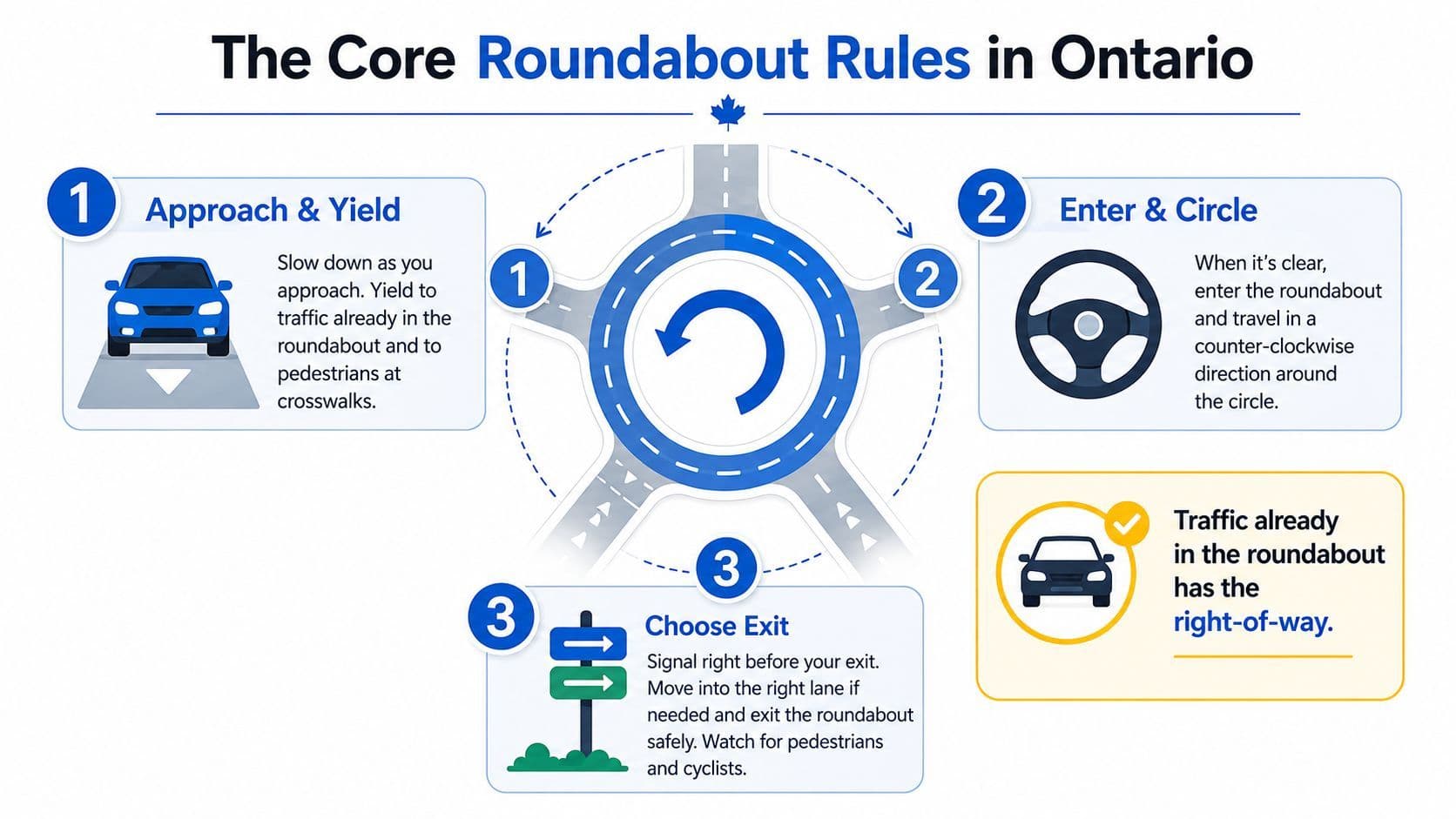
Ontario's roundabout rules are built around one mental model: traffic moves counter-clockwise around a central island. The official legislative definition describes a roundabout as an intersection with one-way circulation counter-clockwise around that island, where entering traffic must yield to circulating traffic. The Ontario definition in Bill 72 reflects the same right-of-way logic used in driver training.
Use the counter-clockwise model
When you approach, traffic inside the roundabout will generally come from your left. That doesn't mean you automatically enter whenever the lane looks open. You must assess whether vehicles already circulating have priority and whether your entry can be made without forcing another road user to brake or change direction.
The practical sequence is:
- Slow down and read the approach. Use the signs, lane arrows, and road markings.
- Yield to circulating traffic. Wait for a safe gap rather than trying to squeeze into a moving stream.
- Enter counter-clockwise. Keep to the right of the central island and follow your selected lane.
- Continue without unnecessary stopping. Stop only when required to prevent a collision or respond to blocked traffic.
- Leave at the planned exit. Signal right shortly before exiting and watch the crossing area.
A roundabout is still an intersection, not a free-for-all circle. Ontario's legislative history includes Bill 46, the Safe Roundabouts Act, 2013, which proposed a province-wide study and public consultation concerning safe roundabout use. That formal treatment reinforces an important G1 idea: the intersection operates through standardised right-of-way and lane-use rules.
The official handbook also says drivers must not change lanes while in the roundabout. If you're in the inside lane and miss your exit, continue around until you reach that exit again. Don't stop in the circle, reverse, cut across the central island, or make a sudden lane change.
Choosing the Correct Lane Before Entering
A driver approaching a two-lane roundabout sees arrows pointing to different exits. The correct choice depends on the exit planned before reaching the yield line. Read the approach signs, lane arrows, and pavement markings early. A two-lane roundabout may allow different movements from each lane, while a three-lane design may assign a narrower set of movements.
For a simple two-lane example, the right lane generally serves a right turn or straight movement. The left lane may serve a straight movement, left turn, or U-turn. Transport Canada's roundabout guidance presents these lane-based movements as the operating model used in many Ontario practice questions. Local signs and arrows control because designs vary.
Match the lane to the exit
Intended Exit Single-Lane Roundabout Two-Lane Roundabout Three-Lane Roundabout First exit to the right Use the only lane and leave at the first exit. Usually use the right lane, unless markings direct otherwise. Follow the lane arrow assigned to the right turn. Straight ahead Use the only lane and continue to the opposite exit. Use the lane permitted by the approach arrows. Both lanes may allow straight movement at some designs. Select the lane specifically marked for the straight movement. Farther exit to the left Use the only lane and continue around to the planned exit. Usually use the left lane when the markings permit a left movement. Use the left-side lane or another lane designated for that exit. U-turn Continue around the single circulating lane. The left lane is commonly used where the arrows permit a U-turn. Use the lane marked for the U-turn.
The table gives you a study framework, but signs still control. Some Ontario roundabouts require the right lane to exit at a particular point. Continuing around in that lane would then be incorrect. Lane arrows override assumptions.
Stay with the lane you chose
Choose your lane before entering and hold it through the circle. Ontario's official handbook says drivers must not change lanes while in the roundabout. Another vehicle may be beside you, hidden in a blind spot, or committed to the same exit, so a lane change can create a conflict quickly.
If you discover that you chose the wrong lane, keep the vehicle steady. Continue safely, and if you miss the exit, go around again. On a G1 question, the expected answer usually preserves lane discipline and avoids an abrupt manoeuvre.
Three-lane roundabouts require closer attention. Do not memorise one universal arrangement and apply it everywhere. Read the signs and arrows at that approach, then choose the lane assigned to your intended exit.
Signalling and Leaving the Roundabout
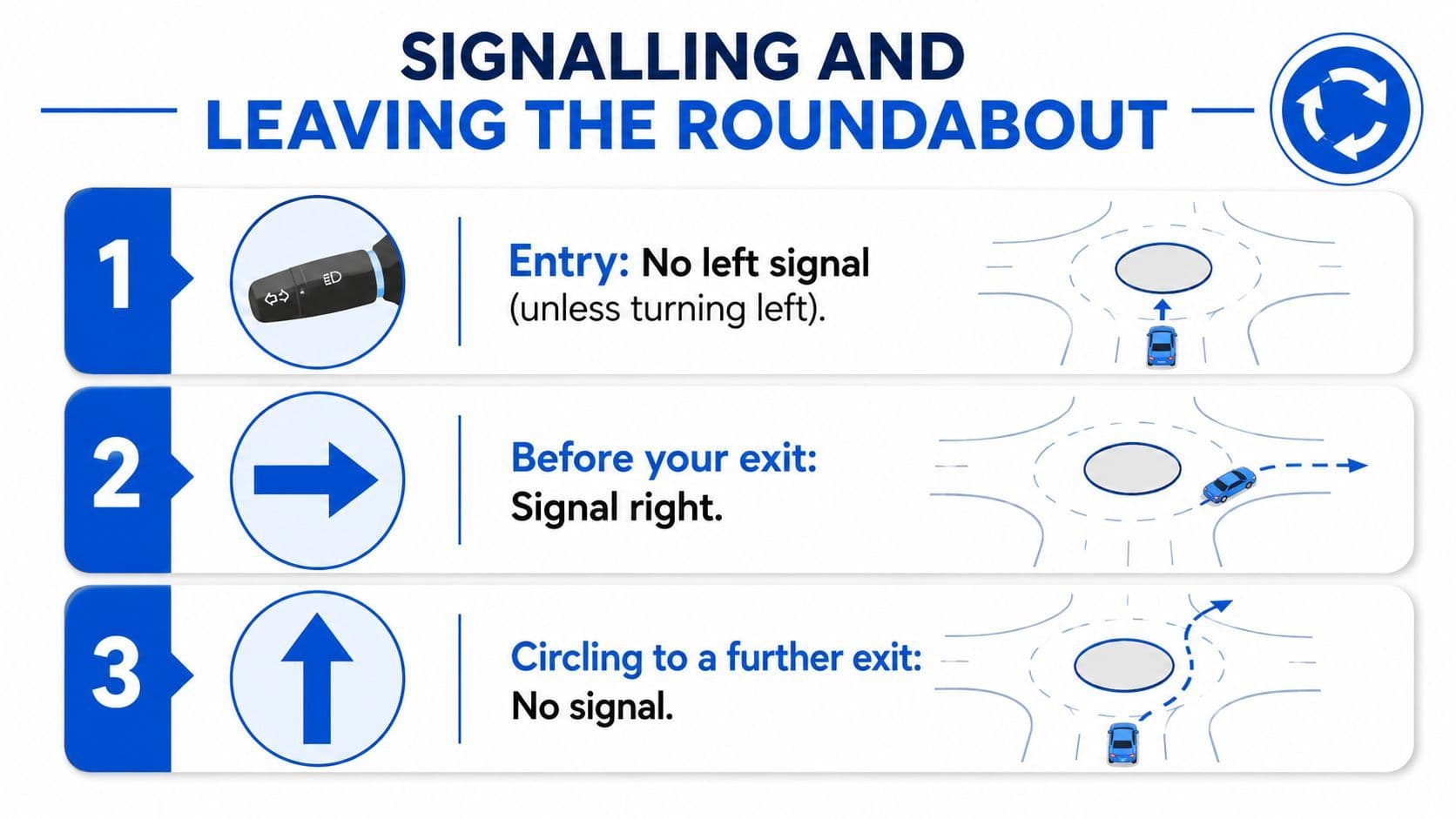
Signal timing causes many avoidable mistakes because drivers confuse entering the roundabout with turning onto a conventional street. Ontario's public guidance says the Ministry does not require a signal when entering a roundabout, but it recommends signalling right immediately before exiting so other road users can understand your intention. The Ontario handbook guidance on changing directions is the source to remember for G1 preparation.
Signal for the movement others need to understand
A left signal on approach can confuse drivers if you're taking the first exit or continuing straight. The most important signal for ordinary roundabout use is the right signal before your chosen exit. Activate it late enough that it identifies the exit, but early enough to give useful warning.
Use this movement-based guide:
- Right movement: Choose the lane marked for the first exit, then signal right before leaving.
- Straight movement: Follow the permitted lane arrows, avoid an unnecessary left signal on entry, and signal right before the exit.
- Left movement or U-turn: Select the lane marked for that movement, remain in it, and signal right before the exit you finally take.
If you miss the exit, don't signal as though you're leaving. Continue around in your lane until the exit comes around again. The handbook specifically says that a driver who misses an exit from the inside lane must continue around until reaching the exit again. A missed exit is inconvenient, but a sudden stop or lane change creates a more serious problem.
Mirrors and blind-spot checks still matter before leaving, especially at a multi-lane roundabout. Use the mirror, shoulder-check, and signal guide to connect the signal with the observation that should come before the manoeuvre.
A short visual explanation can help reinforce the timing:
Roundabout Safety for Every Road User
A driver sees lanes and gaps. A pedestrian sees a crossing. A cyclist may be travelling through the roundabout, taking a lane, or using a pedestrian crossing, depending on the design and the choice they make. Everyone needs a predictable path, and drivers must scan beyond the vehicle immediately ahead.
Pedestrians should cross at marked crosswalks rather than treating every point around the circular roadway as a crossing. When a pedestrian is already in a marked crosswalk, the driver must yield and avoid entering the crossing. Don't assume that a person standing well away from the crossing has automatically entered your path, but don't ignore someone who has begun crossing either.
Cyclists require a wider scan. A cyclist may be visible near the splitter island, beside the approach, in the circulating lane, or near the exit. Drivers should check for cyclists both before entry and before leaving, because the exit movement brings the car close to the crossing area.
Road User What to Do Driver Reduce speed, scan the entry and exit, yield to circulating traffic, maintain the selected lane, and watch marked crossings. Pedestrian Use the marked crosswalk and move predictably through the crossing area. Cyclist Follow the facility and lane arrangement provided at that roundabout, or use the marked crossing when choosing that route.
The common G1 trap is the statement that pedestrians always have priority at every approach, regardless of where they are. The better answer is more precise: yield to a pedestrian who is in the marked crosswalk, while also scanning for people who may be about to enter it. That wording tests observation rather than a blanket assumption.
Common G1 Roundabout Mistakes
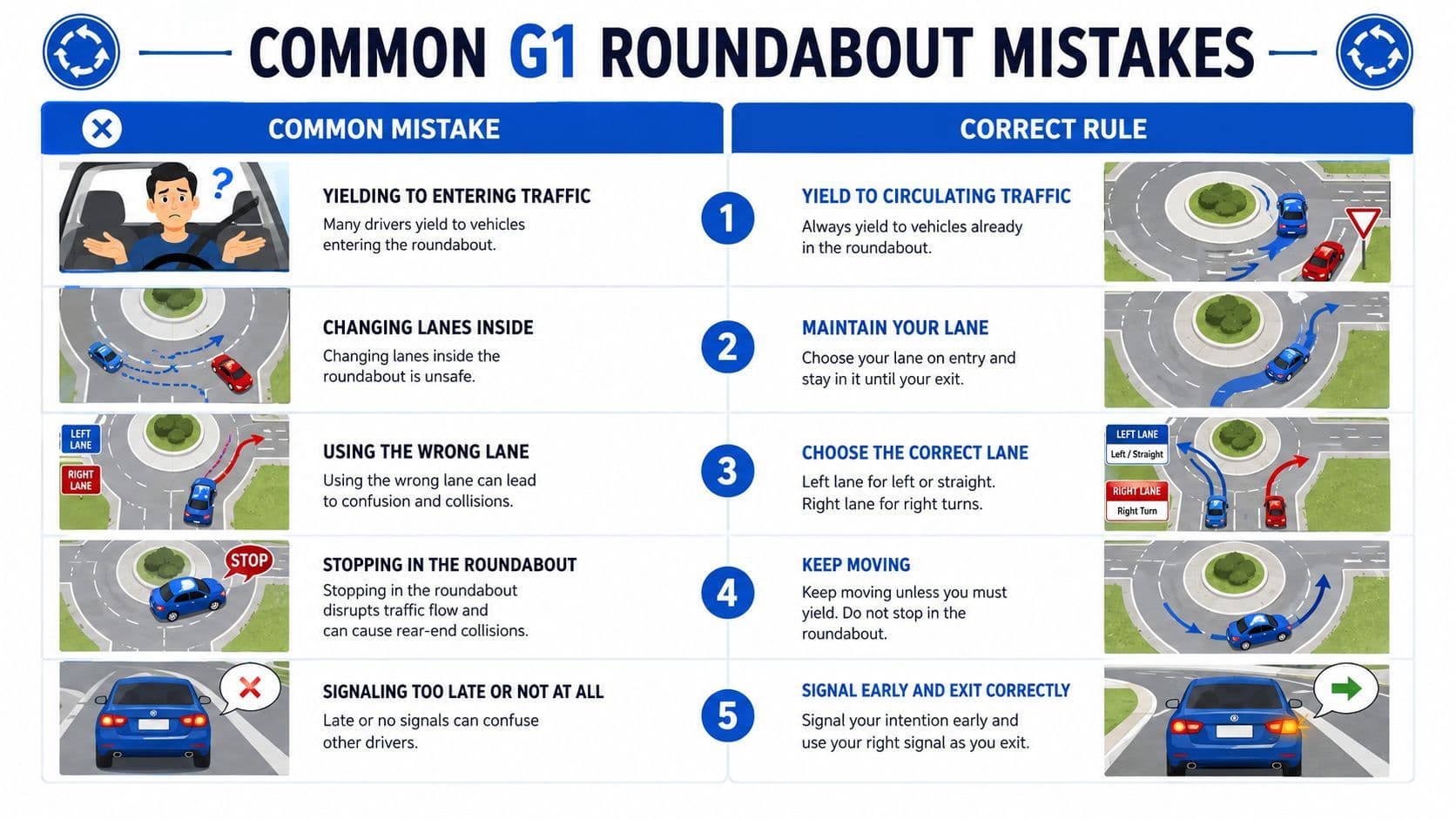
Many incorrect answers sound cautious because they use words such as “always stop” or “let everyone go first.” The G1 test expects you to apply the actual rule, not choose the most hesitant-sounding option.
Test the tempting answer
Question: You're waiting to enter, and a vehicle is already circulating from your left. What should you do?
- A. Enter first because you're approaching the intersection.
- B. Yield to the vehicle already in the roundabout.
- C. Stop permanently until all lanes are empty.
Correct answer: B. Circulating traffic has the right-of-way. You wait for a safe gap, but you don't stop when the entry is clear.
Question: You enter in the right lane and see the exit you want ahead. Another lane is open beside you. What should you do?
- A. Change lanes inside the roundabout.
- B. Maintain your lane and follow the markings.
- C. Move across quickly before the exit.
Correct answer: B. The official handbook says not to change lanes while in the roundabout. Lane choice belongs before entry.
Reject unsafe corrections
Question: You're turning right. How should you negotiate the central island?
- A. Travel counter-clockwise around it.
- B. Cut across the island because the exit is close.
- C. Drive clockwise if the opposing lane looks empty.
Correct answer: A. Ontario roundabouts use one-way, counter-clockwise circulation. The central island is never a shortcut.
Question: Traffic is moving smoothly, and no collision risk requires a stop. What should you do?
- A. Stop inside the circle to confirm your exit.
- B. Continue steadily while staying in your lane.
- C. Stop after every entry point.
Correct answer: B. Stopping unnecessarily disrupts the flow and conflicts with the handbook's direction to avoid stopping unless necessary to prevent a collision.
Question: You're approaching your exit. Which signal communicates your intention?
- A. Right signal shortly before exiting.
- B. Left signal for the entire roundabout.
- C. No signal at any point.
Correct answer: A. Signal right before leaving, then check the exit area for pedestrians and cyclists.
Practice Roundabout Questions for the G1 Test
Use the same reasoning each time: identify the traffic position, read the lane markings, and choose the action that preserves a safe, predictable path. The free Ontario G1 practice test can complement this kind of focused review.
Question one
You're approaching a roundabout. A vehicle is already circulating in the lane you need to enter. What's the correct action?
- A. Enter because you have reached the yield line.
- B. Yield and wait for a safe gap.
- C. Sound your horn and enter slowly.
Answer: B. The vehicle already in the roundabout has the right-of-way. The yield line tells you where to make the decision, not that you automatically proceed.
Question two
You plan to take the first exit to the right at a two-lane roundabout. The approach arrows show the right lane permits that movement. Which lane should you select?
- A. The right lane.
- B. The left lane.
- C. Either lane without checking the arrows.
Answer: A. Select the lane that matches the marked movement before entering. Don't rely only on a general rule when the pavement arrows provide specific directions.
Question three
You plan to take a farther exit to the left, and the approach markings assign that movement to the left lane. What should you do?
- A. Enter in the right lane and change lanes inside.
- B. Choose the left lane before entering and maintain it.
- C. Enter in either lane and decide after the first exit.
Answer: B. Lane discipline begins on the approach. Changing lanes inside the roundabout is prohibited by the official handbook.
Question four
You're nearing your chosen exit. Which signal is appropriate?
- A. Signal right shortly before exiting.
- B. Signal left while circulating.
- C. Use no signal because the exit is obvious.
Answer: A. Ontario guidance recommends the right signal immediately before leaving so other road users can understand your intention.
Question five
You're in the inside lane and miss your exit. What should you do?
- A. Stop and reverse toward the exit.
- B. Change lanes immediately across the circle.
- C. Continue around until you reach the exit again.
Answer: C. Continue counter-clockwise, stay in your lane, and take the exit when it comes around again. If a pedestrian is already in the marked crosswalk at that exit, yield before leaving.
A Repeatable Roundabout Checklist
A reliable routine is easier to remember than a collection of disconnected rules. Before entry, while circulating, and before exiting, ask yourself one direct question at each stage.
Before entry
- Identify the exit: Know where you intend to leave.
- Choose the lane: Follow the approach arrows and signs.
- Scan the crossing: Watch for pedestrians and cyclists.
- Yield: Give priority to traffic already in the roundabout.
While circulating
- Follow the direction: Travel counter-clockwise around the central island.
- Maintain the lane: Don't change lanes inside.
- Keep moving: Avoid stopping unless traffic or a collision risk requires it.
- Recover calmly: If you miss the exit, continue around.
Before exiting
- Signal right: Activate the signal shortly before the exit.
- Check around you: Use mirrors and shoulder checks where appropriate.
- Watch the crosswalk: Yield to pedestrians in the marked crossing.
- Leave smoothly: Follow the exit lane without cutting across the island.
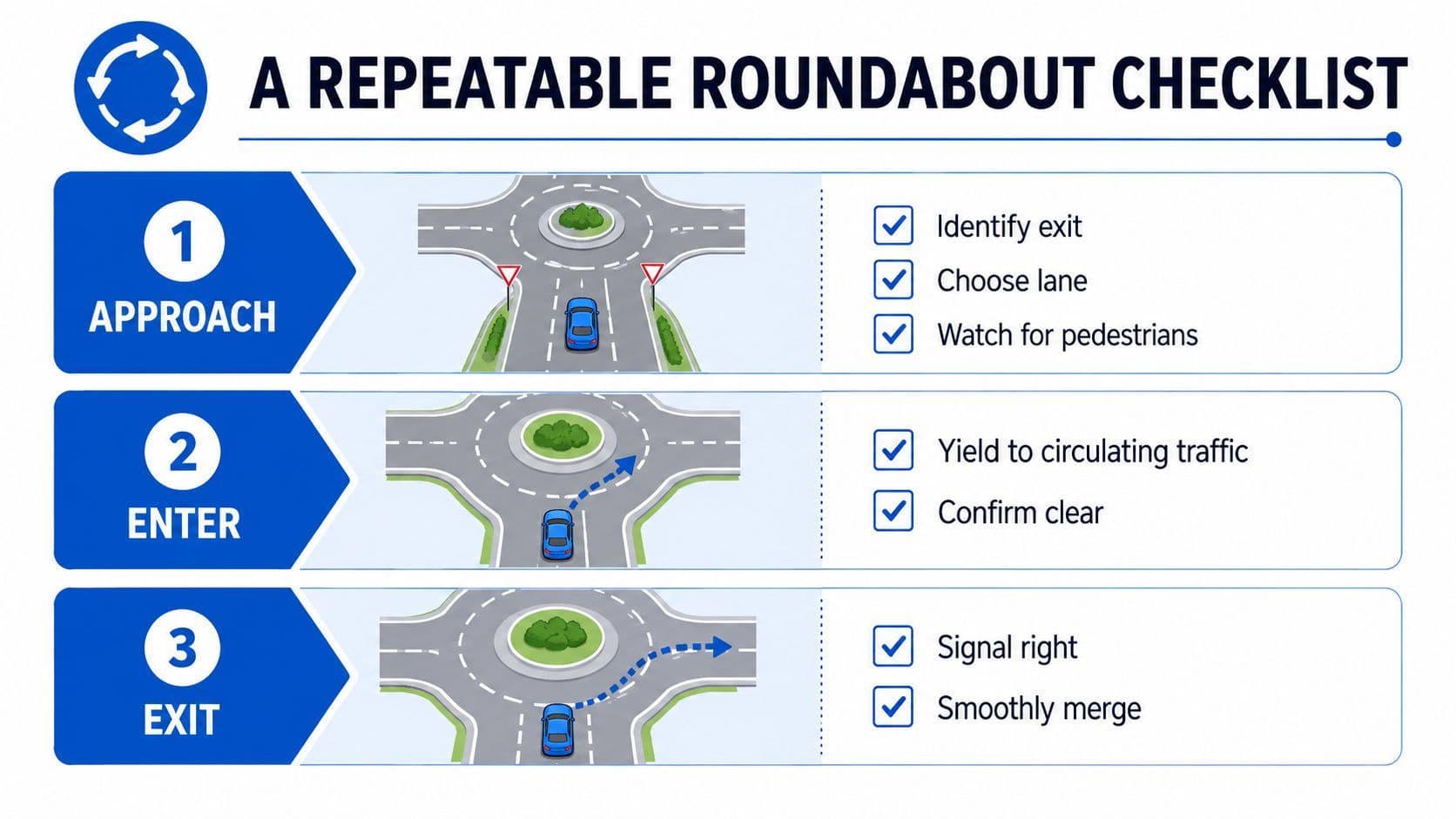
Practise saying the sequence aloud before your next study session: choose, yield, enter, stay, signal, exit. That wording turns a confusing diagram into a repeatable driving decision.
G1ready.ca offers free, registration-free practice exams, targeted quizzes, mixed tests, diagnostic practice, and a G1 exam simulator aligned with the Ontario handbook. Visit G1ready.ca to practise roundabout questions, review explanations immediately, and build a focused routine before test day.


