
You're a new G1 driver, you've just received your first ticket, and the words demerit points suddenly feel much more serious than they did in the handbook. Maybe you rolled through a stop sign, misunderstood a speed-zone change, or made a decision that seemed minor at the time. Your first question is probably simple: does this ticket mean you're about to lose your licence?
The answer depends on several details, including the offence, whether you're convicted, your licence class, and the date the offence happened. Understanding demerit points in Ontario means looking beyond the number of tickets. The system treats novice drivers differently from fully licensed drivers, and the two-year offence-date rule can affect how long a violation remains relevant.
What Demerit Points Actually Mean for Ontario Drivers
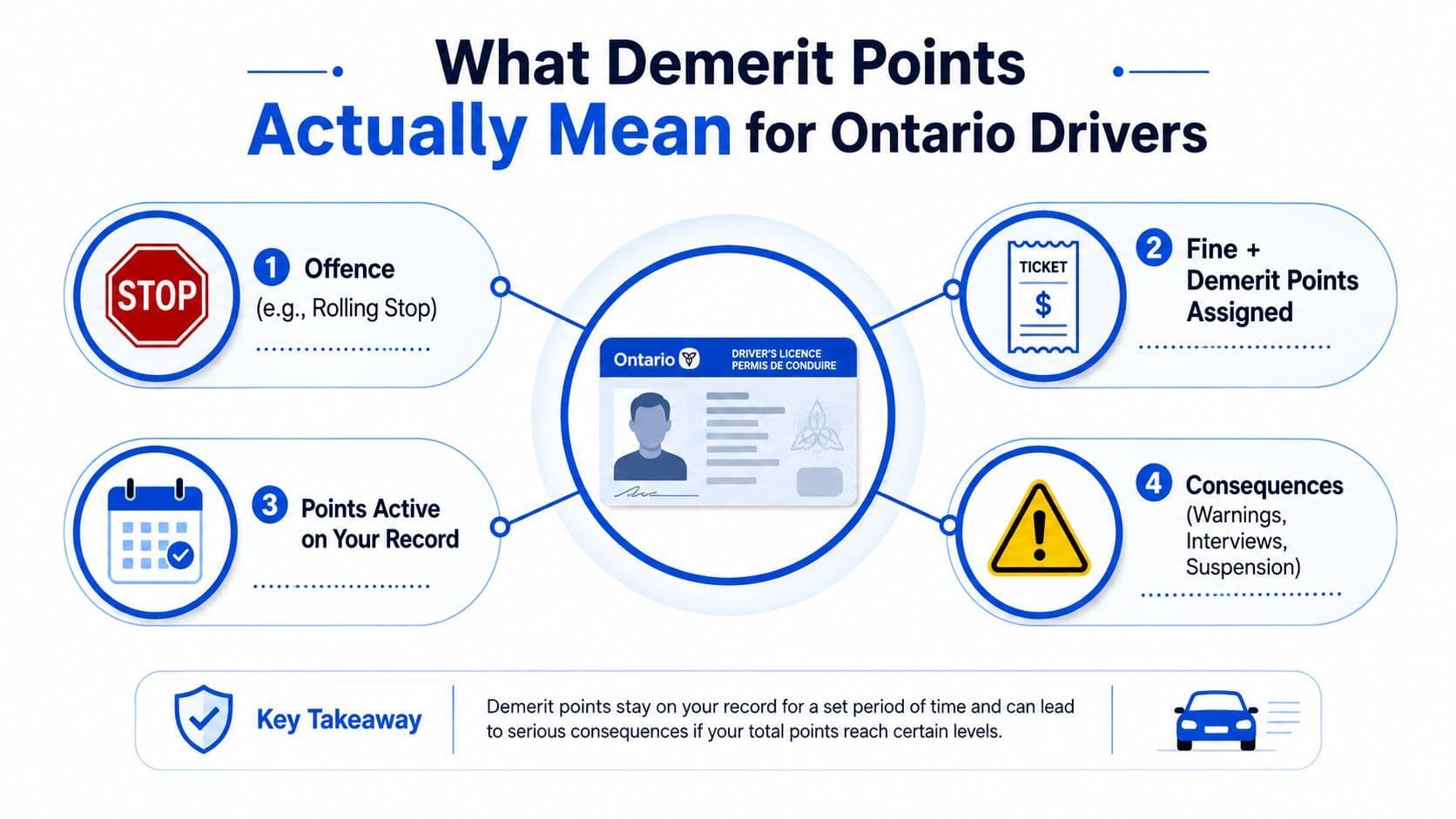
A G1 driver rolls through a stop sign and receives a ticket. The first worry is often, “Did I just lose points?” Ontario's system does not begin with a bank of points that drivers spend. You start with zero points, and demerit points are added after a conviction for certain traffic offences.
A ticket and demerit points are separate steps. The offence must be covered by Ontario's demerit-point rules, and the driver must be convicted before points appear on the driving record. Paying attention to that sequence can prevent a common misunderstanding: receiving a ticket does not, by itself, prove that points have already been added.
Points measure recent driving behaviour
Demerit points track recent convictions rather than creating a permanent tally of every mistake. The offence date starts the period during which an offence can affect the record, so the timing of separate convictions matters. A driver's record can change as older offences move outside the relevant period, provided new offences do not keep adding to it.
For the G1 student, a stop-sign conviction can create a more immediate licence concern than the same conviction would for a fully licensed driver. The point value may be the same, but the consequences attached to the driver's licence class are different. That difference is easy to miss if you look only at the number printed beside an offence.
Practical rule: A ticket does not automatically equal points. The offence, conviction, licence class, and offence date all matter.
Why the system matters more to a learner
A fully licensed driver generally has more room before accumulated points trigger licensing consequences. A G1 or G2 driver has less room under Ontario's novice-driver rules, so one conviction can put a learner closer to a warning, an interview, or licence suspension.
Treat demerit points like warning lights on a dashboard. One light identifies a driving problem, while several recent convictions can prompt action against your licence. The record is not a score to manage by luck. It shows convictions that may affect your ability to keep driving, especially while you are still in the G1 or G2 stage.
How the Two-Year Rule Affects Your Driving Record
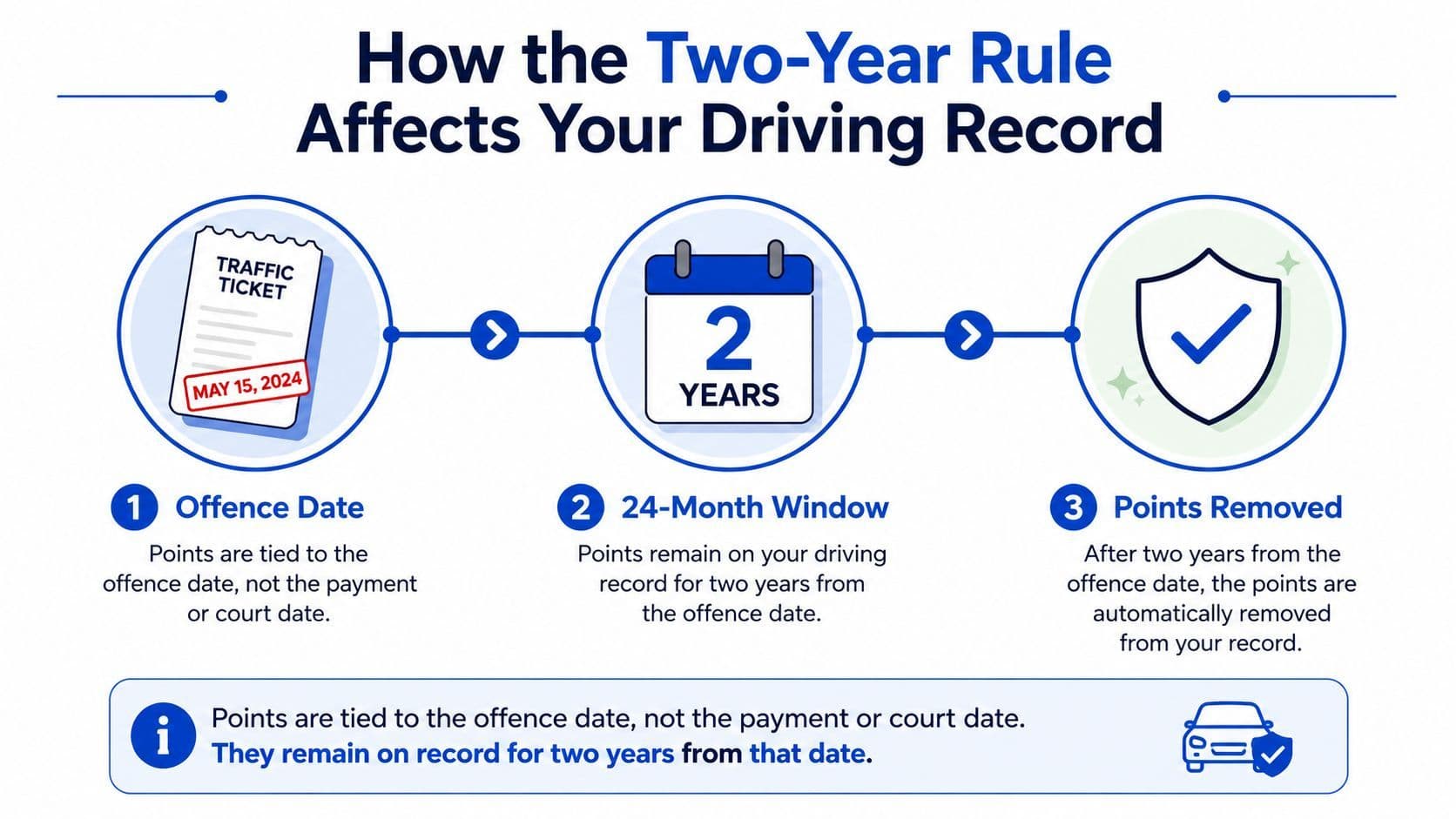
A ticket paid in autumn can still be tied to an offence that happened in spring. For Ontario drivers, the two-year clock starts on the date of the offence, not the date you pay the ticket and not necessarily the date the court matter is resolved. The provincial explanation of demerit points confirms that points remain on the record for two years from the offence date.
Suppose a G1 driver is convicted months after being stopped for speeding. The delay does not start a fresh two-year period. The relevant date remains the day the speeding occurred.
What accumulated points means
Ontario uses a rolling two-year window. Accumulated demerit points are the points from offences committed within that period. The record therefore focuses on recent offence dates, rather than keeping every point from a driver's entire history in the current total.
For example, a driver receives one conviction near the beginning of the window and another much later. Whether both count at the same time depends on the two offence dates. Checking an official driving record is safer than relying on memory or the date printed on a ticket.
Why offence dates matter for G1 preparation
A nervous learner may write down the payment date and assume it controls the record. Use this sequence instead:
- The offence happens.
- The matter may proceed to a conviction.
- Points are added if the offence carries them and a conviction results.
- The two-year period is measured from the offence date.
The same offence date rule applies to G1, G2, and fully licensed drivers. The difference is what the active points can trigger. A learner has less room under novice-driver rules, so a recent conviction may create a licence concern sooner than it would for a fully licensed driver.
The window does not measure behaviour forever. If no further offences occur, older offences eventually fall outside the active two-year period. That is why the offence date matters each time you review your record.
Common Offences and Their Point Values
A speeding ticket for travelling 16 km/h over the limit does not carry the same demerit result as one for 50 km/h or more over. Ontario assigns points according to the specific offence, and some speeding offences depend on the speed band involved. The consolidated Ontario demerit-point regulation is the appropriate source for confirming the rule for a particular charge.
One ticket does not automatically mean one point. Some violations can result in a fine without demerit points, while other convictions carry a larger point consequence. The offence wording matters more than the ticket amount.
Read the charge, not just the fine
A speeding charge is assessed by how far above the posted limit the driver was alleged to be travelling. Other offences have their own assigned values. Two tickets that seem similar to a nervous G1 driver can therefore affect the record differently.
Offence Demerit Points Speeding from 16 to 29 km/h over the limit 3 Speeding from 30 to 49 km/h over the limit 4 Speeding at 50 km/h or more over the limit 6 Careless driving 6 Failing to remain at the scene of a collision 7 Following too closely 4 Failing to stop for a school bus 6 Distracted driving involving a handheld device 3 Failing to wear a seatbelt 2
The table shows why counting tickets alone can give the wrong impression. One conviction for failing to remain at a collision scene carries more points than several lower-point offences might carry individually. For a G1 or G2 driver, that difference can matter sooner because novice-driver rules allow less room before a licence consequence becomes possible.
A useful G1 study habit
Connect each offence to the danger it creates. Careless driving reflects a broad failure to drive with reasonable care. Following too closely leaves less time to react. Failing to stop for a school bus puts children at risk, while leaving a collision scene creates a serious accountability problem. The values are tied to the behaviour, not chosen at random.
If you receive a charge, write down the exact offence wording and the offence date. Do not estimate the point value from the fine or rely on a general online chart. Confirm the charge and conviction outcome through official Ontario information. The exact wording and final conviction determine whether points are added, and how many apply.
Suspension Thresholds for Novice Versus Full Licence Holders
A G2 driver receives a conviction carrying three points. A fully licensed G driver receives the same conviction. The point value is identical, but the licence consequences may be very different. Ontario uses a stricter escalation process for novice drivers, while fully licensed drivers have higher thresholds. The Ontario driver licence laws in the MTO handbook explain how these licence groups are treated.
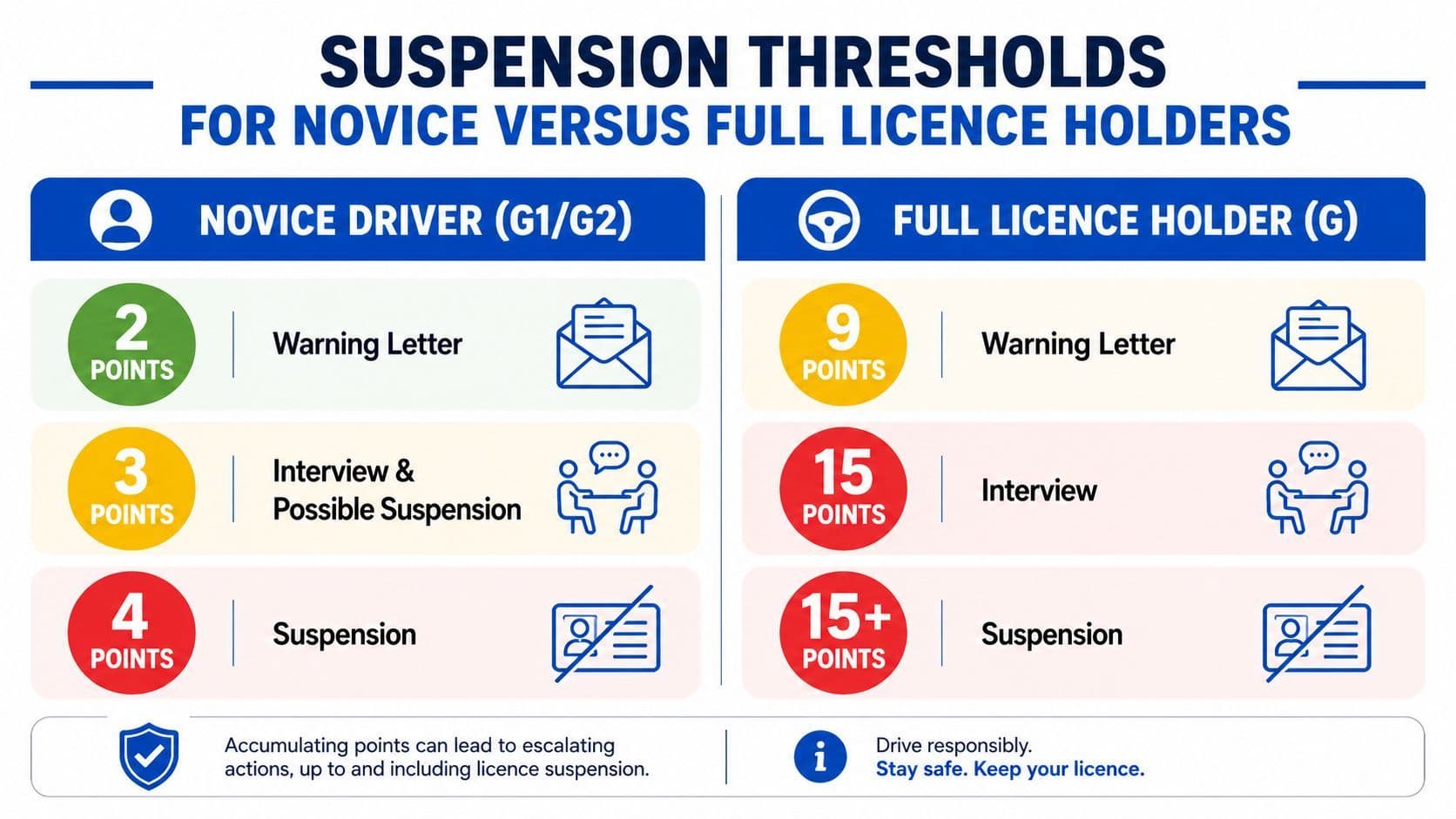
For G1 and G2 drivers, the pattern is:
- Two points can lead to a warning letter.
- Three points can lead to an interview and possible suspension.
- Four points can lead to suspension.
For fully licensed G drivers:
- Nine points can lead to a warning letter.
- Fifteen points can lead to an interview.
- More than fifteen points can lead to suspension.
The same conviction creates different pressure
A conviction that leaves a fully licensed driver below a warning threshold may bring a novice driver close to an interview or suspension. That difference is easy to miss when a new driver compares their result with a parent's or friend's experience. The comparison only helps if both drivers hold the same licence class.
For example, a G2 driver with three points may face an interview and possible suspension, while a fully licensed driver with the same total remains below the first full-licence warning threshold. The offence and conviction are the same. The driver's licence status changes the risk.
A G1 or G2 driver should review every conviction carefully, including the offence date and the points added to the record. This guide to the Ontario G2 licence can help explain how novice licensing rules fit into everyday driving decisions.
For new drivers: Your licence class can matter as much as the offence itself. A fully licensed driver's experience does not predict your outcome.
Commercial licence holders have a separate rule
Class B and E licence holders may have no more than eight demerit points. Going over eight automatically downgrades them to the next-highest class for which they qualify, until their points fall below eight.
The first question after checking a points total is therefore simple: which licence class do you hold? Ontario does not use one threshold for every driver.
How Demerit Points Affect Insurance and Licence Status
Demerit points and insurance convictions are related, but they aren't identical concepts. A driver can remain below a suspension threshold and still face insurance consequences after a conviction. Insurers assess driving history and risk using information from the driver's record, so the offence itself can matter even when the points total doesn't immediately threaten the licence.
That's why “I only received a small number of points” doesn't necessarily mean “my insurance won't change.” A conviction may affect how an insurer views the policy, and the impact can depend on the nature of the offence, the driver's history, and the insurer's underwriting rules.
Licence status is only one part of the outcome
Many drivers focus on suspension because it's the most visible consequence. Insurance creates a separate concern. A driver may keep their licence while dealing with a higher premium, fewer insurer options, or a more difficult renewal conversation.
A suspension can create another complication. Once the driver is eligible to return to the road, they may need to explain the interruption in their driving history, and insurers can treat a suspension as a serious risk signal.
Insurance perspective: Staying below the suspension threshold doesn't guarantee that a conviction will have no financial effect.
Keep the two records conceptually separate
Think of your situation as two connected tracks:
- The provincial licensing track records convictions and demerit points, then applies the rules for warnings, interviews, and suspension.
- The insurance track evaluates convictions and other driving-history information when setting policy terms.
The two tracks may respond differently to the same event. A ticket with few or no demerit points can still deserve attention if the underlying conviction is significant. Conversely, a licence consequence can affect future insurance discussions even after the active point period ends.
For a new driver, the safest financial strategy is simple, drive in a way that prevents convictions rather than trying to calculate whether a particular ticket will remain below a threshold.
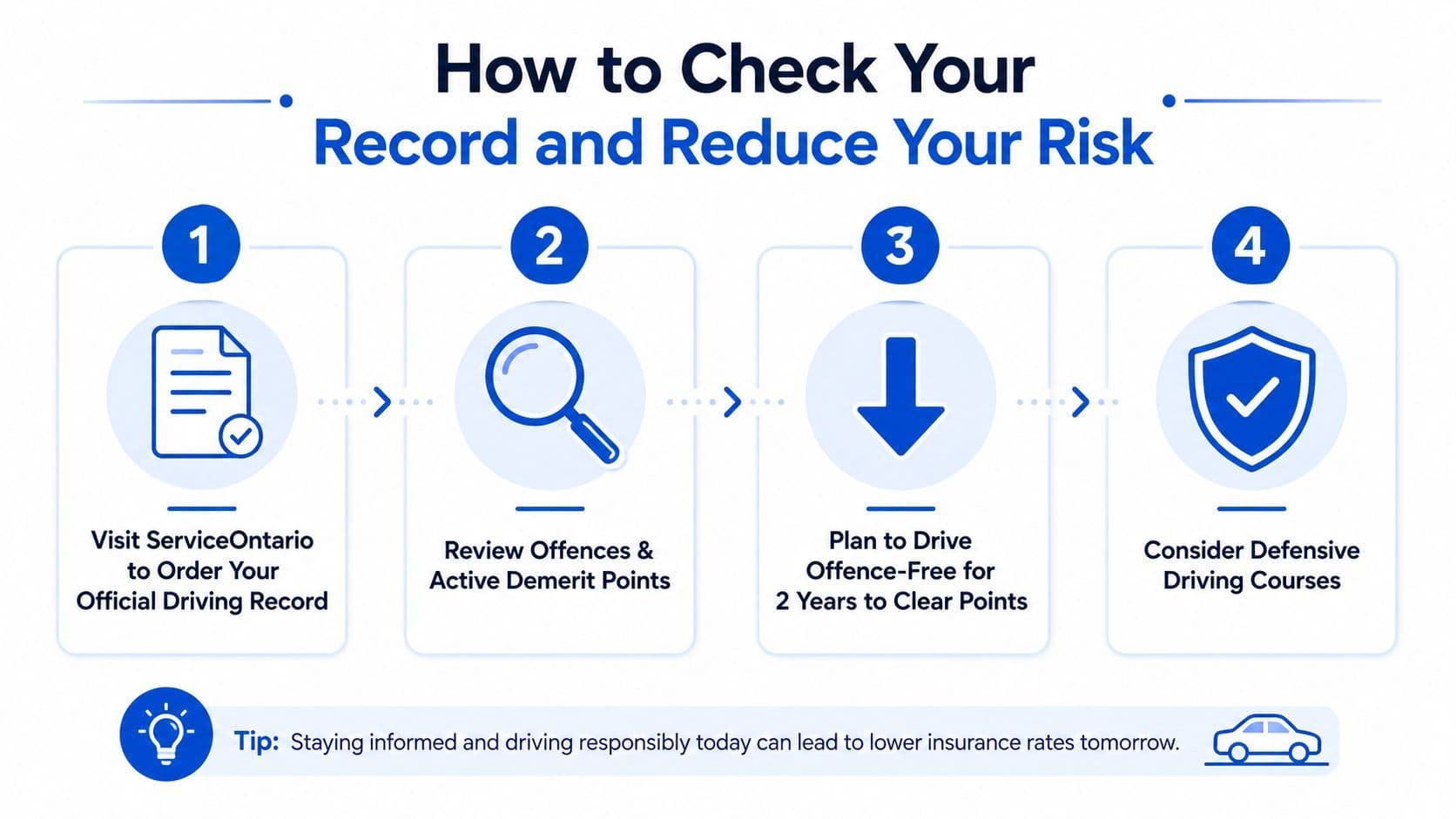
How to Check Your Record and Reduce Your Risk
If you're unsure about your current status, stop relying on memory. Order an official driving record through ServiceOntario and review the entries, offence dates, convictions, and active demerit points. The available record type determines how much history you'll see, so choose the option that answers your actual question.
Use a simple record-checking routine
- Order the record: Visit ServiceOntario and request the official driving record that fits your needs.
- Check offence dates: Look at when each offence occurred, not only when the conviction was processed.
- Separate convictions from points: A conviction and a demerit-point entry are connected, but they aren't interchangeable.
- Mark the active window: Use the two-year offence-date rule to understand which entries may still affect your current status.
Prevent the situations that create tickets
Defensive driving starts before a risky moment appears. Scan well ahead, keep a safe following distance, and slow down before speed-zone transitions rather than after you pass the sign. At a stop sign, bring the vehicle to a complete stop and check for pedestrians, cyclists, and other traffic before moving.
A defensive driving course can also give a learner structured practice with hazard awareness and decision-making. Ontario learners can compare course options with this guide to defensive driving courses.
If you receive a ticket, read the charge carefully before deciding what to do. Paying a ticket can result in a conviction, while contesting it in court gives you the opportunity to present your position. Consider getting legal advice if you don't understand the process or the possible licensing consequences.
Real Scenarios Showing How Points Play Out Differently
A G2 driver is convicted of speeding 30 km/h over the limit. That offence carries four demerit points. Because the driver is in Ontario's novice system, four points can lead to a suspension. The conviction may also affect insurance separately, so the licence consequence and insurance consequence should be considered as two different tracks.
The two-year period starts on the date of the offence, not necessarily the date the conviction was processed or the ticket was paid. The driver should record the offence date and check the official driving record instead of guessing when the entry stops mattering.
A fully licensed G driver receives the same conviction. The offence still carries four points, but the driver is assessed under the higher thresholds for a full licence. The same charge can therefore create a serious licensing problem for a G2 driver while leaving the G driver below an immediate suspension threshold.
That difference is easy to miss. Licence class works like a different warning line on the same dashboard: the points stay the same, but the point at which action is taken changes. The offence-date rule also determines how long the event remains active.
Before your knowledge test, practise separating the offence, its points, your licence class, and the two-year window with this Ontario demerit-point quiz.
G1ready.ca offers free, registration-free Ontario G1 practice exams, targeted quizzes, explanations, hints, progress tracking, and an exam simulator aligned with the current Ontario handbook. Visit G1ready.ca to practise demerit-point questions and build confidence before test day.


