You've passed the G1, or you're close to it, and now the next question is starting to feel very real. When can you book the road test, what does the examiner look for, and what changes once you finally get your G2?
That uncertainty is normal. Most new drivers aren't worried only about driving. They're also trying to decode timelines, restrictions, booking delays, and the little mistakes that can turn a good test into a failed one.
A driver license G2 in Ontario is more than a checkpoint. It's the point where you stop being only a learner and start driving on your own. If you understand the rules early, practise the right habits, and plan your booking carefully, the whole process feels much more manageable.
Your Next Step After Passing the G1
Passing the G1 feels good because it proves you understand the rules. The next stage feels different because now you have to apply those rules while the car is moving, traffic is changing, and someone is watching every decision you make.
That's why many drivers feel a mix of excitement and nerves. You know the G2 means more freedom, but you also know the road test is your first real driving evaluation. If you're trying to figure out the timing, this guide on how long after G1 to get G2 in Ontario helps clarify the waiting period and what affects it.
The good news is that the G2 process is very learnable. It isn't about driving perfectly like a machine. It's about showing that you can make safe, organised decisions behind the wheel and follow a routine under pressure.
Practical rule: Treat the G2 as a skills test, not a confidence test. You don't need to feel fearless. You need to show safe habits consistently.
Many students get overwhelmed because they try to prepare for everything at once. A calmer approach works better. Focus on four areas:
- Licence rules: Know what the G2 allows and what restrictions still apply.
- Test skills: Practise the exact manoeuvres and observation habits examiners score.
- Booking strategy: Don't wait until the last minute and then get trapped by limited appointments.
- Test day readiness: Make sure your documents, car, and mindset are all in order.
If you build those pieces one at a time, the path becomes much clearer. That's when the driver license G2 stops feeling like a big mystery and starts feeling like the next reasonable step.
Understanding the Ontario G2 Licence
Getting your G2 changes the kind of driving you do every day. With a G1, someone experienced has to sit beside you. With a G2, you start making those decisions yourself in real traffic, in real weather, and under real time pressure.
That shift is why the G2 matters so much. It is the stage where Ontario begins treating you less like a learner in practice mode and more like a new driver who can handle routine trips alone, while still following novice rules.
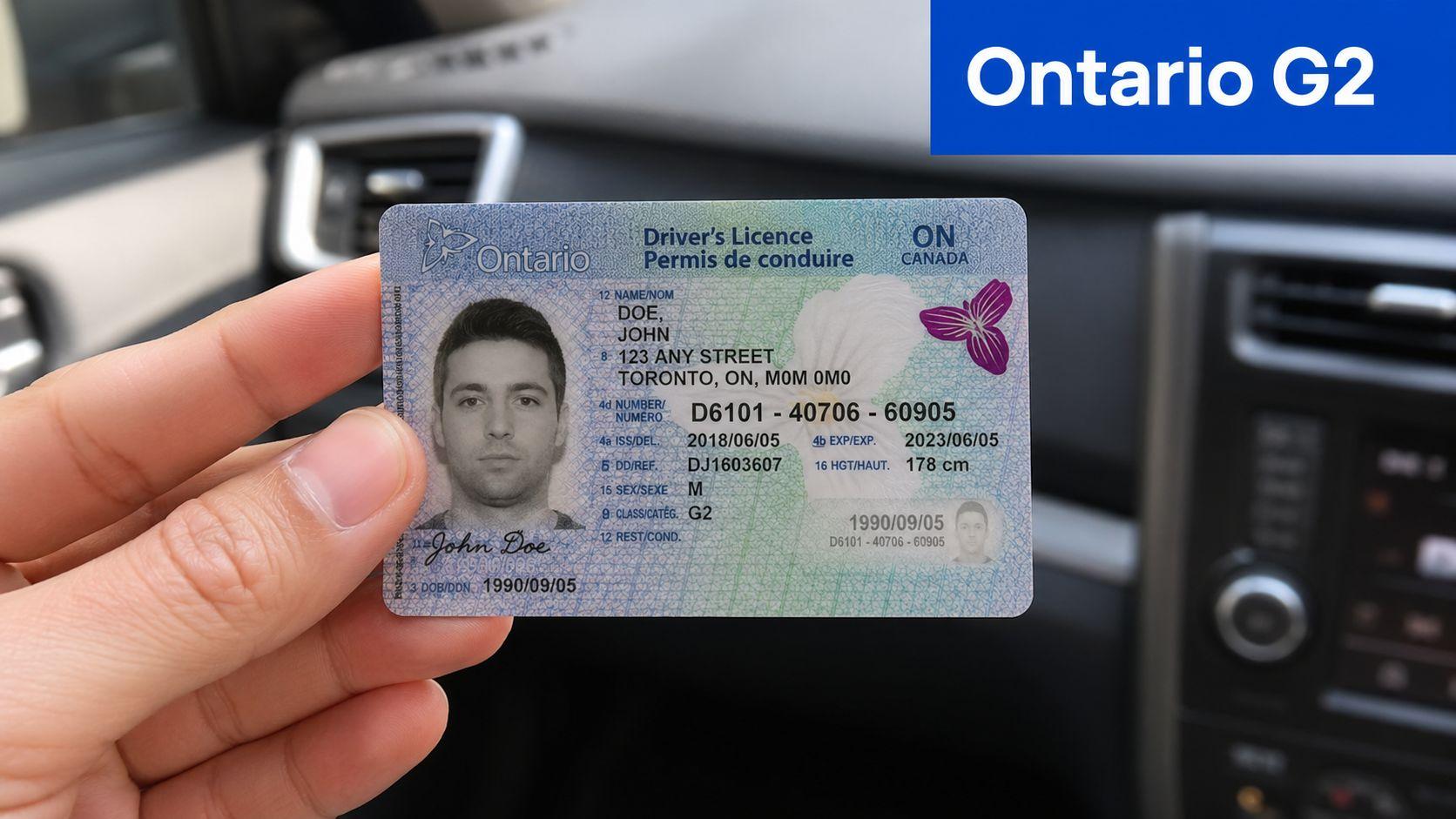
What the G2 actually means
A lot of students hear "intermediate licence" and assume it is just a halfway label. In practice, it is the point where driving starts to feel real.
With a G2, you can drive Class G vehicles on your own on Ontario roads, including major roads and highways. If highway driving still feels intimidating, it helps to review the practical breakdown of Ontario G2 highway restrictions and access rules before you start doing solo trips.
For many new drivers, this is the first time a licence fits normal life. You can drive to work, school, appointments, or pick up groceries without arranging a supervising driver first.
Why students often misunderstand this stage
The confusion usually comes from one simple idea. Independent does not mean unrestricted.
Your G2 gives you freedom to drive alone, but it does not place you in the same category as a fully licensed G driver. You are still in graduated licensing, which means Ontario expects you to build experience in steps. That matters on the road, and it matters during the test process too.
Students in the GTA often focus only on passing the next road test. A better approach is to treat the G2 like an apprenticeship. You now work without your coach in the passenger seat, but the system still expects careful habits, legal awareness, and steady judgment.
The timeline behind the licence
The G2 also sits inside a larger clock that many applicants notice too late. After you earn it, you must hold it for a period before you can take the full G test. Your progress through graduated licensing also stays tied to the original date you got your G1.
That is more than a paperwork detail. It affects how you plan lessons, how early you book, and whether you get boxed into long test waits in busy centres. In places with heavy demand, especially around the GTA, drivers who delay often end up taking whatever appointment is left instead of choosing a date, time, and location that suit their skill level.
A morning test in lighter traffic can feel very different from a late afternoon test near a packed commercial area. Strategic booking is part of smart preparation, not a side task.
Why this stage shapes your driving more than people expect
The G2 period is where habits harden. Shoulder checks either become automatic or they get skipped. Speed control either becomes steady or drifts with traffic pressure. Small choices start repeating until they become your normal style.
That is also why some students fail for reasons the handbook does not stress enough. The issue is often not one dramatic mistake. It is a pattern of small signs that the driver is not fully scanning, not planning early, or not managing pressure well when the route gets busy.
Treat the G2 as your working stage. You are no longer just learning the rules. You are proving you can use them calmly in everyday driving.
Navigating G2 Licence Restrictions and Rules
You pass your G2, drive alone for the first time, and suddenly the rules feel less like theory and more like real decisions. Can you give two younger friends a ride home after midnight? Does “just one drink a while ago” still count? These are the moments that catch new drivers, especially because the handbook often states the rule without explaining how it shows up in everyday life.
A G2 gives you far more freedom than a G1, but you are still a novice driver under Ontario's graduated licensing system. The easiest way to keep it straight is to separate freedom from limits. You can drive on your own. You still have to follow novice-driver rules.
What changes once you have your G2
Here is the side-by-side view that clears up the most common confusion.
Restriction G1 Licence G2 Licence Full G Licence Supervising driver required Yes No No Can drive on Ontario roads independently No Yes Yes Novice restrictions still apply Yes Yes No Must follow zero alcohol and zero cannabis rule Yes Yes Not under the same novice rules Young passenger limits between midnight and 5 a.m. Not the same G2 rule set Applies if driver is 19 or under No G2 novice passenger limit Eligible to attempt next road test immediately No, must complete required waiting period Must hold G2 before full G Final stage
Many new drivers read “independent driving” and assume it means full driving privileges. A better way to see it is this: G2 is a supervised stage without the supervisor in the passenger seat. The province is letting you drive alone, but it still expects beginner-level safeguards.
If you want a practical breakdown of Ontario G2 highway driving rules, review them before your first solo trips, especially if you plan to drive beyond familiar local roads.
The rules that catch people off guard
For drivers aged 19 or under, passenger limits apply between midnight and 5 a.m. During the first six months with a G2, you may carry only one passenger aged 19 or under during those hours. After six months, or once you turn 20, that limit rises to three passengers aged 19 or under. Immediate family members and certain trips with a fully licensed driver in the front seat are exceptions. Belairdirect outlines these Ontario G2 passenger restriction details.
This rule trips people up because it sounds narrow on paper but broad in real life. A ride after a birthday dinner, a late movie, or a quick pickup after work can put you into the restricted time window without much thought. Young drivers often focus on whether they are driving safely and forget to count who is in the car.
The other rule is simpler, and stricter. All G2 drivers must maintain zero blood alcohol and zero cannabis in their system.
Treat that rule like a closed door, not a judgment call. If you drank, do not drive. If you used cannabis, do not drive. “I feel okay” is not a defence, and it does not protect your licence.
Official summaries can make these rules sound like small technical details. They are not. They tend to cause trouble in ordinary situations, late at night, with passengers, under social pressure, or after a plan changes at the last minute. Those are also the conditions that increase stress on test day and later as a new solo driver, because good driving is not only about steering well. It is also about making calm decisions before the car even moves.
How to Prepare for Your G2 Road Test
Preparation gets easier when you stop treating the test as one big unknown. The examiner is looking for a set of observable habits. If you practise those habits often enough, your driving starts to look calm and predictable.
According to this guide on Ontario G2 application steps and road test structure, the G2 road test evaluates seven distinct operational modules: Start, Backing, Driving Along, Intersections, Turns, Parking, and Stopping on a Grade. Successfully passing requires a minimum 12-month G1 holding period, which can be reduced to 8 months by completing an approved driver training course.
What the examiner is testing
Those seven modules sound formal, but they reflect normal driving tasks. The examiner wants to see whether you can control the car, observe properly, and make safe decisions without prompting.
A useful way to practise is to group the skills by real driving situations:
- Moving off and basic control: Starting smoothly, steering steadily, checking mirrors, and entering traffic safely.
- Positioning and turns: Staying in the correct lane, choosing the proper turning path, and keeping speed under control.
- Low-speed manoeuvres: Parking, backing, and three-point turns without rushing or losing awareness.
- Traffic judgement: Handling stop signs, lights, intersections, and right-of-way situations confidently.
Students usually struggle most when one small task interrupts another. For example, a driver may know how to park, but forget mirror checks before pulling over. Or they may know how to turn left, but drift wide because they entered too fast.
A practice routine that actually helps
Use a simple rotation instead of repeating the same comfortable route every time.
- Neighbourhood sessions: Practise stop signs, residential scanning, curb parking, and smooth starts.
- Busier roads: Work on lane changes, speed control, and choosing safe gaps.
- Parking-focused sessions: Repeat reverse parking, parallel parking, and three-point turns until the routine feels automatic.
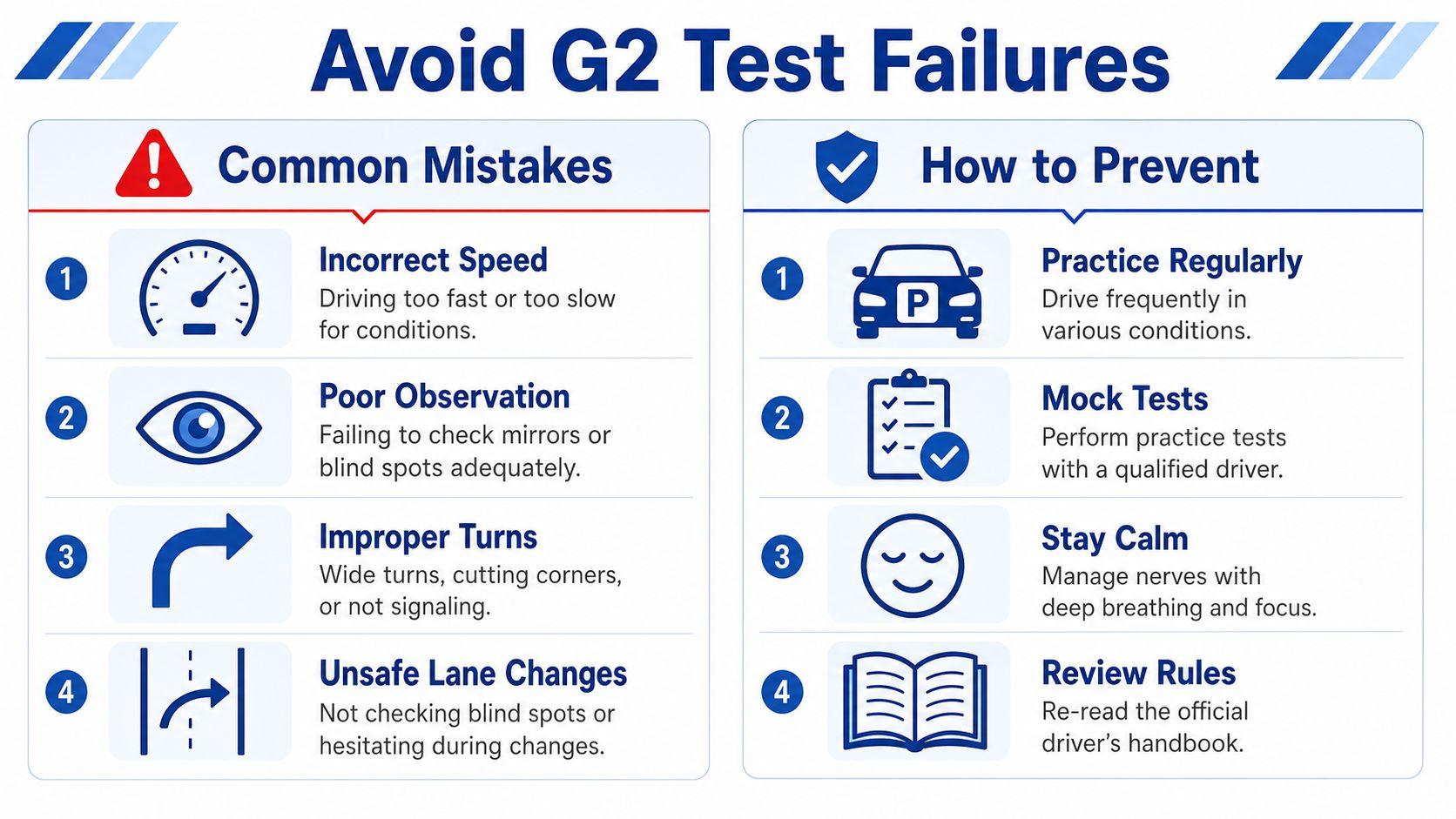
- Mock tests: Ask a qualified supervising driver or instructor to give directions with no coaching unless safety requires it.
Before you book, check the current G2 road test requirements in Ontario so your practice matches what you'll be judged on.
A visual walk-through can also help you connect the checklist to what happens inside the car.
On practice drives: Say your checks out loud at first. “Mirror, signal, blind spot.” That verbal rhythm helps build a habit you can still follow quietly on test day.
One more point matters. Strong G1 knowledge still helps you here. Drivers who remember signs, right-of-way rules, and speed-limit discipline make fewer hesitant choices during the road test because they're not trying to guess what the rule is in the moment.
Booking Your Test and What to Bring
For many students, booking feels like paperwork. In reality, it's part of your strategy. A poor booking decision can delay your licence progress even if your driving is ready.
How to book without getting stuck waiting
If you're in or near the Greater Toronto Area, don't assume you'll get a quick appointment. Ratehub notes in its overview of the Ontario G licensing process and test timing that average G2 test booking delays in the GTA surged to 67 days in 2025, which is why booking early matters.
That number changes how you should plan. Waiting until you “feel almost ready” can backfire. By the time you search for an appointment, the next available slot may be much later than expected.
A practical booking approach looks like this:
- Book early, adjust later: Reserve a date well in advance, then use the time before it to sharpen weak areas.
- Check more than one test centre: Centres outside the busiest GTA locations may offer earlier appointments.
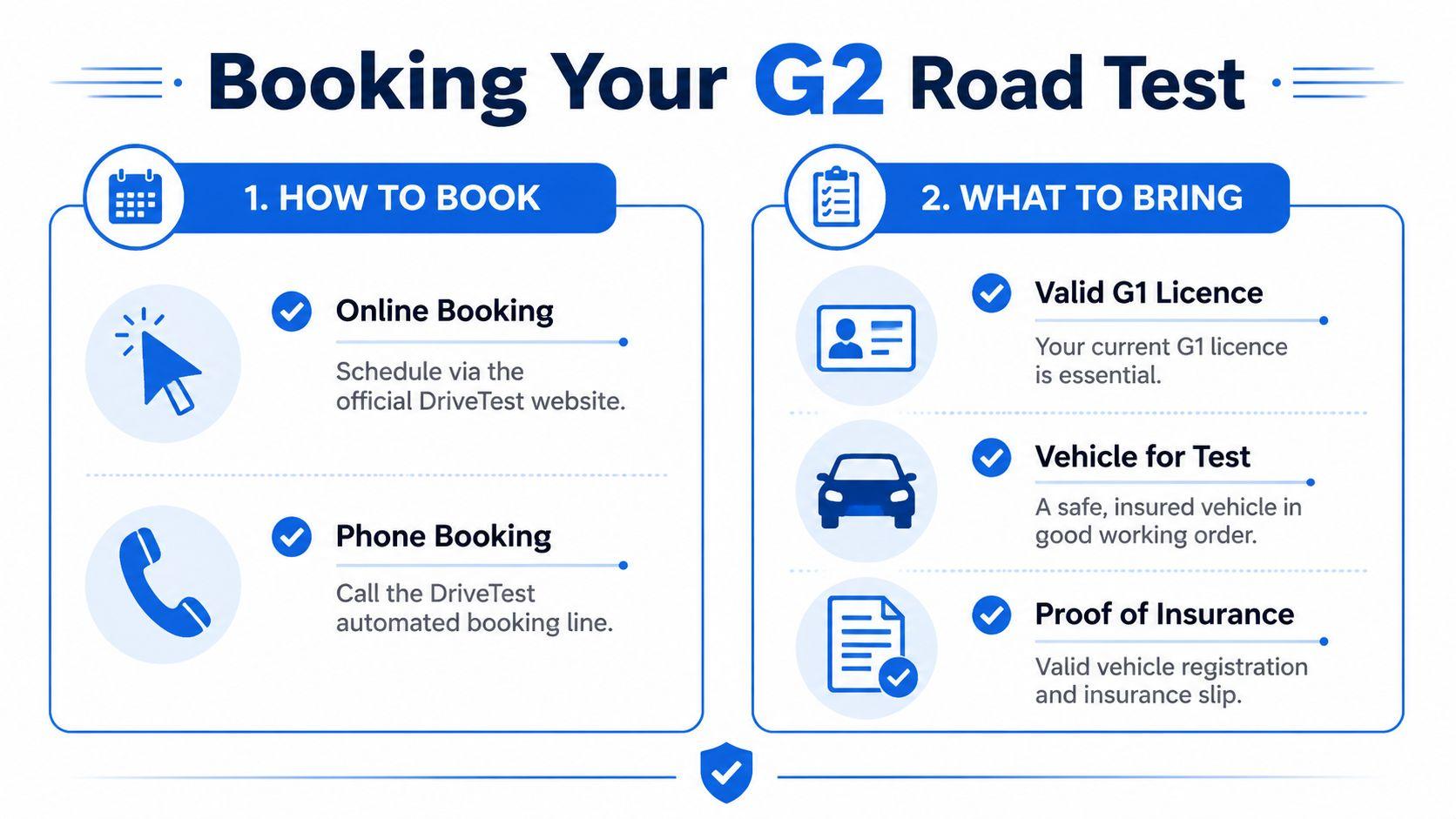
- Use both booking methods if needed: Online booking is convenient, but the phone line can sometimes help when you need to explore other options.
- Match the centre to your comfort level: Don't choose the closest location automatically if traffic conditions there make you far more nervous.
Your test day checklist
The booking itself is only half the job. Test day goes better when nothing administrative is left to chance.
Bring and confirm the following:
- Your valid G1 licence: This is essential because it identifies you and confirms your current stage.
- A safe test vehicle: The car should be in good working order, clean enough to use comfortably, and suitable for the road test.
- Proof the vehicle is properly documented: Make sure valid registration and insurance information are available.
- Enough time to settle in: Arrive early enough to breathe, park, and review your mirrors and seat position without rushing.
The car matters more than people think. Even a well-prepared student can start the test flustered if the seat is wrong, the windshield is cluttered, or the controls feel unfamiliar.
If possible, practise in the same vehicle you'll use for the test. Familiar pedals, mirrors, turning radius, and brake response make a noticeable difference when nerves are already high.
Common G2 Test Failures and How to Avoid Them
The fear of failing is common, and it's not irrational. According to Elan Road Test Rental's summary of Ontario driving test trends, the overall pass rate for the Ontario G2 road test is approximately 53%, which means nearly half of candidates fail their first attempt. The same source says the test costs $53.75 per attempt, so a weak first try can cost both time and money.
What a shaky test drive looks like
A typical failing drive usually doesn't collapse because of one dramatic mistake. More often, it starts with tension and then turns into a string of smaller errors.
The student leaves the parking spot but forgets a full observation routine. At the first turn, they signal, but enter too quickly. At the next intersection, they hesitate too long because they're trying to remember the rule instead of reading the situation calmly. Then comes a lane change where they check the mirror but barely move their head for the blind spot.
None of those moments feels huge inside the car. To an examiner, they add up fast. The test is short, and every action needs to show awareness.
The non-obvious mistakes examiners notice
Some errors are obvious, like speeding. Others are more subtle and catch capable drivers off guard.
- Weak observation: Examiners look for visible mirror checks and blind-spot checks, not private eye movements.
- Rolling stops: Many students slow down enough to feel safe, but not enough to show a complete stop.
- Late decisions: Turning on the signal too late, braking late, or changing lanes too close to an intersection makes the drive look unplanned.
- Improper steering and lane position: Wide turns, cutting corners, and drifting within the lane suggest poor control.
- Hesitation with right-of-way: Being overly timid can be just as problematic as being too aggressive.
One of the least obvious reasons for failure is divided attention. A nervous driver becomes so focused on the next instruction that they stop actively scanning the road. That's why some students perform worse during the test than in practice, even when they know the skills.
A better mindset is to drive one task at a time:
Situation What to do Approaching a stop sign Check mirrors, slow early, stop fully, scan both directions, move when safe Making a lane change Mirror, signal, blind spot, smooth movement, cancel signal if needed Turning at an intersection Choose lane early, control speed, steer into the proper lane, recover smoothly Parking manoeuvre Go slowly, keep observing, correct calmly instead of rushing
A calm correction is usually better than a rushed mistake. If your angle is off during parking, pause and fix it safely.
Mock tests help because they reveal habits you don't notice yourself. If you can, ask your supervising driver to stay quiet and only write down errors. That silence feels uncomfortable at first, but it's the closest thing to the actual experience.
Becoming a Confident and Safe G2 Driver
A driver license G2 is a major step, but it's still a learning stage. The strongest new drivers don't assume the licence means they've mastered everything. They use it as a chance to keep building judgement, consistency, and calm routines.
Confidence on the road doesn't come from hype. It comes from repetition. You practise enough that mirror checks, lane positioning, speed control, and safe turns start to happen in the right order without panic.
There's also a practical maturity that comes with the G2. You're driving alone now. That means you make the decision to leave earlier instead of speeding. You decide not to drive after alcohol or cannabis. You choose whether to carry passengers responsibly and whether to take a route that matches your skill level.
A good G2 driver is not the one who looks the boldest. It's the one who stays organised when traffic gets messy, who doesn't let nerves rush the car, and who keeps learning after the road test is over.
If you're preparing now, be patient with yourself. It's common not to feel polished at the beginning. You become better because you practise deliberately, fix mistakes early, and keep the rules clear in your mind.
You're closer than you think. One careful step at a time is how most solid drivers earn their G2 and grow into a safe full G driver later.
If you're still working toward the first stage of Ontario licensing, G1ready.ca is a helpful place to study with realistic practice tests, targeted quizzes, and clear explanations based on the current handbook. It's a practical way to build the rule knowledge that supports everything you'll need later for your G2.