
You're driving along Highway 401 when flashing amber lights appear ahead and concrete barriers narrow the road. Then you see an 80 km/h construction zone speed limit and wonder whether it's mandatory or merely advisory. Many learners hesitate because the orange signs, shifted lanes, barrels, and visible workers seem to create several different rules at once.
Ontario's system becomes easier once you separate three questions: What sign is posted? Has the reduced limit legally taken effect? Are workers present? The answers determine the speed you must follow and the level of enforcement risk. This guide builds that mental model so you can recognise the rule at the wheel and handle G1 test questions without guessing.
Why Construction Zone Speed Limits Catch Drivers Off Guard
A regular white speed sign usually feels simple. You see the number, adjust your speed, and continue until another sign changes it. A construction area adds visual noise, so drivers often notice the cones or lane shift but miss the regulatory speed sign that controls the legal limit.
That's where the confusion starts. One driver sees an orange diamond warning sign and slows down but doesn't know whether the new speed applies yet. Another notices that no worker is immediately visible and assumes the reduced limit can be ignored. A third driver follows traffic through a narrowed lane while looking only at the vehicle ahead.
Three details matter at the same time
A properly signed work zone combines a reduced speed limit, altered road conditions, and possible worker presence. These details aren't interchangeable.
- The posted number tells you the maximum legal speed for the signed section.
- The road layout tells you how to drive safely through narrowed lanes, barriers, uneven pavement, and lane shifts.
- Worker presence affects the special construction-zone penalty rules.
Drivers often react to only one layer. They may slow for the cones but not check the sign, or obey the sign while failing to prepare for a sudden lane change. A calm scan ahead helps you process all three before you reach the first barrier.
Practical rule: Treat the orange warning sign as an early planning signal, then look for the regulatory speed sign that establishes the temporary limit.
Ontario's Highway Traffic Act says a reduced construction-zone limit doesn't take effect until the affected highway section is signed, as set out in the Ontario Highway Traffic Act. That legal detail gives you a reliable decision point. Don't debate whether cones “look official”. Read the signs, identify the current limit, and drive for the road conditions in front of you.
How a Construction Zone Speed Limit Becomes Active
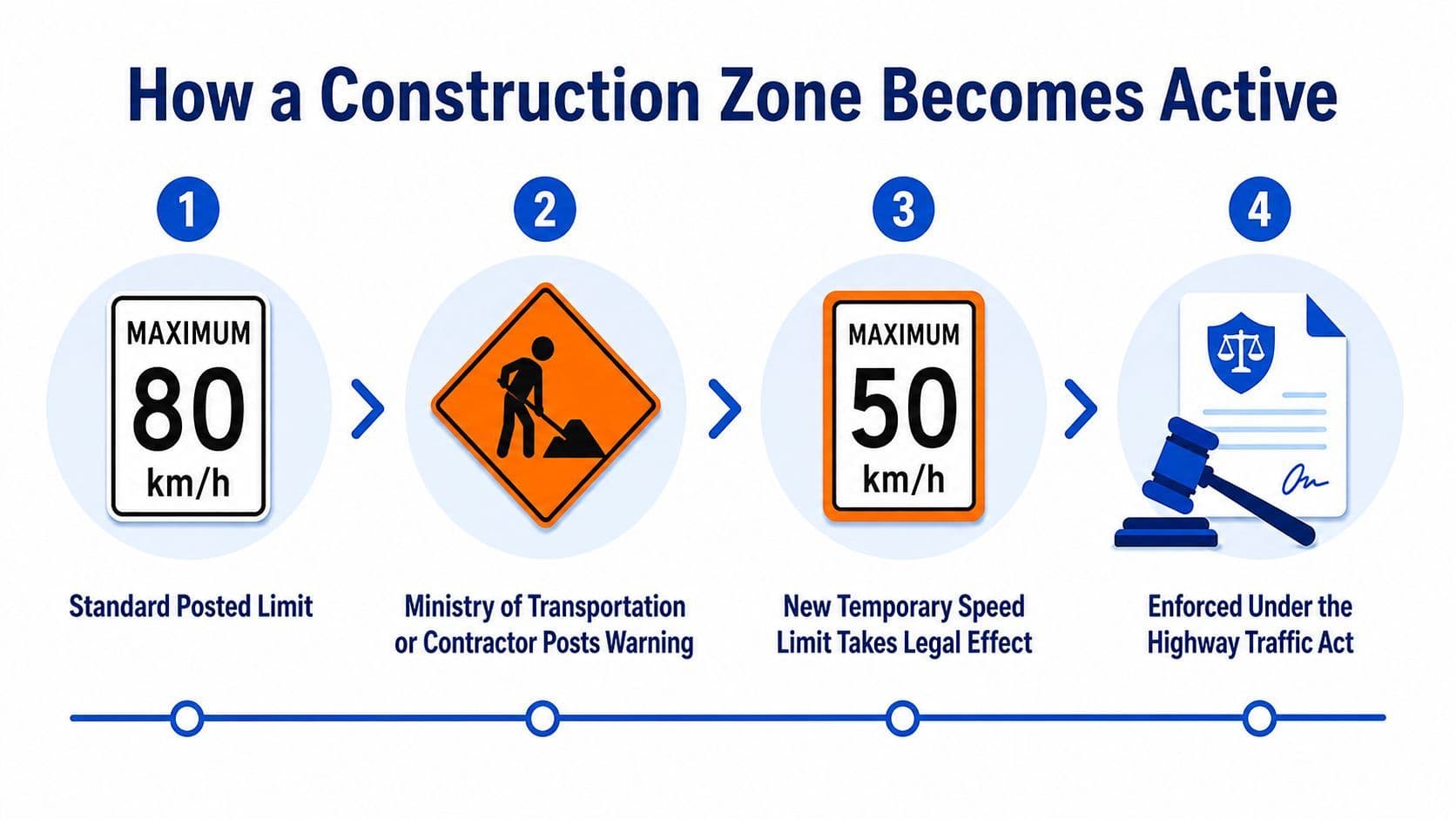
You see an orange sign, ease off the accelerator, and then wonder which number is legally active. The clearest answer comes from reading the signs as a sequence. Cones, equipment, and workers warn that the road environment is changing, while the reduced regulatory limit becomes effective when the affected section is properly signed.
Read the signs in order
- An orange diamond-shaped warning sign gives advance notice of construction, workers, a lane shift, or another temporary hazard.
- A regulatory speed sign displays the temporary number. It may include construction-zone wording, a worker symbol, or another qualifying tab.
- At the point where that regulatory sign applies, the reduced construction zone speed limit becomes the number you must follow.
- Continue obeying that limit until another sign changes it or indicates that the temporary restriction has ended.
The Highway Traffic Act provides the legal starting point: the reduced limit does not apply to the affected highway section until it is signed. That does not make the warning sign irrelevant. If it shows a lane shift or workers ahead, begin slowing smoothly and arranging your position early, so you enter the active area at the posted speed rather than braking sharply beside the first barrier.
Worker presence answers a different question. Ontario's special construction-zone rule applies when a worker is in the designated zone, as Oxford County explains the worker-presence penalty rules. Cones and heavy equipment help identify the work area, but neither one alone determines every penalty consequence. Follow the signed speed limit in all cases. Worker presence determines whether the doubled-fine rule applies.
Know where the limit ends
Watch for a sign stating that the previous speed resumes or that the temporary restriction has ended. Until you reach a lawful change, keep following the lower posted number, even if the pavement looks complete or no worker is visible at that moment.
Use this mental model at the wheel: warning sign means prepare, regulatory sign means obey, end sign means reassess. It separates advance notice from the point where the legal limit changes.
A short video can help connect the signs to the driving environment:
How Much Speed Typically Drops in a Work Zone
Ontario doesn't choose temporary limits randomly. Work-zone design guidance connects the posted speed to factors such as lane width, sight distance, road geometry, and superelevation. The aim is to create a speed that fits the temporary road arrangement, rather than forcing drivers into an abrupt and unrealistic stop.
The general engineering guidance says a reduced regulatory speed limit should usually be no more than 20 km/h below the preconstruction posted speed, unless an engineering study justifies a larger reduction. The Ontario work-zone design guidance provides that framework and explains why a reduction is tied to the actual geometry of the site.
Common examples
Road Type Normal Limit Construction Zone Limit Typical Drop Freeway or major highway 100 km/h About 80 km/h About 20 km/h Arterial road 80 km/h About 60 km/h About 20 km/h Lower-speed urban road 60 km/h About 50 km/h About 10 km/h
These are typical examples, not a universal Ontario schedule. The exact limit can vary with lane width, visibility, barriers, traffic arrangement, and the engineering assessment for that location. A major reconstruction may require a larger reduction when the road geometry warrants it, while a controlled project with better visibility may use a smaller change.
The same guidance notes that, where conditions permit, the recommended work-zone speed should meet or exceed the design speed or the preconstruction posted speed plus 10 km/h. That may sound counterintuitive, but it reinforces the central point: engineers set the temporary control around the road's design and operating conditions. Drivers shouldn't invent a lower number, and they shouldn't dismiss the posted one as arbitrary.
The safest prediction isn't “construction always means 60.” It's “read the temporary sign, then match the road environment.”
Fines and Demerit Points in a Construction Zone
Speeding in a signed Ontario construction zone becomes especially serious when workers are present. The provincial schedule and municipal summaries show that fines are doubled in that circumstance, with the amount increasing sharply as your speed rises.
The following figures are the published construction-zone examples from Oxford County's Ontario worker-safety guidance. They show the set fine and demerit-point consequences described for common speeding levels.
km/h Over Limit Base Fine (CAD) Demerit Points 10 km/h $60 0 20 km/h $180 3 30 km/h $420 4 40 km/h $560 4 50 km/h $975 Court appearance required
Why the tiers matter
The dollar amount isn't a gentle upward slope. A driver who treats the temporary limit as something to exceed “just a little” can move into a much more serious band with another increase in speed. At the highest listed tier, the matter requires a Provincial Offences Court appearance, and guidance identifies possible licence suspension and a 7-day vehicle impoundment.
The published base fine also isn't necessarily the full financial result of a ticket. Victim surcharges and court-related amounts can affect what a driver ultimately pays, so the table should be read as the set-fine schedule rather than a promise of the final total.
The Ontario Court of Justice set-fine schedule confirms that construction-zone penalties use escalating bands, including offences below 20 km/h over, from 20 to 35 km/h over, from 35 to 50 km/h over, and 50 km/h or more over. The exact legal treatment depends on the charge and circumstances, so a learner shouldn't reduce the rule to a simple multiplication exercise.
New drivers face added pressure
Demerit points can affect any driver, but a G1 or G2 holder has less room for mistakes under Ontario's graduated licensing system. A conviction can combine with other offences and create licensing consequences before a new driver has built much experience.
For a broader explanation of how points affect Ontario drivers, review demerit points in Ontario. The practical lesson is straightforward: when workers are present, strict compliance protects both people at the roadside and your licence.
Temporary Limits Versus Permanent Speed Limits
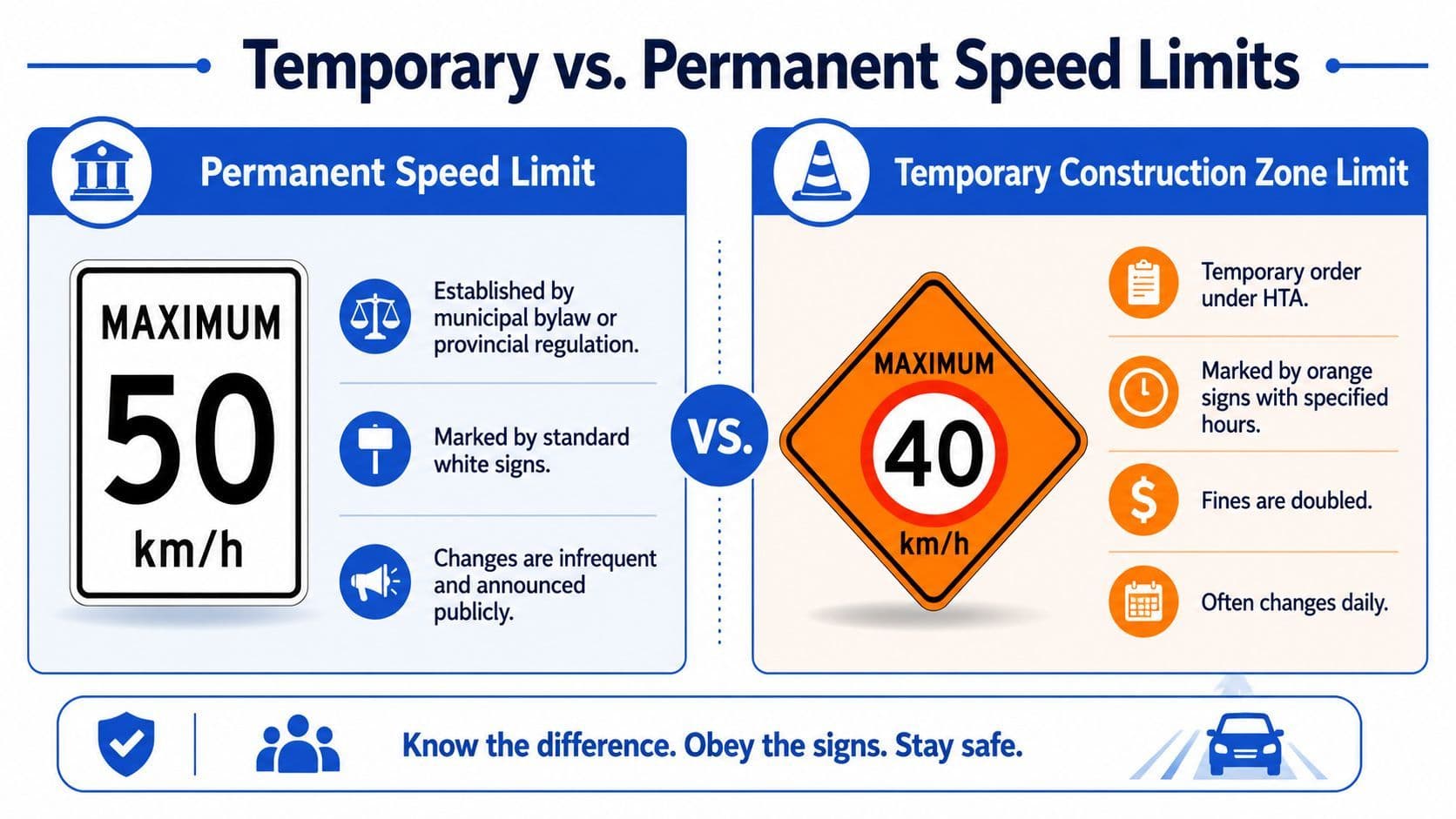
A permanent speed limit is the normal regulatory control for a road. It's generally displayed on a standard white sign and continues to apply unless another official sign or regulation changes it. The limit doesn't depend on whether a crew is working nearby that day.
A temporary construction-zone limit serves a different purpose. It responds to a project's changing road layout, such as narrowed lanes, shifted traffic, barriers, temporary pavement, or reduced sight distance. It may appear alongside orange construction messaging, and it applies to the signed section while that temporary arrangement is in force.
Put the two controls side by side
Feature Permanent Speed Limit Temporary Construction Zone Limit Main purpose Controls ordinary road use Controls travel through changing work conditions Sign context Standard regulatory sign Temporary work-zone signing Duration Continues until officially changed Continues for the signed project section Driver response Follow the posted number Follow the lower temporary number when active Worker requirement Not part of ordinary limit validity Worker presence affects special doubled penalties
A temporary sign doesn't merely suggest that you should be cautious. Once the temporary limit is properly posted, ignoring it means travelling above the legally applicable speed. Ontario's design guidance treats the temporary number as an engineered control connected to the road's altered geometry, not as a casual recommendation.
For related rules that help connect ordinary speed signs with temporary controls, use this G1 speed-limit rules guide. It's useful to keep the legal ideas separate: signage activates the reduced limit, while worker presence affects the special penalty rule.
Safe Driving Habits Inside a Construction Zone
Good work-zone driving starts before the first cone. Scan well ahead for orange signs, brake lights, lane arrows, and traffic-control people. That early scan gives you time to move into the correct lane and reduce speed smoothly instead of braking hard beside the first barrier.
Build a repeatable scan
Use the following routine during supervised practice:
- Scan early: Find the warning sign, then search for the regulatory speed sign and any lane-closure information.
- Brake progressively: Reduce speed before the work activity begins, not at the last cone.
- Hold your lane: Keep the vehicle centred in a narrowed lane and avoid drifting toward barriers.
- Create space: Leave enough following distance for the vehicle ahead to stop suddenly.
- Follow the traffic-control person: A flag person's direction can control your movement through the work area.
- Reduce distractions: Keep both hands available for steering and watch the road rather than your phone or infotainment display.
The target is to reach the first active work area at the new posted limit. You shouldn't wait until the last sign or the workers themselves to begin slowing. At the same time, don't panic-brake because another driver has slowed early. Check mirrors, signal when required, and make a controlled adjustment.
Expect the lane to behave differently
Construction lanes may be narrower or shifted from their normal position. Pavement edges can change, vehicles may merge unexpectedly, and a queue can form around a bend. Avoid making an unnecessary pass, particularly on the right where lane markings and traffic patterns may change quickly.
Flag persons deserve special attention because they're managing the immediate movement of vehicles and equipment. Follow their clear direction, even when the normal lane arrangement feels familiar. A learner who practises looking far ahead, holding a steady position, and leaving room to stop develops the defensive habits an examiner wants to see.
The right work-zone speed is the posted number, adjusted early and held steadily through the changing roadway.
Practicing Construction Zone Questions for the G1 Test
Construction-zone questions test whether you can connect a sign with an action. The Ontario Driver's Handbook is the natural starting point because it gives the terminology and sign meanings used in provincial driver education. Read the construction and temporary-sign sections slowly, then turn each rule into a road scenario.
Practise the decisions, not isolated symbols
A useful quiz should make you answer questions such as:
- What sign warns that construction or a lane shift is ahead?
- Which sign establishes the temporary speed limit?
- When does the reduced number become legally active?
- What should you do when a flag person directs traffic?
- How should you respond to uneven pavement, narrowed lanes, or a sudden queue?
- When does worker presence affect the construction-zone penalty?
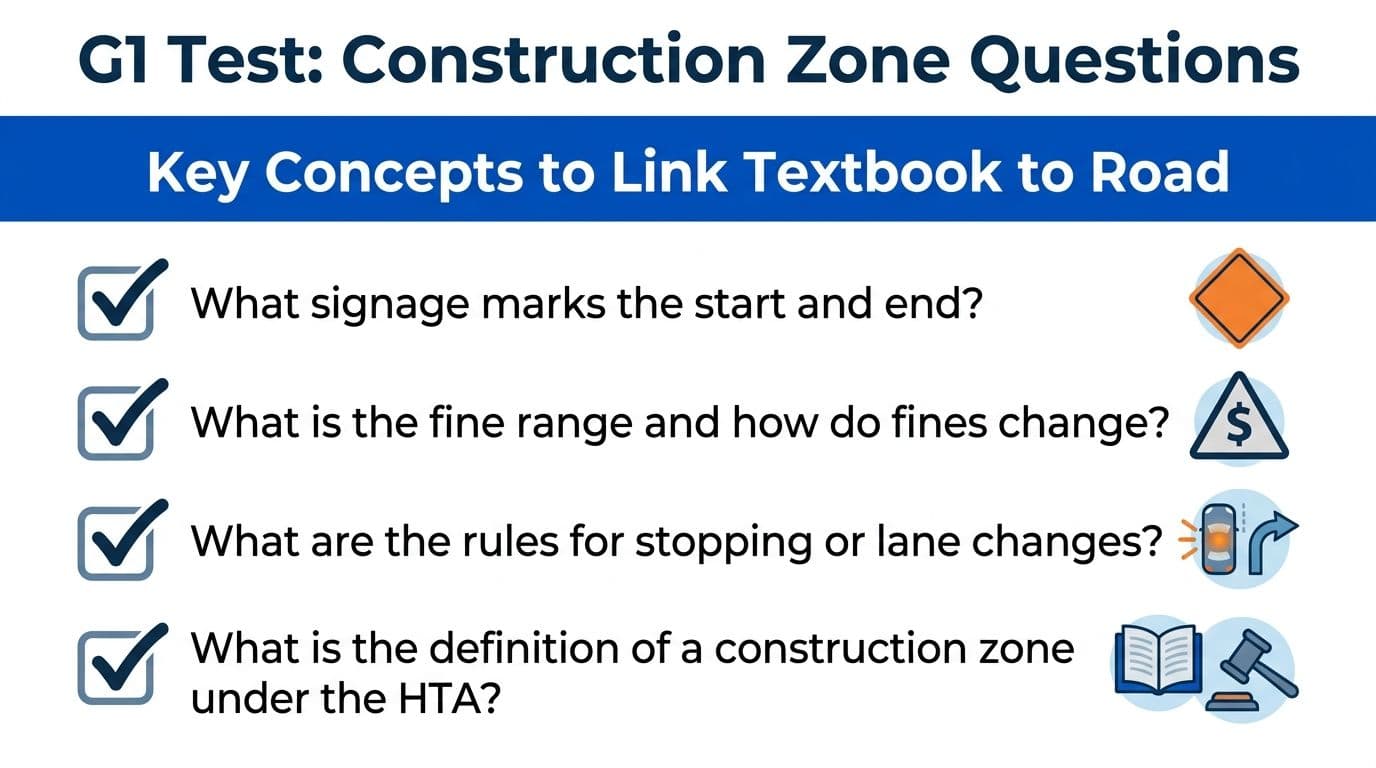
Don't memorise “orange means slow” and stop there. A test question may describe an orange warning sign followed by a lower regulatory sign, or it may ask what you should do when workers are visible in a signed zone. The correct response depends on identifying the active control and choosing a safe, lawful action.
Use feedback to correct the mental mistake
Sample tests, official practice material, and instructor-led mock quizzes each serve a different purpose. After an incorrect answer, write down the reason for the mistake. Did you confuse a warning sign with a regulatory sign? Did you assume the limit changed before the regulatory sign? Did you focus on cones and ignore the worker-presence rule?
G1ready.ca offers free, registration-free practice exams, targeted quizzes, mixed tests, a diagnostic test, marathon practice, and an exam simulator. Questions include immediate feedback, hints, and explanations, while progress tracking can help you identify topics that need more review.
Bringing It All Together as a New Ontario Driver
A construction zone speed limit becomes much less confusing when you use one mental model: identify the sign, confirm the active number, read the road, and check for workers. The warning sign gives you time to prepare. The regulatory sign gives you the enforceable speed. The work area tells you why the road needs a different approach.
Engineering guidance explains why Ontario commonly uses a moderate reduction rather than an arbitrary dramatic drop. The normal limit, lane arrangement, sight distance, and temporary road geometry all influence the number. In ordinary examples, a reduction of about 20 km/h is common, while a larger change requires an engineering justification under the guidance described by the Ontario Ministry of Transportation work-zone manual.
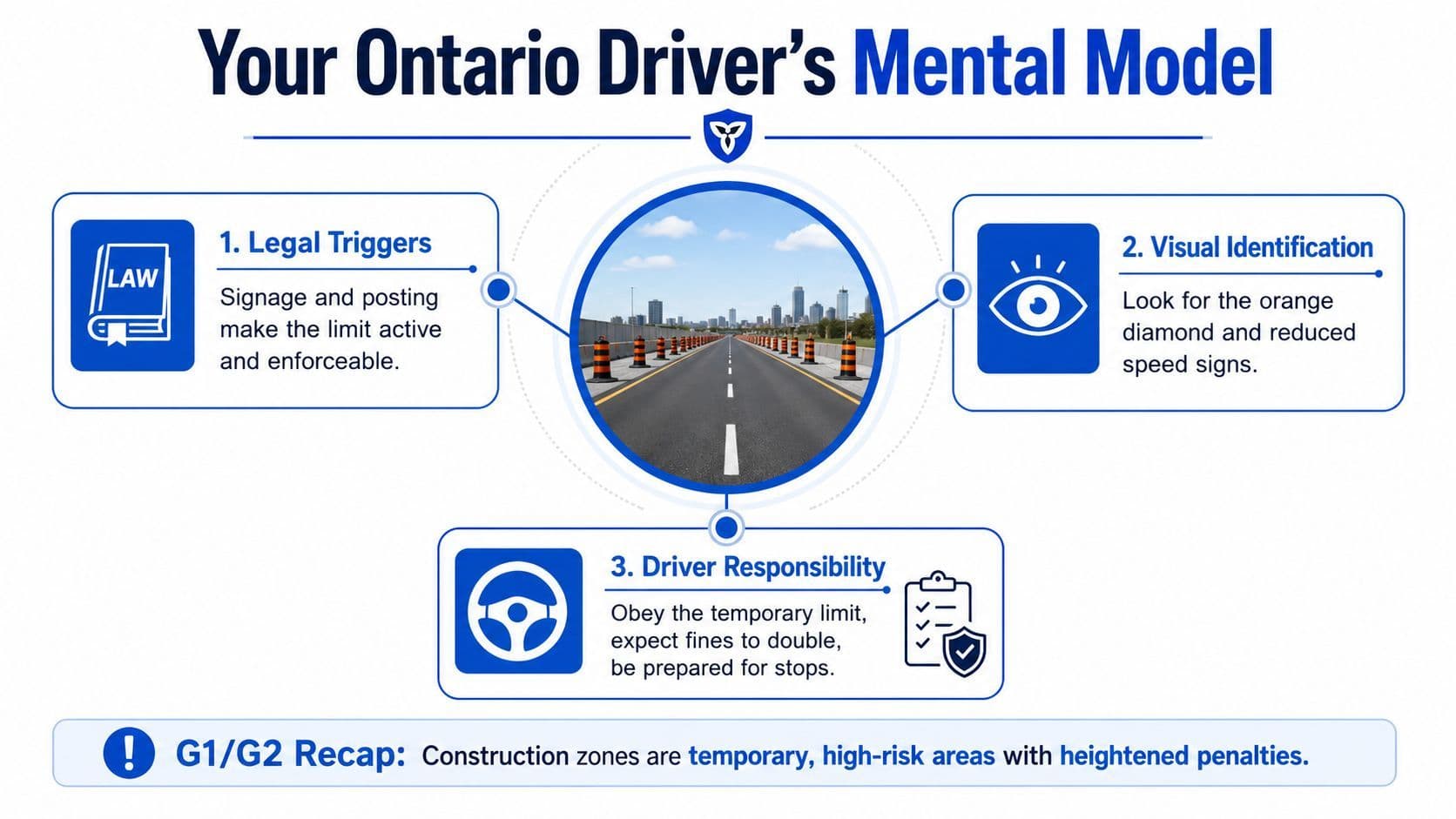
Keep the four-part routine
- Look ahead for orange signs. Don't wait for the first barrel to reveal the road change.
- Match the lowest current posted limit. The temporary number controls the signed section.
- Expect sudden changes. Lane shifts, stopped traffic, and traffic-control people can alter your path.
- Respect worker presence. The special doubled-fine rule makes speeding especially costly when workers are in the zone.
This routine helps with both the G1 test and real driving. It also prevents a common mistake, treating a construction zone as an ordinary road with a few cones added. The temporary limit, altered geometry, and worker risk belong in the same decision.
For broader preparation as you move from a learner licence toward independent driving, review these new driving rules in Ontario. Then practise the decisions until reading the signs and adjusting early feels automatic.
Visit G1ready.ca to practise construction-zone questions alongside targeted Ontario speed-limit quizzes, mixed tests, and realistic G1 exam simulations. Use the explanations and progress tools to identify the rules you're still second-guessing, then return to those scenarios until you can recognise the correct action before you're behind the wheel.


