Are you preparing for a commercial-truck licence when all you need is permission to drive your motorhome? Before studying for the Class D knowledge test in Ontario, settle that question. The standard Class D route and the RV-restricted route share requirements, but they don't lead to identical driving privileges.
Good preparation starts with the vehicle you intend to drive, then connects the right handbook material, practice questions and application documents. Memorising a question bank won't help if you've chosen the wrong route or arrive without the paperwork needed to proceed.
Who Needs the Class D Knowledge Test and Which Route Applies
Do you need a full Class D licence, or is the RV restriction enough for your vehicle? A first-time commercial applicant and a motorhome owner shouldn't automatically follow the same preparation plan.
The MTO Truck Handbook's licence requirements distinguish the standard route from the RV-restricted route, including the minimum age of 18 and the modified RV road test in a recreational vehicle over 14,000 kg. Use the following comparison to identify the route before choosing study material.
Class D requirements by route
Requirement Standard Class D Class D with RV restriction Minimum age 18 18 Licence held Valid Ontario licence other than G1, G2, M, M1 or M2 Valid Ontario licence other than G1, G2, M, M1 or M2 Vision test Required Required Medical report Required Required Knowledge test Large-truck knowledge test Class D knowledge test Learning module RVLM isn't a requirement for this route Recreational Vehicle Learning Module (RVLM) required Road test Compliant commercial-truck road test Modified road test in a recreational vehicle over 14,000 kg Daily inspection in road test Included Not required
Choose according to the driving you'll actually do
The standard Class D route suits applicants planning to drive an eligible large commercial vehicle. It involves preparation for a commercial-truck road test, including the inspection component and the vehicle requirements that accompany that test.
The RV-restricted route suits motorhome owners whose intended driving falls within that restriction. Its sequence is specific: complete the Recreational Vehicle Learning Module, pass the Class D knowledge test, then take the modified road test in the qualifying RV. Removing the daily-inspection component from that road test doesn't remove the need to understand your vehicle's safe operation.
For instructors, the useful starting point is a vehicle assessment, not a stack of quizzes. Ask the student to bring the vehicle specifications and explain whether they plan to drive commercially later.
Route check: An RV-restricted Class D licence isn't interchangeable with an unrestricted Class D licence. Read the restriction on the licence card before driving a different vehicle.
If you're unsure how Ontario's licence categories fit together, use our guide to classes of vehicles to orient yourself, then verify the intended vehicle against Ontario's requirements.
Before studying, answer these questions:
- Vehicle: What vehicle will I drive?
- Weight: How heavy is it?
- Future use: Will I ever drive a commercial truck?
Those answers choose the route. The route chooses the material.
What the Class D Knowledge Test Covers
Prepare for a multiple-choice knowledge assessment, using the Official MTO Truck Handbook as your primary study text. Read for understanding rather than treating the handbook as a collection of answers to memorise.
Organise your notes into the following study groups. These are practical revision categories, not a claim about the official test's section names or question distribution.
The topic map gives you a visual starting point.
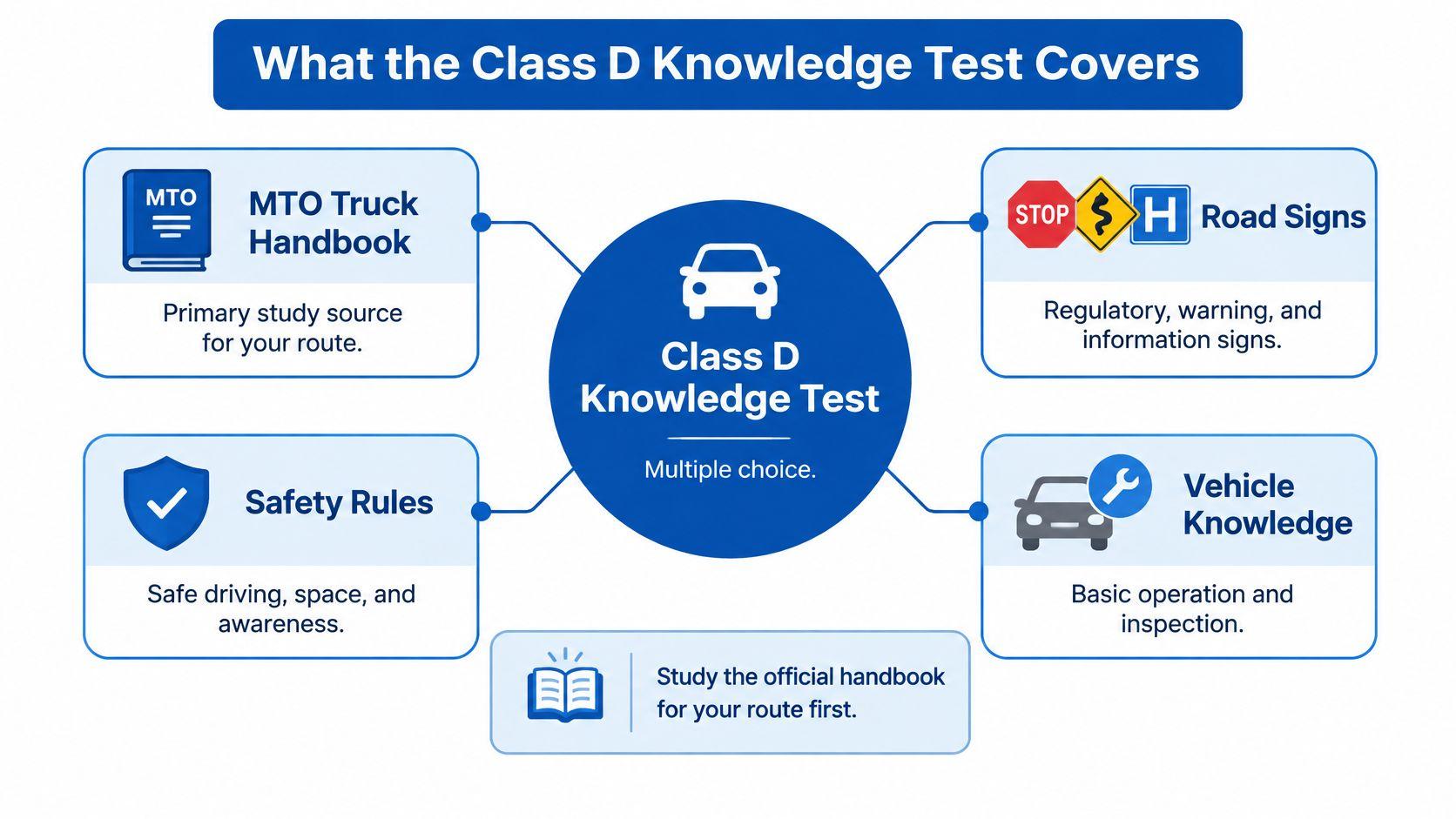
Signs, road rules and vehicle knowledge
- Signs: Study regulatory, warning and information signs. Pay attention to truck-related restrictions, lane instructions and symbols whose meaning changes with the vehicle shown.
- Road rules, hazards and driver condition: Connect right-of-way, stopping, following space, lane use and passing with blind spots, weather, fatigue and distraction. Ask what a safe driver should notice before choosing an action.
- Vehicle knowledge: Work through weight, loading, braking basics, inspection and safe operation. Consider how a long or tall vehicle changes turning clearance, overhead clearance and the space needed to manoeuvre.
These topics overlap in real driving. A lane-change question, for example, can require knowledge of signs, road rules and the vehicle's blind spots at the same time.
Give your route the right emphasis
RV applicants should concentrate on the learning module alongside the relevant handbook material, particularly vehicle dimensions, handling and braking. Don't interpret the modified road test as permission to skip learning how a heavy recreational vehicle behaves.
Applicants who previously prepared for G1 will recognise basic road-rule and sign concepts. The Official MTO Driver's Handbook identifies those subjects for learner preparation, but familiarity with them doesn't replace truck-specific study.
Our CVOR practice-test guide can help you distinguish operator-related study from your driver-licensing preparation. Don't assume resources with commercial-driving labels all prepare you for the same assessment.
Confirm the current question count, passing mark and delivery format before attending. The official requirements discussed here don't establish a fixed Class D question count or a complete test blueprint. Check current official MTO testing information rather than treating an unofficial quiz's length as the exam specification.
Sample Question Types and How to Answer Them
The following are illustrative practice items, not real Class D test questions. Their purpose is to teach a repeatable way to reason through unfamiliar wording.
Use a study setup that lets you annotate both the question and the explanation.
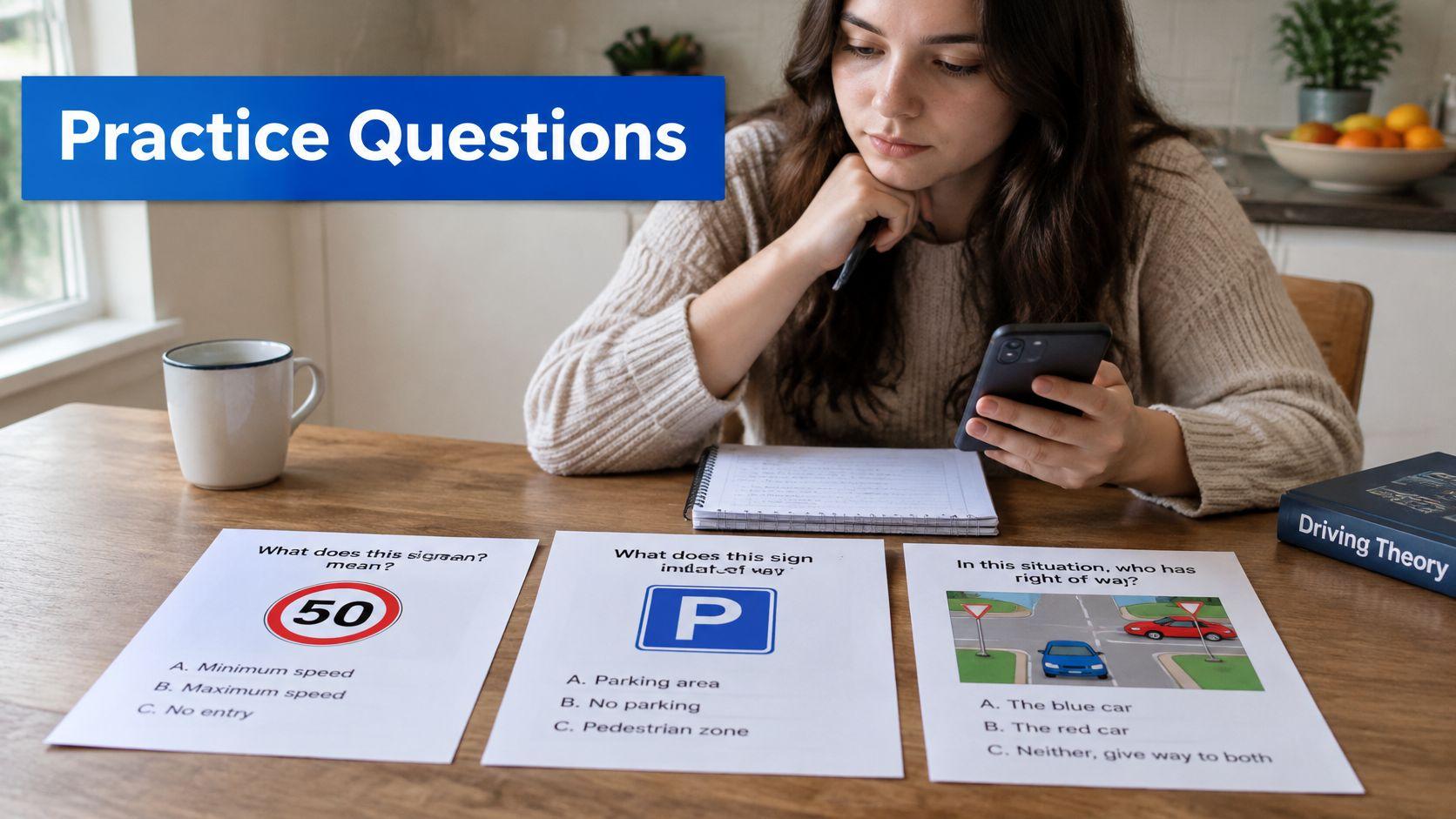
Sign recognition
Question: A sign shows a manoeuvre symbol inside a red circle crossed by a diagonal bar. What does it mean?
- A: The pictured manoeuvre is recommended.
- B: The pictured manoeuvre is prohibited.
- C: Every vehicle must stop.
Answer: B. The symbol identifies the manoeuvre, while the red circle and diagonal bar communicate prohibition. You still need to identify the symbol, rather than guessing the exact prohibited action from colour alone.
Apply the method:
- Read the stem twice. Notice that it asks about a prohibition, not a destination.
- Eliminate unsafe or incorrect options. A recommendation doesn't match the prohibition marking.
- Check absolute wording. “Every vehicle must stop” adds a rule the described sign doesn't establish.
- Match the handbook rule. Choose the meaning of the complete sign, including its symbol.
Following space
Question: You're driving a large vehicle behind traffic as road conditions deteriorate. Which response gives you the safest margin?
- A: Close the gap so another driver can't enter it.
- B: Keep the same gap regardless of conditions.
- C: Reduce speed appropriately and create a longer safe following gap.
Answer: C. Greater speed increases stopping demands, and a heavy vehicle's braking performance must be understood in relation to its load, brakes and road conditions.
Read the stem twice to catch the worsening conditions. Eliminate tailgating and an unchanged-gap response, question “regardless,” then match your choice to the handbook's space-management guidance.
For additional visual review, use the video alongside your handbook notes.
RV eligibility
Question: A motorhome owner asks whether the RV-restricted route is appropriate. What should you check first?
- A: The vehicle's weight and the licence the applicant holds.
- B: The motorhome's colour.
- C: Whether the owner will ever carry luggage.
Answer: A. Ontario's RV licensing guidance establishes vehicle and applicant requirements, including the modified road test in an RV weighing more than 14,000 kilograms.
Read the stem twice, eliminate irrelevant details, check for unsupported blanket assumptions, and match the remaining answer to the eligibility rule.
Use official MTO sample questions where available for your route. G1 samples illustrate multiple-choice reasoning, but aren't evidence of Class D content. If you can explain why each wrong option fails, you understand more than the answer letter.
Test-Day Readiness Beyond the Handbook
An applicant with strong handbook knowledge can still leave without a finished application. Ontario's truck-driver licensing checklist sets separate entry conditions for Class D, including being at least 18, holding a valid Ontario licence other than G1, G2, M, M1 or M2, passing a vision test and submitting a medical report. Read the licence rule as a check on the card in your wallet. Newcomers to Ontario miss this step when they assume a foreign licence or a motorcycle class will transfer directly.
The full Class D route and the RV-restricted route share this paperwork test, but they divide after it. A straight truck applicant moves toward a vehicle with commercial equipment rules. An RV applicant stays inside the motorhome rules and weight limits. Sorting your folder early keeps you from preparing road-test details for the wrong vehicle.
Build one folder and review it the night before travel:
Identification: Bring two pieces of identification or your Ontario licence, following the current official document instructions. Staff cannot process the file when an item is missing or unacceptable.
Medical report: The form must be complete, signed and dated. Clinics sometimes return forms with a blank field, so read every line before you leave the office.
Payment: Look up the current fee and accepted payment methods on the day you plan to attend. Old prices copied from forums create surprises at the counter.
Corrective lenses: Bring them when you need them for vision screening.
Road-test equipment: Wheel chocks or blocks belong to the later practical stage for a vehicle with air brakes. Pack that plan separately from your written-test notes.
Knowledge testing comes first, vehicle handling comes later. For the written step, study both the MTO Truck Handbook and the operating manual for the actual vehicle you will drive later. If air brakes are involved, study the air-brake section of the official MTO Truck Handbook first, then review Ontario air-brake test preparation practice structure to see how those questions are usually grouped.
A missing medical report or an ineligible licence class can stop your application even when you know every practice answer.
Common Mistakes That Cost Applicants a Pass
More practice isn't always better preparation. If you repeatedly answer the same familiar questions without checking your reasoning, you can feel confident while leaving the important gaps untouched.
These are practical preparation pitfalls, not a ranked list based on published failure statistics. Each has a specific remedy.
Common Class D preparation mistakes and fixes
Mistake What it costs Fix Preparing for the wrong route Wasted study time and an unfinished RV learning module Confirm the route with the requirements table before studying Memorising answers instead of rules Failure on reworded questions Write a reason for each handbook rule Skipping the vehicle manual Missed questions on equipment and operation Read the operating manual for the vehicle you will test in Ignoring timed practice Running out of time on test day if you assume a deadline or leave too little time for the visit Complete two timed mixed sets in the final week as a study exercise, not an assumed official time limit Booking before the admin checklist is done A wasted appointment Check ID, medical report, payment and stage-appropriate equipment first
Fix the cause rather than adding more questions
Wrong-route preparation often begins with a broad search for truck-test questions. The correction is to identify the intended vehicle and required licence outcome before selecting chapters or quizzes.
Answer memorisation becomes obvious when you can select the right letter but can't explain the rule without seeing the options. Close the question bank and describe the safe action in your own words, then verify it in the handbook.
Skipping the vehicle manual creates a different problem. General road rules won't tell you where a particular control is located or how the manufacturer describes a warning indicator. Mark unfamiliar controls and ask your instructor to explain them before practical training.
Practice safeguard: A timer is a revision tool, not proof that the official test has a fixed deadline.
Use timed sets to notice rushing, repeated rereading or mental fatigue. Don't turn a practice countdown into an unsupported claim about Ontario's test conditions.
Administrative mistakes need a checklist, not another quiz. Keep your document review separate from your score review so a good practice result doesn't distract you from an unfinished application.
If a mistake appears in your practice results, correct it before adding new material. Otherwise, you're increasing the amount you've seen without improving what you can reliably explain.
Two-Week Study Plan and Booking Steps
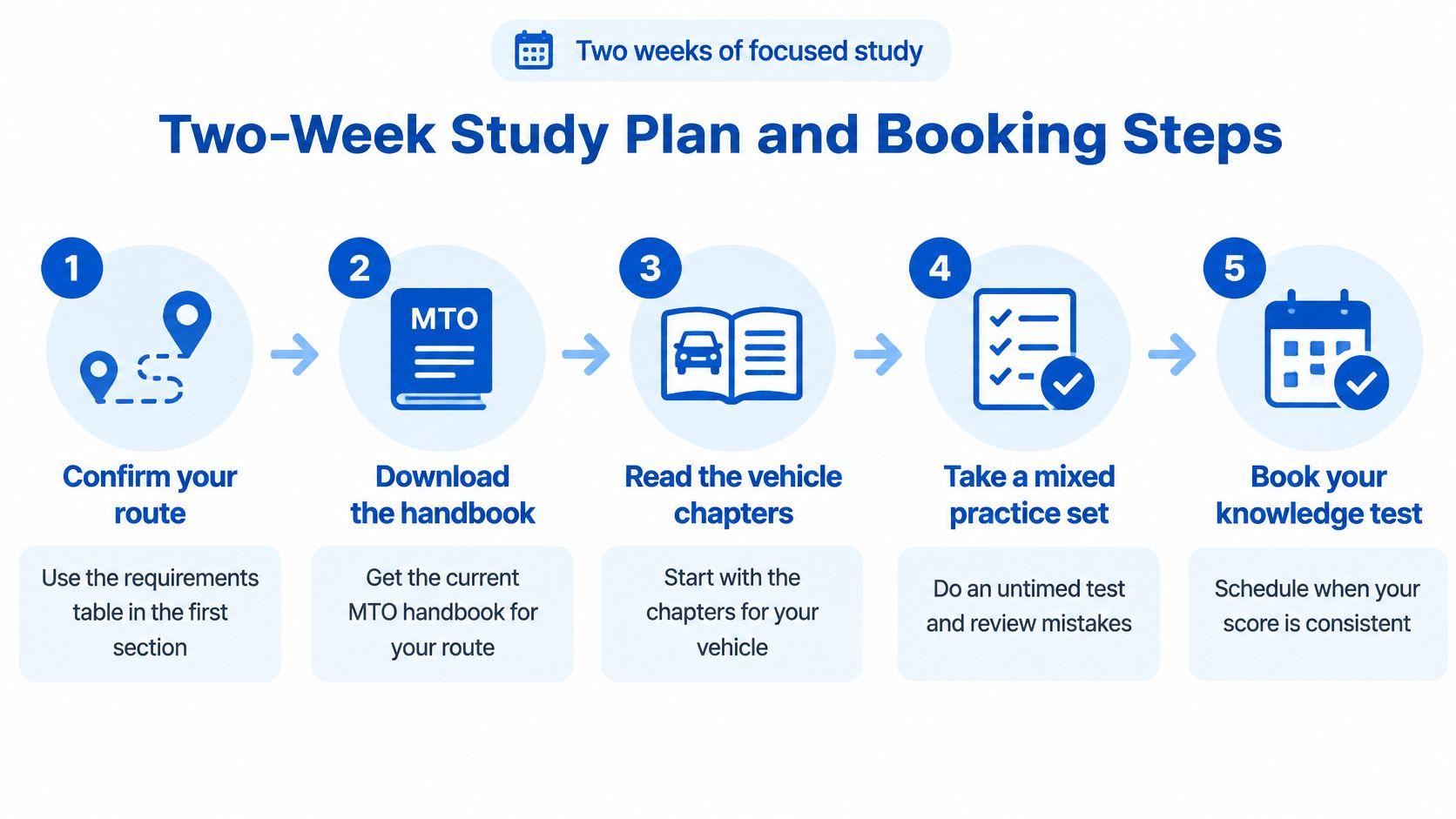
Treat this two-week plan as a suggested study schedule, not a guaranteed preparation period. Someone familiar with heavy vehicles may need different support from an applicant encountering truck controls and inspection concepts for the first time.
Your goal is dependable understanding across signs, road rules including hazards and driver condition, and vehicle knowledge. A strong overall practice score isn't enough if it conceals a weak category.
Use the visual plan as a reminder of the sequence, then adapt the work to your results.
Set up the right materials
- Confirm your route before opening a question bank. Use the requirements comparison to choose standard Class D or Class D with an RV restriction. Write the intended vehicle and licensing goal at the top of your study notes so you don't drift into unrelated preparation.
- Get the current official handbook and relevant vehicle information. Read the chapters connected to your vehicle first, and keep the operating manual available for equipment questions. RV applicants should include the learning module in the schedule rather than treating it as an optional task after revision.
- Take an untimed mixed diagnostic set. Use questions relevant to your route, then classify every wrong answer as signs, road rules or vehicle knowledge. If a question seems ambiguous, check the handbook before recording its answer as a rule.
A useful error log has columns for the topic, your mistaken reasoning, the handbook rule and the corrective action. Record guessed answers too, even when you happened to select correctly.
For example, “confused warning with prohibition” is more useful than “got sign question wrong.” It tells you what to practise next.
Build understanding before adding pressure
- Days one to five, concentrate on the weakest group. Read each relevant rule and write a one-line explanation of why it matters. For a space-management topic, describe the hazard the rule helps you avoid rather than merely copying its wording.
Mix recognition with explanation. Identify a sign, describe what it requires, then explain what you'd do when approaching it in your intended vehicle.
For vehicle knowledge, connect written material to a diagram, control label or supervised walk-around. Don't operate unfamiliar equipment just to test a theory from a quiz.
- Days six to nine, work through mixed sets under a timer. Review every miss and write why the incorrect options fail. The timer is there to reveal your study habits, not to impose an unverified official deadline.
If you rush through signs but spend most of the session struggling with vehicle questions, adjust the next study session accordingly. Don't keep repeating the strongest category just because it produces reassuring scores.
- Days ten to twelve, repair the remaining gaps. Revisit uncertain handbook passages, ask an instructor about unresolved vehicle questions and practise applying rules to changed scenarios. If your weakest category hasn't improved after the first week, extend the schedule instead of adding more unfamiliar material.
Try changing a scenario's weather, traffic or vehicle dimensions. If your answer changes, explain which detail caused the change and verify that reasoning against the appropriate material.
Decide whether you're ready to attend
- Use the final two days for review, documents and rest. Recheck your weakest category, complete the administrative checklist and avoid replacing sleep with a last-minute marathon. Put your documents and corrective lenses together before the day you intend to attend.
As a suggested readiness benchmark, look for consistent results across two timed mixed practice sets, with no category below your chosen practice target. This isn't an official passing standard, and repeating a memorised set doesn't provide the same evidence as answering unfamiliar, route-appropriate questions.
You should also be able to explain your answers without reading the options aloud. If your explanation depends on remembering where the correct answer appeared on the screen, return to the rule.
- Check the current official service instructions and arrange the next step. Confirm eligibility, medical and document requirements, fees, available testing services and whether a booking is needed. Don't assume a knowledge-test visit and a later road-test booking use the same process.
Choose resources that fit the licence stage. Our G1ready.ca practice tests are built for Ontario G1 preparation, not as a Class D question bank; we offer the Road Rules Test, Road Signs Test, 200-Question Test and Diagnostic Test. Class D applicants should use their route's official MTO material and apply the study method above.
Before you attend, make a final official-page check rather than relying on a saved screenshot or an older preparation article. Your next action should follow current instructions, with your route settled and your application folder ready.
G1ready.ca offers free G1 practice tests with instructor-reviewed answers for learners strengthening Ontario road-rule and sign knowledge. Visit G1ready.ca for G1-stage practice, and keep the official MTO Truck Handbook and your route's requirements at the centre of Class D preparation.