
You're sitting behind the wheel, passing a row of open parking stalls while cars move through the lane behind you. The space looks wide enough, but the moment you select reverse, your hands feel busy, your mirrors seem unhelpful, and you're no longer sure where the rear bumper is. That awkward feeling is normal. Reverse stall parking combines steering, low-speed control, and continuous observation, so it rarely feels natural on the first attempt.
The important shift is to stop treating the manoeuvre as a steering trick. In an Ontario parking lot, a safe decision comes before the turn. You need a clear path, usable reference points, enough room to correct, and an exit that won't put pedestrians, cyclists, or other vehicles at risk. The Ontario Ministry of Transportation's Driver's Handbook presents reversing as a structured safety task, not just a test of whether your vehicle can fit between two lines.
What Reverse Stall Parking Actually Is
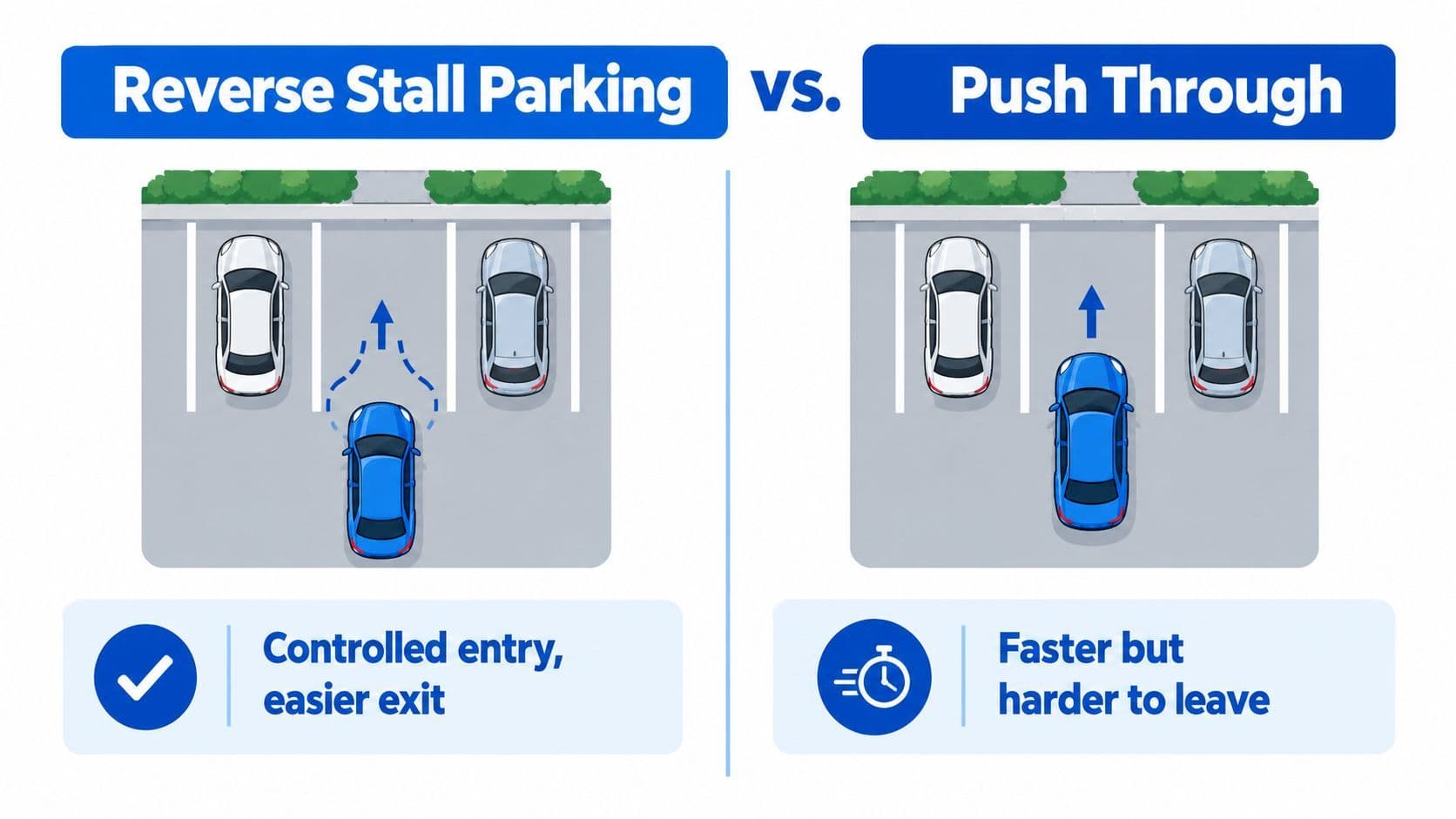
Reverse stall parking means you drive past an empty stall, stop in a suitable position, and guide the vehicle backward into the space. As the vehicle enters, you steer toward the stall, then unwind the wheel so the car finishes centred between the painted lines. The final position should keep the vehicle within the markings without touching the curb or another vehicle.
That differs from nose-in parking, where you drive forward into the stall and later reverse into the traffic lane to leave. It also differs from angle parking, where the stall and approach create a more obvious turning path. Reverse stall parking usually requires a tighter turning arc and exposes the rear of the vehicle to hazards during entry, but it can give you a forward-facing exit later.
A typical Ontario plaza makes the difference easy to understand. Bays can be narrow, traffic can pass close to the front of your vehicle, and shoppers may step between parked cars without much warning. Reversing into a stall isn't automatically the safer option. It's safer only when you can observe the area, control the vehicle, and leave enough room for everyone around you.
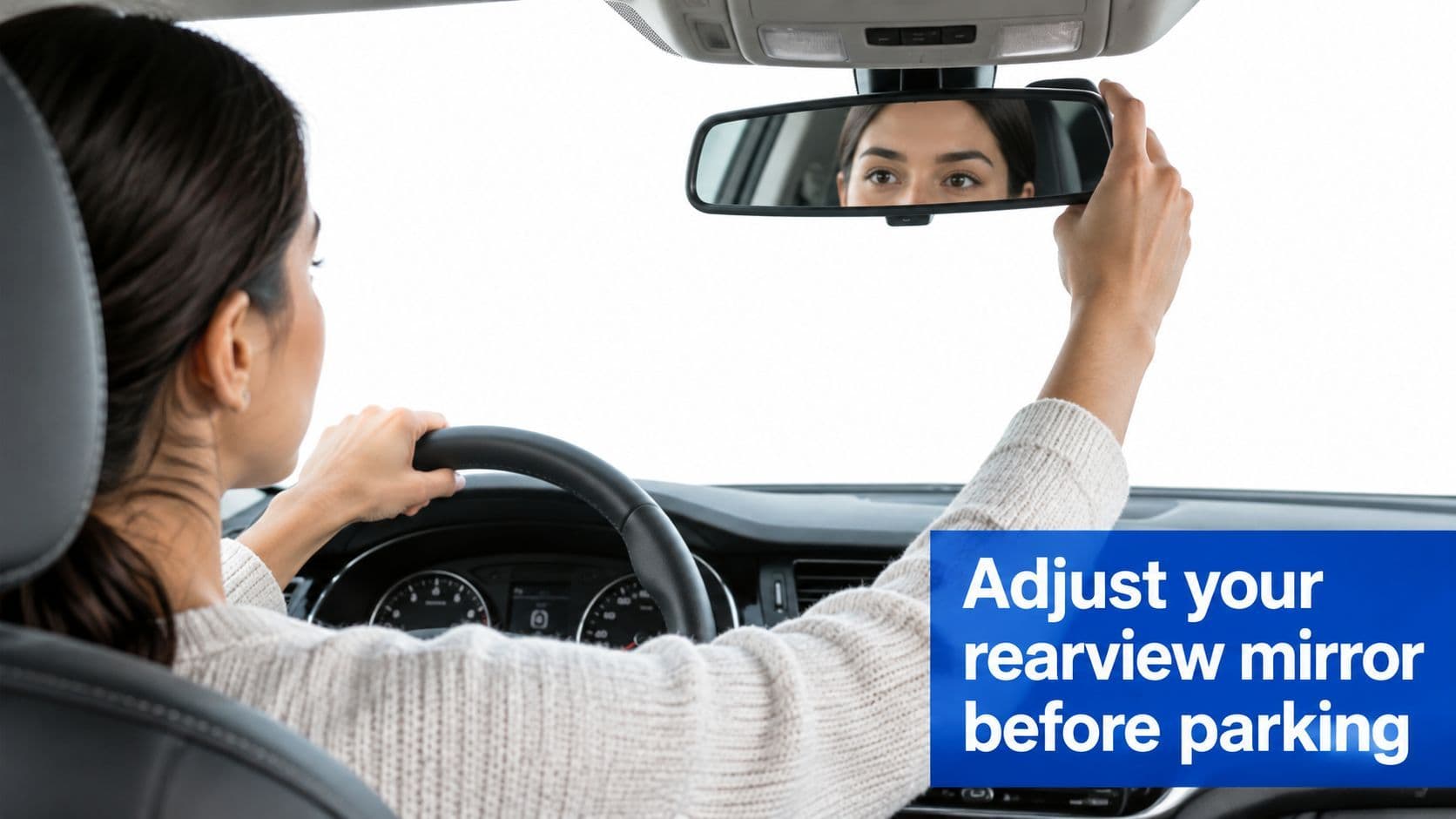
Before the wheels move, confirm that the mirrors are clean and correctly adjusted. Your seat should let you rotate comfortably and look over both shoulders. You should be able to use the left mirror to monitor the rear-left corner and curb line, while still turning your head to look in the direction the vehicle is travelling.
Practical rule: The aim isn't a memorised number of steering turns. The aim is a clear path, a controlled entry, and a final position that leaves useful space around the vehicle.
Ontario licensing guidance identifies reversing as an observable practical-driving skill alongside actions such as starting, stopping, turning, and parking. The broader lesson is useful even when you're practising in a plaza: an instructor is looking for defensive habits, not a single magic turning point. Reverse stall parking should therefore be taught as a sequence of checks, gentle steering corrections, and accurate positioning.
Setting Up Before You Turn the Wheel
A calm setup removes much of the panic. Begin by checking the left mirror so it shows the rear-left corner and nearby line without forcing you to move your head. Set the right mirror to cover the vehicle's right flank, then make sure your seat and headrest allow a full shoulder check. Mirrors help you monitor space, but they don't replace looking around the vehicle.
Turn on the signal toward the chosen stall before you position the vehicle. Keep your foot covering the brake and scan the lane for a following vehicle, a pedestrian crossing behind the stall, a cyclist, or a driver preparing to leave an adjacent space. The MTO guidance on backing stresses planning ahead, checking blind spots, and recognising that rear visibility is limited.
Approach the stall slowly and leave enough lateral room for the rear of the vehicle to swing into the space. Stop in a position that gives you a repeatable relationship between your vehicle and the stall, rather than trying to judge every attempt from scratch. A nearby parked vehicle, the stall line, or a fixed point on the dashboard can serve as a reference, but the reference must be confirmed with active observation.
Ontario conditions can make familiar landmarks unreliable. Snowbanks may cover the end of a line, ice may sit across the stall entrance, and worn paint may make the boundaries difficult to see. If you can't identify the stall edges, pull forward and choose a clearer space instead of guessing.
Accessible stalls require particular care. A vehicle can sit between its painted lines and still block an access aisle, a pedestrian route, or a passenger-loading area. Canadian accessibility guidance covers barrier-free paths and routes to entrances, so don't use an accessible stall or its adjacent clear zone unless you're legally entitled to do so and can leave the required area unobstructed. The Canada.ca accessibility publication provides useful background on why those surrounding spaces matter.
For a concise refresher on hand position and control, review this guide to steering wheel grip. Then pause. If traffic hasn't stopped or the path isn't clear, don't select reverse yet.
The Reversing Sequence From Approach to Centred
Once the area is clear, release the brake gently and let the vehicle roll backward at a walking pace. Keep your eyes moving. Look over the shoulder in the direction of travel, check the mirrors briefly for both rear corners, and return your attention to the space. The Ontario Driver's Handbook's parking guidance calls for very slow reversing, small steering adjustments, and stopping if a pedestrian, cyclist, or other hazard enters the path.
As the rear of the vehicle reaches the useful reference point for the stall, steer toward the space with a controlled input. Don't snap the wheel or hold it at full lock while staring at only one line. Your hands should guide the car gradually, while your eyes confirm whether the rear corner is clearing the boundary and whether the front end is swinging into the lane.
The first few attempts feel awkward because the front of the vehicle moves in the opposite direction from the rear. A rightward steering input sends the rear toward the right, but the front end may swing left into traffic or a neighbouring vehicle. That's why the scan must include the full vehicle, not only the area visible through the rear window.
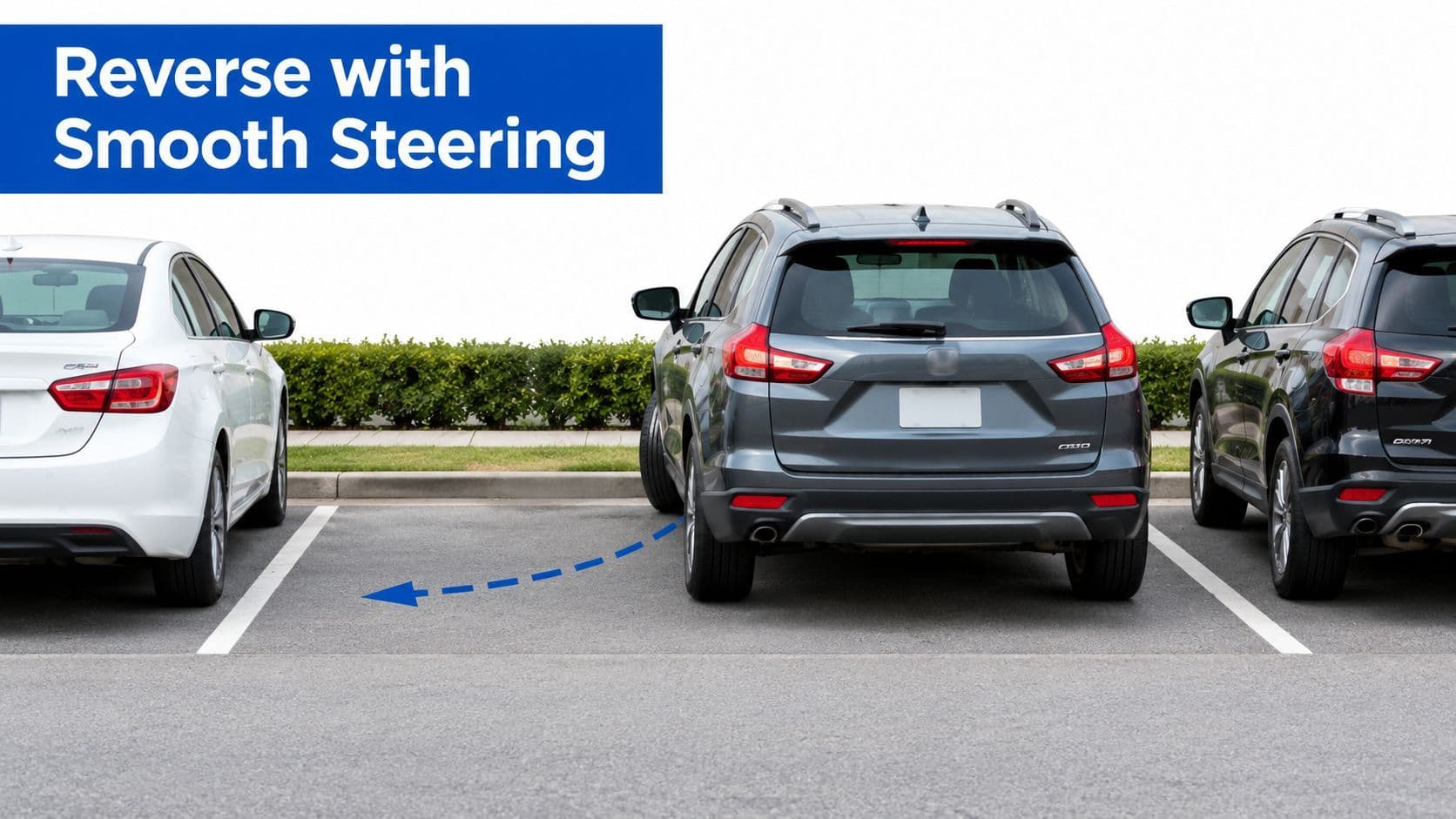
When the vehicle begins to centre, unwind the wheel smoothly. Compare the left and right lines through the mirrors and by turning your head. If one side is closing quickly, stop. Select drive, pull forward enough to reset the angle, and try again. Continuing to reverse while uncertain usually turns a small alignment problem into a larger one.
The final phase should be quiet. Straighten the wheel, keep checking both rear corners, and stop before the vehicle reaches a curb, another vehicle, or the end of the stall. The Ontario guidance requires the vehicle to remain within the pavement markings and avoid contact. If you're not sure where the front bumper is, stop and reassess rather than relying on a camera image alone.
A backup camera is helpful for seeing objects directly behind the vehicle, but it doesn't show every blind spot, the full front-end swing, or the behaviour of people moving through the lane. This mirror, shoulder-check, and signal guide supports the observation routine that should accompany the camera.
You can watch the manoeuvre here, but use the video as a visual aid, not as a substitute for checking your own vehicle's dimensions and surroundings.
Knowing When to Skip the Maneuver
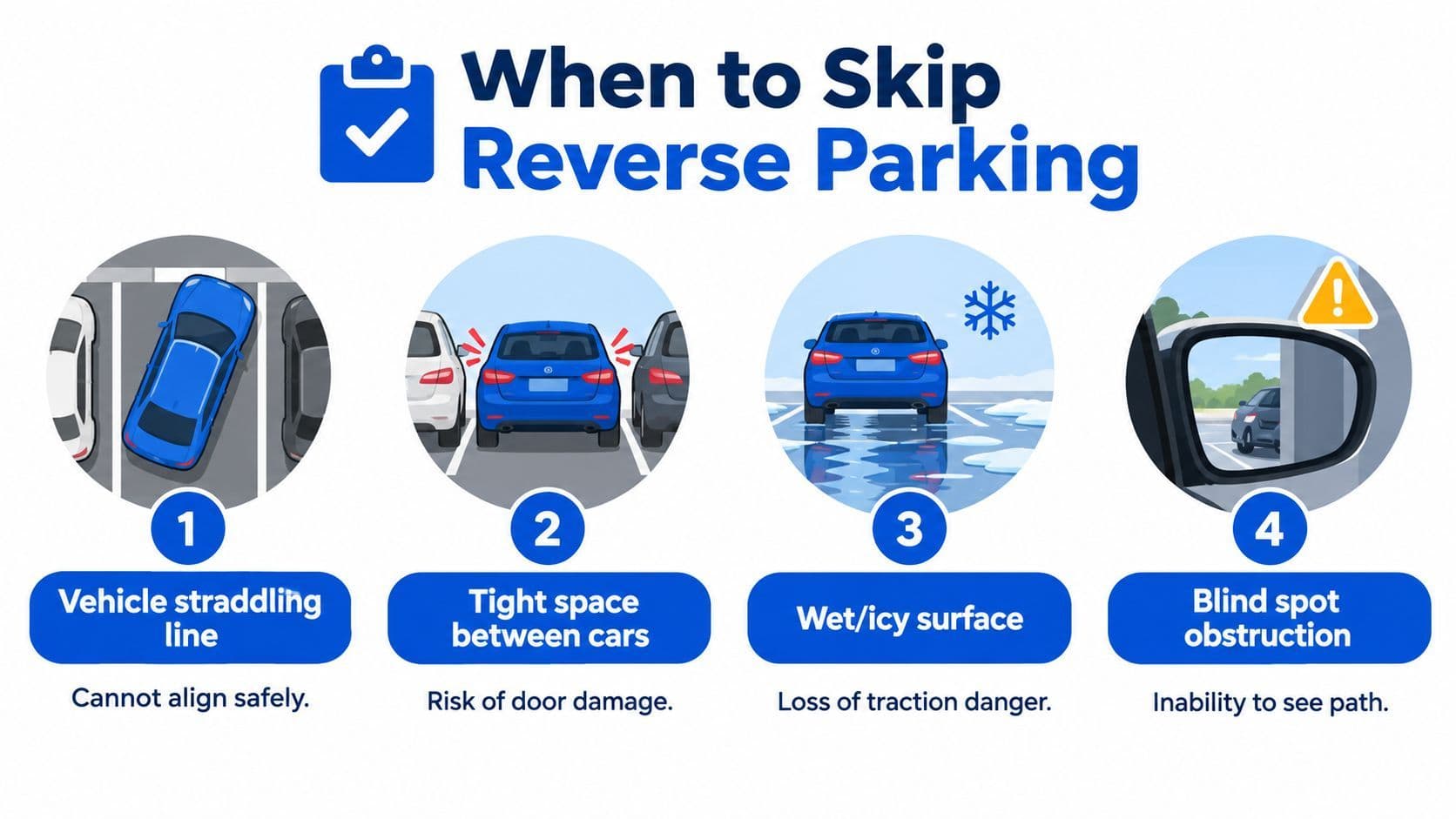
Reverse stall parking is not always the safest choice. A stall may be technically available while the surrounding conditions make the manoeuvre a poor decision. If a vehicle is straddling the line, a cart corral blocks the approach, or a pickup's tow hitch extends into the space, your reference points and clearance may no longer be reliable.
Other warning signs include:
- Poor markings: Faded or snow-covered lines make accurate centring difficult.
- Restricted visibility: A tall SUV, van, snowbank, pole, or hedge may hide a child, cyclist, or vehicle.
- Limited escape room: Tight angled rows can leave little space for the front end to swing.
- Active pedestrian movement: A crowd crossing behind the stall can turn a clear path into an occupied one.
- Slippery pavement: Ice or slush reduces the time and distance available for a controlled stop.
A vehicle leaving a stall must still yield appropriately to traffic using the parking-lot thoroughfare. Four-way flashers may make your intention more visible, but they don't give you right of way. If another driver is approaching, wait until the path is clear or choose a different space.
The point of no return isn't a marked spot on every lot. It's the moment when you've committed to the turn but can no longer see enough of the path to continue confidently. If doubt appears, stop while you still have room to select drive and reset. You can also drive past the stall, circle around, and approach from a side with better visibility.
If the mirrors raise a serious question, don't answer it by moving faster. Skip the stall and preserve your options.
Canadian survey evidence helps explain why this decision deserves attention. In an Angus Reid Forum survey of 1,012 Canadians who drove at least three times per week, conducted from April 6 to April 8, 2011, 38% said they avoided backing into parking spots because they feared hitting something, and 25% had been involved in or witnessed an accident involving a vehicle in reverse. The survey was national, not Ontario-only, and it shouldn't be treated as an Ontario collision rate. It does show why confidence must come from repeatable observation rather than bravado. Read the Canadian Tire survey release for that context.
The Mistakes That Cause Most Fails
Most poor attempts come from one of three sources: an unreliable reference point, unsuitable speed, or incomplete observation. Fixing the cause is more useful than memorising a correction after the vehicle is already crooked.
A driver who turns too early may be watching the curb instead of the stall line. A driver who turns too late may fixate on the side mirror and miss how far the rear axle has travelled. Choose one repeatable visual reference, confirm it with the surrounding lines, and steer in small stages rather than committing to a dramatic turn.
Speed creates a second cascade. If the vehicle rolls too quickly, there's no time to notice the front end swinging or a pedestrian entering the path. If you creep with inconsistent brake pressure, every steering correction can feel jerky. Keep the vehicle slow and steady, using the brake to control movement where possible.
The third problem is an awareness gap. Mirrors don't show every blind spot, and a camera doesn't tell you whether traffic is approaching from the side. Complete a full scan before reversing, then keep checking as the vehicle moves. If you lose the reference, stop and re-aim instead of adding more steering.
Mistake Pattern Root Cause Quick Fix Turning before the rear has reached the reference Watching the curb instead of the stall boundary Pause, confirm the rear axle's position, then begin a gradual turn Turning too late Fixating on one mirror Share attention between both sides, the direction of travel, and the front swing Ending crooked Holding steering input too long Start unwinding as the vehicle enters the centre of the stall Bumping a curb or object Reversing without a clear path Stop immediately, select drive, and reset Cutting across a neighbouring space Inadequate setup or excessive angle Pull forward and establish a wider, clearer approach Missing a pedestrian or cyclist Trusting mirrors or the camera alone Look around the vehicle before and during the manoeuvre
Ontario's official guidance says to stop if a hazard enters the path and not to touch the curb or another vehicle. Those are better performance standards than an unsupported provincial success percentage, because they describe behaviour you can observe and improve.
Practice Drills That Actually Build Skill
Start in a quiet, empty lot. Use cones or cardboard boxes to represent stall edges, but leave enough room that a mistake won't damage the vehicle. First, practise reversing in a straight line while keeping the vehicle stable and observing both sides. This teaches your eyes and hands to work together before you add a turn.
Next, create marked stalls and repeat the setup each time. Focus on the same sequence: signal, stop, scan, select reverse, move slowly, steer gradually, unwind, and stop. Don't chase speed. A clean, repeatable entry teaches more than a rushed attempt that happens to land between the lines.
A passenger can act as a spotter during early practice, but their voice shouldn't replace your own checks. Ask the passenger to identify hazards and distances, then confirm what they say through your mirrors and shoulder checks. This prevents you from blindly following a helper's directions.
Move to a quiet plaza only when the empty-lot routine feels controlled. Practise with real stall lines and parked vehicles, then introduce the complications Ontario drivers face, such as slush, faded paint, snowbanks, shopping carts, pedestrians, and a neighbouring vehicle parked badly. If conditions remove your reference points, treat that as a decision exercise and skip the stall when necessary.
Keep a short record after each session:
- Setup: Was the signal on, the path clear, and the vehicle positioned consistently?
- Execution: Did you maintain low speed, observe both sides, and correct without panic?
- Exit: Could you drive forward out while checking for traffic and pedestrians?
Only add a harder condition after you can complete repeated clean runs without contact, unobserved hazards, or uncontrolled corrections. The practice driving guide can help you organise supervised sessions around specific skills instead of accumulating time behind the wheel.
The complete routine is simple to carry with you:
- Decide first. Check visibility, surface, traffic, pedestrians, markings, and clearance.
- Prepare the vehicle. Adjust mirrors and seat, signal, and position consistently.
- Scan completely. Look around the vehicle and wait until the path is clear.
- Reverse slowly. Keep your eyes in the direction of travel and use small steering inputs.
- Correct early. Stop and pull forward if the angle or clearance becomes uncertain.
- Finish centred. Check both sides, avoid contact, and secure a safe exit.
If reverse stall parking still feels tense, use G1ready.ca's free, registration-free Ontario G1 practice exams to strengthen the rules behind safe observation, yielding, and parking-lot decisions. Visit G1ready.ca to practise with targeted quizzes, explanations, progress tracking, and an exam simulator before your next supervised driving session.


