
You've got the car half in a spot, the engine still running, and you're doing that quick mental math every driver in Kitchener knows: “Am I close enough to the curb, am I too near that driveway, and is this street one of the winter ones?” That's exactly where the Kitchener parking bylaw starts to matter. It's not just a ticket book, it's the rule set that decides whether a normal stop stays normal or turns into a penalty.
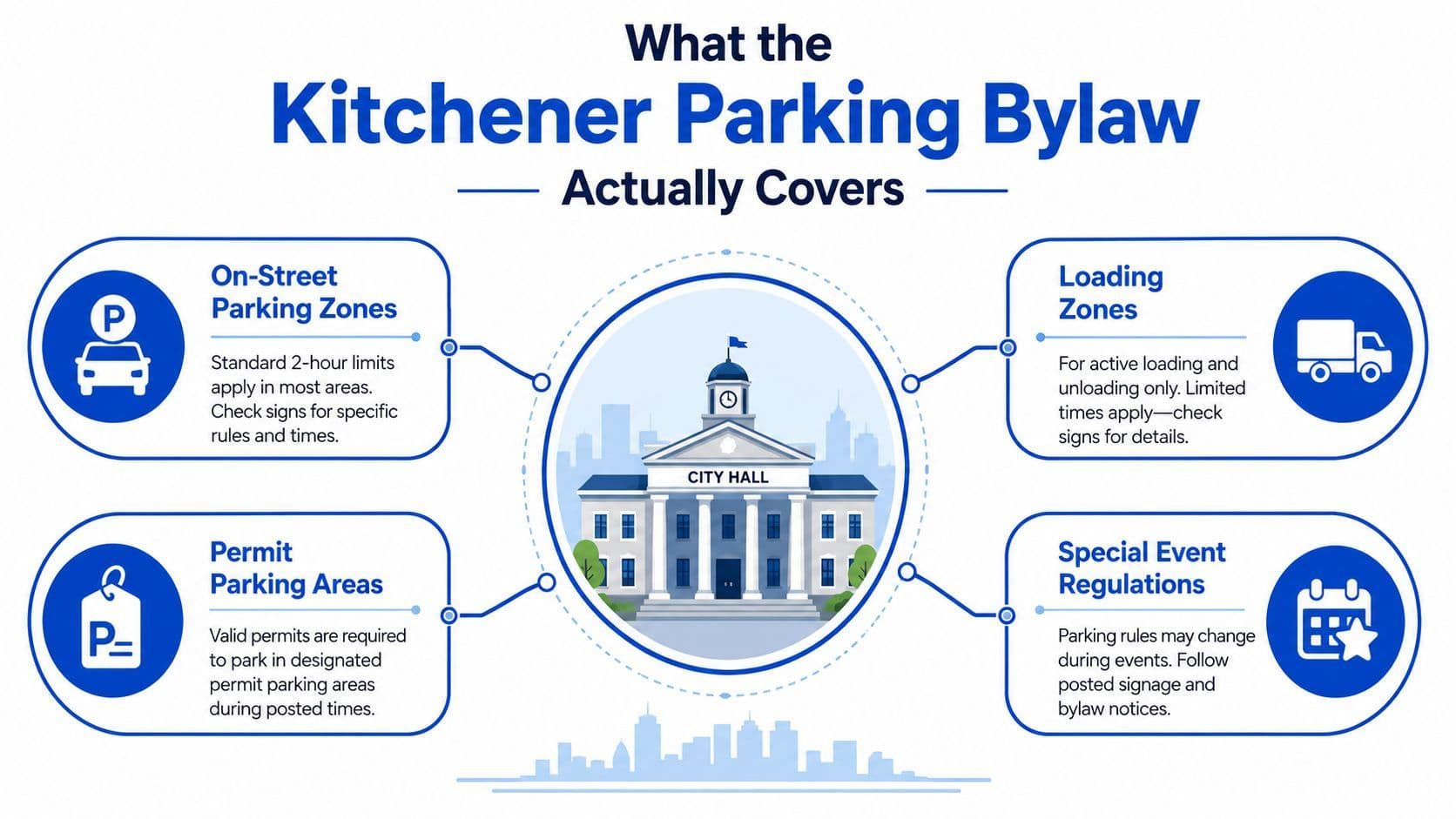
What the Kitchener Parking Bylaw Actually Covers
A new driver circles downtown Kitchener on a weekday afternoon, looking for a place to stop for five minutes. One space is tempting, another has a sign that's hard to read from the lane, and a delivery van is sitting in a loading area with its hazard lights on. That little scene is where parking rules stop being abstract and start deciding who gets a ticket.
Kitchener's parking rules sit inside By-law No. 2019-113, the City of Kitchener Traffic and Parking By-law, and violations are processed through Administrative Penalty System By-law No. 2019-039. In plain terms, that means parking enforcement is built into the city's legal structure, not handled as an informal warning system. The bylaw also covers basic roadway behaviour, including where a vehicle may sit on the street and where it absolutely cannot.
Why one bylaw reaches so many daily trips
Parking rules touch almost every kind of trip, not just commuting. A coffee run, a grocery stop, a visit to a friend, and a contractor's unloading routine can all fall under the same system if a vehicle is stopped in the wrong place or for too long.
Practical rule: if a space looks convenient but has a city sign, a curb marking, or a special purpose, treat that as the real rule, not your first impression.
The practical effect is simple. The city uses one bylaw to manage turnover on streets, protect driveways and hydrants, keep intersections clear, and shape how developments provide parking in the first place. That last part matters because parking is not only a curbside issue, it's also part of land use and site design.
For drivers, the big takeaway is this. The Kitchener parking bylaw governs both day-to-day stopping decisions and the wider parking system behind new development. If you understand that, the rest of the rules start making sense faster.
Core Time Limits and Distance Rules Every Driver Should Know
A lot of parking mistakes in Kitchener happen because drivers guess instead of measuring. The signs may be familiar, but the difference between a legal stop and a ticket often comes down to a clock, a driveway edge, or a fire hydrant that feels farther away than it really is.
The three rules that catch most drivers
The city says a vehicle may not park on a city street for more than 3 consecutive hours between 6 a.m. and 11 p.m. unless signs say otherwise, and street parking also has to stay at least 1.5 metres from a driveway and 3 metres from a fire hydrant. Those numbers are not suggestions. If your bumper sits too close, the stop can become a violation even when it feels brief to the driver.
A good habit is to look at the space the way an enforcement officer would. If you're two feet past a driveway edge, you're still inside the buffer. If you've parked near a hydrant “just for a minute,” the city still treats the location itself as the issue. Time and distance both matter, and either one can trigger a ticket.
For broader Ontario learner-driver parking practice, this G1 parking guide is a useful study aid.
Road position matters too
Kitchener also requires vehicles to park on the right side of the roadway unless otherwise permitted. The bylaw further prohibits parking within an intersection, and that includes a roundabout. Those rules sound obvious until a driver tries to squeeze into a turning area or half-block the lane because “there was nowhere else.”
A parking spot that creates a conflict point is usually the wrong spot, even if the vehicle fits.
New drivers get tripped up here. They focus on whether the car physically fits, but the bylaw cares about traffic flow, sight lines, and access for other road users. That's why a vehicle parked within an intersection is not a harmless convenience, it's a direct obstruction in a space meant for movement.
If you want the safest mental shortcut, use this sequence. Check the sign, check the clock, check the curb distance, then check whether your vehicle is sitting where other traffic needs to move. That habit prevents most curbside mistakes before they happen.
Restricted Zones Including Accessible Spaces and Loading Areas
Some spaces look like ordinary parking at first glance, but Kitchener treats them as special-use areas with stricter expectations. Drivers usually run into trouble here when they assume a short stop is fine because no one is using the space at that exact moment.
Accessible spaces are designed, not accidental
Kitchener's zoning standards show how seriously the city treats accessible parking at the development level. Barrier-free accessible parking begins at 1 space for 1 to 12 spaces, rises to 4% for 13 to 100 spaces, and reaches 11 plus 1% for lots with 1,000+ spaces. Those thresholds matter because they show accessible spaces are planned into lots based on size, not added casually after the fact.
That planning matters on the street too. A valid permit has to be displayed when a vehicle uses an accessible space, and misuse is still enforceable. A permit is not a free pass to ignore the purpose of the space.
Loading areas and other restricted zones
Loading zones, school-adjacent areas, bus stops, crosswalk approaches, and intersections all work on the same principle. The city protects a specific function, then expects drivers to leave that function undisturbed. A delivery driver who parks in a loading zone outside active loading hours may still be in violation if the space is reserved in the way the sign or mark indicates. The key question is not whether the truck is there for a few minutes, it is whether the vehicle is using a space set aside for something else.
This also explains why a car stopped near a pedestrian crossing or bus stop can become a problem quickly. Those locations are built for visibility and movement, and the bylaw treats interference seriously.
Driver's shortcut: if the space has a special purpose, assume it is not general parking unless the sign clearly says so.
The everyday mistake is easy to see. A driver thinks, “I'm only unloading,” but the city sees a protected zone that needs to stay available. That gap between intention and rule is where tickets usually start.
Overnight Parking and Winter Rules in Kitchener
Winter changes how the city treats curb space. A street that seems fine one week can become off-limits the next, and newcomers often get caught because they expect the same overnight rule to apply year-round.
Why winter parking gets treated differently
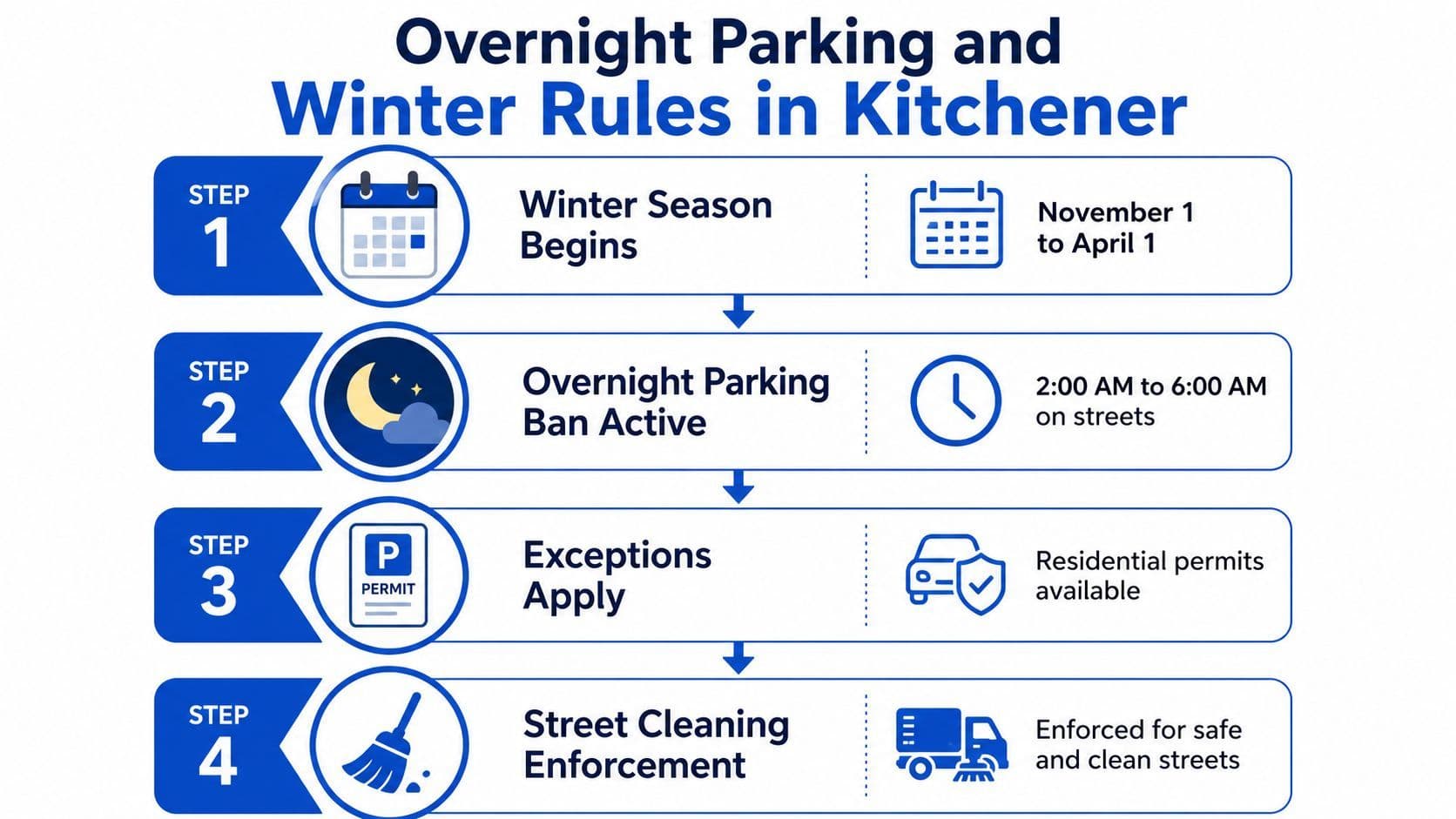
Overnight parking on streets is prohibited during the winter period, and the city's parking rules page directs residents to request exemptions when necessary. That approach gives the city room to handle snow operations and curb conditions without vehicles blocking the route. It also means the important question is not just the season, but whether winter parking rules are currently active for the street you want to use.
A winter overnight restriction is easy to underestimate because the curb may look quiet. But quiet does not mean open. When snow operations are underway, the city needs space to work street by street.
How to think about overnight stops
If you're used to parking overnight on a residential street during warmer months, don't assume the same habit carries through winter. Check the city's current parking guidance before you leave the car, especially if guests are coming or you'll be away from home for the night. When an exemption is needed, request it ahead of time instead of hoping for the best.
Winter rule to remember: if the city has moved into winter curb management, overnight street parking can turn from normal to prohibited without much warning.
The safest routine is simple. Before you park overnight in cold weather, check whether the city is running winter restrictions. That one check can save a long walk, a tow, and a frustrating morning.
How Parking Tickets Are Issued Under the Administrative Penalty System
A ticket in Kitchener isn't just a paper notice tied to the driver who happened to be behind the wheel. The city uses an administrative penalty system, which means the owner of the vehicle can be liable when the vehicle is parked, standing, or stopped in contravention of a designated bylaw. That's a major shift in how accountability works.
How a normal mistake becomes a penalty
Think about three common scenarios. A driver leaves a car too close to a hydrant while grabbing coffee. Another parks within the 1.5-metre driveway buffer while unloading groceries. A third stays past the street's time limit because the errand took longer than planned. In each case, the violation starts with a location or time issue, then becomes a ticket because the vehicle remained where the bylaw says it should not.
The bylaw's roadway-position rules also feed into those decisions. If a vehicle is parked on the wrong side of the roadway, or inside an intersection or roundabout, the issue is visible even before anyone argues about intention. Enforcement can focus on the vehicle's position, not just on whether the driver thought the stop was brief.
What AI-assisted enforcement changed
Kitchener's newer enforcement approach also uses AI-based parking enforcement, which has changed how often and where tickets appear. That doesn't make the rules softer. It makes detection more systematic, which means drivers are less likely to get away with a quick mistake they used to think no one would notice.
Ontario learner drivers can also review parking and road-rule practice with this New Driver guide.
The important part for drivers is this. Once a vehicle is observed in a prohibited place or beyond a time limit, the penalty process starts with the vehicle and its registered owner. If someone else was driving, that may matter to your personal story, but it doesn't erase the administrative framework behind the ticket.
Fines, Enforcement Volume, and the Move to Higher Penalties
Kitchener isn't handing out parking tickets casually. The city's own numbers show a system that handles a huge amount of curbside enforcement and is still leaning harder into compliance.
What the 2025 enforcement picture looked like
In the year before a June 2025 staff report, Kitchener received 17,162 complaints and issued 67,191 tickets, while complaints had been rising year over year since 2017. Staff also recommended $10 increases, which would be the first citywide bump since 2008. That tells you two things at once. Parking issues are common enough to keep the city busy, and fines are being used as a practical compliance tool.
Metric Value Source period Parking complaints 17,162 Year prior to June 2025 staff report Parking tickets issued 67,191 Year prior to June 2025 staff report Recommended fine increase $10 June 2025 staff report context First citywide increase since 2008 June 2025 staff report context
The same reporting said Kitchener's fine levels were lower than those of three partner municipalities discussed by staff. That comparison matters because it shows the city was looking at pricing as one lever inside a broader enforcement strategy, not relying only on warnings or officer discretion.
What the AI rollout changed
Independent 2025 reporting said the city's AI-based parking enforcement system increased compliance by about 70% and that ticket counts remained about 30% higher year over year after the rollout. Those figures help explain why parking enforcement feels more visible to drivers now. The city is not just reacting to complaints, it's using technology to find violations more consistently.
If you're a new driver, the message is straightforward. Parking enforcement in Kitchener is active, data-driven, and increasingly targeted. A quick stop that used to slip by can now show up in the system much faster than many drivers expect.
How to Contest a Parking Ticket in Kitchener
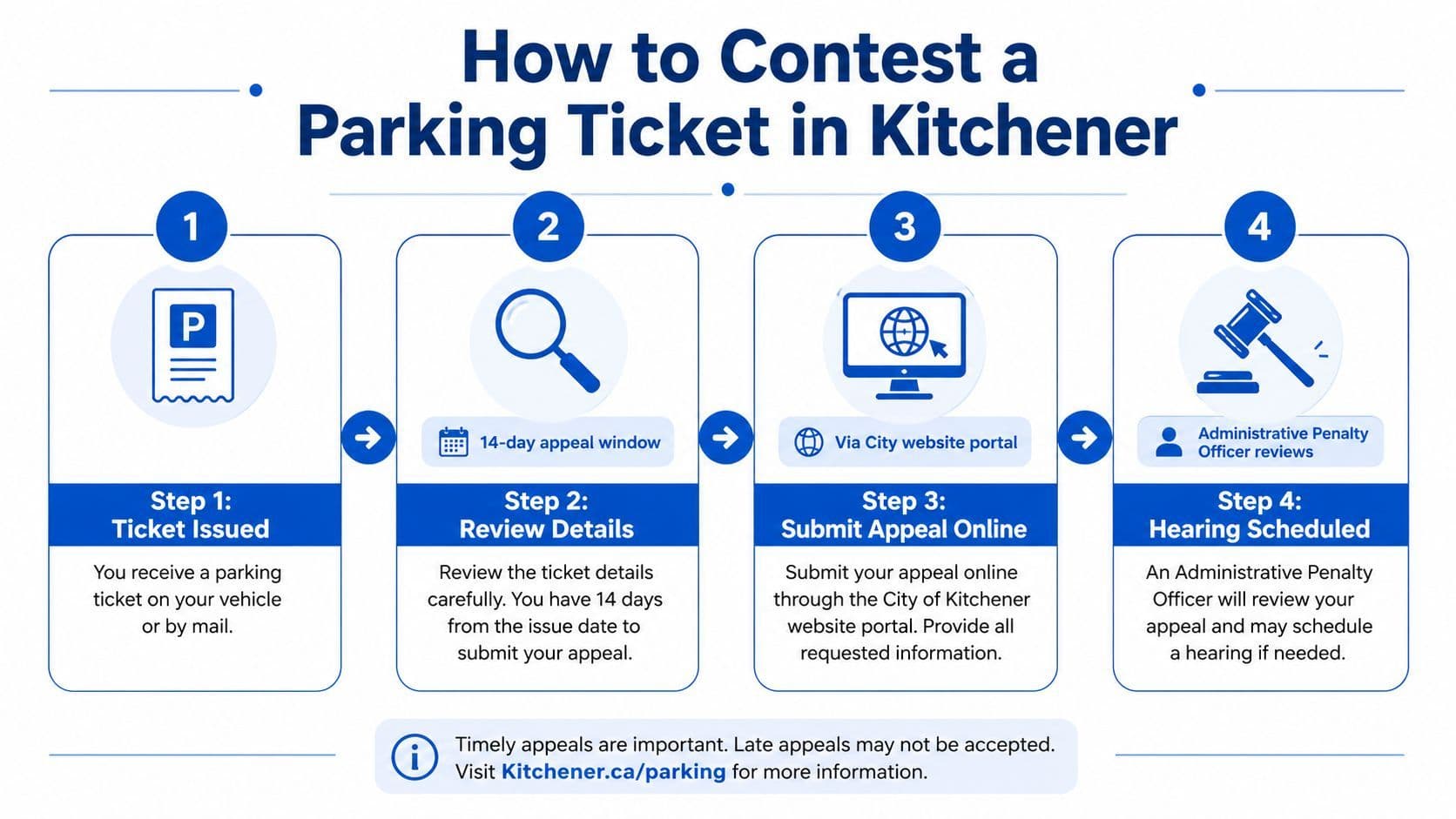
A ticket isn't always the end of the story, but the best appeals are the ones built on evidence, not frustration. If you think the ticket is wrong, start by reading it carefully and comparing the location, time, and sign details against what happened.
What helps in a review
Photos of faded signs, a clear shot of the curb area, a receipt showing when you returned to the vehicle, or proof of a valid permit can all matter if the facts support your position. If the sign was unclear or the marked zone was worn down, that can give a reviewer something concrete to assess.
A driver ticketed near a fire hydrant with poor marking may have a much better argument than a driver who forgot the time limit. The first situation raises a question about clarity. The second is usually just a mistake.
Where to start
The city's administrative penalty process is the place to begin, and you'll want to move quickly once the ticket is issued. Look for the screening or review forms on the city's official parking and administrative penalty pages, then submit the details with any evidence you have. A screening officer looks at the facts, the sign, the location, and the supporting material, not just the story told by the driver.
Realistic expectation: a review can help when the ticket is tied to unclear signage or a disputed location, but it usually won't reverse a straightforward time-limit violation.
If the violation is obvious and the evidence is weak, a challenge usually goes nowhere. If the location was unclear, the review process gives you a proper place to make that case.
Practical Tips, Common Scenarios, and Where to Find Official Sources
Most parking tickets come from familiar habits, not dramatic mistakes. Drivers rush, assume they'll be quick, or stop based on what looks available instead of what the sign and curb allow.
The habits that prevent most tickets
- Read the full sign: Don't stop at the first line. Check the time limit, the zone type, and any seasonal restriction.
- Count the metres: If you're near a driveway or hydrant, judge the buffer before you leave the car.
- Watch the clock: The 3 consecutive hours limit matters even on quiet streets.
- Check winter status first: Overnight parking can change when the city is in winter curb management.
- Use permit rules carefully: Residential and accessible permits only help when they're valid and properly displayed.
Kitchener's zoning rules for multi-unit dwellings also show how parking gets planned at the building level. For units under 51.0 m², the standard is 0.165 spaces per unit, while larger units require 0.8 spaces per unit, with at least 20% of required residential spaces pre-designed for future EV supply equipment. That's a good reminder that parking in Kitchener is shaped long before a driver ever pulls up to the curb.
For official verification, bookmark the city's parking bylaw page, the Traffic and Parking By-law PDF, and the city's Administrative Penalty System By-law. For learner drivers who want to practise Ontario road rules in a broader way, this G1 practice test for Kitchener is a useful place to start.
If you want to get more confident before the G1, G2, or your first solo drives around Kitchener, G1ready.ca gives you practice that fits Ontario rules and everyday driving decisions. Visit G1ready.ca to work through realistic tests, review the mistakes that new drivers make most often, and build the kind of parking judgement that keeps you out of trouble at the curb.


