Ontario's G1 knowledge test is available in Arabic, and it still uses the same 40-question official format with 20 road-sign questions and 20 rules-of-the-road questions. You need at least 16/20 in each section to pass, so this guide will walk you through the Arabic options, study materials, and test-day steps with no confusion.
A lot of newcomers reach this point with the same worry. They know they need the licence, but the system feels unfamiliar, the language feels like a barrier, and it's hard to tell which advice is official and which advice is just someone guessing.
Your Guide to Taking the G1 Test in Arabic
If you're new to Ontario, this can feel like the first big test of your driving life. You may be trying to read English road rules, compare notes from friends, and figure out whether Arabic support is available at the centre near you.
The good news is simple. The G1 test in Ontario Arabic is a real, official option, and it uses the same provincial knowledge-test structure as every other language version. That matters because the exam is not a loose conversation or an informal interview. It is a fixed written knowledge test that checks your understanding of road signs and road rules in the same official way at DriveTest centres across Ontario.
Practical rule: learn the test structure first, because it tells you how to study. If one half of the exam is weak, the whole attempt can still fail.
That's why this guide starts with the official language choices, then moves into study resources, then ends with a practical plan for preparing and booking. You'll see how to use Arabic-friendly materials, how to think about interpreter support when needed, and how to practise in a way that matches the actual test rather than wasting time on random questions.
For a newcomer, that can remove a lot of stress. Once you know the system, you can stop guessing and start preparing with purpose.
Official Language Options at DriveTest Centres
Ontario gives Arabic speakers two official paths for the G1 knowledge test. The first is the straightforward one, taking the test in Arabic where the language option is offered through the official system. The second is using an accredited interpreter when that route is allowed and arranged properly.
The written Arabic test path
The written test is still the same knowledge test, just presented in Arabic. That means you're not preparing for a separate exam with different rules, you're preparing for the same Ontario G1 knowledge test structure that all applicants face. The primary advantage is clarity, because you can focus on understanding traffic concepts instead of fighting the language.
This option is often the cleanest choice for Arabic speakers who can read Arabic comfortably and want to avoid any extra coordination on test day. It also keeps the experience simple, since you deal directly with the centre and the official test process.
The interpreter path
The other official route is to use an accredited interpreter. This can help if you understand the material better when it's explained aloud, or if you're more comfortable hearing questions in your preferred language. The key point is that the interpreter must meet the official requirement. A family member or friend isn't automatically acceptable just because they speak Arabic.
That distinction matters. The centre needs a clear, reliable process, and the interpreter is part of the official testing environment, not a casual helper standing beside you.
Before test day, make sure your documents are in order. Ontario requires original identification documents proving your legal name, date of birth, and signature, and it requires applicants to be at least 16 years old to take the test. Photocopies, scanned images, and phone photos are not accepted. If you want a location reference while planning your trip, use the official DriveTest centre locations page to check where you can go.
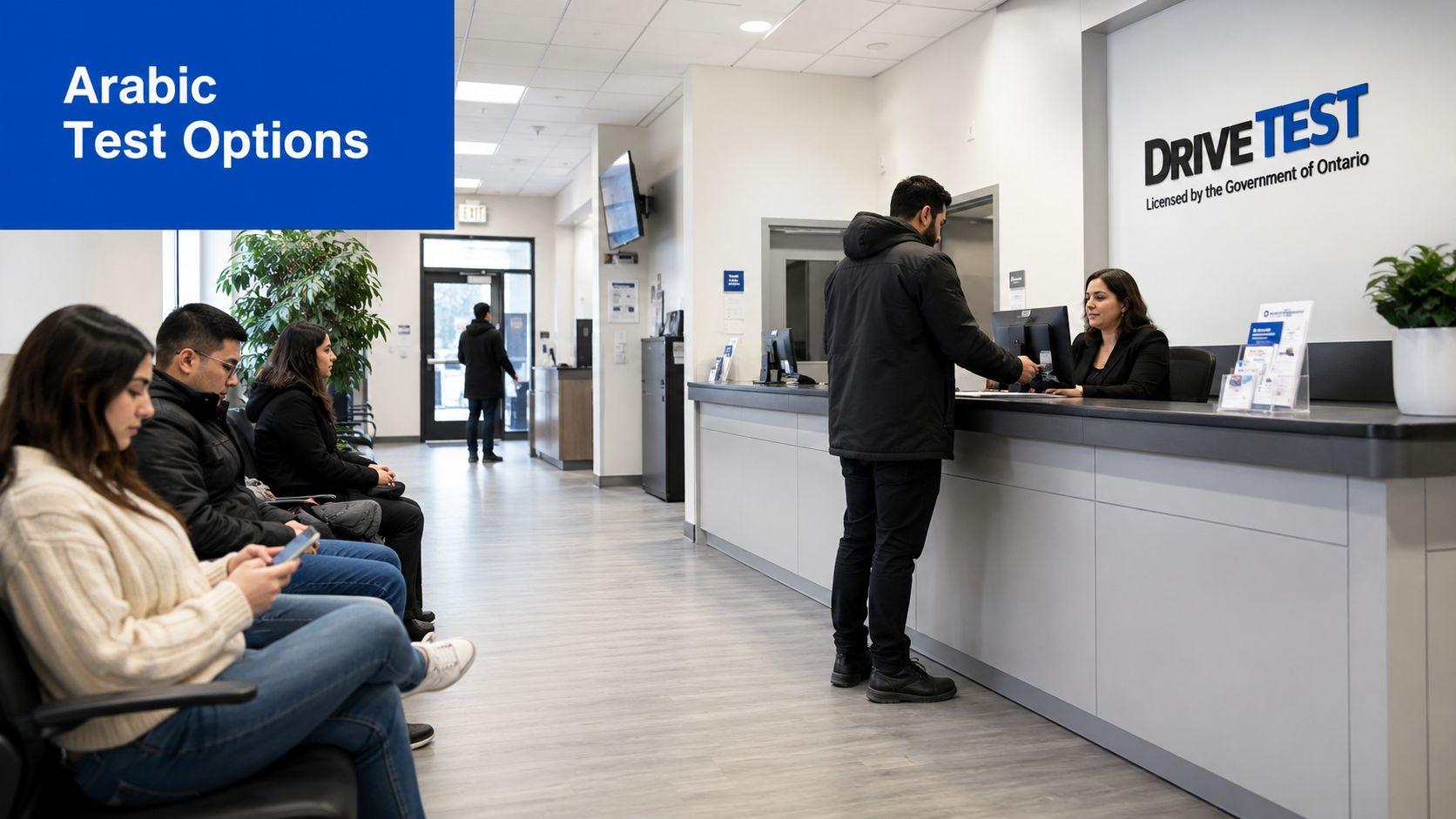
The centre visit is usually easier when you arrive with the language option already clear in your mind. That way, you can focus on the actual test instead of trying to solve paperwork problems at the counter.
Finding G1 Study Materials in Arabic
Once you know the Arabic option exists, the next job is gathering material you can study with. A lot of learners get stuck here because they assume there's only one official booklet and that everything else is unreliable. In practice, you want a small set of sources that work together.
Start with the official handbook
The MTO Driver's Handbook is the core resource because it covers the rules and signs the test is built around. If you can get an Arabic translation, that gives you the cleanest foundation for understanding the material in your strongest language. Use it as your main reference, not as something you skim once and forget.
Read it slowly and with a pen or notes app nearby. When you see a rule that feels unfamiliar, write it down in plain Arabic or simple English so you can revisit it later.
Add supportive learning sources
After the handbook, look for community support. Some driving schools, local educators, and Arabic-speaking tutors explain the same ideas in a more conversational way, which can help when the handbook language feels dense. Forums and third-party educational sites can also be useful for translation help or extra explanations, but they should support the handbook, not replace it.
That's especially helpful for people who learn better by seeing the same idea in different forms. One explanation might make sense on paper, while another becomes clear after someone talks it through with you.
If you want a visual overview of how official and supplementary resources fit together, use the study-resource diagram below. It's a quick way to see what belongs at the centre of your study stack and what belongs around it.
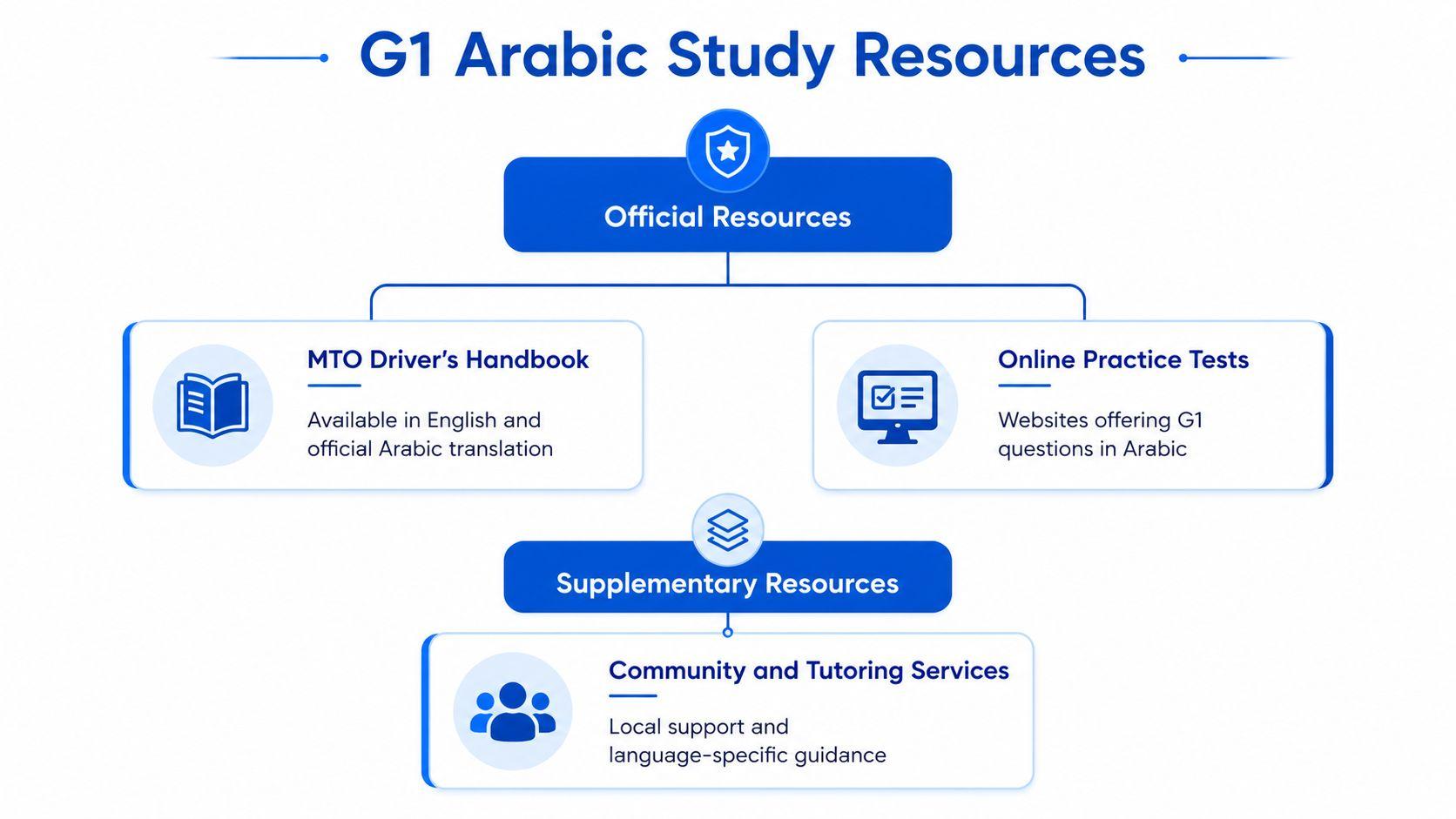
Keep your material organised in two folders, one for signs and one for rules. That small habit makes later practice much easier, because you'll know exactly where to go when a question keeps tripping you up.
A Step-by-Step G1 Study Plan for Arabic Speakers
A practical plan works better than cramming. When you study in a new country, the main problem usually is not intelligence, it is overload. Too many sources, too much vocabulary, and no clear order can make even a motivated learner lose momentum.
Start by making the process simple. Choose one path for the handbook, one path for practice, and one path for support in Arabic when a sentence or rule feels unclear.
Build your base with the handbook
Start with the official handbook and work through it in short sessions. Do not try to memorise everything at once. Read one section, stop, and ask yourself what the rule means in real driving terms.
For example, if a sign says something about stopping or yielding, connect that sign to the action you would take as a driver. That link between rule and action is what helps the material stick.
Separate signs from rules
Once the basics feel familiar, split your study into two lanes. One lane is road signs, the other is road rules. Ontario's G1 knowledge test uses 20 road-sign questions and 20 rules-of-the-road questions, and you need 16/20 in each section to pass. That means a strong score in one area cannot cover a weak score in the other.
Use that structure to your advantage. Spend one session on signs only, then another on rules only. If you keep mixing them too early, it becomes harder to see what you know.
Move into practice with tools that let you review mistakes
After your foundation is set, practise under test-like conditions. One useful approach is to work through a modern practice platform such as G1ready.ca, then use browser translation tools when you need help understanding a rule-based explanation. For many Arabic speakers, the signs are the easiest starting point because the visual meaning is universal, and the written explanation can be translated after the fact.
You can also add official guidance from DriveTest knowledge test guidance to check how the test is set up and what the centre expects. That keeps your study plan tied to the actual exam, while still letting you use Arabic support and digital practice tools together.
The goal of practice is not only getting questions right. It is learning why a wrong answer is wrong, then returning to the handbook section that explains it.
If you can explain the rule in your own words after a practice test, you are studying properly. If you can only recognise the answer when you see it again, you still need review.
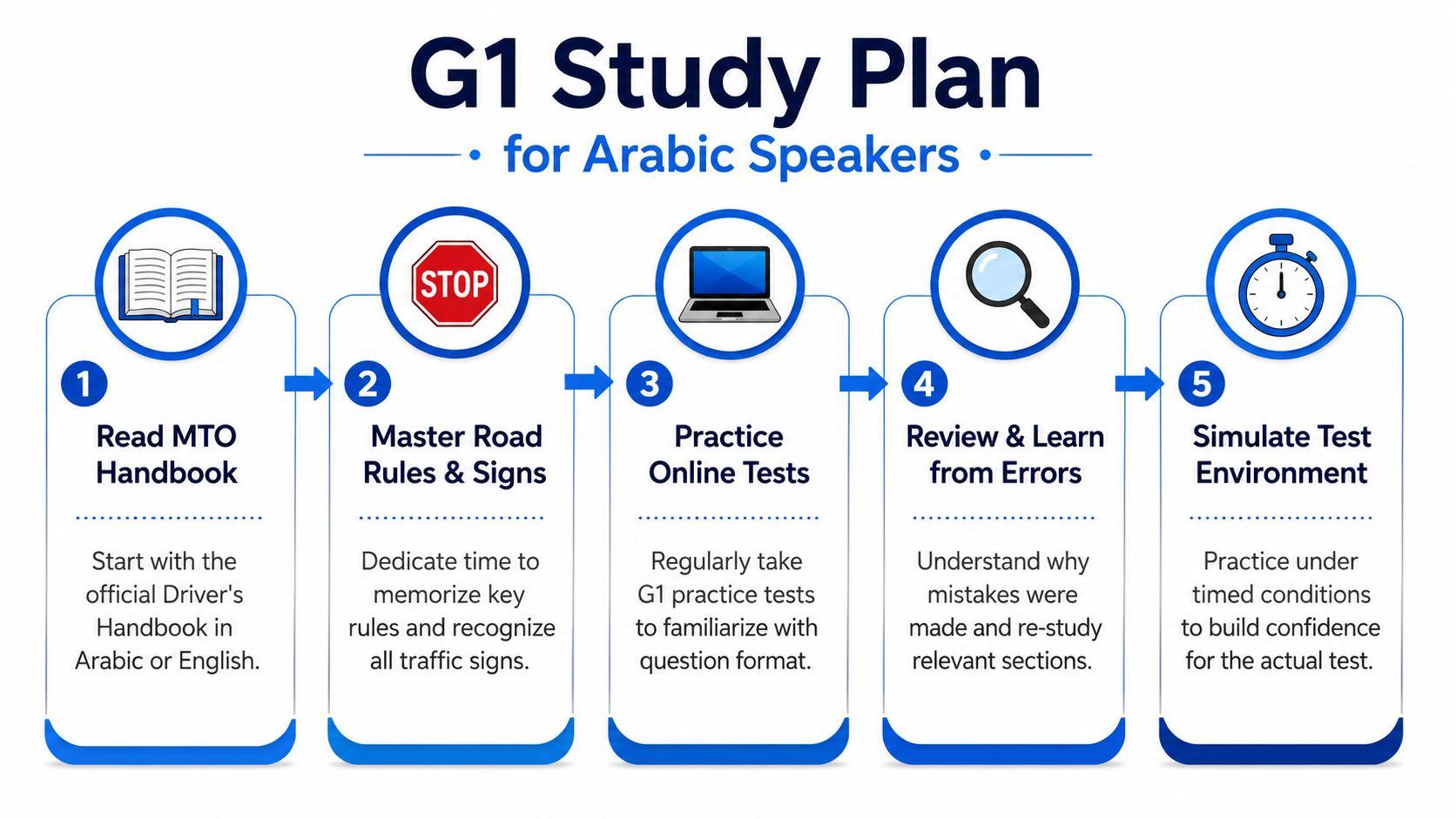
Use the final phase for simulation. Sit down without distractions, answer in one sitting, and check where you hesitate. That habit trains your attention for test day much better than casual browsing ever will.
G1 Practice Questions and Test Strategy
A practice question can look straightforward and still feel confusing if the wording is new. For many Arabic speakers, the hard part is not the rule itself. It is matching the English phrasing to the driving situation quickly enough to choose with confidence.
What the questions are really testing
Road-sign questions test recognition. You see the symbol, read the colour or shape, and identify the action it points to. Rules-of-the-road questions ask you to apply that rule in context, so you have to read the situation carefully before you answer.
The official test uses 40 questions drawn from a larger pool, and a weak result in either section means you do not pass (DriveTest knowledge tests). That is why a study plan built on guesswork usually falls apart on test day. You need to understand the rule behind the answer, not just memorise the letter beside it.
Use a pattern-based method
Sort your practice by question type. If a question is about an intersection, right of way, or safe following distance, place it with your rules practice. If it asks about a sign shape or colour, place it with your signs practice. This helps you review by pattern, the same way you would sort keys before opening the right door.
A simple loop works well:
- Answer first without help. Your first choice shows what you know under pressure.
- Check the explanation. Read why the correct answer works, not only which option is right.
- Translate only the hard parts. Use translation support for the explanation if English is blocking understanding.
- Retest the same concept later. Come back after a break and see whether the rule still makes sense.
For a companion reference while you review question types, use the Ontario driving test question guide. It can help you connect the wording of a question with the rule it is testing.
Focus on error review, not volume
A larger stack of questions does not help much if you never return to the ones you missed. The same confusion comes back when the mistake is not reviewed. A smaller set of questions you have corrected carefully is usually more useful than a bigger set of guesses you leave untouched.
Aim for confidence with accuracy. Once you can explain why an answer is correct, the material starts to feel steadier, and the test becomes easier to approach with a clear head.
Booking Your Test and Using an Interpreter
Booking the test is the part where preparation becomes logistics. You've studied, you understand the language choice, and now you need to make sure the centre visit goes smoothly. That means documents, timing, and interpreter rules all need attention.
Get the basics right before you book
Check that you meet the age requirement and have the right ID ready. Ontario requires applicants to be at least 16 years old and to bring original identification documents showing their legal name, date of birth, and signature. Photocopies, scanned images, and phone photos are not accepted (G1 test requirements).
That sounds simple, but it's one of the most common places people run into trouble. If the document isn't original, it doesn't help you at the counter.
Handle the interpreter step carefully
If you plan to use an interpreter, treat that as an official arrangement, not a last-minute favour. The interpreter has to meet the DriveTest process, and you should confirm the details before test day so there's no confusion when you arrive. A family member who casually speaks both languages is not automatically the right choice.
For local logistics and city-based planning, the Toronto G1 knowledge test guide can help you think through the process in a practical way, especially if you're comparing centre options or planning around transit.
If you're unsure, call ahead and ask the centre what they expect from your specific setup. That saves time and lowers the chance of being turned away because of a missing document or a misunderstood interpreter arrangement.
Keep your test-day folder ready the night before. Put your original ID, booking details, and any interpreter-related information in one place so you're not searching for anything in the morning.
Frequently Asked Questions About the Arabic G1 Test
Can a family member act as my interpreter? Not by default. You need an accredited interpreter arranged through the official process, so don't assume a relative or friend can step in just because they speak Arabic.
Is there an extra fee for taking the test in Arabic? The language itself doesn't change the nature of the test. Focus on the official booking and test process, and confirm any fee details directly when you arrange your appointment.
What happens if I fail? The retest process follows the same Ontario G1 system, regardless of language. Since the test is section-based, the smartest next step is to review the part that caused the failure and practise that section more deliberately.
Will the Arabic version be easier? Not easier, just clearer if Arabic is your stronger reading language. The official structure stays the same, so the main advantage is understanding the question without translating every word in your head.
If you're getting ready now, set up your study materials, confirm your documents, and choose the language path that fits your comfort level. Then use G1ready.ca to keep practising in a way that matches an authentic Ontario G1 experience.