
You're probably in one of two spots right now. You've either bought the helmet, started looking at bikes, and realised the licence process comes first. Or you've already tried a few random motorcycle quizzes online and noticed something unsettling. The questions feel inconsistent, the wording shifts from site to site, and you're not sure if any of it matches what Ontario expects.
That uncertainty is where individuals commonly lose time.
Passing the Class 6 knowledge test in Ontario isn't about grinding endless mixed questions and hoping your score climbs. It's about understanding how the test is built, then preparing in a way that closes weak spots before they cost you the result. That matters because the motorcycle learner test is less forgiving than many first-time riders expect. A broad sense of confidence isn't enough. You need section-by-section control.
A good class 6 knowledge test practice routine should do two things at once. It should help you pass the exam, and it should start building the habits of a rider who notices risk early, reads the road properly, and respects the machine.
Your First Step to Two Wheels
The appeal of riding is easy to understand. A motorcycle gives you a kind of focus that a car never does. Every turn, every stop, every lane choice demands attention. For a lot of new riders, that's exactly the point.
The first gate, though, is the written test. And this is where enthusiasm can work against you. Plenty of people assume the motorcycle learner exam is just a lighter version of the car test with a few bike questions mixed in. It isn't. It rewards organised preparation, not casual familiarity.
If you're still sorting out how Ontario licensing works as a whole, it helps to review the Ontario graduated licensing system before you book anything. That bigger picture matters because the written stage isn't an isolated task. It's the start of a progression, and each stage builds on the discipline you develop now.
Ride motivation is good, but system beats motivation
A rider who studies only when they feel inspired usually ends up with patchy knowledge. They know obvious signs, remember a few right-of-way rules, and feel decent about safety gear. Then the test hits a narrow weakness they never drilled properly.
Practical rule: Treat the motorcycle knowledge test like skills training, not trivia.
That shift changes how you prepare. Instead of asking, “How many practice questions can I do tonight?”, ask, “Which topic am I tightening up tonight?” That's how you move from vague confidence to dependable recall.
What works right away
These habits make the biggest difference early:
- Read with a pencil: Mark anything that feels easy to skim past, especially wording tied to rider judgement, lane position, and hazard awareness.
- Separate topics immediately: Keep road signs, road rules, and motorcycle-specific material in different notes from day one.
- Study for recall, not recognition: If you can only answer when options are in front of you, you're not ready yet.
That's the essential starting line. Not booking the test. Not opening a quiz app. Building a method you can trust.
Deconstructing the Motorcycle Knowledge Test
The biggest mistake I see is simple. New riders underestimate the structure.
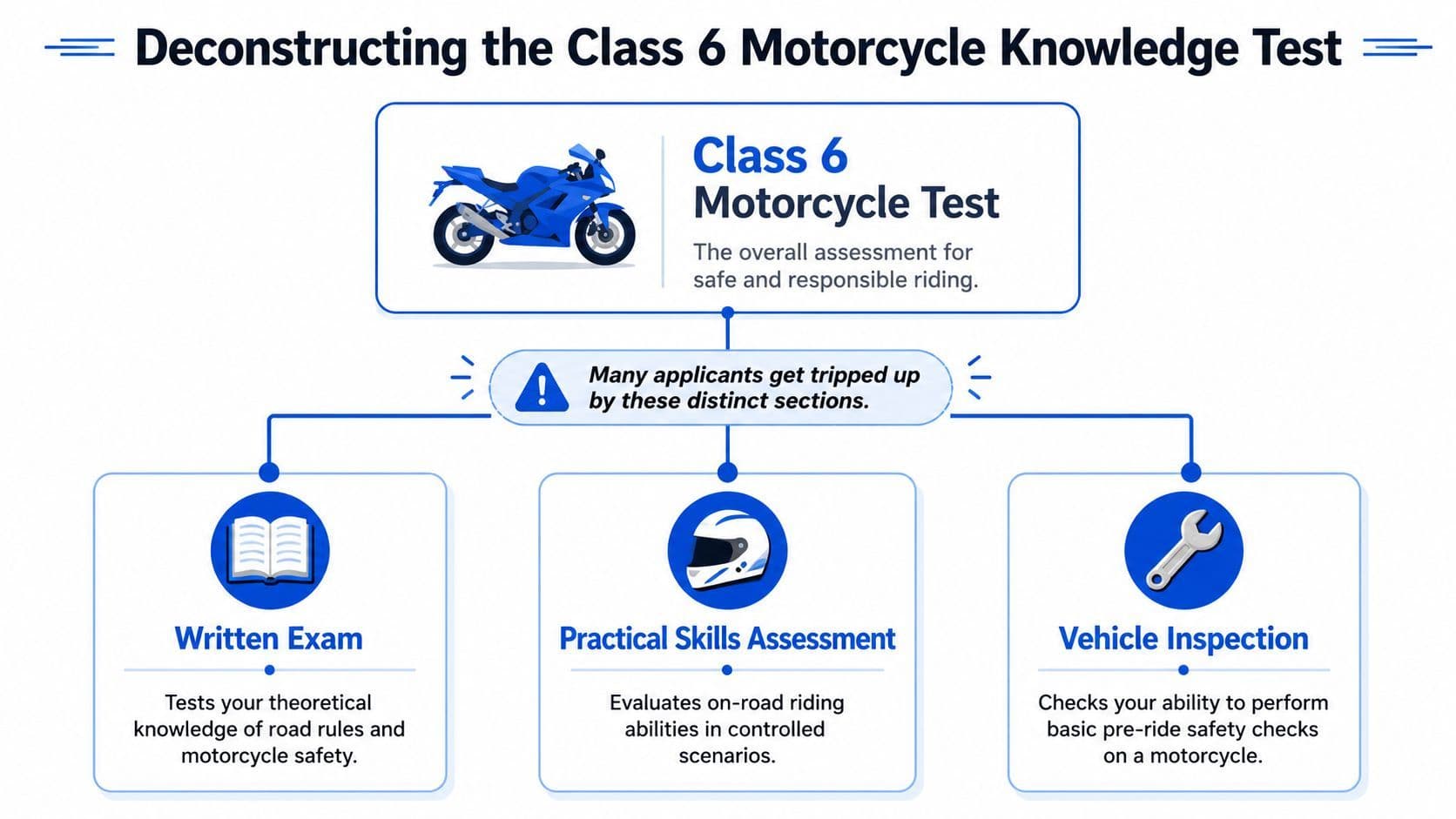
For Ontario motorcycle learners, the Class M1 knowledge test requires at least 80% in each of the three separate sections: road signs, rules of the road, and motorcycle-specific issues. If you fail even one section, you fail the whole test. About 35% of first-time candidates fail because they misunderstand that all-section-pass requirement rather than because they lack general knowledge (Ontario M1 test breakdown).
Why the structure changes everything
That one rule should shape your entire class 6 knowledge test practice plan.
A mixed score can hide a weakness. You might do very well on signs, stay decent on general rules, and struggle on motorcycle-specific questions. On a casual practice quiz, your overall result may still look fine. On the official test, that weak section can sink the whole attempt.
This is why broad practice alone doesn't work well at the start. It blurs your problem areas instead of exposing them.
Passing the test is not about being strong overall. It's about not having a weak section on exam day.
That's a different standard, and it calls for a different system.
What each part is really testing
Each section demands a slightly different kind of thinking.
Road signs test quick identification. You need clean recognition, not hesitation. If you pause too long to reason through a sign, you're probably relying on memory that isn't settled yet.
Rules of the road test precision. These questions punish sloppy reading. One small phrase can change the right answer, especially when the choices seem similar.
Motorcycle-specific issues test judgement that applies to riders, not drivers in general. Many beginners often find this surprising. They studied as if they were writing a car test plus a few bike extras. Ontario doesn't treat it that way.
A practical way to think about the test is this:
Section What usually causes mistakes Best study approach Road signs Confusing similar signs Fast visual flashcard drills Rules of the road Misreading wording Slow review, then short written self-tests Motorcycle-specific issues Assuming car knowledge carries over Chapter-by-chapter notes and scenario questions
When riders understand this structure early, their preparation gets sharper fast. They stop chasing one average score and start building three reliable ones.
Building Your Practice Test Arsenal
Most learners begin in the wrong place. They search for class 6 knowledge test practice, open five tabs, and assume more quizzes means better preparation. It doesn't. If the material is outdated, shallow, or car-focused, repetition just reinforces weak studying.
Your safest foundation is the official motorcycle handbook and your own study tools built from it.
If you want a place to compare quiz styles and practise selectively, you can review different practice test formats, but use online tests as a supplement. Don't let them become your source of truth.
Start with the handbook, not random quizzes
The handbook gives you the wording, concepts, and categories the test is built around. That matters because good preparation starts with reliable input. A random website may help you rehearse. It may also teach you shortcuts that fall apart under slightly different wording.
I tell new riders to read the handbook in layers.
First pass, read for familiarity. Don't stop every minute. Just get the terrain in your head.
Second pass, turn passive reading into active notes:
- Mark sign meanings: Keep one running list of signs that are easy to confuse.
- Pull out rule triggers: Write down situations that change what a rider must do, such as lane choices, scanning, and positioning.
- Flag rider-only material: Anything that applies specifically to motorcycles should go into its own page or note set.
Build tools you can reuse
Once you've got the source material, turn it into a small system.
Flashcards work best for signs. Put the image or name on one side and the meaning plus a short note on the back. If two signs seem similar, pair them and compare them directly.
Self-made questions work best for rules. After each handbook section, write a few questions in plain language. Then rewrite some in a trickier style. That second step matters because the main challenge often isn't the topic. It's recognising the correct answer when the wording is less obvious.
Scenario notes work best for motorcycle topics. Don't just copy sentences. Write short riding situations and answer them. For example, ask yourself what the safe response is when traction changes, visibility drops, or a driver may not have seen you.
Field advice: If you can explain a rule out loud in simple language, you probably understand it. If you can only recognise it in multiple choice form, keep studying.
A strong practice arsenal isn't complicated. It's organised. That's what makes it dependable.
A Strategic Study Schedule That Works
Many individuals waste their first two weeks by doing mixed tests too early. It feels productive because you're answering questions, but you're not building control. You're sampling. That's not the same thing.
The better approach is staged. Isolate each category first. Then combine them once your weak spots are harder to find.
For general Ontario test prep, the study habits in this guide to preparing efficiently line up well with this approach. The motorcycle version just needs more deliberate separation between categories.
The first half of your prep
The first part of your schedule should be narrow and repetitive in a useful way.
For Ontario motorcycle learners, one effective method is to break practice into isolated section drills until you can consistently reach 90% in each section before moving to mixed tests. That recommendation appears alongside the explanation of the all-section-pass rule in the same motorcycle test reference discussed earlier.
That threshold matters because it gives you margin. You don't want to scrape by in practice and hope pressure doesn't lower your score on test day.
Here's a workable four-week structure:
Week Focus Monday-Wednesday Thursday-Friday Weekend Week 1 Road signs only Read sign material, build flashcards, do short sign drills Review misses and sort confusing signs into pairs Run several sign-only practice rounds and correct every mistake Week 2 Rules and motorcycle topics in isolation Split sessions between road rules and motorcycle-specific notes Write your own scenario questions and review weak areas Alternate section-only drills, no mixed tests yet Week 3 Controlled integration Begin mixed sets after warm-up drills in weak sections Track misses by category, then return to isolated review Do timed mixed practice and post-test correction sessions Week 4 Exam simulation and polish Short targeted refreshers only Full simulations with careful review of errors Light review, rest, and final readiness check
The second half of your prep
Weeks three and four should feel different from the start. By then, you're no longer trying to learn what's on the test. You're trying to prove you can hold up under mixed conditions.
Use this sequence:
- Start each session with your weakest category.
- Move into a mixed set only after that warm-up.
- Review every wrong answer by asking why you missed it.
- Rewrite the ones you got wrong into a note or flashcard.
That last step is where a lot of improvement happens. Riders often repeat quizzes without repairing the underlying mistake. Don't just mark wrong answers. Convert them into study material.
The best practice sessions feel a bit narrow. If every session feels entertaining and varied, you may be avoiding the exact repetition your weak areas need.
A strategic schedule works because it respects how the test is scored. You aren't studying for an average. You're training until no section can betray you.
Common Mistakes That Lead to Failure
The most common bad habit is also the most accepted one. People take random mixed tests from the start and assume that's realistic preparation. For this exam, it usually isn't.
When the scoring standard requires a pass in each section, mixed practice can hide what matters most. It gives you one blended result. The test does not.
Why mixed testing too early backfires
A rider gets a decent overall score and relaxes. But inside that result, the motorcycle-specific section may still be unreliable. That's how people walk into the test feeling ready and leave frustrated.
Memorising answer patterns creates the same problem. You start recognising the right option instead of understanding the rule. Then one wording change throws you off.
Three better checks are more revealing than a single average score:
- Section confidence: Can you handle one category on its own without warm-up questions?
- Error pattern: Are your mistakes random, or do they cluster around one topic?
- Explanation test: Can you say why the right answer is right and the others are wrong?
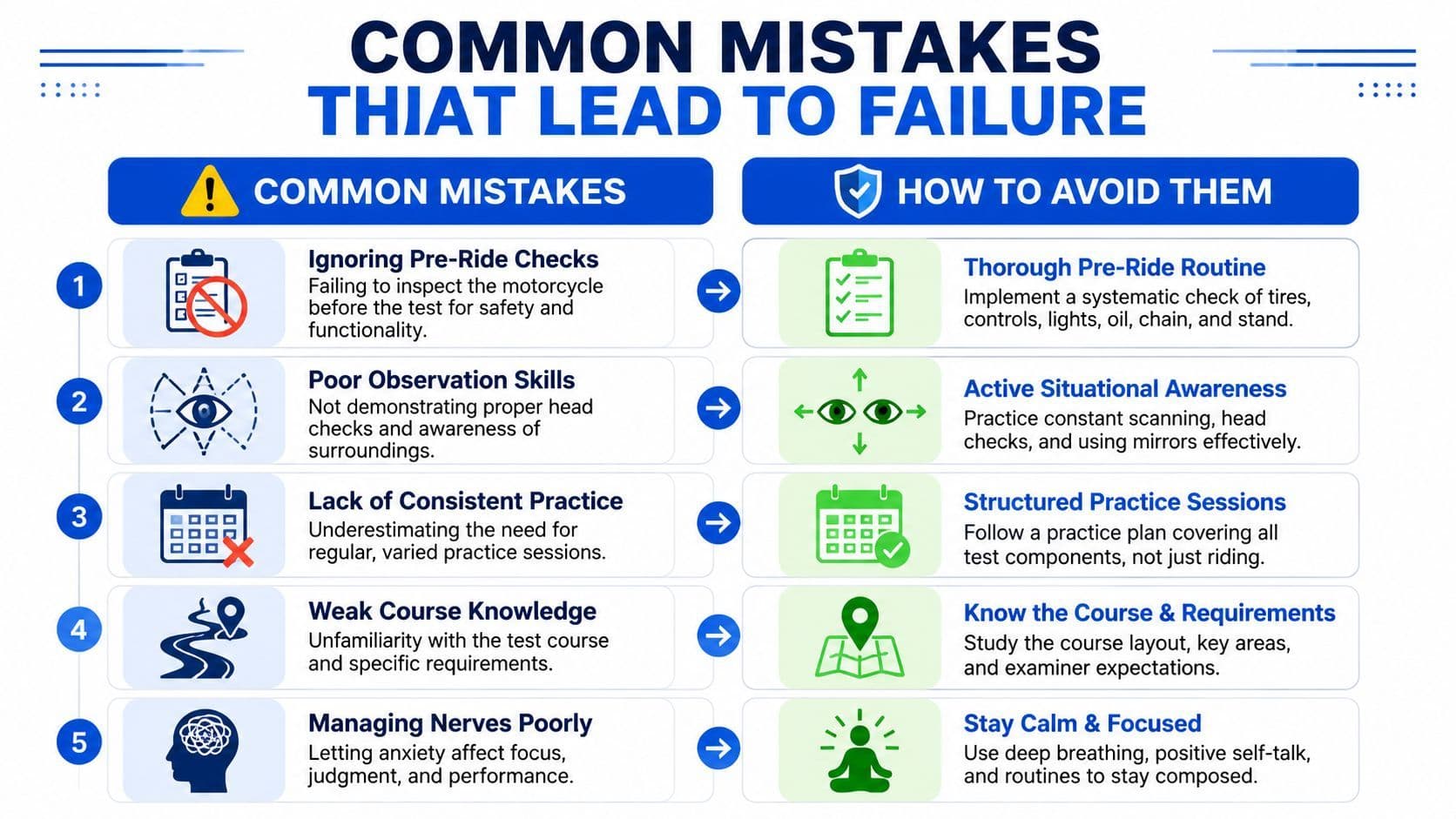
Here's a quick visual reminder of what tends to go wrong and how to fix it.
The traps I see most often
Some mistakes repeat themselves so often that they're almost predictable.
- Neglecting motorcycle-only material: Riders with car knowledge often assume this part will be easy. It's often the section that exposes them.
- Reading too quickly: On rule questions, one missed word can flip the answer.
- Changing a correct answer from nerves: If you understood the rule and chose carefully, last-second switching often hurts more than it helps.
- Using only one study mode: Endless quizzes without notes, flashcards, or explanation work lead to shallow retention.
- Cramming mixed sets late at night: Tired practice creates false confidence and sloppy reading.
Good riders don't just know the answer. They know why the answer protects them.
That's the standard worth chasing. It helps on the test, and it matters even more once you start riding in traffic.
Your Final Week and Test Day Plan
The last week is not for chasing new material. It's for tightening recall, calming your pace, and reducing avoidable mistakes.
What to do in the final stretch
In your final study days, shorten the sessions and sharpen the focus. Review the notes you already built. Re-run your weak flashcards. Do a few mixed simulations, but stop if you catch yourself guessing from fatigue rather than thinking clearly.
Keep the review practical:
- Revisit your misses: Look at the questions or topics you've missed more than once.
- Use short sessions: A clean review session beats a long, unfocused grind.
- Stay section-aware: Even late in prep, don't let mixed testing erase category tracking.
For Ontario drivers taking the G1 knowledge test, the initial fee in 2026 was approximately $158.25 and included one knowledge test attempt, while retaking the knowledge test cost an additional $15.75 per attempt (Ontario fee reference). That figure is a good reminder of the broader point. Preparation is cheaper than retakes.
What to do on test day
Bring what you need, arrive with time to spare, and don't create pressure by rushing the start of your day. Once you're seated, read every question once for meaning and a second time for detail if needed.
Use a simple test-day checklist:
- Bring required identification: Don't assume. Confirm what the test centre expects before you leave.
- Eat and hydrate normally: Don't show up distracted by hunger or too much caffeine.
- Set a steady pace: Fast isn't the goal. Clean reading is.
- Protect your focus: Don't dwell on one hard question and let it affect the next ones.
If nerves show up, that's normal. Riders who prepare properly still feel them. The difference is that preparation gives you something solid to fall back on.
If you want extra practice for Ontario knowledge testing in a clean, structured format, G1ready.ca offers registration-free practice exams, targeted quizzes, instant feedback, and mobile-friendly study tools that make it easier to spot weak areas and build confidence before test day.


