You're probably doing one of two things right now. You're either sitting in the parked car with both hands on the wheel, wondering if they're in the right place, or you're studying for your Ontario test and realising that “just steer normally” isn't enough.
That feeling is completely normal.
Most new drivers think steering is the easy part. Press the pedals carefully, check mirrors, stop at signs, and the wheel will take care of itself. In practice, your steering wheel grip is one of the first things that shows whether you're calm, controlled, and test-ready. Examiners notice it quickly. Instructors notice it even faster. If your hands slide around, cross awkwardly, or drop to one hand in a turn, it tells everyone in the car that the basics still need work.
A good grip doesn't make you stiff. It makes you predictable. That matters on every lesson, every lane change, and every turn through an intersection. It also helps when you're reviewing the broader rules of the road in the Ontario road rules guide, because steering control only works when it supports correct decisions.
Your First Connection to the Road
The first time a learner pulls out of a driveway, the wheel usually gets squeezed too tightly or held too casually. I see both. One student locks their elbows and stares straight ahead. Another rests one hand at the top of the wheel because it feels natural. Neither habit gives solid control.
Steering is your first physical connection to the car. Before you master parking, merging, or test routes, you need to feel what the front wheels are doing and guide them smoothly. That only happens when your hands start in the right place and stay organised while the car is moving.
A learner who holds the wheel properly usually improves faster in other areas too. Their lane position settles down. Their turns stop looking rushed. They make fewer sudden corrections because the wheel isn't surprising them.
Practical rule: If your hands are placed well, the rest of your steering becomes easier to clean up.
That's why instructors spend so much time correcting grip early. It isn't fussy detail. It's the foundation. Good steering wheel grip helps you keep the car centred, make cleaner turns, and show the examiner that you're managing the vehicle instead of reacting to it.
Why this matters on the test
On an Ontario road test, the examiner isn't grading style. They're grading control. They want to see that you can keep both hands available, steer without panic, and recover smoothly after a turn. Even simple mistakes at the wheel can affect how safe and prepared you appear.
Think of your steering as a quiet skill. When it's done well, nobody comments on it. The car tracks cleanly, the turn finishes neatly, and your hands never seem lost. That's the standard you want.
The Official 9-and-3 Steering Wheel Grip
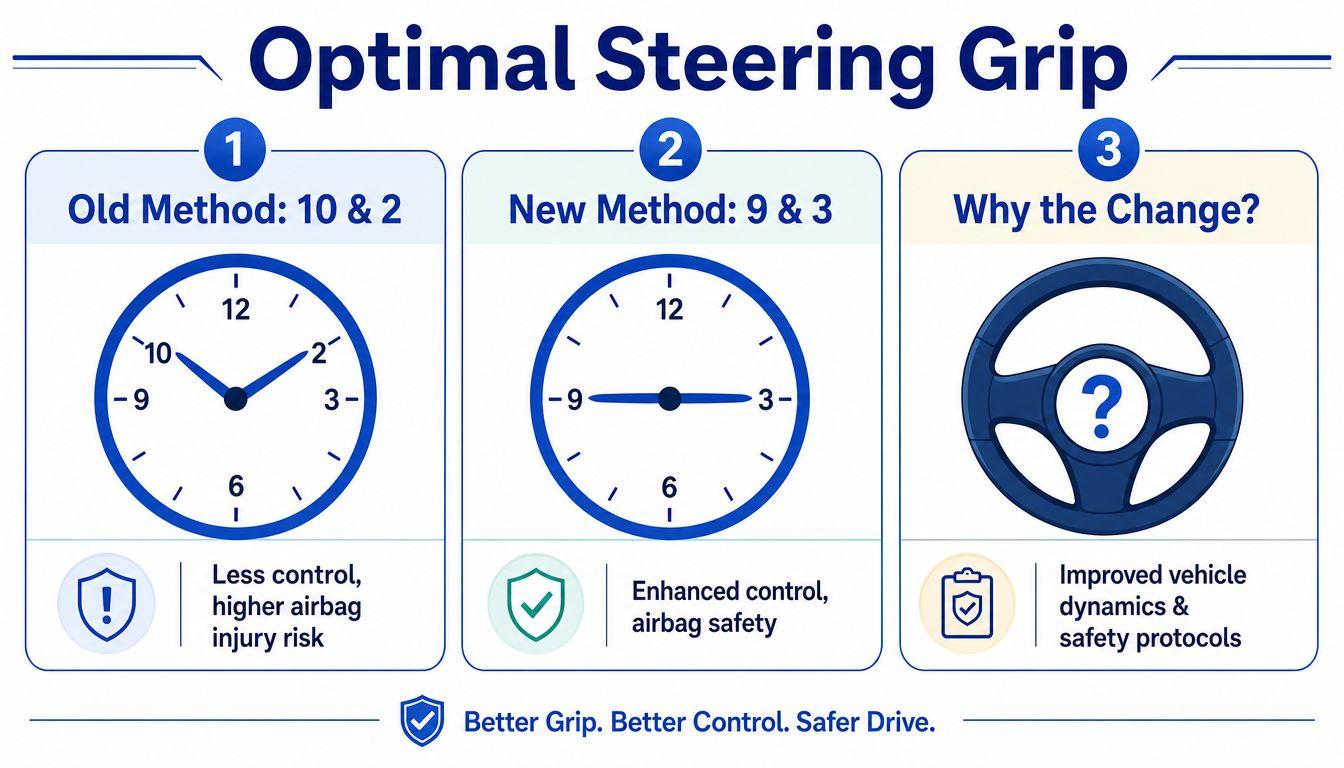
The old advice was 10 and 2. That's what many parents still say. For Ontario learners, that's no longer the standard.
Ontario driving safety experts and the Ministry of Transportation officially recommend 9 and 3, replacing 10 and 2 because of airbag deployment risks. The older position could force a driver's arms into the airbag's path and cause severe injury, while 9 and 3 reduces that risk and is now standard in driver education, as described in this summary of the current 9 and 3 recommendation.
Why Ontario changed the standard
The change wasn't cosmetic. It came from safety. When airbags deploy, they do it with force. A higher hand position places your arms where that force can hit them directly. New drivers don't always think about that because the wheel feels harmless when the car is parked. In a collision, it's a different situation.
The 9 and 3 position also gives better balance. Your hands are level. Your shoulders stay more relaxed. You can make normal steering adjustments without lifting and re-grabbing constantly.
That matters on city streets where you're correcting gently, entering turns, and returning the wheel to centre in a controlled way.
How to place your hands properly
Set your left hand at 9 o'clock and your right hand at 3 o'clock. Think of the wheel as a clock face. Keep your thumbs resting on the rim, not hooked tightly inside it.
Here's the setup I teach learners:
- Sit at the right distance: You should be close enough to the wheel that your arms keep a slight bend.
- Relax your shoulders: Tension travels into the wheel. If your shoulders are up near your ears, your steering will look jerky.
- Hold firmly but gently: You want control, not a death grip.
- Keep your thumbs on the outside: Rest them along the rim instead of wrapping them fully around.
When your thumbs curl too far inside the wheel, your hands tend to get dragged around during sharper steering.
A proper steering wheel grip should feel stable, not forced. If your wrists are bent oddly, your seat may need adjustment. If your palms are doing all the work, loosen up and let your fingers guide the wheel more naturally.
What a correct grip feels like
A correct grip feels boring in the best way. The wheel stays steady in your hands. Lane changes are small and tidy. You don't need to shuffle around looking for a better hold every few seconds.
For most normal driving, 9 and 3 lets you do what you need without lifting both hands off the wheel. That's one reason it works so well for test preparation. It gives the examiner a clear picture of organised control from the moment the vehicle starts moving.
How to Steer Correctly Using Push-Pull Steering
For the Ontario road test, grip is only half the job. The other half is how you move the wheel.
For Ontario driving tests, push-pull steering is the preferred expert technique, and Ontario instructors evaluate it as the acceptable method for wheel rotation during a road test, as outlined in this beginner steering guide covering 9 and 3 and push-pull steering.
What examiners want to see
Examiners want to see hands working together. They don't want to see you spinning the wheel casually with one palm or crossing your arms over the top because you ran out of plan halfway through the turn.
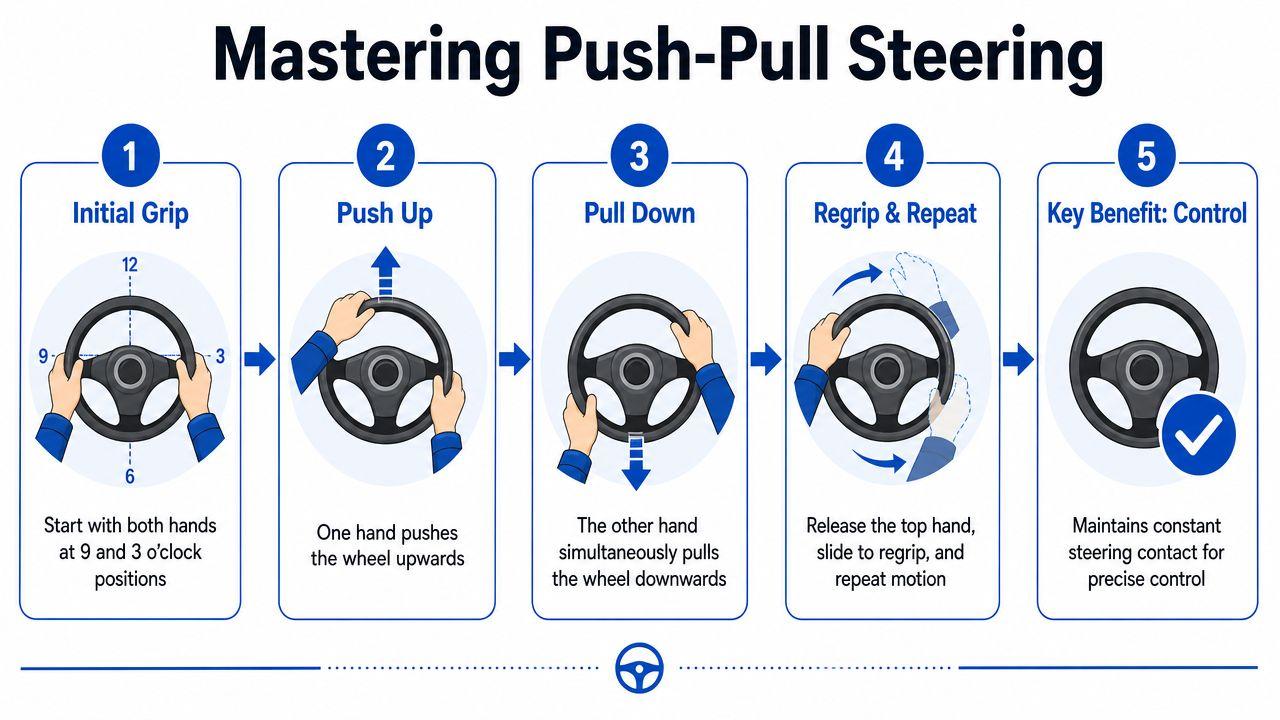
Push-pull steering keeps your movements measured. One hand pushes the wheel up while the other hand slides, regrips, and pulls down. The motion repeats as needed. It's tidy, safe, and easy to judge from the passenger seat.
Here's a good visual reference before you practise it in the car:
A simple pattern for left and right turns
You don't need to memorise a complicated script. You need a repeatable hand pattern.
For a normal right turn:
- Start at 9 and 3.
- Let your left hand push the wheel upward.
- Let your right hand slide up, regrip, and pull the wheel down.
- Repeat if the turn needs more steering.
- As you exit the turn, guide the wheel back smoothly. Don't let it spin freely through your hands.
For a normal left turn, the pattern reverses:
- Your right hand pushes upward.
- Your left hand slides, regrips, and pulls downward.
- Both hands stay engaged.
- The wheel returns under control, not by itself.
This method matters because learners often oversteer when they get rushed. Push-pull slows the hands down just enough to keep the car balanced.
What doesn't work well
Some habits feel easier at first, but they create trouble on the test.
Method What it looks like Why it causes problems Hand-over-hand Arms cross over the wheel Can reduce control and make recovery messy One-handed turning One hand stays idle or drops away Leaves you slow to correct Palm spinning The wheel rolls under one palm Looks careless and is hard to control precisely Letting the wheel snap back Hands release pressure after the turn The car may straighten abruptly
Smooth steering beats fast steering every time on a road test.
Building the habit
Practise push-pull slowly at first, even while parked. Turn the wheel a little left, return to centre, then a little right. Focus on hand order, not speed. If your hands cross, reset. If one hand leaves the wheel for no reason, reset again.
Once that pattern becomes automatic, your turns start looking calmer. That's usually the moment a learner begins to feel like they're driving the car instead of chasing it.
Common Steering Mistakes That Cause G1 Test Fails
You roll up to an intersection, start the turn, and your hands leave the proper position the moment the car needs more steering. That is a common test problem. Examiners in Ontario are not only watching whether you complete the turn. They are judging whether you keep steady, organised control from entry to exit.
Research highlighted in this report on how drivers actually hold the wheel found that only about 25% of drivers use the recommended two-handed 9 and 3 grip, while over 40% drive one-handed. The same report notes that distracted driving is involved in a meaningful share of crashes on Ontario roads. On a road test, one-handed steering can signal weak preparation even before a major mistake happens.
Mistakes examiners notice quickly
These habits cost marks because they affect precision, especially during turns, lane changes, and parking manoeuvres. They also show up beside other common G1 test mistakes Ontario learners make.
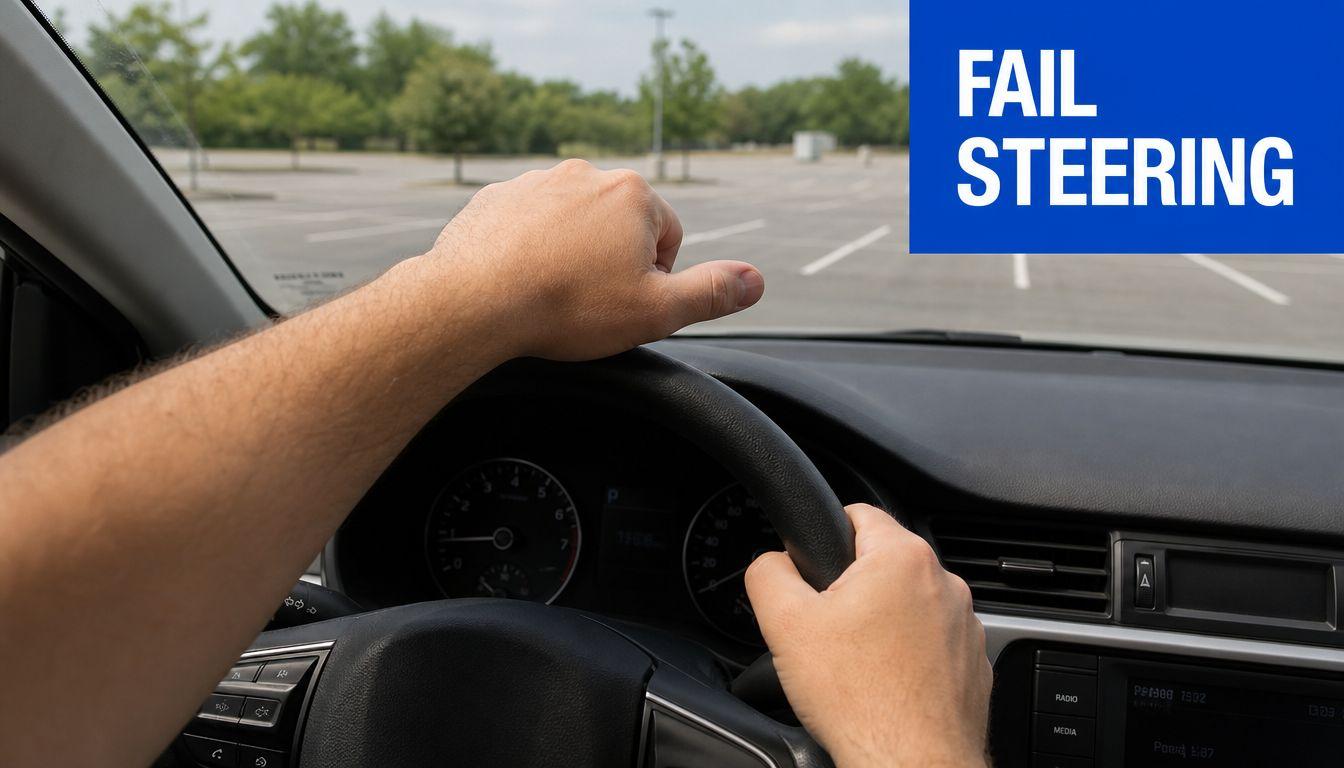
- Driving with one hand: Learners often do this on straight roads, then need a sudden correction and react late.
- Palming the wheel: The hand slides the wheel instead of gripping it. That usually makes the turn rough and the recovery sloppy.
- Holding the inside rim: This diminishes control and puts the wrists in a weak position.
- Crossing arms too early: Once the arms tangle, small corrections get harder.
- Letting the wheel spin back freely: The car may straighten, but the driver is no longer fully in charge of the movement.
None of these are style issues. On an Ontario road test, they point to inconsistent control.
Why these mistakes matter on the test
I tell learners the same thing before every lesson. The examiner is not impressed by fast hands. The examiner wants to see that the wheel stays controlled through the whole manoeuvre.
A left turn is a good example. One learner turns with both hands engaged, keeps the wheel guided back to centre, and exits in the proper lane. Another gets through the same corner by palming the wheel, crossing awkwardly, and grabbing at the rim on the way out. Both cars make the turn, but only one driver looks ready for the next traffic situation.
Ontario training guidance from the Official Ministry of Transportation Driver's Handbook stresses smooth steering, proper lane position, and full control of the vehicle at all times. That standard is exactly what examiners score against. If your grip breaks down in a plaza entrance, a residential turn, or a lane change, it affects your overall result because it suggests the car is controlling you instead of the other way around.
Clean steering looks calm. Calm steering passes tests.
Practice Drills to Perfect Your Steering Control
On test day, many learners know the right hand position until the first tight turn. Then the hands slip, the wheel gets rushed, and the examiner sees control break down. Practice needs to train the exact steering habits Ontario examiners expect to see.
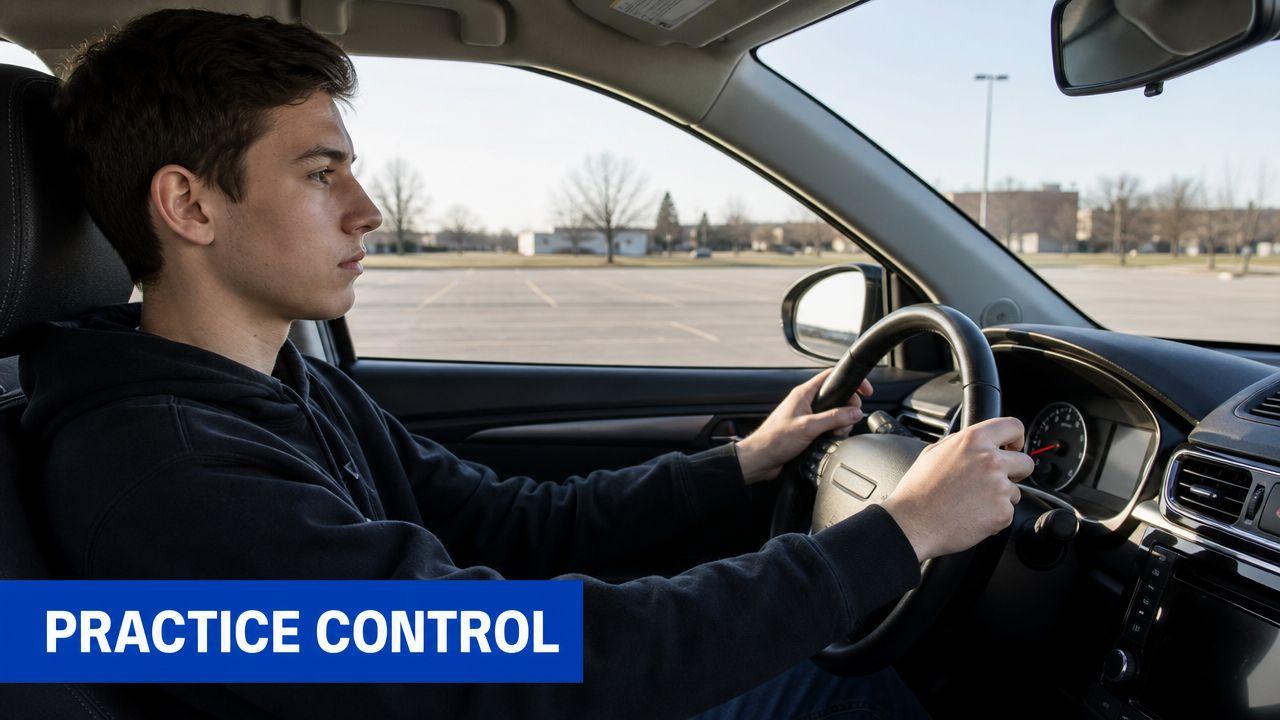
Parking lot drill for 90 degree turns
Use an empty parking lot with clear space on both sides. Keep the car at walking speed so you can pay attention to your hands, not just the path of the car.
Follow this pattern:
- Line up as if you are approaching a normal right turn at an intersection.
- Set both hands at 9 and 3 before you begin steering.
- Turn using push-pull steering, keeping the movement steady.
- Guide the wheel back to centre with both hands still in contact.
- Stop, reset, and repeat the same drill to the left.
Watch for what an examiner would notice during a G2 road test. Hands stay on the outside of the wheel. Steering stays smooth through the full turn. The wheel does not spin back on its own.
Do ten clean repetitions to each side. If one turn feels messy, count it as practice, not progress, and do it again. That same control carries into tighter tasks, including parallel parking on the Ontario driving test.
Lane control drill for smooth transitions
This drill builds the small steering corrections learners need for regular driving, because road tests are not scored only on corners. Examiners also watch how well the car holds its lane between turns.
Use parking lines or pick two long visual markers in an empty lot. Drive straight at low speed and make small left and right corrections without changing your grip. The point is to learn how little input the car usually needs when your hands are set properly.
Then try a second version. Place a few wide reference points and steer around them in a gentle path, almost like a slow slalom. Keep your shoulders relaxed and your movements even.
If one hand starts doing all the work, stop and reset.
That is usually the moment a learner notices the trade-off. Fast hand movement can make the car change direction quickly, but it often looks abrupt and uncontrolled. Calm, measured steering keeps the vehicle stable, and that is what helps on Ontario road tests.
Conclusion Your Path to Safe and Confident Driving
Good steering wheel grip is one of the simplest skills to learn and one of the easiest to get wrong under pressure. That's why it deserves real attention before your test.
Keep the essentials clear in your mind. Use the official 9 and 3 hand position. Turn with push-pull steering instead of crossing over or spinning the wheel casually. Practise until both habits feel normal, not forced.
You don't need perfect hands on day one. You need consistent hands. Examiners want to see that you can control the car calmly, especially during ordinary turns, lane changes, and low-speed manoeuvres. When your steering is organised, the rest of your driving often settles down with it.
That's the bigger point. This isn't only about passing G1 or G2 requirements. It's about building the kind of control that keeps you safer every time you drive in Ontario.
If you're getting ready for your Ontario licence, G1ready.ca is a practical place to study. It offers free G1 practice tests, targeted quizzes, and clear explanations that help you build confidence before test day.