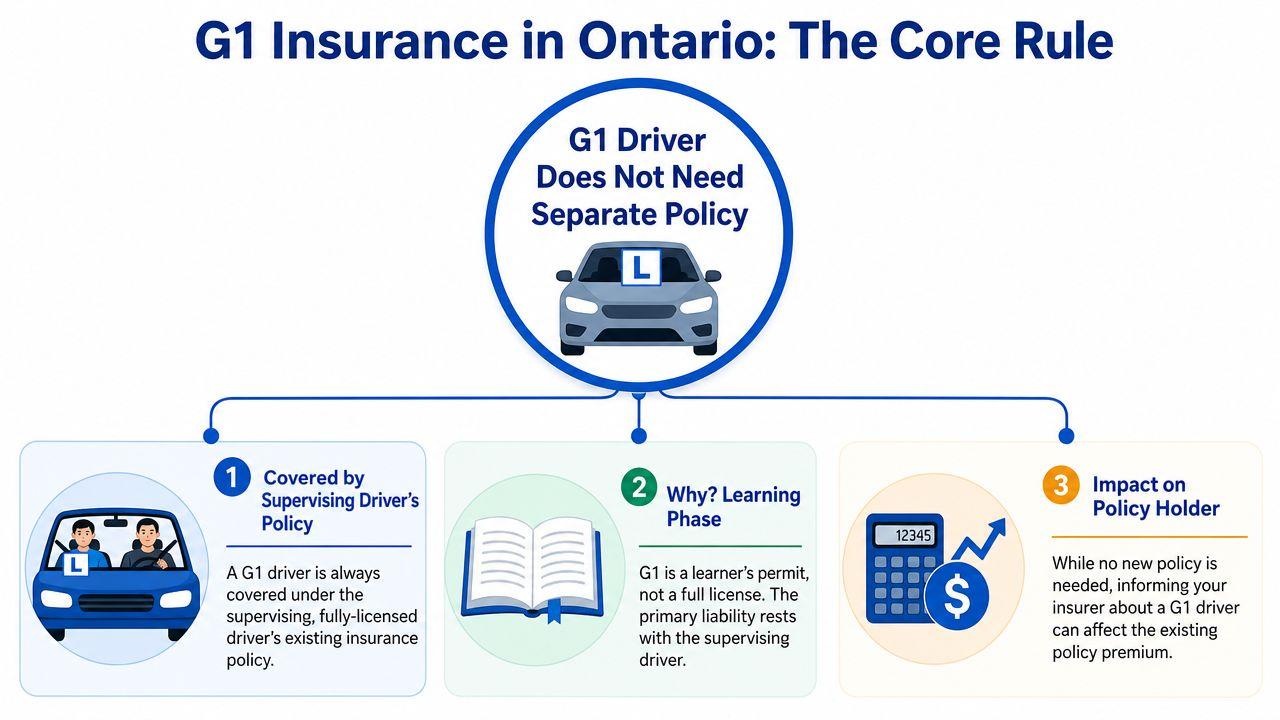
G1 drivers in Ontario don't need their own insurance policy because they're covered under the supervising driver's insured vehicle, and the minimum third-party liability requirement is $200,000. But you should notify your insurer as soon as a new G1 driver starts practising, because that keeps the household policy accurate and avoids confusion later if there's a claim.
If you're a parent with a teen who just passed the knowledge test, or a new driver trying to sort out what happens next, this is usually the moment when insurance starts to feel more stressful than the licence itself. You know the driving has to be supervised. You know the car already has insurance. What most families want to know is simple: do we need to buy anything now, and what changes later?
The short answer is calmer than many anticipate. During the G1 stage, the big insurance event isn't buying a separate policy. It's making sure the insurer knows a learner is driving the car, and then getting ready for the significant shift that comes when the driver earns a G2.
The Core Rule for G1 Insurance in Ontario
A parent adds their teen to weekend practice plans, and the first question is usually, "Do we need to buy a whole new insurance policy now?" In Ontario, the answer is usually no. A G1 driver does not normally carry a separate auto policy. They practise in an already insured vehicle, under the rules of the G1 licence, with a qualified supervising driver.
Why a separate G1 policy usually doesn't exist
The simplest way to understand it is to start with what a G1 driver is allowed to do. A G1 licence is a learner's licence. The teen cannot just take the car out on their own. They can drive only within a supervised setup, so insurers focus on the insured vehicle and the experienced driver who is overseeing that practice.
That structure is the reason the insurance rule looks different at the G1 stage than it does later at G2. During G1, the learner is practising under someone else's policy conditions. At G2, the driver can operate a vehicle alone, which changes how insurers assess risk and why families often see a significant insurance update happen at that point.
Ontario's graduated licensing rules are built around that progression from supervised practice to more independent driving. If you want the licensing stages explained in plain language, this guide to Ontario's Class G licence system helps connect the licence steps to the insurance rules.
Why insurers treat G1 driving differently
Insurance works a lot like borrowing a tool from the garage. What matters first is whose tool it is, whether it is in good condition, and whether an experienced person is supervising its use. With a G1 driver, the insurer is still mainly looking at the vehicle, the household policy, and the licensed adult who must be there.
Practical rule: If the car is insured and the G1 driver is practising legally with the required supervisor, coverage usually comes through that existing vehicle policy.
This is also why the jump from G1 to G2 matters so much. A G1 driver is learning inside a controlled arrangement. A G2 driver can drive alone. That single change affects insurance more than the G1 licence itself, because the insurer is no longer assessing only supervised practice.
Notifying Your Insurer About a New G1 Driver
Your teen passes the written test, comes home with a G1, and the first question is usually, "Do we need to buy insurance now?" In most cases, no separate policy starts at the G1 stage. But one phone call still matters. Tell your insurer or broker that a new learner will be practising in the household car.

Why this call matters
Insurance works a lot like a family file. The company needs the file to reflect who lives in the home, who may use the vehicle, and what stage of licensing each driver is in. A G1 driver is still learning under supervision, but that does not mean the insurer wants to discover their existence only after a claim.
That is the main reason to notify them. It helps prevent confusion if there is a collision during a practice drive, and it gives you a record that you disclosed the new learner properly.
For parents, this is often the part that feels backwards. If the G1 usually does not trigger the same insurance change as G2, why mention it now? Because insurers are tracking household risk over time. The G1 stage is the beginning of that timeline. The G2 stage is usually when the bigger policy and pricing changes arrive.
A simple early update can save a stressful argument later.
This call is about accuracy, not panic. You are not asking for a new teen policy. You are making sure the existing policy reflects what is happening in the household.
What to have ready before you call
The process is usually straightforward if you gather a few details first. One parent can often handle it in a short call or online message.
- Learner details: Full legal name, date of birth, and G1 licence number.
- Vehicle details: Which household vehicle the teen will practise in most often.
- Driver details: Which fully licensed adult will usually supervise those practice drives.
- Household details: Whether the learner lives at home full-time or splits time between households.
- Training details: Whether the teen has started, booked, or plans to take an approved driver education course.
Ask the representative to note the G1 driver on the file. Then ask a follow-up question that many families forget: "What should we do when this driver passes to G2?" That one question helps you prepare for the licence stage where insurance rules usually start to matter more.
If the insurer confirms the update by email or in the policy portal, keep that record. It is the insurance version of getting a receipt after an important purchase. You hope you never need it, but if there is confusion later, you will be glad you have it.
How a G1 Driver Affects Your Insurance Premiums
A common family moment goes like this. Your teen passes the G1 test, everyone is excited, and then a parent asks, "Did our insurance just go up?"
In many cases, the answer is no. A G1 licence usually does not create the same immediate premium change that families often see later at G2. The reason comes back to risk. A G1 driver can only practise under strict conditions, with a qualified supervising driver in the car, so insurers generally view that stage differently from a driver who can head out alone.
That distinction matters more than the licence card itself. Insurance pricing usually changes when the new driver gains more freedom and more responsibility on the road. G2 is often the point where the insurer needs to rate that person as an active driver on the policy.
A useful way to explain it to a nervous teen is this: G1 is the supervised practice stage. G2 is the stage where the insurer starts treating the new driver more like a regular road user.
For many households, the G1 stage is the calm before the pricing decision. The bigger insurance change often arrives at G2, not on the day the G1 is issued.
Parents should still treat G1 as the preparation window. If your teen plans to keep driving, now is the time to ask what your insurer will require once they pass the next road test. A guide to updating licence information with your insurer can help you see where that handoff usually happens.
G1 vs G2 insurance requirements at a glance
Factor G1 Driver G2 Driver Separate policy needed Usually no May need to be added to a policy or obtain independent coverage Supervision Must drive with a fully licensed supervising driver Can drive alone Policy impact Usually noted on the household policy Formal policy update is required Premium effect Usually little or no immediate change A premium increase is more likely once the driver is rated on the policy Insurance logic Learner driving in a supervised setting Driver has much greater operating independence
The parent checklist is simple. Confirm the G1 is noted on the file. Ask how the policy will change at G2. Set aside room in the budget before that road test date sneaks up on you.
That approach turns G2 from a surprise into a scheduled next step.
Your Step-by-Step Guide for Policy Updates
When families feel unsure, a checklist helps more than a lecture. If you're updating a policy for a new learner, keep the process simple and documented.
The checklist for a new G1 driver
Start with the paperwork before you pick up the phone.
- Gather the learner's ID details.
Have the full name, date of birth, and G1 licence number in front of you. If the learner has completed any part of formal training, keep that information nearby too. - Confirm which car the learner will use.
If there are several vehicles in the household, know which one will be used for practice. Insurers may ask who owns it and who normally drives it. - Contact the insurer or broker directly.
A phone call is often the cleanest option because you can ask follow-up questions in real time. - Ask for confirmation that the policy file has been updated.
Don't end the call with a vague understanding. Ask the representative to confirm what was added to the file. - Keep the note with your policy documents.
Save the email, portal message, or written summary. If questions come up later, you'll know exactly when you notified them.
If the driver has just received a G1 and is also updating licence details in other places, this guide on updating your driver's licence information is a useful companion checklist.
The follow-up step when G2 arrives
The second update is the one many families underestimate. Once the driver passes to G2, don't assume the insurer will know automatically. Call again.
Use this short script as a model:
- State the licence change clearly: "My teen has moved from G1 to G2."
- Confirm vehicle use: Will they be an occasional driver or the main driver of a specific car?
- Ask about documents: Find out whether the insurer wants proof of the new licence stage or driver training completion.
- Request written confirmation: Make sure the policy records reflect the new status.
Write down the date of the call, the name of the representative, and what they confirmed. Families forget these details faster than they expect.
This isn't about bureaucracy for its own sake. It's how you make sure the policy matches the driver's real-world status.
Preparing for G2 Insurance and Managing Costs
The G2 test is the moment many parents feel the insurance rules suddenly get complicated. A better way to see it is this. G1 is practice under supervision. G2 is the point where the new driver can use a car with much more independence, so insurers take a closer look at risk, vehicle use, and who should be listed on the policy.
Choices you can make during the G1 stage
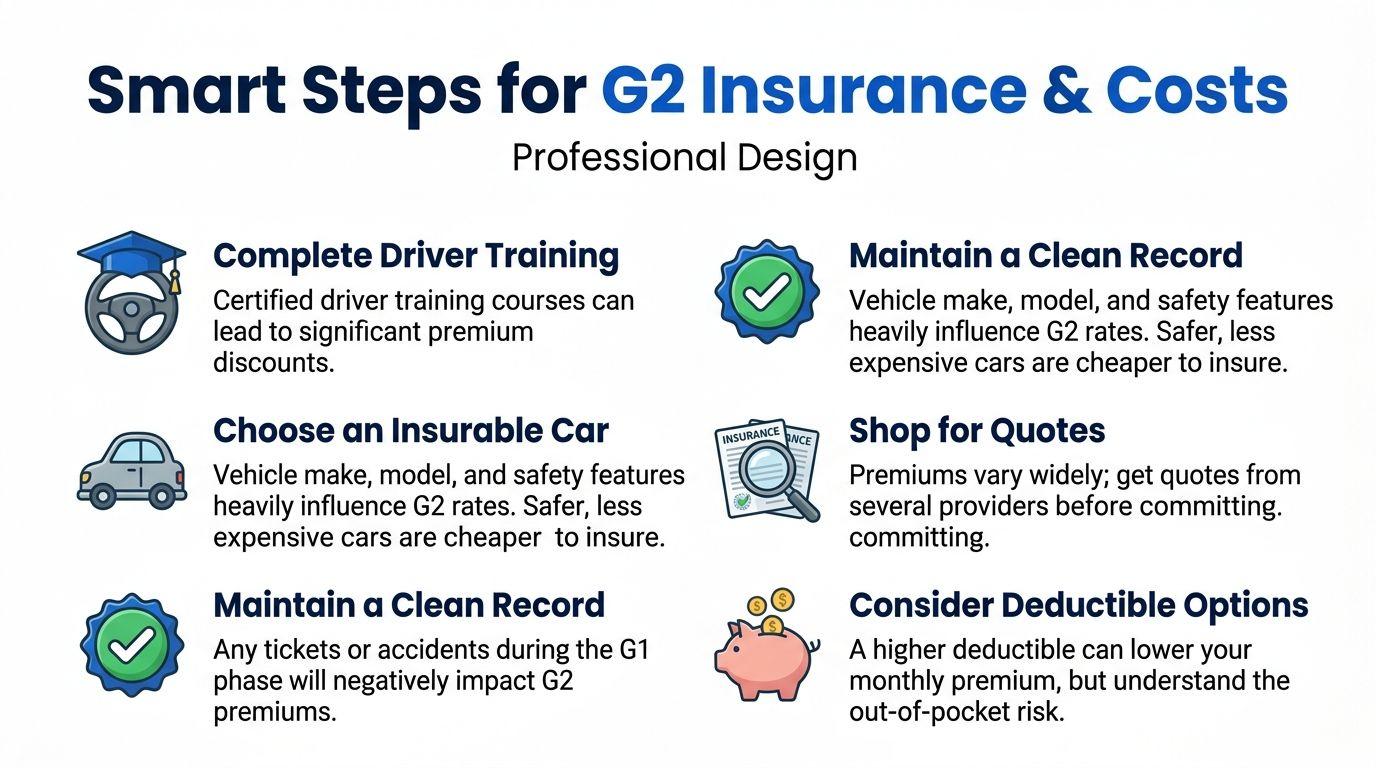
The smartest time to prepare for G2 insurance is before the test is booked.
Driver education can help in two practical ways. It can shorten the wait to attempt G2 under Ontario's graduated licensing rules, and it gives the new driver more structured practice before they start driving with fewer restrictions. For a parent, that matters because the insurance change often feels less abrupt when the household has already planned for it.
Good training also tends to produce better habits. A learner who has spent months practising lane changes, scanning, parking, and hazard response is usually easier to place on a policy than someone whose experience is rushed and uneven. If your family wants more practice ideas, this guide to an Ontario defensive driving course is a useful next step.
Vehicle choice matters just as much. Insurers look at the whole picture, not only the licence class. A small, common vehicle with lower repair costs usually creates fewer surprises than a sporty model, a luxury vehicle, or anything expensive to fix after a minor collision.
What parents should decide before the G2 test
Before the road test, sit down together and settle the questions that affect insurance costs the most. This works like making a school checklist the night before. If you wait until the morning, small missing details create stress.
Use this checklist:
- Which car will the teen drive most often. The answer affects how the insurer views day-to-day risk.
- How often they will drive. Occasional use and regular commuting are not the same.
- Whether they completed approved driver training. Keep the certificate with your policy records.
- What your budget can handle. A lower-cost vehicle and limited driving use can make the G2 transition easier to manage.
- Who pays for what. Decide early whether the teen will help with insurance, fuel, or parking.
The goal is clarity. When a family already knows the car, the expected use, and the training history, the G2 update becomes a straightforward policy change instead of a last-minute scramble.
One last point helps parents understand the "why" behind all of this. Insurers are not reacting to the plastic card itself. They are reacting to a new stage of driving freedom. Once a teen reaches G2, they can spend more time behind the wheel with less supervision, and that increased exposure is what can change the premium.
Your Top G1 Insurance Questions Answered
Can a G1 driver own a car
Yes, a G1 driver can technically own a car. The confusing part is insurance. A G1 driver cannot be the principal driver on a policy for collision damage, and if a G1-owned vehicle is parked and hit by another driver, the owner may face a total loss if the coverage is limited to fire and theft, as discussed in this Ontario discussion of G1 car ownership and insurance limitations.
That means ownership and full practical insurability aren't the same thing. Parents often miss that distinction.
What if the G1 driver has an accident in our car
The first question will be whether the learner was driving legally under G1 conditions in an insured vehicle with the required supervisor. If the household has already informed the insurer and the arrangement matched the licence rules, the claim process is much cleaner. If the insurer wasn't told about the learner at all, that can create avoidable problems.
Does the driver need to live with me full-time
Living arrangements can complicate the file, but they don't change the need for honesty. If the learner splits time between homes, tell the insurer exactly that. The important part is that the insurer understands who owns the vehicle, where it is kept, and who may be driving it.
Do I need to list the G1 driver as a named driver right away
Often, no formal separate listing is required at the G1 stage. But you still need to notify the insurer so the file reflects the learner's presence and practice use.
When should we worry most about cost
Usually when the driver is close to G2. That's when the insurer needs to know the learner has become a more independent driver, and that's when a premium change commonly enters the conversation.
If you're helping a teen prepare for the next step, G1ready.ca offers Ontario-focused G1 practice tests and study tools that make the knowledge side of licensing less stressful. It's a practical place to build confidence before test day, especially for first-time drivers, nervous learners, and families who want a simple way to practise together.