Ontario's G1 test languages are available in 27 languages, including English, French, and several Indigenous languages. If you're preparing in Ontario and English isn't your first language, you can still take the knowledge test in a format that matches your needs.
A lot of newcomers reach this point with the same worry. You may understand the driving rules well enough, but the test process itself can feel unfamiliar, especially when you're dealing with forms, a vision check, and a system that doesn't look like the one back home. Ontario does give you language options, and the practical details matter just as much as the list of languages.
Your Guide to Taking the G1 Test in Another Language
If you're a newcomer standing outside a DriveTest centre, the biggest challenge often isn't the driving rules. It's figuring out whether the system will meet you where you are linguistically. Ontario's knowledge test is built for that reality, since the province has long treated language access as part of the G1 process, not a bonus feature.
The simplest way to think about G1 test languages is this, the test is still about road signs and road rules, but Ontario offers ways to make the reading and listening part manageable. That matters because a learner who understands the material in their own language can focus on the actual safety content instead of decoding unfamiliar English under pressure. The official test structure is fixed, but the language access around it is flexible. Ontario's G1 knowledge test guide is a useful starting point if you want a plain-language overview before test day.
There's also a practical side to this. Some centres offer the computerised test in many languages, and in some cases there's audio support too, so the question isn't just “Is my language listed?” but also “How will it be presented when I sit down?” That difference can be confusing at first, especially if you've only heard that Ontario offers multilingual testing without seeing the steps laid out clearly.
Practical rule: choose your language support before test day, then confirm how it will be delivered at the counter so there's no surprise when you start the exam.
Official G1 Test Languages Available in Ontario
Ontario's official language access has expanded over time. CBC reported that the G1 knowledge test is available in 27 languages, including Ojibway, Oji-Cree, and Cree, with written and audio versions available at DriveTest locations across the province and in some northern, fly-in First Nation communities. Ontario also announced that the written G1 test would become available in Armenian, showing that language access can change as the province responds to newcomers and local needs. CBC's report on Indigenous-language G1 testing and Ontario's release on Armenian access show that the list is active, not fixed.
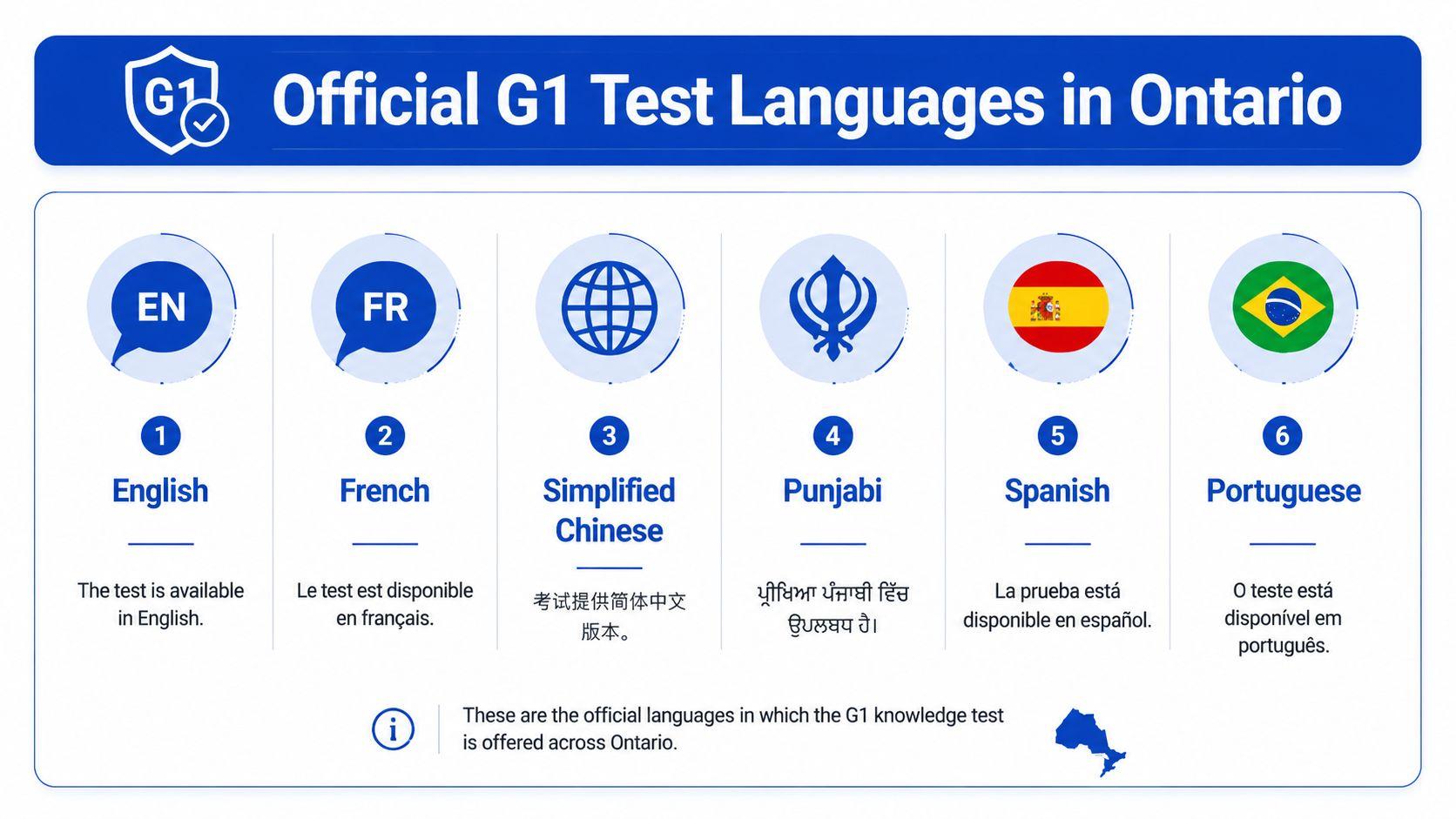
The cleanest way to verify your options is to treat the language list as a service feature tied to the test centre, not a permanent promise that every language is offered everywhere. DriveTest says computerised knowledge tests are available in up to 31 languages with full audio support, which creates a practical gap between what people hear in community conversation and what they may encounter at a specific site. DriveTest's language page is the most direct place to check the testing format.
Sample of Available G1 Test Languages
Language Availability Notes English Official test language French Official test language Arabic Available on computerised tests Chinese Available on computerised tests Spanish Available on computerised tests Punjabi Available on computerised tests Armenian Added by Ontario for written G1 access Ojibway Reported by CBC as available in written and audio formats Oji-Cree Reported by CBC as available in written and audio formats Cree Reported by CBC as available in written and audio formats
A useful detail here is that “available in many languages” doesn't always mean the same experience for every learner. Some people can read the questions in their language, while others may depend on the audio version to move through the test with less pressure. If you're unsure which version matters most for you, ask the centre what's offered at that site before the day you go.
How to Request Your Test in a Different Language
The request happens in person, not from home. Ontario's G1 knowledge test must be written at an accredited DriveTest Centre or participating ServiceOntario location, so the language choice is part of the check-in process when you arrive. Ontario test location guidance can help you find a place to go before you make the trip.
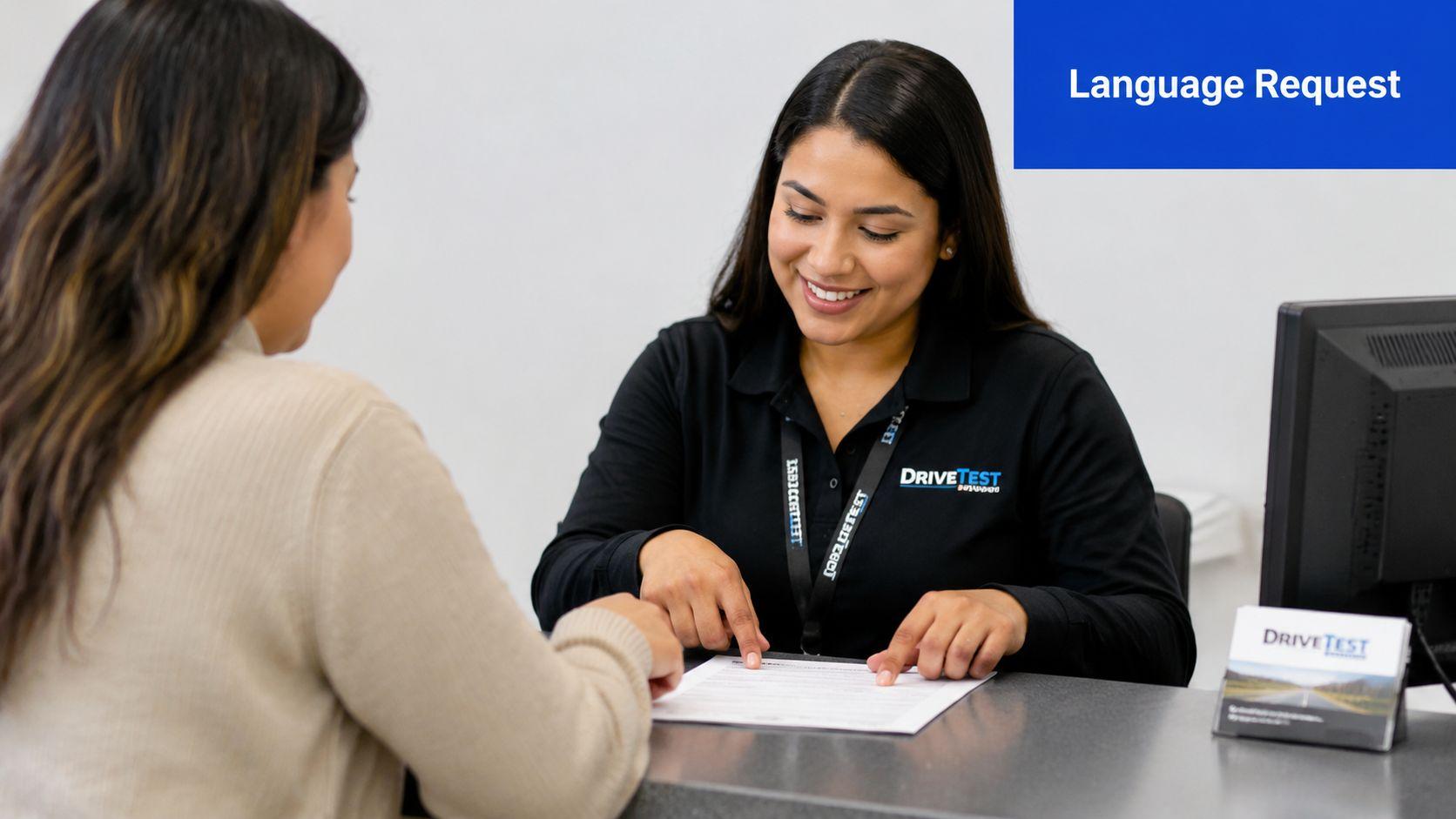
Bring original identification that proves your legal name, date of birth, and signature. Ontario also requires a vision screening before the knowledge test, and you'll need to pay the fee at the centre, which the cited source lists as $159.75 CAD as of 2025. You also need to be at least 16 years old and live in Ontario. G1 test requirements lays out those basics clearly.
What to say at the counter
Be direct and simple. Tell the staff that you want to take the G1 knowledge test in your preferred language, then confirm whether the version you need is written, audio-supported, or both. If the language is available at that centre, staff can guide you through the rest of the process.
A good habit is to keep your documents ready before you speak to anyone. That helps the visit stay calm and short, especially if you're nervous or not used to Ontario paperwork.
Plain advice: if you can explain your language need in one clear sentence, the rest of the check-in is usually much easier to manage.
Using an Interpreter for Your G1 Test
If your language isn't on the official list, you still have a path forward, but it takes planning. The key point is that you can't just bring a friend or relative to translate informally, because the test needs to stay fair and standardised.
Use a certified interpreter and arrange that service before test day. That's your responsibility, including payment, so it helps to think of the interpreter as part of your preparation rather than something the DriveTest centre will organise for you. The interpreter's role is to help you understand the language of the exam, not to coach you on the answers or influence the test.
The safest approach is to call ahead and confirm what the centre expects when you arrive with an interpreter. Some learners assume they can sort it out at the counter, but that creates avoidable stress. A quick check beforehand lets you focus on the test itself instead of negotiation at the front desk.
What the interpreter can and can't do
- Can translate the questions: Their job is to help you understand the wording accurately.
- Can be present at the centre: They should be there with you during the test process.
- Can't act like a tutor: They're not there to explain road rules or teach test strategy.
- Can't be a casual helper: A friend, cousin, or neighbour is not the same as a certified interpreter.
This option matters most for applicants whose language isn't officially supported in the test system. It's a practical backup, not a shortcut, and it still leaves the knowledge test focused on your own understanding of Ontario driving rules.
Find Handbooks and Practice for Your G1 Test
A learner who can read the handbook but still feels unsure in English or French often does better with a clear practice routine. Ontario's official knowledge test uses 40 multiple-choice questions, split into 20 road signs and 20 rules of the road, and you need at least 16 out of 20 in each section to pass. The two-part format matters because a strong score in one section does not make up for a weak score in the other. DriveTest's knowledge test page lays out that structure, and this guide to Ontario driving test questions helps you see how the question style usually works.
The official handbook should be your first study source. Many learners also use translated support from community groups, libraries, or local settlement services, especially if they are still building confidence with English or French. Road signs are a good place to start because they rely on quick recognition, much like matching a symbol to a meaning before your brain has time to overthink it. A practice tool can then help you rehearse the test format before you go to the centre.
One option is G1ready.ca, which follows the same split between road-rules and road-sign practice. That matters because the actual test is not one mixed set of questions, it is two separate sections, so your study plan should reflect that structure.
A simple study order
Start with the handbook. Read the rules and the signs before you begin trying to answer practice questions, so the meanings are familiar instead of guessed.
Then practise the signs on their own. Visual recognition usually helps more than memorising isolated words, especially if the language in the test still feels new.
After that, move to a mixed review. Switching between sections helps you avoid overpreparing only one half of the exam. Keep track of the questions you miss more than once, because those weak spots usually point to the topics that need another look.
This order gives you a steadier path if you are taking the G1 test in a language you do not use every day. The aim is not to memorise every sentence in the handbook, but to make the wording familiar enough that the driving rules are easier to understand under test conditions.
Frequently Asked Questions About G1 Test Languages
G1 Language FAQ
Question Answer Can I take the G1 test online from home? No. You must write it in person at a DriveTest Centre or participating ServiceOntario location. How many questions are on the test? 40 multiple-choice questions, split into two sections of 20 each. What score do I need to pass? You need at least 16 out of 20 in both sections. Can I bring a family member to translate? No. If you need language help outside the official list, use a certified interpreter. Are the language options the same everywhere? Not always. Availability can depend on the centre and on whether the version is written or audio-supported.
A few other worries come up again and again. People ask whether a translation app on a phone is enough, but that's not the same as an approved test-language option, and it won't replace the official process. Others want to know if the test language changes the pass mark, and it doesn't, the scoring rule stays the same.
If your language isn't listed, don't assume you're stuck. First check the centre's current options, then look at whether an interpreter can bridge the gap. That's usually the most realistic path for applicants who need extra language support and want to avoid showing up unprepared.
If you're getting ready for the Ontario G1 and want practice that matches the official test format, visit G1ready.ca and start with handbook-aligned quizzes that let you study road signs and road rules at your own pace.