You're probably in the same spot as most new riders when they start looking up a practice test motorcycle learner's permit strategy. You want the freedom of getting on two wheels, but the written test feels like the gatekeeper. Not because it's impossible. Because it's unfamiliar.
That's the part that rattles people.
I've seen plenty of learners walk in thinking they just need to “read the handbook a bit” and wing it. Some get lucky. Many don't. The riders who pass comfortably usually do one thing differently. They treat practice tests as a system, not as random quizzes they tap through on their phone while half distracted.
If you're aiming for your Ontario M1, that mindset matters. The written exam isn't a trivia contest. It checks whether you can recognise signs fast, understand road rules clearly, and think like a rider instead of a passenger. The good news is that this is very trainable when you use practice material properly.
A smart plan fixes most of the stress before test day. It shows you what the test looks like, where people lose marks, how to use diagnostics and simulators properly, and how to avoid the common trap of memorising answers without learning the rule behind them.
Your First Step to Two Wheels
Most riders don't remember the exact day they first wanted a motorcycle licence. They remember the feeling. Independence. Curiosity. The idea of finally riding legally instead of just thinking about it.
Then the written test shows up and turns that excitement into hesitation.
A lot of new learners make this harder than it needs to be. They either overcomplicate it and drown in notes, or they underprepare and assume common sense will carry them through. Neither approach works well. The M1 rewards organised preparation, especially if you use practice tests with intention.
Practical rule: Don't study until you feel busy. Study until your errors become predictable, then fix those errors on purpose.
That's what separates productive prep from endless scrolling through sample questions.
The useful way to look at the M1 is as a manageable checkpoint. You're not being asked to prove that you're already an experienced rider. You're being asked to show that you understand road signs, road rules, and motorcycle-specific basics well enough to start safely. That's a very different challenge from “learning everything about motorcycles.”
What strong preparation looks like
A good study plan usually has three parts:
- A baseline check: You need to see what you already know and what you only think you know.
- Focused correction: Weak spots need targeted practice, not more random mixed quizzes.
- Simulation under pressure: Once your accuracy improves, you need practice answering in test-like conditions.
Learners who follow that sequence usually feel calmer walking into the test centre. Not because nerves disappear, but because there are fewer surprises left.
If you've been bouncing between handbook pages, videos, and scattered quiz apps, simplify it. One structured practice routine will help more than ten disconnected study sessions.
Deconstructing the Ontario M1 Test
The fastest way to reduce anxiety is to make the test concrete. Once you know the structure, it stops feeling like a vague hurdle and starts looking like a set of tasks you can train for.
What the M1 actually includes
The Ontario M1 Motorcycle Knowledge Test consists of 64 multiple-choice questions split into three sections: 20 for road signs, 20 for road rules, and 24 for motorcycle operations according to this Ontario M1 test breakdown.
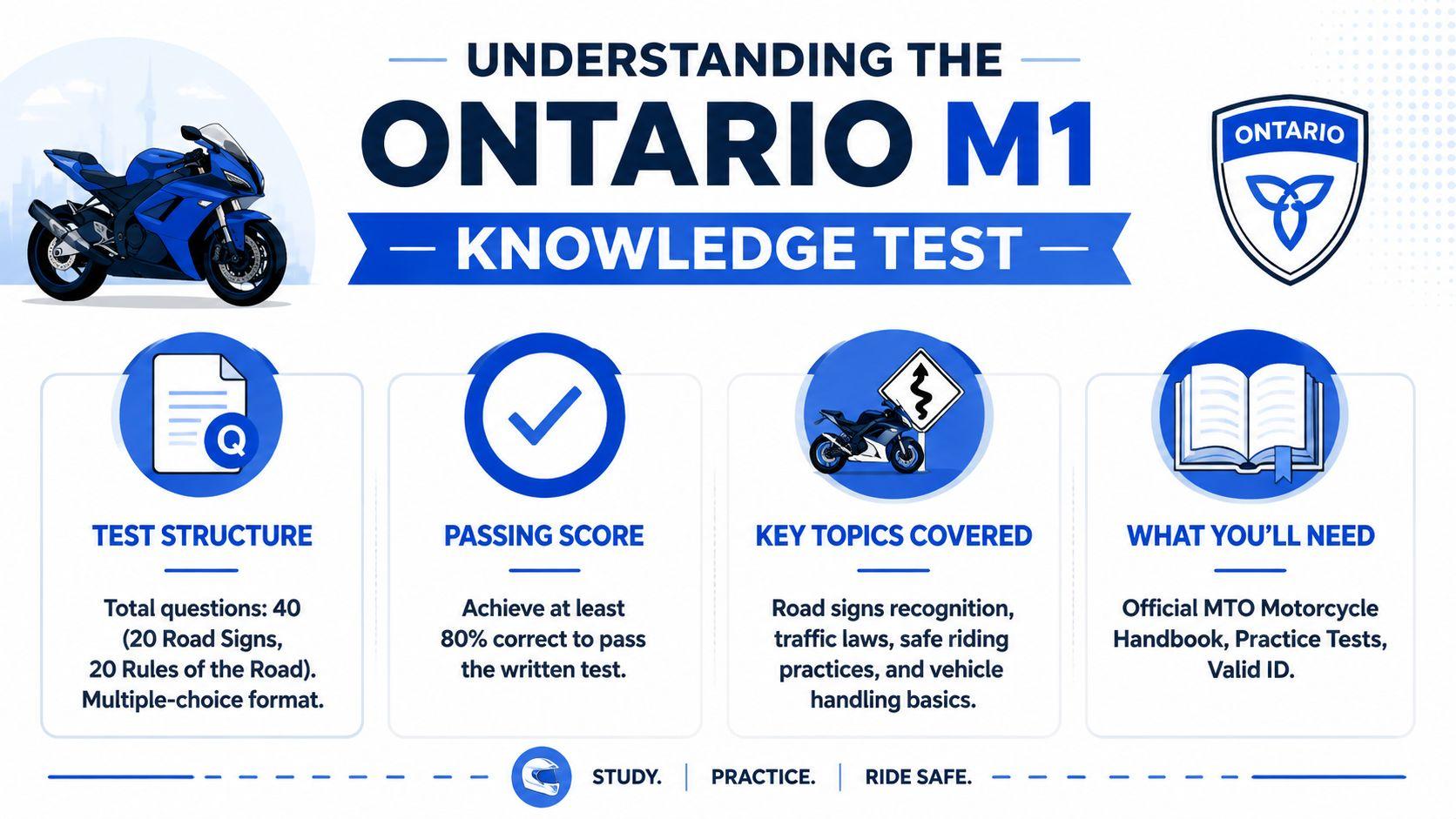
That same breakdown states that to pass, you must get at least 16 out of 20 in road signs and at least 19 out of 24 in motorcycle rules. Those passing requirements matter more than most learners realise because they change how you should practise.
Here's the structure in one place.
Test Section Number of Questions Minimum to Pass Road Signs 20 16 Road Rules 20 Not specified separately in the verified data Motorcycle Operations 24 19
Why the section split changes your study plan
Many learners study mixed sets because they feel efficient. Early on, they aren't.
When a test is split into sections, weak performance in one area can sink you even if you're strong elsewhere. That means your study sessions need to mirror the actual categories, especially at the start. If you're excellent on signs but shaky on motorcycle operation questions, more sign drilling won't save you.
Treat the M1 as three smaller exams that happen on the same day. That mindset keeps weak categories from hiding inside a decent overall score.
There's another practical point. The test format may feel familiar if you've looked at car licence prep, but motorcycle questions add their own layer. You're not just recalling signs and laws. You're also expected to understand how a motorcycle behaves, what keeps a rider visible, and how to respond safely in common situations.
What to study first
If you want your practice test motorcycle learner's permit routine to work, build it in this order:
- Road signs first because quick recognition is trainable and boosts confidence early.
- Motorcycle operations next because this category often exposes knowledge gaps.
- Mixed review last once the separate pieces stop feeling shaky.
That order gives you faster feedback. It also keeps you from mistaking familiarity for mastery.
A Strategic Plan for Practice Test Success
Random practice feels productive. Structured practice gets people through the test.
The best study systems I've seen all use the same sequence. Start by diagnosing your weak points, isolate them, then move into full simulation only after the basics are stable.
Start with a diagnostic not a marathon
Your first session shouldn't be about scoring well. It should be about finding blind spots.
A diagnostic test does that better than a long mixed quiz because it reveals patterns quickly. Maybe you recognise basic signs but miss wording-heavy questions. Maybe you know road rules in plain language but stumble when the answer choices are very close to each other. That tells you where your study time should go.
When learners skip diagnostics, they often spend too much time polishing what they already know.
Use your first few sessions to answer one question after another with full review after each miss. Don't rush. You're building a map of your own habits. If you want a reference point for how a structured quiz flow can look, this Ontario practice test format shows the kind of organised category-based work that helps learners identify weak areas instead of just collecting scores.
Use targeted drills to fix weak spots
Once you know where you're leaking marks, stop doing full mixed sets for a while. Narrow the focus.
A targeted drill works best when it attacks one category at a time. Signs. Right-of-way. Lane position. Motorcycle controls. Safe riding practices. The reason this works is simple. Your brain learns faster when the questions are related closely enough for patterns to become obvious.
Here's how I'd structure that phase:
- For sign confusion: Group similar signs together and say out loud what each one requires you to do.
- For rule questions: Read every answer choice fully before selecting. Rule questions often punish fast guessing.
- For motorcycle-specific items: Tie the rule to a riding situation. If you can picture it on the road, you're more likely to remember it under pressure.
- For recurring mistakes: Keep a short handwritten list of errors you repeat. Those are the rules you haven't learned yet.
The wrong answer you repeat is more valuable than ten questions you get right. It shows you exactly what still needs work.
Progress tracking matters here. Not because charts are exciting, but because memory is unreliable. Learners often feel like they're “still bad at signs” long after their sign scores have stabilised. A simple record of weak categories helps you stop overstudying one area while neglecting another.
Finish with full simulation work
Once targeted practice stops producing the same repeat mistakes, move to simulator mode, where timing, focus, and stamina start to matter.
The goal of full simulation isn't just knowledge recall. It's consistency. You want to sit down, answer a complete set without wandering mentally, and finish without panicking over two or three uncertain questions. That's a different skill from answering isolated practice items in short bursts.
After you've built some momentum, it helps to switch formats and study with an exam-style walkthrough. This video is useful when you want to rehearse staying composed through a test-style session.
A good final routine usually looks like this:
- One full simulated test
- A review session focused only on misses
- A short targeted drill on the weakest category
- Another full run on a different day
That cycle is what turns practice into readiness.
How to Master Every Type of M1 Question
The M1 doesn't just test what you know. It tests whether you can recognise what kind of question you're looking at. Once you understand that, the exam becomes easier to read.

Sign questions reward pattern recognition
Sign questions usually look simple, but they catch people who read too casually. The common mistake is focusing on one familiar visual cue and ignoring the whole sign.
Train yourself to identify signs by category first. Warning sign, regulatory sign, direction sign, lane-use sign. Then look for the specific instruction. That extra half second prevents the classic error of choosing the answer that feels generally related but isn't precise enough.
If you need extra practice understanding how Ontario test questions are worded, this guide to Ontario driving test questions is helpful for spotting patterns in multiple-choice design.
Scenario questions test judgment not memory
These are the questions where a vehicle does something, a hazard appears, or road conditions change. Many learners search their memory for an exact sentence from the handbook. That's often the wrong move.
Instead, ask yourself two things:
- What is the risk in this situation?
- Which answer reduces that risk most directly?
That method works because the safest answer is usually the one the test wants. Not the boldest answer. Not the fastest one. The safest, clearest, most controlled response.
When two options both sound possible, choose the one that gives you more space, more visibility, or more control.
That simple rule helps with a lot of rider-focused questions.
Multiple choice traps are usually wording traps
The hardest questions are often difficult for boring reasons. One word changes the whole meaning. “Always.” “Best.” “First.” “Must.” Those are signal words.
Use process of elimination aggressively:
- Remove extreme answers first if they sound absolute and unrealistic.
- Watch for partial truths where one part of the answer is right but the rest makes it wrong.
- Compare close options side by side instead of rereading the question ten times.
- Don't change answers casually unless you can explain why the second choice is better.
A lot of learners lose marks because they answer from experience or instinct. The exam doesn't care what “sounds about right.” It cares what the rule says.
If you want to sharpen this skill, review missed questions by type, not just by topic. Ask whether the problem was sign recognition, wording, overthinking, or rushing. That's how you become better at taking the test, not just better at reading the handbook.
Avoiding Common Pitfalls and Test Day Traps
Most first-time failures don't come from one huge misunderstanding. They come from a chain of small bad habits. A learner memorises answer order instead of the rule. They overfocus on one category. They get tired halfway through. Then the official test feels harder than practice even though the content is familiar.
The biggest prep mistake is false confidence
The January 2023 experience shared in this Ontario M1 test discussion highlights a key point. The M1's strict sectional passing scores mean you can't use a high score in one section to make up for a weak score in another.
That catches more people than it should.
A learner might feel ready because mixed practice feels comfortable. Then they hit a rough patch in one category and find out too late that decent overall performance doesn't protect them. That's why section-specific review matters so much.
What catches people in the real test room
The test centre changes how people perform. Even learners who do well at home can tighten up when they're sitting at a computer in a quiet room with other applicants around them.
Watch for these traps:
- Answer memorisation: If you only recognise the right answer when choices appear in the same order, you're not ready yet.
- Rushing easy questions: Familiar items are where careless mistakes happen.
- Overthinking hard ones: If two choices seem close, eliminate what's clearly weaker and move on.
- Mental fatigue: Long study sessions right before the exam can dull recall instead of sharpening it.
A practice score only means something if you earned it by understanding the rule behind the answer.
Another common issue is reading the handbook passively. Learners tell themselves they've “covered everything” because they finished the pages. But recognition is not recall, and recall is not judgment. Practice tests matter because they force retrieval. That's what reveals whether the knowledge is usable.
If your scores swing wildly from session to session, treat that as a warning. It usually means your knowledge isn't stable yet.
Your Final 24 Hours and DriveTest Centre Guide
By the final day, the work should feel lighter, not heavier. You're not trying to cram your way into competence. You're trying to protect the preparation you already built.
What to do the night before
Keep the evening simple.
Review your mistake list, not the entire handbook. Go over signs that still look too similar. Revisit rules that you keep second-guessing. Then stop. A late-night panic session usually creates noise, not clarity.
Use this checklist:
- Set out your identification: Don't leave document checks to the morning.
- Plan your route to the centre: Remove the stress of guessing travel time.
- Do one short review only: Your job is reinforcement, not relearning.
- Sleep like the test matters: A tired brain misreads questions.
What to expect at the test centre
Walk in expecting a routine process, not a dramatic event. That mindset helps.
For general Ontario knowledge testing context, the official G1 written test is administered at nearly 100 DriveTest centres and no appointment is required, according to this Ontario DriveTest overview. If you're checking logistics and centre expectations in advance, this Toronto G1 knowledge test guide gives a practical sense of how learners prepare for the visit itself.
Once you're there, focus on the next question only. Don't count mistakes in your head. Don't replay one uncertain answer while trying to read the next one. If a question is tricky, slow down and read every option carefully. Most errors on test day come from speed, not from lack of intelligence.
The rider who passes isn't always the one who studied the longest. It's usually the one who stayed organised, practised deliberately, and showed up settled.
If you want a clean, structured way to prepare, G1ready.ca is worth using. It gives Ontario learners diagnostic tests, targeted quizzes, a realistic simulator, instant feedback, and progress tracking in one place, which makes practice more organised and less stressful.