
Passenger vehicles make up 72.1% of Ontario's vehicle population and are involved in 76% of all vehicles recorded in collisions, according to the Ontario Road Safety Annual Report 2021. That makes the Class G family more than a test topic. It's the licence group most new drivers will use, and understanding it gives you the foundation for every other class of vehicle.
Ontario's system can feel complicated because a licence class isn't just a label for “small,” “medium,” or “large.” The rules also consider the vehicle's purpose, weight, trailer, passenger capacity, and braking system. This guide breaks the system down in the same practical way a patient driving instructor would, with examples involving cars, pickups, trailers, buses, motorcycles, and recreational vehicles.
Why Ontario Drivers Need to Know the Classes of Vehicles
Ontario has 12 driver licence classes, and the class on your licence must match the vehicle you're operating. Class G is the foundational passenger-vehicle class for cars, vans, and small trucks, while Class G1 is the first stage of graduated licensing. The official Ontario licence-class rules set out how these categories work.
The reason is practical. A driver handling a passenger car doesn't automatically have the training needed for a tractor-trailer, an air-brake-equipped vehicle, or a bus carrying passengers. The class system connects the driver's training and testing to the demands of the vehicle.
Three situations show why this matters:
- A passenger vehicle with a heavy trailer: A light pickup may look like an ordinary Class G vehicle, but the trailer can change the licence requirement.
- A bus used for school purposes: A driver who can legally operate a car may still need a different class and endorsement for a bus.
- A large motorhome: An RV may look like a recreational version of a truck, but its weight and braking equipment can affect the licence needed.
Practical rule: Identify the vehicle and the combination, then check the licence class. Don't choose a licence based only on the vehicle's appearance.
The rest of the guide separates the everyday G family from commercial classes, motorcycles, special vehicles, and the newer RV endorsement. The goal isn't to memorise isolated labels. It's to learn which question to ask before you drive.
How Ontario Organizes the 12 Licence Classes
Start with a simple distinction:
- Vehicle class: The type of vehicle or vehicle combination you're driving.
- Licence class: The legal permission and training credential you hold.
A sedan and a light pickup may both fit within the Class G family, but that doesn't mean every pickup-and-trailer combination does. Ontario's rules also consider gross vehicle weight, the weight of the towed unit, axles, passenger use, and air brakes.
The broad structure looks like this:
- The G family covers ordinary passenger vehicles and eligible light trucks.
- Classes A through F cover commercial vehicles, combinations, buses, ambulances, and other specialised vehicles.
- The M family covers motorcycles and related motorcycle or moped stages.
- RV endorsements create a specific pathway for certain recreational vehicles that would otherwise raise a commercial-licence question.
A half-ton pickup towing a utility trailer is a useful example. If the vehicle combination remains within the Class G limits, a qualifying G licence may be enough. If the towed unit exceeds the 4,600 kg threshold, the combination no longer fits the ordinary G-family allowance and a different licence pathway may apply. The overall Class G or G1 combination ceiling is 11,000 kg, subject to the applicable rules in the Ontario regulation governing licence classes and combinations.
That distinction prevents a common mistake. The tow vehicle alone doesn't tell you the answer. You must examine the complete combination, including the trailer's permitted weight and whether the vehicle has air brakes.
The ladder isn't a ranking of driver ability from “easy” to “difficult.” It's a matching system. The correct licence depends on what you're driving, how it's configured, and what the vehicle is designed to do.
Class G, G1, and G2 Explained
The Class G family is the starting point for most Ontario drivers. It covers ordinary cars, minivans, SUVs, and eligible light pickup trucks, including qualifying combinations within the provincial weight and towing limits.
G1 is the learner stage. A G1 holder may drive only Class G vehicles and must have a qualified accompanying driver in the front passenger seat. The accompanying driver must hold an eligible full licence and have at least four years of driving experience, as described in Ontario's official driver handbook guidance for new drivers.
G2 is the intermediate stage. It gives a new driver substantially broader operating freedom than G1, but novice-driver conditions still apply. A full G is the unrestricted stage for ordinary Class G driving, subject to any special endorsement or vehicle-specific requirement.
For Class G and G1 combinations, the key thresholds are:
- The vehicle or combination may be up to 11,000 kg under the Class G rules.
- The towed vehicle may not exceed 4,600 kg.
- The towed vehicle must meet the applicable axle requirements.
- Air-brake-equipped vehicles aren't covered just because the tow vehicle looks like a car or pickup.
Stage Typical Vehicle GVW Cap Towed-Unit Cap Key Condition G1 Car, SUV, minivan, or eligible light truck 11,000 kg 4,600 kg Supervised driving only G2 Qualifying Class G vehicle 11,000 kg 4,600 kg Intermediate-stage conditions apply Full G Qualifying Class G vehicle 11,000 kg 4,600 kg Full Class G privileges, subject to endorsements
A large motorhome can require more than a standard G licence. Likewise, a vehicle fitted with air brakes may require a Z endorsement or a different base class. The vehicle's registration details and braking system matter as much as the badge on the grille.
Commercial Classes A Through F
Commercial classes cover vehicles that demand additional knowledge, testing, or medical requirements. The important point for beginners is that the class is determined by the vehicle's function and configuration, not by whether the driver uses it for work every day.
Class A is associated with heavy vehicle combinations such as tractor-trailers. Class B is associated with heavy buses, including certain school-bus operations. Classes C, D, E, and F cover other commercial vehicles and passenger-carrying configurations, including straight trucks, buses, ambulances, and related vehicles.
A trailer can push a vehicle into a different class. The 4,600 kg towed-unit threshold is especially important, while the 11,000 kg figure separates important parts of the Class G and commercial categories. Air brakes create another decision point. A vehicle that might otherwise fit a lower category can require a Z air-brake endorsement when it is equipped with a full air-brake system.
Class Max GVW (kg) Typical Vehicle Towed Unit Limit Endorsements A Depends on the combination Tractor-trailer or heavy combination Above the Class G allowance Z may be required B Depends on the vehicle Heavy bus or qualifying school bus Vehicle-specific School-bus or air-brake requirements may apply C Depends on the vehicle Commercial vehicle carrying passengers or goods Vehicle-specific May require additional testing D Above ordinary Class G use Straight truck, dump truck, or certain RVs Vehicle-specific Z may be required E Vehicle-specific Special bus or commercial configuration Vehicle-specific Vehicle-specific endorsements F Vehicle-specific Ambulance or qualifying passenger vehicle Vehicle-specific Passenger or air-brake requirements may apply
Commercial applicants may face medical, vision, knowledge, and road-testing requirements. A driver considering a commercial route should review the Ontario Class A and Class B licence guide and confirm the current requirements with the Ministry of Transportation.
The RV rules add an important exception. Since July 1, 2025, a full Class E, F, or G driver with an RV endorsement may operate a recreational vehicle up to 14,000 kg. Without that endorsement, a full Class E, F, or G driver remains limited to 11,000 kg for this purpose, according to Ontario's truck and recreational-vehicle licensing information.
Special Vehicles, Motorcycles, and the RV Endorsement
The RV endorsement changed the practical path for some recreational-vehicle owners. As of July 1, 2025, eligible full Class E, F, or G drivers can use the endorsement for recreational vehicles up to 14,000 kg, rather than automatically entering the full commercial stream. The rule can apply to self-propelled or towable recreational vehicles, but the exact vehicle and equipment still need to be checked.
That means “bigger vehicle equals bigger commercial class” is no longer a reliable shortcut. For an RV, the endorsement and the vehicle's weight can matter as much as the base licence.
Motorcycles follow their own ladder:
- M1 is the entry motorcycle stage.
- M2 is the intermediate motorcycle stage.
- M is the full motorcycle licence.
- Separate conditions apply to limited motorcycles, mopeds, and motorized bicycles.
A learner shouldn't assume that a G1 licence covers every small engine vehicle. A 50 cc scooter or moped must be checked against its own motorcycle or moped rules. The Ontario motorcycle licence test guide can help learners identify the relevant stage before they practise.
Farm tractors, qualifying farm vehicles, school-purposes buses operated under an exemption, and motorized snow vehicles may follow separate rules. A snowmobile may require both a standalone driver's licence and an Ontario Snowmobile Operators Licence. Always match the endorsement to the base licence instead of treating it as a replacement for the base class.
G1 Versus G2 Operating Limits Compared
G1 and G2 mark different points in Ontario's graduated licensing system. A G1 driver is practising under supervision. A G2 driver has passed the first road test and can drive with broader independence. The change is similar to moving from a classroom lesson with an instructor to a supervised solo exercise, although novice-driver rules still apply.
The clearest difference is who may sit in the front passenger seat. A G1 driver must have a qualified accompanying driver beside them. That supervisor needs an eligible licence, at least four years of driving experience, and must meet Ontario's supervision requirements. A G2 driver has passed the first road-test stage and can drive with broader independence. Review the Ontario G2 licence guide for the full conditions.
Rule G1 Level 1 G2 Level 2 Supervision Qualified accompanying driver required No accompanying driver required for ordinary driving Blood alcohol Must be zero Novice-driver zero-tolerance conditions apply Curfew No driving from midnight to 5 a.m. G1 curfew no longer applies High-speed highways Restricted unless accompanied by an instructor Broader highway access Front seat Only the accompanying driver may sit there Passenger rules are broader Rear passengers Must fit within applicable learner restrictions and available seat belts Passenger restrictions are relaxed, subject to novice rules
Ontario's graduated licensing guidance sets out the limited privileges of G1 holders. Passing the knowledge test does not permit solo driving. A G1 learner cannot drive alone to work, take friends home after midnight, or choose a restricted highway just because it is the fastest route. G2 changes those operating limits, while its own novice-driver conditions remain in force.
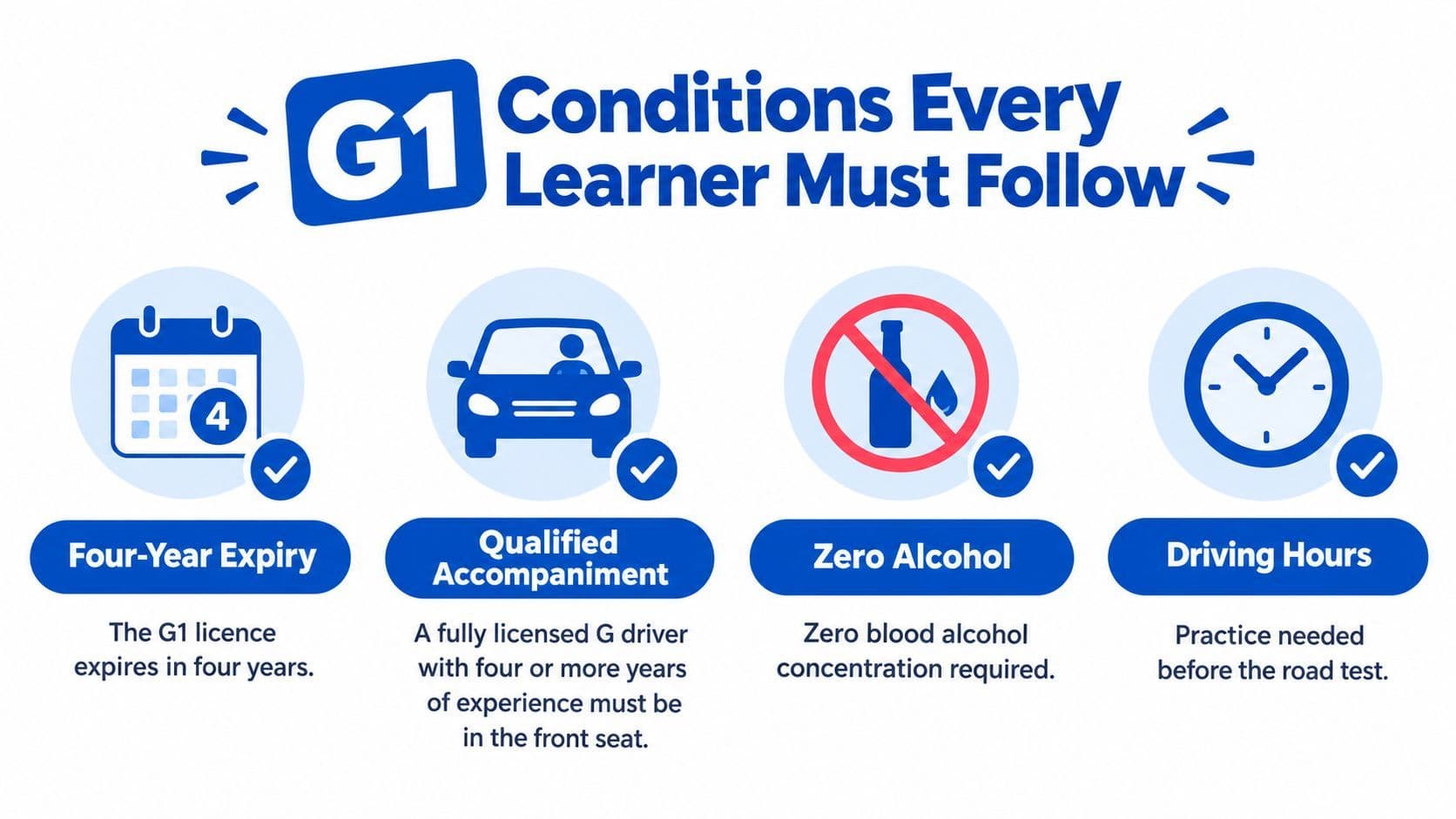
G1 Conditions Every Learner Must Follow
A G1 practice session should begin with a safety check and a licence-condition check. The vehicle may be roadworthy, but the trip still isn't legal if the driver is alone, driving during the prohibited hours, or carrying passengers incorrectly.
Keep these conditions visible:
- Qualified accompaniment: A fully licensed accompanying driver with at least four years of driving experience must sit in the front passenger seat. A friend who has only recently passed a road test doesn't qualify.
- Zero alcohol: A G1 driver must have a blood-alcohol concentration of zero. That applies even when the driver feels completely normal.
- Driving hours: G1 drivers may not drive between midnight and 5 a.m. A late soccer match can't become a reason to drive home during the curfew.
- High-speed highways: G1 drivers may not use specified high-speed highways unless accompanied by a driving instructor. A solo trip to a job in Brampton may therefore require a different route or a different licence stage.
- Passenger seating: Only the accompanying driver may sit in the front seat. Rear passengers must not exceed the available operable seat belts, and additional restrictions apply to young passengers during the early learner period.
- Seat belts and identification: Every occupant must wear a seat belt. The learner should carry the G1 licence and follow any required novice-driver display rules.
The G1 licence also has an expiry period of four years, so learners shouldn't leave the progression unattended. Ontario's official handbook remains the authority for the exact conditions and exceptions.
Treat each practice trip as a supervised lesson. The accompanying driver should plan the route, check the vehicle, and intervene early rather than waiting for a dangerous mistake.
Matching a Vehicle to the Right Ontario Licence
A quick match is useful, but it should never replace checking the vehicle's weight and equipment. The examples below show the starting point for common Ontario questions.
Vehicle Example Class Required Licence Key Endorsement Toyota Corolla Passenger vehicle Full G, G2, or G1 under its stage conditions None normally Ford F-150 Light pickup Full G, G2, or G1 under its stage conditions Check trailer and brakes Cube van over 11,000 kg GVW Commercial truck Commercial class, potentially D depending on configuration Z if air brakes apply Tractor-trailer Heavy combination Class A Z may be required Bus carrying more than 24 passengers Heavy passenger vehicle Class B or another applicable commercial class Passenger or school-bus endorsement may apply Moped Limited motorcycle or moped category Applicable M-stage licence Check the vehicle definition and restrictions Large recreational motorhome RV or commercial pathway Full qualifying licence plus RV endorsement where applicable Z may apply if air brakes are fitted
The trailer is often the deciding factor. A light pickup towing a towed unit above 4,600 kg can leave the ordinary Class G pathway, even though the pickup itself looks familiar. Similarly, an RV above 11,000 kg needs careful review because the July 1, 2025 endorsement rules may offer a different route from the standard commercial classes.
Mopeds, motorcycles, and certain farm-plated vehicles don't fit neatly into a simple “car to truck” ladder. Identify the vehicle category first, then confirm the licence and endorsement.
The Licence Escalation Path From G1 to Commercial
Most new drivers begin with the G1 knowledge test and supervised practice. The progression then moves through G2 and full G before a driver considers commercial licensing. Each step adds experience and testing rather than just changing the letter on the card.
A practical pathway looks like this:
- G1: Pass the learner knowledge test and begin supervised Class G practice.
- G2: Complete the required learner period and pass the first road test.
- Full G: Pass the next road-test stage and gain full Class G privileges.
- Commercial preparation: Meet the applicable experience, age, medical, vision, knowledge, and road-test requirements for the chosen commercial class.
- Commercial endorsement: Add requirements such as air brakes, school-bus operation, passenger use, or the RV endorsement where the rules permit.
The motorcycle pathway runs separately through M1, M2, and M. A G licence doesn't automatically turn into a motorcycle licence, just as a motorcycle licence doesn't qualify someone to operate a tractor-trailer.
Commercial licensing should be planned around the specific vehicle. A driver interested in Class A needs to understand combination-vehicle requirements, while a driver considering Class B or D must examine passenger use, vehicle weight, and braking equipment. Endorsements attach to an appropriate base licence. They don't replace the training and testing required for that base class.
Quick-Reference Summary of Every Class
Ontario's system is easiest to remember when you group related permissions together rather than treating every letter as an isolated category.
Class Typical Vehicle Max GVW / Weight Licence or Endorsement G1 Learner car or light truck Class G limits apply G1 supervision conditions G2 Intermediate passenger vehicle Class G limits apply G2 novice conditions G Car, van, SUV, or light truck 11,000 kg Full G A Heavy vehicle combination Configuration-specific Class A, with Z where required B Heavy bus Configuration-specific Class B and applicable bus endorsement C Commercial passenger or goods vehicle Configuration-specific Class C D Straight truck or certain heavy vehicles Above ordinary G use Class D, with Z where required E Special bus or commercial vehicle Configuration-specific Class E F Ambulance or qualifying passenger vehicle Configuration-specific Class F M1 Beginner motorcycle stage Vehicle-specific M1 M2 Intermediate motorcycle stage Vehicle-specific M2 M Full motorcycle licence Vehicle-specific M RV endorsement Eligible recreational vehicle Up to 14,000 kg where permitted Added to a qualifying full licence
The core figures to keep in mind are the 11,000 kg Class G combination ceiling, the 4,600 kg towed-unit limit, and the possibility of a Z air-brake endorsement. A G1 holder also can't treat a moped, tractor-trailer, or commercial combination as an ordinary Class G vehicle.
These summaries simplify the framework. The vehicle registration, trailer rating, braking system, and intended use can change the answer, so edge cases deserve a closer look.
Common Questions About Ontario Vehicle Classes
Does a pickup with a trailer need a separate licence?
Not automatically. Check the complete combination. If the vehicle and trailer stay within the Class G limits, the appropriate G-family licence may be enough. A towed unit above the applicable threshold can require a different class.
How does the July 1, 2025 RV change affect a Class G driver towing a 5,000 kg motorhome?
The answer depends on whether the vehicle is treated as an eligible recreational vehicle, whether the driver holds the required full base licence, and whether the endorsement applies to that configuration. A Class G driver shouldn't assume the endorsement is automatic or that the ordinary Class G limit disappears.
When is the Z endorsement mandatory?
When the vehicle requires operation of an air-brake system under Ontario's licensing rules. A vehicle's size alone doesn't answer the question. Check the braking equipment and the licence-class requirements.
Can a G1 driver ride a 50 cc moped?
Don't assume so. Mopeds and limited motorcycles follow their own licensing rules, and a G1 licence is restricted to Class G vehicles.
How long does G1 to full G take?
The process depends on the learner's preparation, road-test timing, and ability to meet the staged requirements. The G1 licence expires after four years, so keep track of the date and use the official handbook and a local DriveTest centre for binding information.
Use targeted practice to reinforce the vehicle classes, towing limits, G1 conditions, and licence-stage rules before test day. Visit G1ready.ca for Ontario-focused practice exams, explanations, diagnostic quizzes, and a G1 exam simulator that can help you study these rules with confidence.


