
In Ontario, you may turn left on a red light only from one one-way street onto another one-way street, after a complete stop and only when the way is clear. A left turn from a one-way street onto a two-way street isn't permitted.
You're sitting at an unfamiliar city intersection, watching the red light above you while a one-way street runs to your left. The curb may have a bus lane, pedestrians may be crossing nearby, and the traffic pattern may look open. G1 learners often make a quick assumption and get the rule wrong here.
Ontario doesn't have a general “left on red” permission. It has a narrow exception with specific roadway geometry, stopping requirements, yielding duties, lane positioning, and sign restrictions. The safest way to remember it is to ask three questions: What does the law permit? What must the vehicle physically do? Which signs or street layouts cancel the permission?
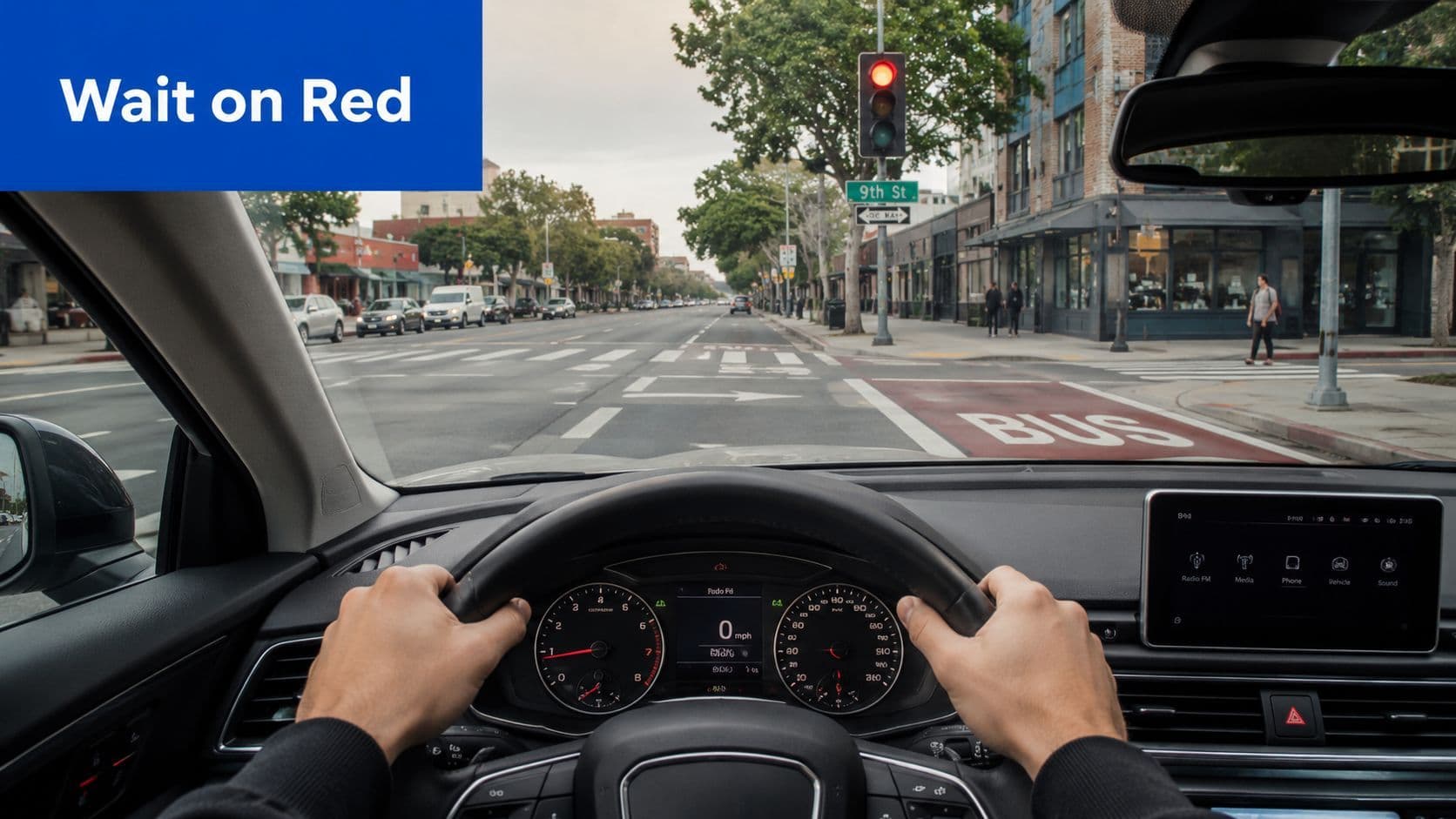
Sitting at a Red Light in Ontario
Keep the vehicle stopped while you work through those questions. Your signal should show your intention, but signalling doesn't make an otherwise prohibited turn legal. The red light still requires a full stop, and the one-way exception only becomes relevant after you confirm that both roads meet the rule.
The Ontario bottom line
You can turn left on red only when:
- The road you're leaving is one-way.
- The road you're entering is also one-way.
- You come to a complete stop first.
- You yield to pedestrians and traffic.
- The way is clear and no sign forbids the movement.
If either street carries traffic in both directions, stop and wait for green. That includes turning from a one-way street onto a two-way street. It also includes turning from a two-way street onto a one-way street. Ontario's exception requires the full one-way-to-one-way arrangement.
Passenger-seat reminder: Don't decide based on the direction your steering wheel moves. Decide based on the direction of traffic on both streets.
The movement must also be made properly. Ontario guidance requires the permitted turn to travel from the left lane into the left lane of the receiving one-way road. A wide turn into a different lane can create a separate safety and test issue, even if the intersection itself appears eligible.
A bus lane, crosswalk, cyclist, or unusual curb design can make the intersection harder to read. Treat those features as reasons to slow down and verify the layout, not as evidence that a left turn is automatically allowed. The rest of the rule comes down to street direction, complete stopping, yielding, lane position, and posted control.
What Ontario Law Says About Red Lights
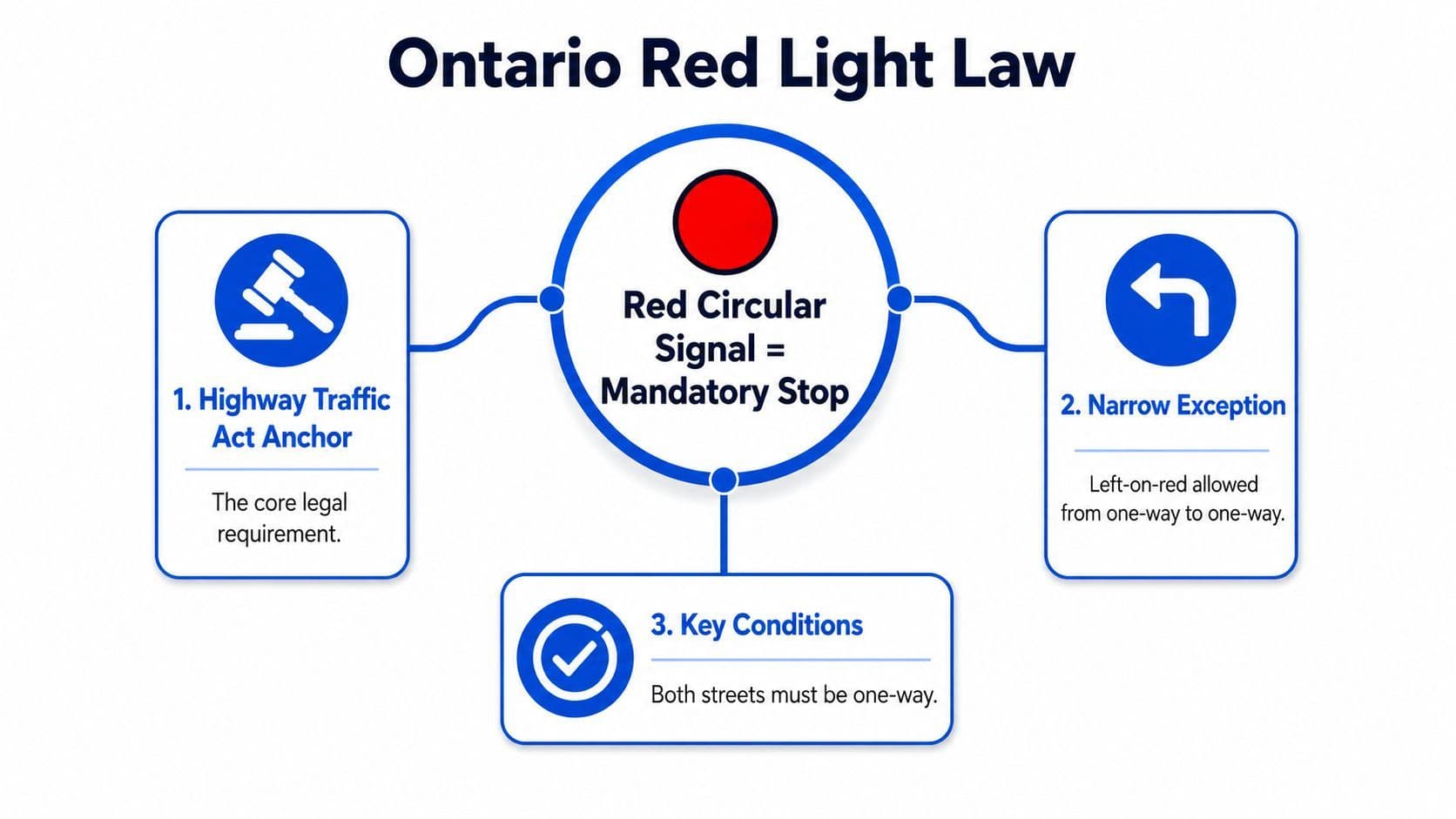
Ontario's legal starting point is simple. The Ontario Highway Traffic Act requires a driver approaching a circular red signal to stop and remain stopped until a green indication appears, unless a specific exception applies. That means a left turn on red isn't a general driving privilege. It's a limited carve-out from the normal stop requirement.
The Ontario driver's handbook gives the practical version. It permits a left turn on red only from a one-way road onto another one-way road, after the driver stops completely and yields until the way is clear. The handbook also describes right turns on red as a stop-and-yield movement, but learners shouldn't treat the familiar right-turn rule as permission to make any left turn that looks open.
What a complete stop means
A complete stop means the vehicle stops before proceeding through the controlled area. A rolling pause, creeping movement, or stop that carries the front of the vehicle into the crosswalk doesn't satisfy the practical standard a learner needs to demonstrate. Stop behind the stop line when one is present. If there's no line, stop before the crosswalk or before entering the intersection.
The reason is control. A stationary vehicle gives the driver time to identify pedestrians, cyclists, vehicles already in the intersection, and traffic approaching on the receiving street. A driver who rolls forward while scanning has already reduced the margin available to everyone else.
Why the exception is so narrow
A left turn from one one-way street to another one-way street avoids the conflict created by entering opposing traffic lanes on a two-way road. Ontario's law permits that specific movement, but it doesn't remove the duty to yield or the need to obey signs and signals.
For a focused explanation of the same Ontario mechanics, review this Ontario left-turn rules guide. It should reinforce the central exam idea: red means stop first, and only the precise exception permits the next movement.
The One-Way to One-Way Exception
Treat the exception as a sequence of decisions, not as a single yes-or-no shortcut. The car must be in the right roadway configuration, stopped correctly, clear of conflicts, and positioned for the correct receiving lane.
Confirm the roadway geometry
Start with the street you're on. Is traffic travelling only in your direction? Then inspect the road to your left. Does it also carry traffic only in the direction your vehicle would enter?
If the answer to either question is no, the exception ends. A one-way street feeding into a two-way street isn't enough. A two-way street feeding into a one-way street isn't enough. The test question may show a familiar-looking intersection, so read the arrows and signs instead of relying on the shape of the road.
Stop, scan, and yield
Bring the vehicle to a complete stop behind the stop line or crosswalk. Keep the wheels controlled while you scan left, right, and ahead. Check every crosswalk leg, watch for cyclists, and identify vehicles that are already in the intersection or have the right of way.
The turn happens only after yielding to pedestrians and traffic and confirming that the path is clear. If visibility is poor, wait. A legal opportunity doesn't require you to use it immediately.
Enter the correct lane
Ontario's guidance requires the movement from the left lane into the left lane of the one-way street being entered. Don't swing across multiple lanes. Begin and finish the turn in the lane that matches the permitted movement, then continue only after checking the new roadway.
An improper or prohibited movement can have serious consequences. Turning left from a one-way street onto a two-way street at a red light is treated as running a red light and can result in a $260 fine plus three demerit points, as described in legal commentary on Ontario's left-on-red rule. A G1 learner can also lose the road-test opportunity for failing to obey the signal or making an unsafe movement.
Intersection Setup Left on Red Allowed? Driver Action One-way street to one-way street, no restrictive sign Yes, if safe Stop fully, yield, then turn left into the left lane One-way street to two-way street No Remain stopped until green Two-way street to one-way street No Remain stopped until green Any layout with a NO LEFT TURN ON RED sign No Obey the sign and wait Any layout where pedestrians or traffic make the path unclear Not yet Continue waiting until the way is clear
A NO LEFT TURN ON RED sign cancels an otherwise legal movement. A NO TURNS ON RED sign does the same more broadly, and a transit-priority lane or other intersection control can change how the movement must be handled.
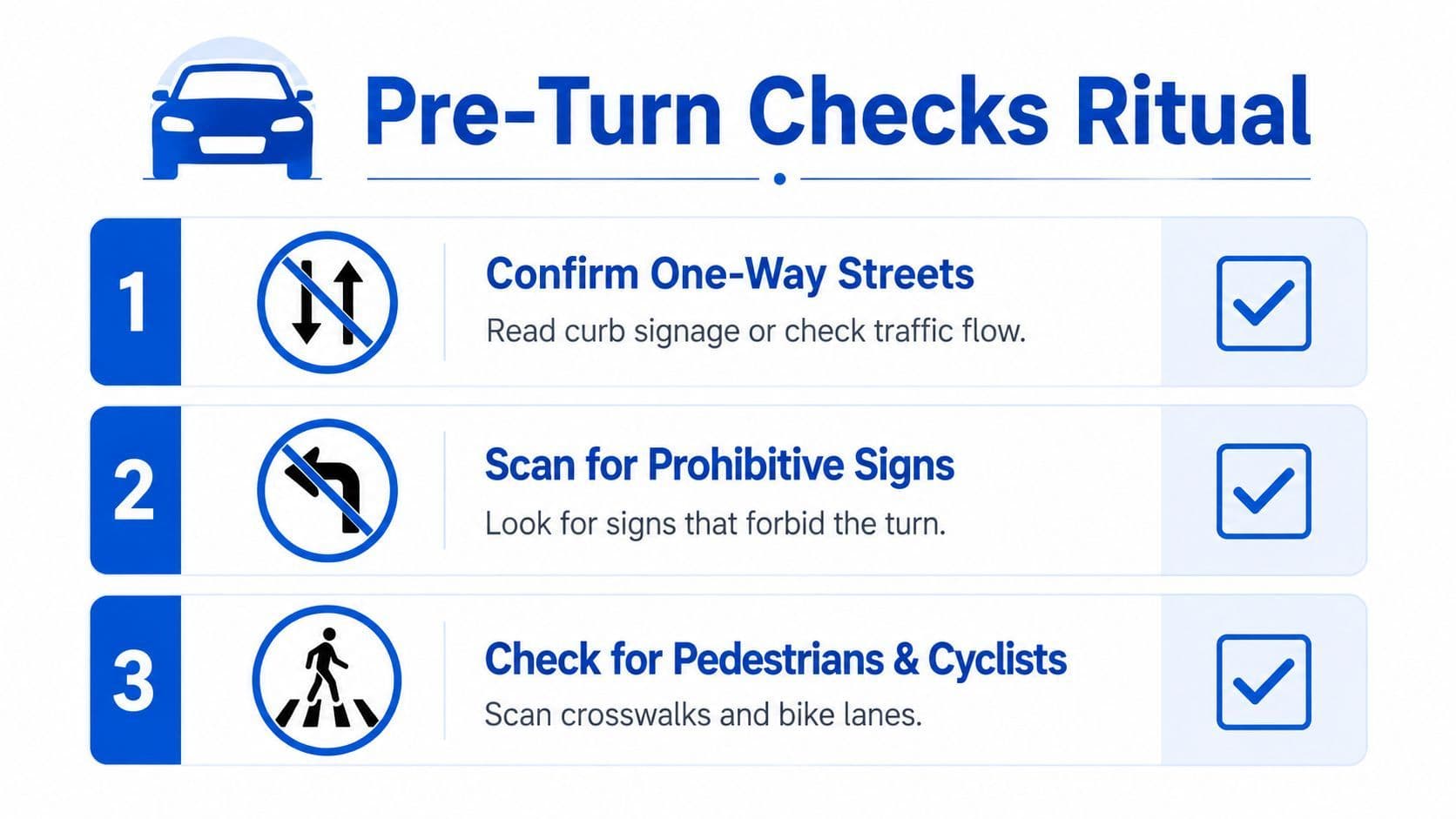
Pre-Turn Checks Every Driver Should Run
Run the checks while approaching the line and again after stopping. They give your eyes and hands a repeatable job, which is more reliable than trying to remember a sentence from the handbook under pressure.
Check the street direction
Look for one-way signs on the road you're leaving and the road you're entering. Read curb-side signs, lane arrows, and the direction of vehicles using the cross street. Don't infer the answer from parked cars, because parked vehicles may face the wrong direction or be positioned irregularly.
Use a simple physical cue: keep the vehicle stopped, look beyond the intersection, and ask whether traffic on the receiving street is allowed to travel in both directions. If it is, the left turn on red isn't available.
Check for restrictions
Scan above and beside the traffic signal for a NO LEFT TURN ON RED sign. Also look for a NO TURNS ON RED sign, a red arrow, temporary construction control, or a lane-use sign that affects the turn. The Ontario Traffic Manual explains that the NO LEFT TURN ON RED sign prohibits a left turn that would otherwise be lawful during the red phase. Its regulatory-sign standard is a useful reminder that roadway geometry isn't the only factor.
Make the body action deliberate. After stopping, move your eyes from the signal to the sign area, then down the curb and lane markings. A circular red light doesn't cancel a separate restriction.
Check visibility and vulnerable road users
Lean forward slightly if the vehicle's A-pillar blocks part of the crosswalk or approach. Check each crosswalk leg for pedestrians, then scan for cyclists near the curb or in a designated lane. Look for approaching headlights and don't turn only because the nearest lane looks empty.
The mirror, shoulder-check, and signal guide can help you rehearse the broader observation routine. For this manoeuvre, the key habit is to keep scanning after the initial check. A pedestrian can enter the crosswalk while you wait, and a vehicle can emerge from behind a larger vehicle.
Visibility rule: If you can't see the conflict area clearly, you can't confidently say the way is clear.
How Ontario Compares to Other Provinces
Canada doesn't use one shared left-on-red rule. Ontario's one-way-to-one-way exception is easy to misapply when a driver has learned a different provincial rule or has seen a general online summary that treats the country as a single jurisdiction.
The comparison below keeps the jurisdictions separate:
Province Left on Red Permitted? Conditions Notes Ontario Yes, in a narrow situation One-way street to one-way street, complete stop, yield, clear path, no restrictive sign The specific lane movement and posted signs matter Quebec No Left turns on red are prohibited Right turns on red follow separate conditions New Brunswick Yes, in a narrow situation One-way street to one-way street, with a complete stop and safe yielding The rule resembles Ontario's exception Prince Edward Island No Left turns on red are prohibited Drivers must wait for the permitted signal
This difference matters at provincial borders and for newcomers who are adapting to Ontario's licensing system. A rule that felt automatic in another jurisdiction may not apply once the road signs, traffic law, and examination standard change.
Cross-provincial habit: Learn the rule attached to the province where you're driving, not the rule you remember from your last city.
Signs can impose an additional restriction even where the provincial rule would otherwise permit the turn. Read the intersection itself each time, especially where lanes, transit movements, or temporary construction controls make the layout unusual.
Drivers preparing for Ontario licensing can use the Ontario new driving rules guide as part of their broader study routine. The practical lesson is straightforward: “Canada” isn't a sufficient answer to a red-light question. “Ontario” is the relevant answer when you're taking the Ontario G1 test or driving here.
Common G1 Mistakes at Red Lights
G1 learners tend to miss this topic for predictable reasons. They remember the existence of a left-on-red exception but lose the conditions attached to it. On the test, one changed detail, such as the direction of the receiving road or a posted sign, can change the correct answer.
Mistake one, treating the exception as universal
A learner sees a one-way street and assumes that any left turn onto it is allowed. That isn't Ontario's rule. The road you're leaving must also be one-way.
The test trap often appears as a diagram where the receiving street is one-way but the approach street carries traffic in both directions. The correct response is to wait for green. Reverse the diagram and the answer remains the same if the approach is one-way but the receiving road is two-way.
Use this question pattern:
- Both streets one-way: The exception may apply.
- Either street two-way: The exception doesn't apply.
- Street direction unclear: Don't assume permission.
Mistake two, rolling past the stopping point
Some learners slow down, glance around, and continue into the crosswalk. They may believe that a nearly stopped vehicle has satisfied the red light because no traffic is approaching. It hasn't.
The stop comes before the scan and before the turn. Stop behind the line or crosswalk, keep the car stationary, and then assess pedestrians, cyclists, and traffic. The Ontario handbook's rule is built around complete stop, yield, and proceed only when clear, not around a slow approach.
Mistake three, missing the sign
A learner focuses on the circular red lamp and forgets to search for a restriction above or beside it. A NO LEFT TURN ON RED sign cancels the permission, even if both streets are one-way. A NO TURNS ON RED sign is broader and also requires the driver to wait.
Temporary construction signs create the same problem because the familiar intersection may operate differently during road work. Train yourself to inspect the entire signal area before deciding.
Mistake four, turning into the wrong lane
The geometry may be legal, but the vehicle still needs to make the correct lane movement. Ontario guidance calls for the left lane into the left lane. A wide turn into the right lane can put the vehicle beside traffic or interfere with another lane user.
G1 test habit: Read every part of the diagram. Street direction, signal type, signs, pedestrians, and receiving lane all matter.
The wording in a practice question may be short, but the visual details carry the decision. Don't answer from the phrase “turn left on red” alone. First identify whether the signal is circular, whether both roads are one-way, whether a sign forbids the turn, and whether the path is clear.
Red Light Checklist for Confident Turns
At a red light, treat the decision like a short inspection before starting the turn. Keep the vehicle stopped, check each condition in order, and proceed only when the roadway, signs, and lane path all agree.
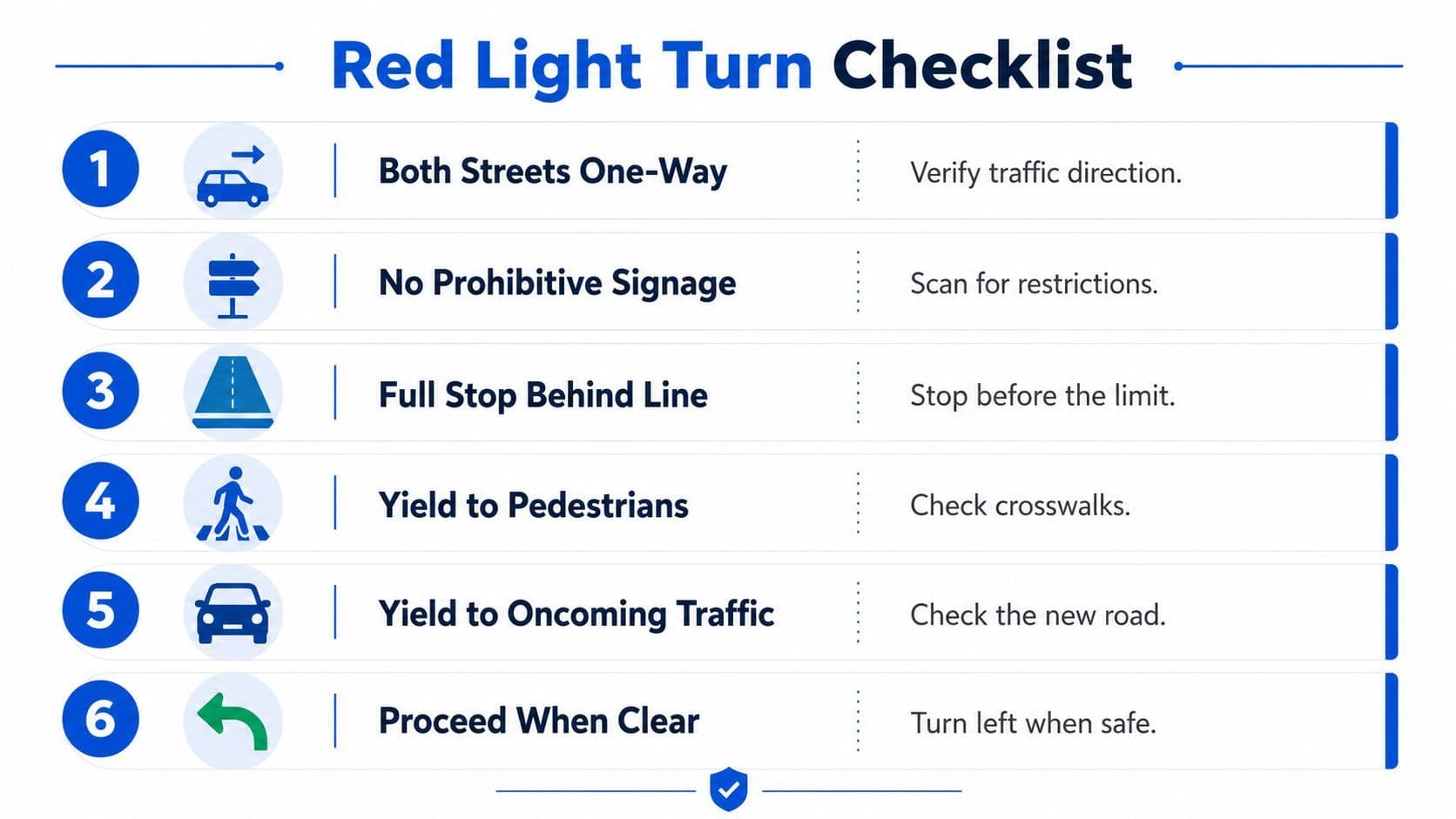
- Confirm both streets are one-way. The road you leave and the road you enter must each carry traffic in only one direction. This is the narrow Ontario exception, not a general permission to turn left at every red light.
- Scan for prohibitive signage. Look for NO LEFT TURN ON RED, NO TURNS ON RED, red arrows, and temporary construction controls. A sign can cancel the permission created by the one-way layout.
- Come to a full stop behind the line. Stop before the limit line or crosswalk. Keep the car stationary while you look, rather than rolling forward as if the red light were a yield sign.
- Yield to pedestrians and cyclists. Check the crosswalk and the curb-side area. Anyone with the right of way must be able to continue safely before your vehicle moves.
- Yield to traffic. Check vehicles already in the intersection and traffic approaching on the receiving street. Your turn waits for road users with priority.
- Turn from the leftmost lane into the leftmost receiving lane. Guide the vehicle into the matching lane and keep the turn controlled. Swinging wide can place you beside traffic or across another lane.
If one answer is unclear, wait. The repeated order helps prevent a familiar-looking question from hiding a different street direction, sign, or lane movement.
G1ready.ca provides free practice exams, targeted quizzes, mixed tests, diagnostic practice, marathon practice, and an exam simulator with feedback and explanations. Use G1ready.ca to practise identifying the one-way exception, the required stop, restrictions, yielding duties, and receiving lane.
Practice until the sequence feels as clear as following road markings. On the G1 exam, read the whole diagram before choosing an answer, because the signal alone does not establish that a left turn is permitted.


