If you're reading this a few days before your Woodstock road test, you're probably doing what most drivers do. Replaying turns in your head, wondering what the examiner will ask for, and hoping you don't make a small mistake feel bigger than it is.
That feeling is normal. The good news is that the drive test in Woodstock isn't random. It has patterns, recurring trouble spots, and a clear standard. When you know the route style, the common errors, and the small administrative details that trip people up before they even leave the parking lot, the whole day becomes much more manageable.
Your Guide to the Woodstock DriveTest Centre
Nerves tend to spike when you start looking up pass rates. That's understandable. What matters is using that information properly. The Woodstock DriveTest centre has a 61% pass rate for the Full G Road Test in 2026, with a 39% failure rate, according to Woodstock full G pass and failure rates. That doesn't mean the test is unfair. It means preparation matters more here than many drivers expect.
Woodstock asks you to show clean, steady driving in two very different environments. One part of the test rewards calm urban control. The other rewards confident highway decision-making. Drivers who practise only neighbourhood driving often feel caught off guard when the test shifts pace.
Why Woodstock feels tougher than expected
Many candidates are comfortable with basic car control but lose marks when the environment changes quickly. A quiet street is one thing. A merge, a lane change, and a return to a busier local road is another.
That difference is why I always tell students to prepare for the test as a sequence, not as a list of isolated skills. You aren't just proving you can steer, stop, and signal. You're proving you can stay predictable through changing road conditions.
Practical rule: Treat the Woodstock test like a safety demonstration, not a performance.
If you're moving from G2 to full G, it helps to review exactly what the licence allows and what the examiner is trying to confirm. A quick refresher on the Ontario Class G licence helps put the test in context.
What good preparation looks like
Strong preparation in Woodstock usually includes:
- Route familiarity: Know the local roads well enough that turns and merges don't feel new.
- Consistent observation: Examiners watch for head movement, mirror checks, and blind spot checks.
- Speed discipline: Staying appropriately paced matters just as much as avoiding speeding.
- Administrative readiness: Licence, vehicle condition, and timing all need to be handled before test stress kicks in.
You don't need perfect driving. You need safe, organised, repeatable driving.
Booking Your Test and Preparing Your Paperwork
Administrative mistakes are some of the most frustrating ones because they can ruin a test day before the examiner even meets you. Handle the booking and paperwork early, then leave them alone.

How to book without mistakes
The simplest approach is to use the official booking process and confirm every detail before you submit. If you want a refresher on the process, this guide to booking a G road test in Ontario is a useful starting point.
When booking your drive test in Woodstock, keep the process practical:
- Choose the correct test class. Make sure you're booking the road test you need. A G test and a G2 test assess different skills.
- Select Woodstock intentionally. Don't assume the nearest appointment is the best one. Choose a date that gives you enough time to practise the local route style.
- Double-check confirmation details. Look at the date, time, location, and any name or licence information before closing the page.
- Save the confirmation immediately. Keep a screenshot, email confirmation, or printed copy so you aren't searching for details later.
- If plans change, deal with it early. Rescheduling is much easier when you act before the last minute.
A rushed booking often creates a rushed lead-up. That's avoidable.
What to bring and what your vehicle must handle
Your paperwork should be gathered the day before, not the morning of the test. Keep it all in one folder in the car.
Bring the essentials that prove you can legally take the test and that the vehicle is suitable for it. Requirements can vary depending on your situation, so check your booking details carefully and make sure your licence status and any supporting documents are current.
For the vehicle, think like an examiner standing outside the car for a quick acceptance check.
- Working lights: Brake lights, signal lights, and other basic exterior lights need to function properly.
- Clean windows and mirrors: Visibility problems create a bad first impression and a real safety issue.
- Reasonable tire condition: If the tires look unsafe, the test may not proceed.
- No dashboard surprises: Warning lights can raise concerns about roadworthiness.
- Accessible controls: Horn, seat belts, mirrors, and defroster should all be usable without fuss.
Bring a car that's boring in the best possible way. No mechanical drama, no clutter, no excuses.
One more detail matters. Sit in the driver's seat before test day and make all your normal adjustments in the same order every time: seat, mirrors, steering position, belt, climate, and visibility. Repetition lowers stress.
Navigating the Woodstock G Test Route
Woodstock is one of those centres where local familiarity helps immediately. The route can vary, but the pattern is known well enough that you should practise it until it feels ordinary, not special.
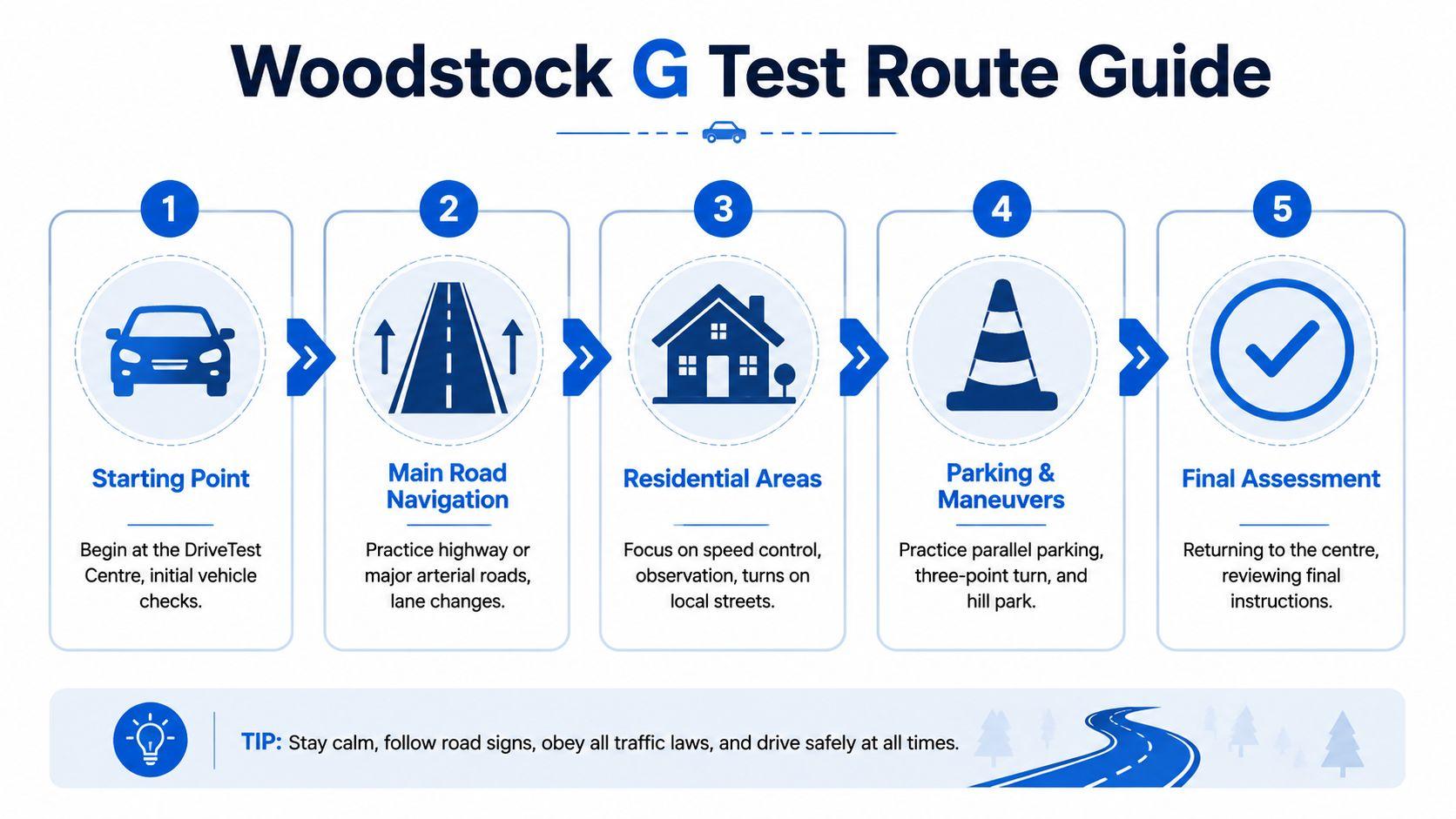
Early in your route review, use this visual summary to build a mental map of the test flow.
What the route usually feels like
The typical Woodstock G road test route includes Huron Street, Norwich Road, and a merge onto Highway 401, with notable pressure points at a four-way stop at Wellington Street, a bridge over railway tracks, and construction on Dundas and Norwich. Parallel parking is excluded, while highway merging and blind spot checks remain major priorities, as outlined in this discussion of the typical Woodstock G test route and speed limits.
Most urban roads in the test area are posted at 50 km/h, except school zones where lower limits apply. That matters because some candidates focus so hard on not speeding that they end up driving too timidly and falling out of rhythm.
A common route pattern looks like this in real driving terms:
- Leaving the centre: Start cleanly, settle yourself, and don't waste attention on trying to guess what comes next.
- Moving through local roads: Huron and Norwich ask for lane discipline, observation, and steady control.
- Highway phase: The 401 section is where hesitant drivers often start overthinking.
- Sweaburg loop: After exiting south, you'll rejoin and work your way back east before exiting at Norwich and returning toward the centre.
That sequence is why I coach students to practise transitions, not just individual streets.
Before you drive it yourself, watch the route style once in motion.
Where drivers lose focus
The route doesn't usually beat people with one dramatic mistake. It does it with stacked small ones.
At the four-way stop on Wellington Street, drivers sometimes stop mechanically without proper observation. On the bridge over the railway tracks, some drivers let speed drift or stop scanning. In construction areas on Dundas and Norwich, lane closures can force quick but controlled decisions. That's where your habits show.
If construction narrows the lane, don't panic and don't freeze. Slow appropriately, read the lane markings, and commit to one safe path.
The highway merge deserves special attention. Build speed purposefully, check mirrors, check your blind spot, and merge with intent. A weak merge tells the examiner that you aren't yet making confident decisions at speed. In Woodstock, that's costly.
Woodstock's Common Mistakes and Trouble Spots
Knowing the route isn't enough if your habits under pressure aren't clean. The Woodstock drive test usually exposes the same weak points again and again, which is good news because weak points can be trained.
The errors that actually matter
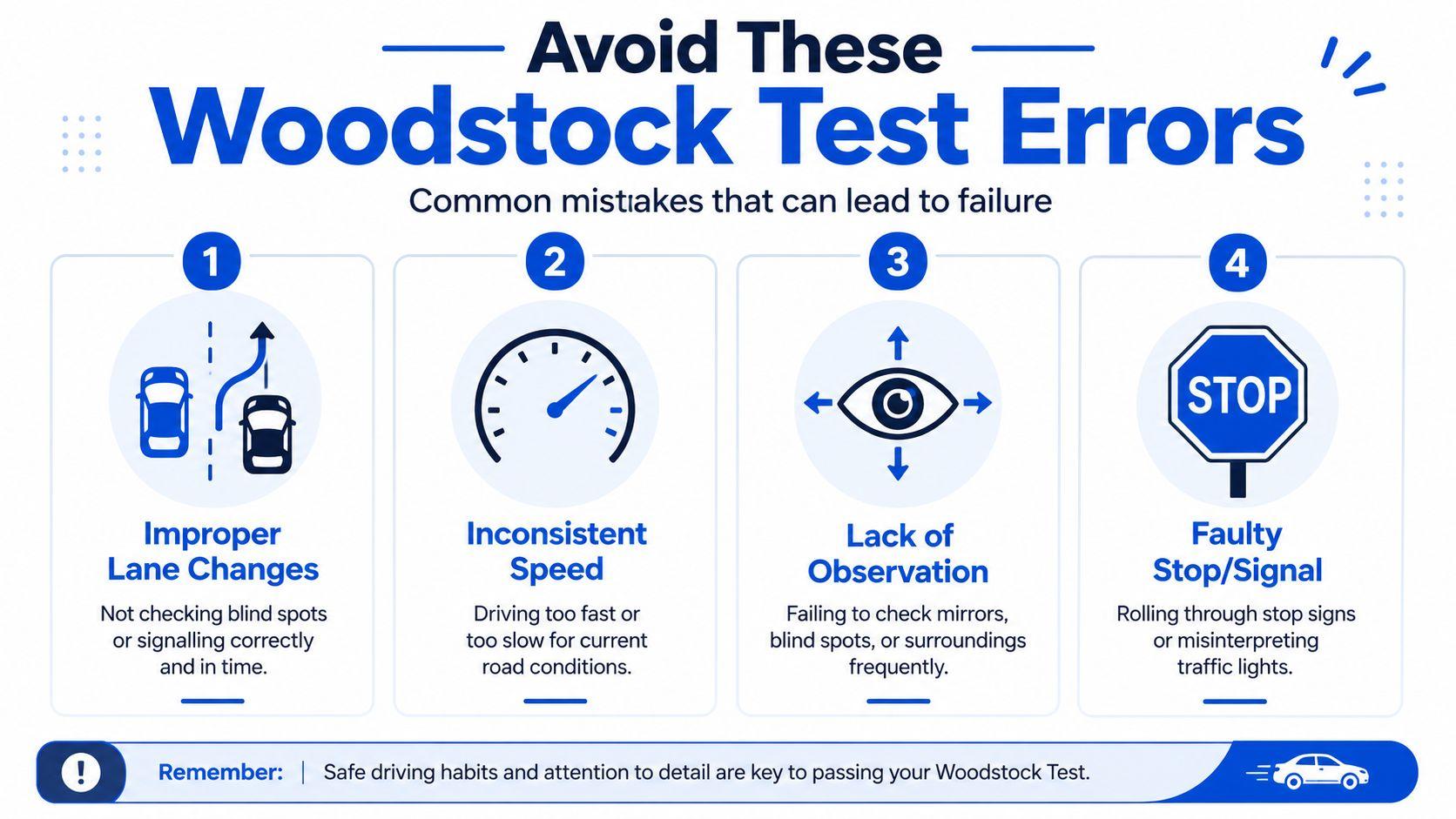
The key failure points in the Woodstock G test include insufficient blind spot checks, rolling stops, and unsafe lane changes. Speed compliance is also strict. Drivers must not exceed the posted limit or drop more than 5 km/h below it, based on the Woodstock-specific breakdown of common G test failure points.
These mistakes matter because each one affects predictability.
- Blind spot checks: The examiner can't give you credit for checks they can't clearly see. Move your head, not just your eyes.
- Rolling stops: A slow creep isn't a stop. At stop signs, the vehicle must fully stop.
- Unsafe lane changes: Signalling alone isn't enough. Timing, space, and observation all count.
- Poor speed control: Driving under the limit to feel safe often creates a different problem. It can signal uncertainty and disrupt traffic flow.
How to practise for examiner priorities
Most students improve faster when they stop saying, "I need to be more careful," and replace that with a visible, repeatable action.
Try practising this way:
Skill What to rehearse What the examiner wants to see Blind spot checks Turn your head before every lane change and merge Clear, deliberate observation Stop signs Count a full stop before moving Wheel stop, scan, then proceed Lane changes Mirror, signal, blind spot, move when space is clear Safe timing and stable steering Speed control Hold the road's pace without drifting up or down Calm compliance with posted limits
Safety and predictability beat perfection. A small mistake handled calmly is usually better than a panicked correction.
One more point matters in Woodstock. The full G test doesn't focus on the same lower-speed manoeuvres that shape many G2 practice sessions. If you've spent weeks polishing parking skills but haven't sharpened your lane changes and highway entry, shift your practice accordingly.
Test Day Execution and Last-Minute Practice
The final hours before your test should feel controlled. Not intense. Not crammed. Controlled.
A calm routine for the final hours
Start with the basics. Wake up early enough that nothing feels rushed. Eat something light, hydrate, and leave more travel time than you think you'll need.
When you arrive at the Woodstock centre, give yourself a few quiet minutes in the parked car. Check your mirrors again, adjust your seat, silence your phone, and breathe normally. You don't need a pep talk. You need steadiness.
A good last-minute routine looks like this:
- Do one short warm-up drive: Keep it simple. Practise a few turns, one proper stop, one lane change, and smooth speed control.
- Avoid cramming manoeuvres: Test-day panic practice usually makes drivers feel worse, not better.
- Refresh your rule knowledge lightly: If you want a mental warm-up, a short review of parking rules and road habits can help. This overview of parallel parking for a driving test is useful if you want to settle your thinking on observation and control.
- Keep conversation minimal: Too much advice from family or friends in the parking lot often increases tension.
How to drive once the examiner is in the car
When the examiner approaches, be polite and businesslike. Listen fully before responding. If you don't hear an instruction, ask for it to be repeated calmly.
During the drive:
- Take each instruction one at a time. Don't try to predict the whole route.
- Narrate with actions, not words. Clear checks, smooth steering, and proper stops speak for you.
- If you make a minor mistake, keep going safely. Many tests are lost because the driver mentally quits after one error.
If you feel your pulse rise at a merge or intersection, exhale and return to the next visible task. Mirror. Speed. Space. Position. That's enough.
Your Printable Day-Of Checklist and Final Resources
By the time test day arrives, you shouldn't be making decisions from scratch. You should be following a routine you've already rehearsed. That's what lowers anxiety.
One useful mindset shift helps here. The Woodstock G2 test and the Woodstock G test don't punish the same things in the same way. For the G2 test in Woodstock, the pass rate is 65%, and common pitfalls include hesitation at residential intersections, accounting for 29% of failures, and improper parallel parking, which is part of 38% of failures. That differs from the full G, which focuses more on highway skills, as noted in this review of the Woodstock driving test route and pass rates. If you're taking the full G, keep your attention on higher-speed decision-making and road awareness, not just low-speed manoeuvres.
Woodstock Road Test Day-Of Checklist
Category Item Checked Documents Driver's licence ☐ Documents Test booking confirmation ☐ Documents Any required supporting driving documents ☐ Vehicle Fuel level is sufficient ☐ Vehicle Signal lights and brake lights working ☐ Vehicle Windows, mirrors, and windshield are clean ☐ Vehicle Tires appear safe and properly inflated ☐ Vehicle Horn, seat belts, and defroster working ☐ Personal Glasses or contacts if you need them for driving ☐ Personal Phone silenced before check-in ☐ Personal Arrived early with time to settle ☐ Driving habits Full stops remembered ☐ Driving habits Blind spot checks deliberate and visible ☐ Driving habits Lane changes planned, not rushed ☐ Driving habits Speed held steadily to posted limits ☐
A final word before you go
The best Woodstock test drives usually look ordinary. No dramatic saves. No flashy confidence. Just a driver who is alert, calm, and consistent from the first turn to the return to the centre.
If that's how you've practised, you're ready.
If you want one more confidence boost before test day, spend a few focused minutes on G1ready.ca. It gives Ontario drivers a clean way to review rules, signs, and test-style questions without extra friction, which makes it useful when you want a quick mental reset before getting behind the wheel.