Divided Highway Ahead, Ontario's Divided Highway Begins warning, means opposing traffic will use separate one-way roads, and you must keep to the right-hand road.
You might be reviewing yellow signs on your phone, certain you recognise the picture but unsure which answer to choose. Or you might be approaching a road that splits around a median and wondering whether “keep right” means changing lanes immediately.
For the Ontario G1, connect the picture to a driving decision. Recognising the symbol matters, but so does resisting a dangerous correction when you miss an exit or realise you've misunderstood the road layout.
What Divided Highway Ahead Tells You
Keep to the right-hand roadway, not whichever roadway looks easier to enter. The Ontario Ministry of Transportation's sign guidance explains that Divided Highway Begins means traffic travelling in opposite directions will use separate roads, with each road carrying one-way traffic.
Before the division, you and approaching vehicles share a roadway, travelling in opposite directions. After the division, a median, barrier, or other physical separation sits between those traffic flows. Your roadway carries traffic going your way; the other roadway carries opposing traffic.
Read the roadways, not just the lanes
A roadway and a lane aren't interchangeable. Your side of a divided highway can contain several lanes going in the same direction. Keeping to the right-hand roadway doesn't automatically mean making an immediate move into its far-right lane.
Say you're following a road toward a planted median. The pavement separates into a roadway on each side of that median. You follow the right-hand roadway, using the lane markings to guide your position rather than steering toward the left-hand roadway because it appears empty.
That distinction prevents a common misunderstanding: the sign isn't offering a choice of routes around an obstacle. It's telling you how opposing traffic will be organised.
Divided highway begins and ends
Sign Traffic pattern Required response Divided Highway Begins (Divided Highway Ahead) Two-way road becomes separate one-way roadways Keep to the right-hand road Divided Highway Ends Opposite directions share one roadway again Expect two-way traffic
Don't swap begins and ends
With Divided Highway Begins, the physical separation is ahead. With Divided Highway Ends, that separation is ending, so approaching vehicles will again use the same roadway in the opposing lane.
The word ends doesn't mean the highway itself stops. You don't stop just because the divided section finishes. Instead, recognise the return to a two-way layout and pay attention to the markings that separate your direction from oncoming traffic.
A useful mental exercise is to describe what happens to the opposing vehicles. For Begins, they move onto a separate roadway. For Ends, they return to the same roadway as you, travelling in the opposite direction.
Memory cue: Begins means separation ahead. Ends means opposing traffic returns to a shared roadway.
Both signs are warnings. They give advance notice of a road feature that requires attention, rather than setting a new speed limit or granting priority over another driver.
On a G1-style question, choose the answer that connects the sign to the correct traffic arrangement and response. An answer about choosing either roadway ignores direction of travel. An answer about stopping invents an action the warning doesn't require.
If you're helping a teen or newcomer study, ask them to explain why the left-hand roadway is wrong. A learner who can explain the opposing traffic pattern understands more than someone who has memorised “keep right” without knowing what “right” refers to.
How the Yellow Warning Looks
You're approaching the transition and notice a yellow sign before the median starts. Recognise the warning first, then look beyond it to see how your lane continues through the split.
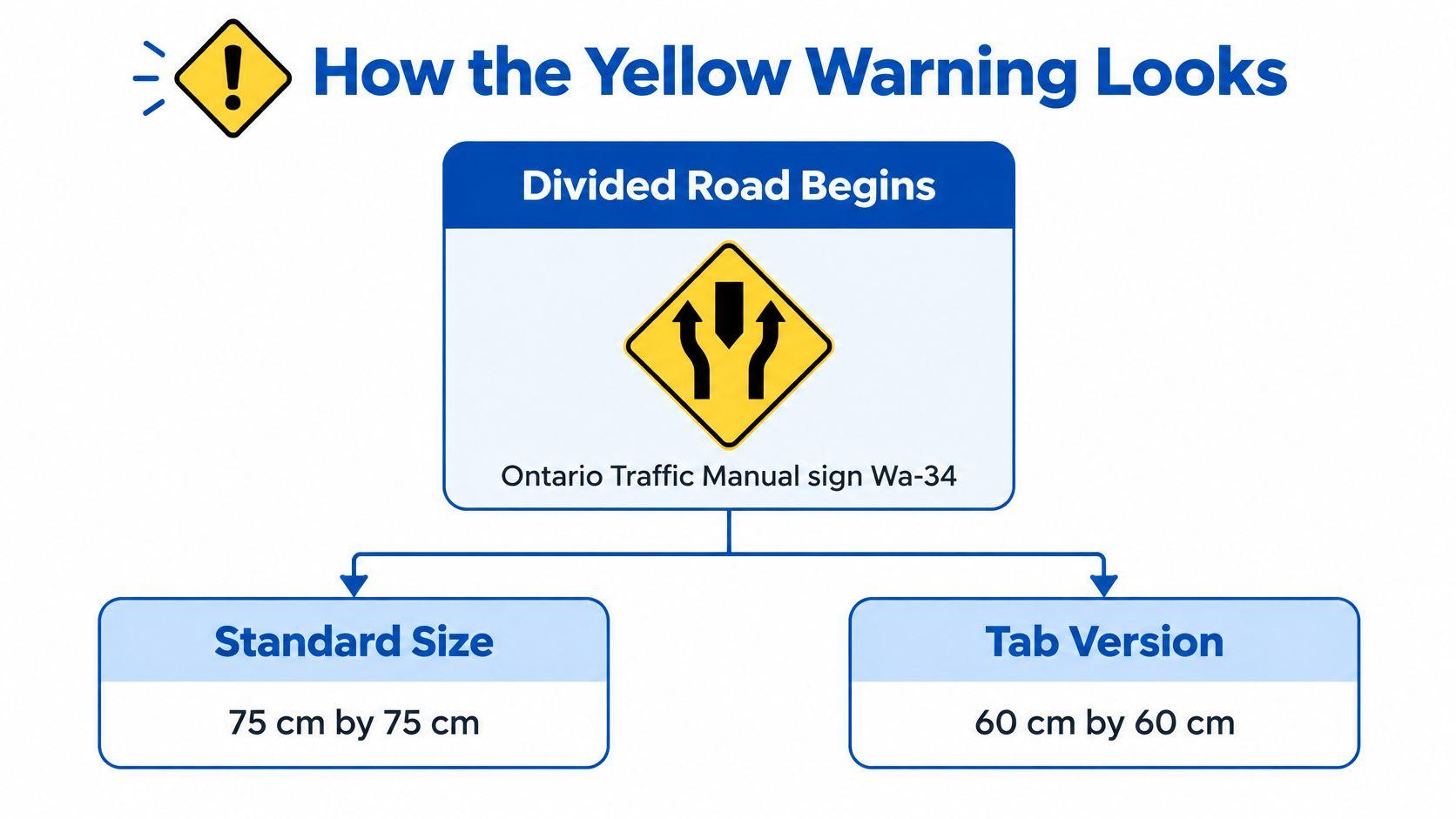
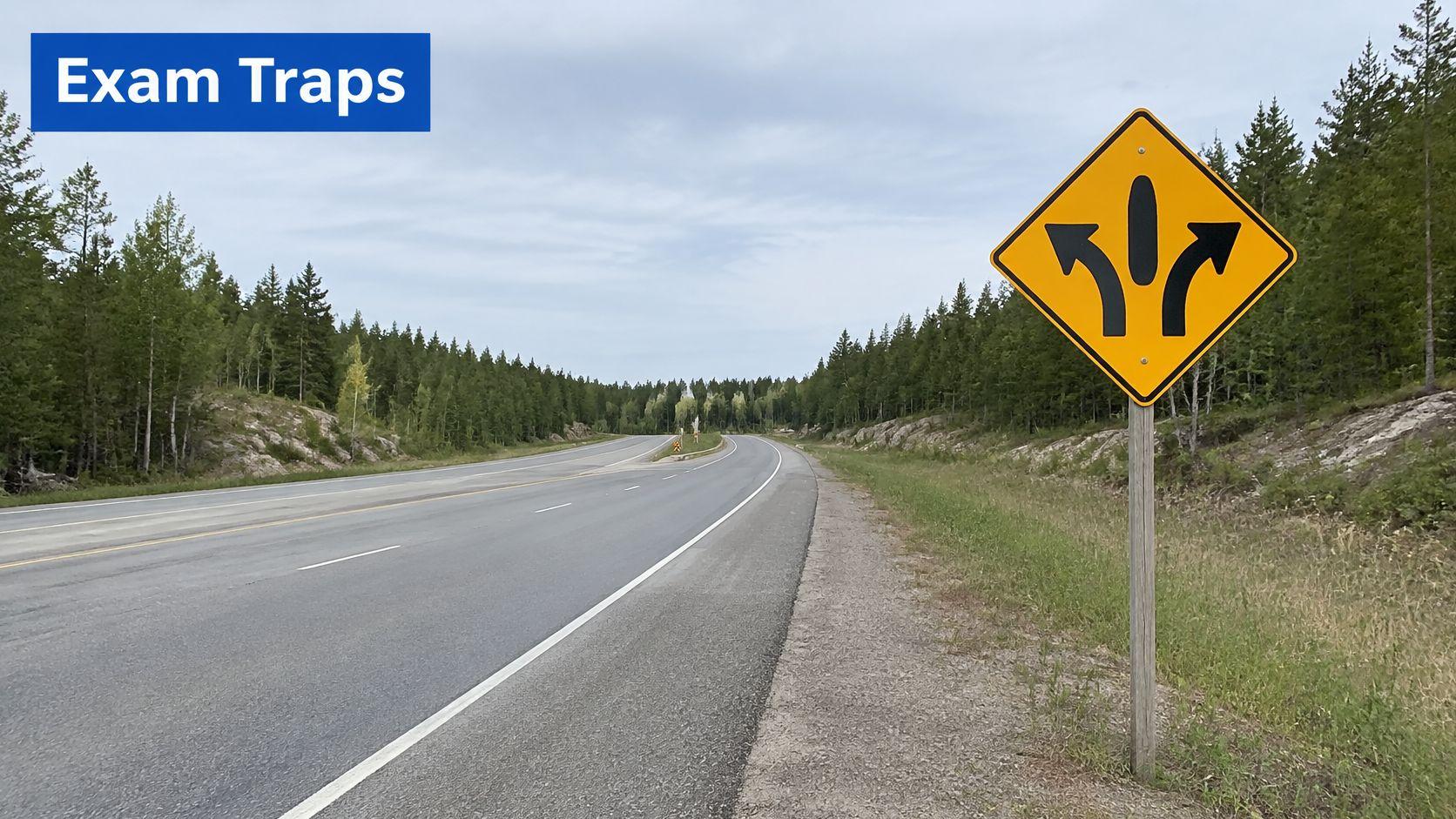
The Ontario Traffic Manual sign index identifies Divided Road Begins as Wa-34, normally 75 cm × 75 cm, and also lists a smaller 60 cm × 60 cm tab version. Its yellow background and black symbol fit the warning-sign design used to draw attention to conditions ahead.
Follow the picture into the actual road
The symbol represents traffic paths separated by a central division. Don't treat it like a navigation arrow telling you to make a sudden turn. It gives you time to understand the upcoming layout.
For example, the road may widen as you approach the median. A turning lane may appear beside your through lane, while a painted island guides traffic away from an opposing entrance. Looking only at the yellow sign won't tell you which individual lane serves your destination.
Read the details together:
- Lane arrows: Identify whether your lane continues ahead or serves a turn.
- Pavement markings: Follow the marked path rather than aiming across painted separation areas.
- Median openings: Don't assume an opening permits the movement you want.
- Regulatory signs: Check the instructions controlling the actual entrance, turn, or crossing.
This is why a driver can know the sign's definition and still position the vehicle badly. Recognising the warning is the start of the observation process, not the end.
Practise recognition without rushing the response
During study, cover the caption beneath a sign picture. Describe the layout in your own words before checking its name. Then ask what you would look for on the pavement after seeing it.
Use the guide to yellow traffic signs to practise separating a warning about road layout from warnings about curves, intersections, or other approaching conditions. The colour helps you recognise the category, but the symbol tells you which condition needs attention.
Seeing the warning early should give you more time to observe, not a reason to steer abruptly.
A divided roadway can include several through lanes, channelised turns, and restricted crossings. Keep your eyes moving between the sign, the lane ahead, and the surrounding traffic so you can follow the intended route smoothly.
Also distinguish the permanent sign from temporary instructions. A yellow divided-road warning describes the road's arrangement; it doesn't confirm that every ramp is open or that no incident lies ahead. Read temporary traffic controls as well rather than assuming the familiar layout will continue unchanged.
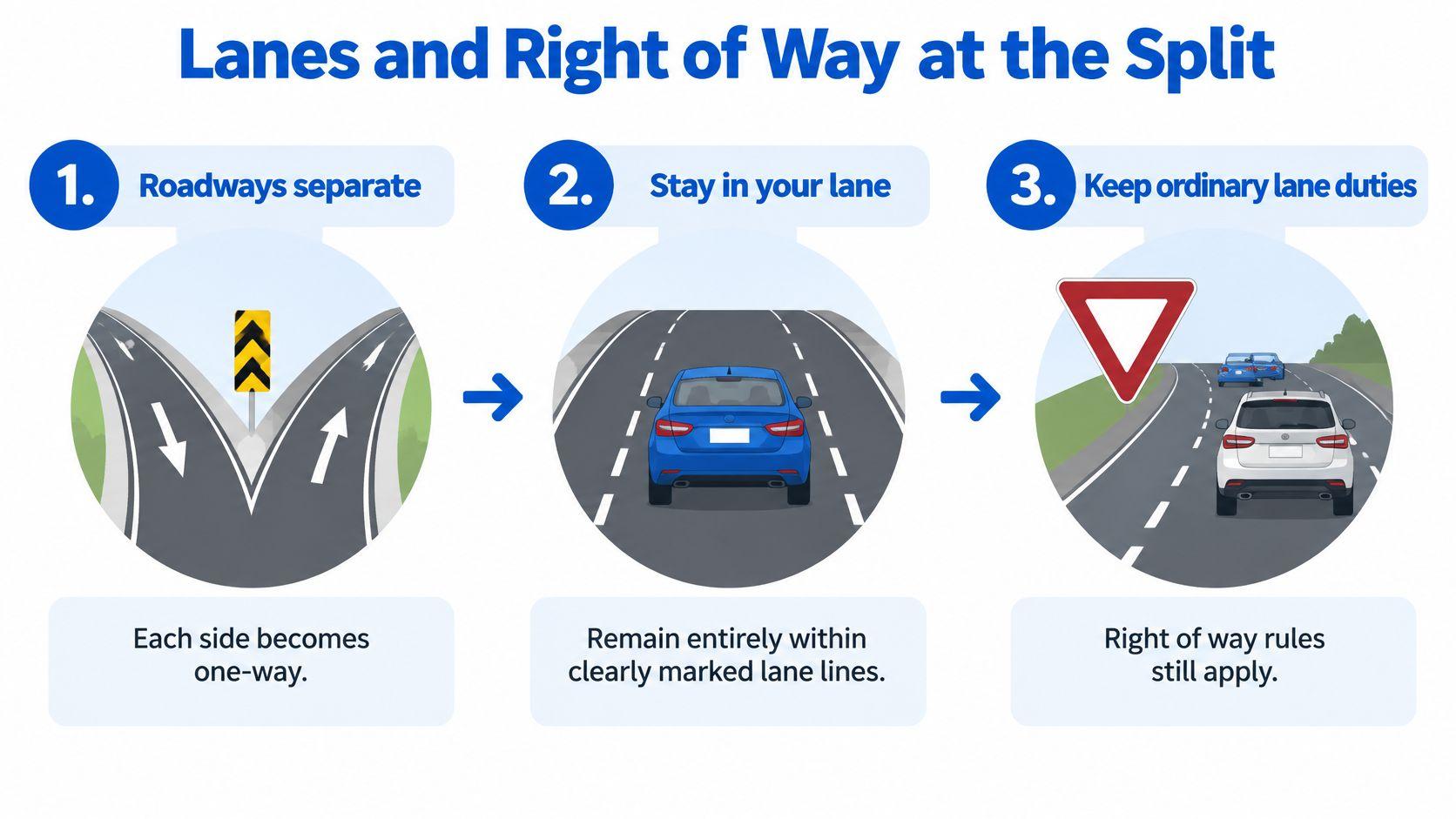
Lanes and Right of Way at the Split
A road split doesn't cancel your lane-change duties. Under Ontario's Highway Traffic Act, drivers on clearly marked lanes must remain entirely within a single lane as far as practicable and must determine that a movement can be made safely before leaving it.
Position the vehicle deliberately
- Hold your lane while you identify how it continues through the transition.
- Locate your roadway. Follow the approach serving your direction, not the opposing carriageway.
- Check before moving. If a lane change is necessary, signal, check mirrors and your blind spot, and move only when there's a safe gap.
- Respect the separation. Don't cut across the median or the painted gore, the area separating diverging traffic paths.
Say you're in the left lane of a pair of lanes feeding your side of the divided highway. Being left within that pair doesn't mean you're entering the opposing roadway. Follow the markings before deciding that a lane change is necessary.
The distinction between a roadway warning and a positioning instruction is also useful when studying the keep-right traffic sign.
Don't assume the split gives you priority to merge. Follow the signs, signals, and markings controlling your movement, and don't force another driver to make room because you've noticed the transition late.
Stops and Reversing on a Divided Road
An emergency response and a navigation correction are different situations. One involves making room for an approaching emergency vehicle; the other involves accepting that you've passed your intended route.
The official MTO Driver's Handbook requires an immediate stop for an approaching emergency vehicle displaying flashing red or red-and-blue lights, or sounding a siren or bell; on a one-way road or a divided highway with more than two traffic lanes, drivers must move to the closest curb or roadway edge.
The same handbook prohibits reversing on the travelled portion or shoulder of a divided road with a speed limit above 80 km/h, except when attempting to help someone in trouble.
Divided-road stop and reverse rules
Situation Where it applies What you do Emergency vehicle with flashing red or red-and-blue lights, or a siren or bell Divided highway with more than two lanes, or a one-way road Move to the closest curb or edge and stop immediately Speed limit above 80 km/h Travelled portion and shoulder of a divided road Do not reverse Trying to help someone in trouble Same high-speed divided road Only stated exception to the reverse ban
Work out which situation you're answering
In an emergency-vehicle question, identify the road arrangement before choosing an edge. The wording closest curb or edge matters. Don't replace it with an automatic instruction to cross the roadway toward the right shoulder regardless of where you are.
For example, you may be travelling beside the left edge of a separated one-way roadway when an emergency vehicle approaches from behind. Read the scenario carefully rather than applying a memorised answer intended for a different road arrangement.
Your aim is to clear the emergency vehicle's path while responding to the surrounding traffic. A sudden movement across occupied lanes can create another hazard.
In a reversing question, focus on the posted speed limit and road type, not how slowly you intend to back up. The rule isn't an exception for drivers who reverse carefully, use hazard lights, or believe the shoulder looks empty.
Practical rule: A shoulder isn't a recovery lane for backing up to a missed exit.
Suppose you pass your ramp and pull onto the shoulder, thinking you can reverse without affecting through traffic. That doesn't remove the restriction. Both the travelled portion and shoulder are included.
The helping-someone exception also doesn't cover ordinary navigation mistakes. Wanting to avoid a detour, retrieve a missed turn, or return to a preferred route isn't the same as attempting to help someone in trouble.
For study, explain the reason for your answer before selecting it. “There's an emergency vehicle approaching” and “I missed my exit” describe different triggers and require different decisions. If an answer tries to justify reversing because you've moved off the traffic lane, reject that reasoning.
Exam Traps and One Practice Question
A convincing wrong answer often contains a familiar phrase with the wrong action attached. You might recognise “keep right” but confuse the roadway with a lane, or recognise the divided-highway symbol but overlook whether the division begins or ends.
Use the picture to identify the traffic arrangement before reading the choices. That gives you a clear answer to compare against the wording, rather than letting the options decide what you think the sign means.
Reject the attractive wrong answers
- Wrong answer, choose the empty left roadway. An empty-looking roadway isn't necessarily available to you. Its direction of travel matters, not whether you can currently see vehicles.
- Wrong answer, change lanes immediately regardless of markings. A warning about the upcoming layout doesn't authorise an unchecked movement. Follow your lane's path and make any necessary change safely.
- Wrong answer, prepare for the median to disappear. That describes the opposite transition. Check whether the symbol indicates the beginning or ending of separation.
- Wrong answer, increase speed because the highway is divided. This warning doesn't set or cancel a speed limit. Don't infer a new limit from the presence of a median.
Notice how each wrong answer adds something the sign doesn't say. Some invent permission, while others substitute the response for a different sign.
Try the question before reading the answer
You're on a two-way road and see Divided Highway Begins. What should you do?
A. Move to the left roadway.
B. Keep to the right-hand roadway.
C. Stop until opposing traffic clears.
D. Treat both roads as two-way.
Choose your answer, then explain the traffic pattern aloud. If you can select a letter but can't explain what happens to opposing vehicles, spend more time connecting the symbol to the road.
Commit to an answer before checking the explanation. Recognising the correct choice afterwards isn't the same as selecting it independently.
The correct answer is B, keep to the right-hand roadway.
Answer A points you toward the roadway intended for opposing traffic. The fact that the road physically splits doesn't make both sides available to you.
Answer C adds a stop that this warning doesn't require. You still respond to actual traffic controls and hazards, but the divided-road warning alone isn't an instruction to wait for approaching traffic to clear.
Answer D ignores the separated one-way traffic arrangement. It would leave you interpreting each carriageway as though vehicles could normally approach within it from the opposite direction.
For parents and instructors, a useful follow-up is to change the situation without changing the symbol. Ask what the learner would do if their lane continued straight, if a turning lane appeared, or if they noticed the sign late.
The core interpretation stays the same, but the lane-positioning decision requires observation. That's the difference between recognising a flashcard and applying the rule to a real approach.
If You Miss the Right Roadway
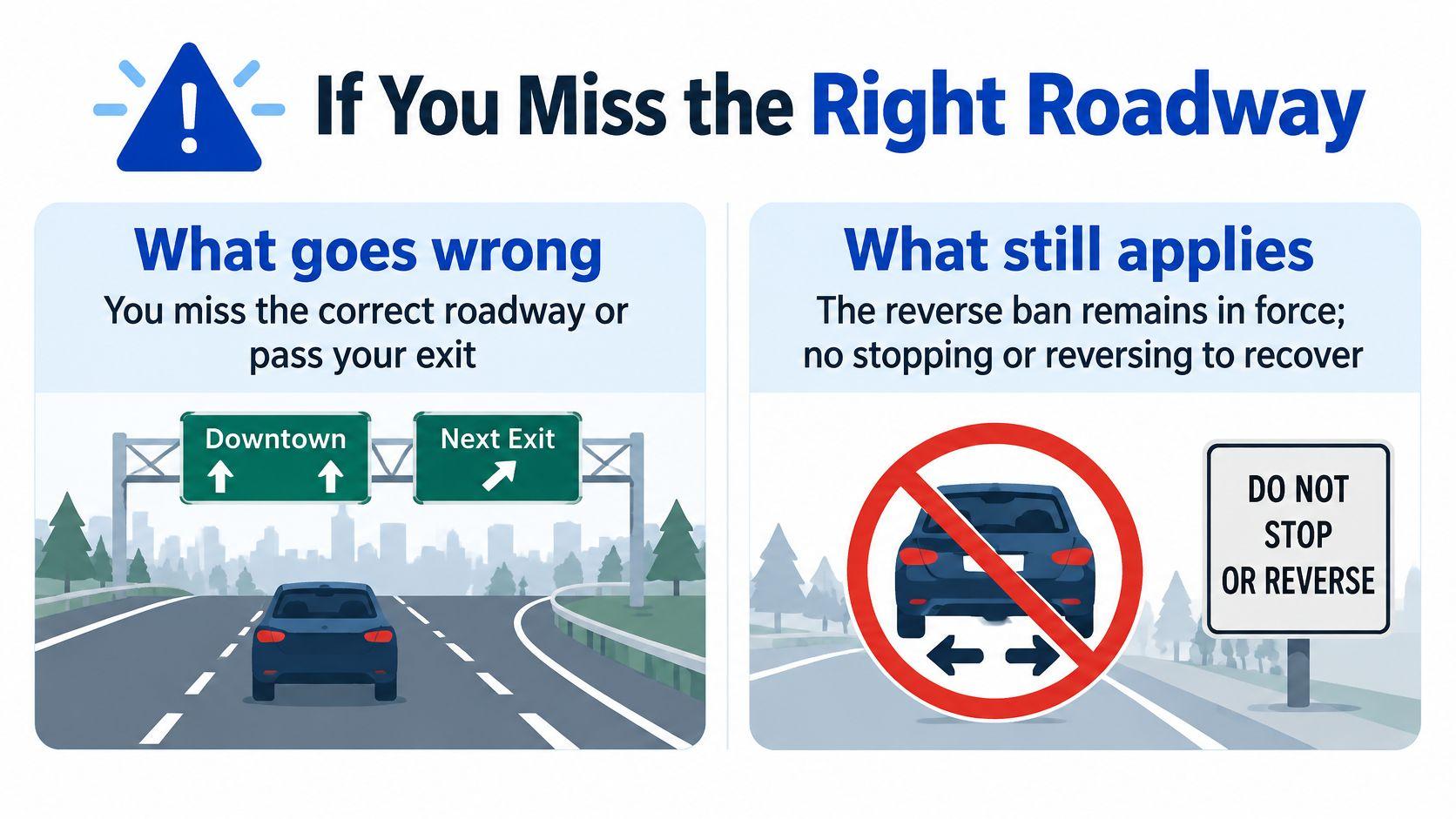
Backing toward a missed ramp or cutting through a median can turn a navigation error into a dangerous conflict. The MTO's changing-directions guidance includes the divided-road reversing restriction; missing your route doesn't create an exception.
Recover without creating another conflict
If you're travelling in the correct direction but have missed an exit:
- Continue with your traffic flow. Don't stop in a live lane to reconsider the route.
- Look for the next lawful exit, interchange, or turnaround.
- Accept the extra distance. Return through a permitted route rather than crossing the median.
Actual wrong-way entry is different from passing an exit. Don't continue against traffic looking for a convenient interchange. Avoid abrupt manoeuvres, get stopped out of the traffic path if safely possible, and seek emergency assistance.
A closed ramp also isn't permission to invent a crossing. Follow the temporary controls and choose a lawful alternative.
Ontario's 511 service provides incident and closure information for provincially owned and maintained highways. Check conditions before leaving, not while driving, and don't assume a permanent warning sign confirms that your planned ramp is available.
Practise the recovery decision as well as the symbol: a missed exit calls for a lawful alternative, not an improvised shortcut.
Practise the Sign Before Test Day
Build recognition first, then add the decisions that make the sign useful. You should be able to name the transition without relying on an answer list, and explain your next action without confusing a roadway with an individual lane.
At G1ready.ca, we offer a separate Road Rules Test and Road Signs Test, alongside sign study materials for visual recognition; our practice tests are built around the 2026 Ontario MTO Driver's Handbook.
Use a repeatable study order
- Identify the appearance. Recognise the yellow warning and its symbol without reading a caption.
- Name the traffic pattern. Decide whether separation is starting or ending.
- Choose the response. Describe what you'd do with the vehicle, not just what the sign is called.
- Check the handbook. Resolve an incorrect answer before attempting another similar item.
Start with the sign pair until you no longer swap Begins and Ends. Then mix recognition with lane-change and emergency-response scenarios so you practise choosing the relevant rule.
Finish by answering the sample question without looking back. Say the checks aloud: recognise the warning, select the proper roadway, and don't undo a navigation mistake with an unsafe manoeuvre.
G1ready.ca offers separate signs and road-rules practice so you can connect divided-highway recognition with safe driving decisions. Visit G1ready.ca to practise the sign pair, review explanations, and test your response to a missed-exit scenario before test day.