
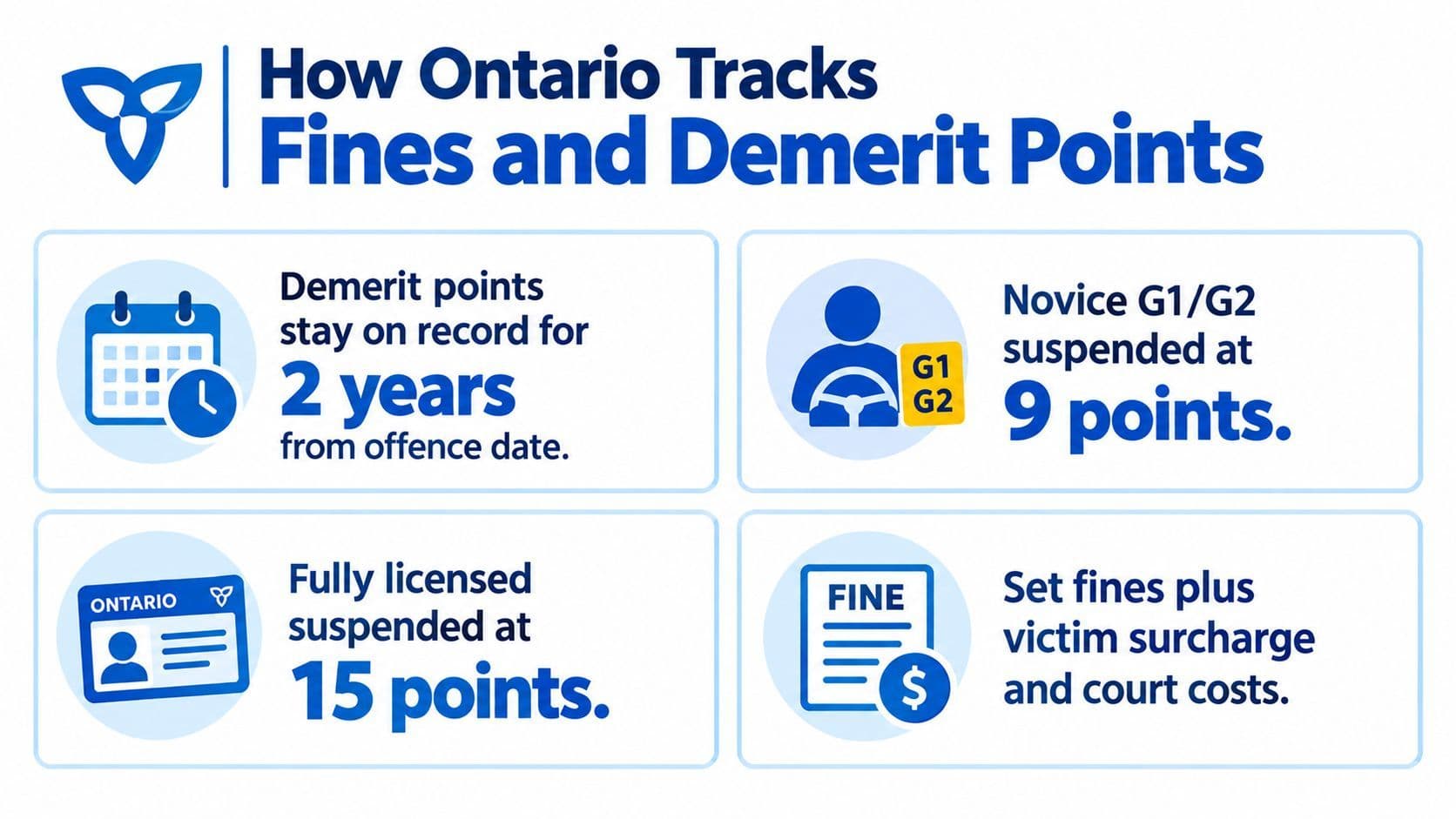
Ontario keeps demerit points on your driving record for two years from the offence date. A novice driver can face suspension at 9 points, while a fully licensed driver faces suspension at 15 points.
You may be looking at a ticket after a rolling stop, a speeding allegation, or a distracted-driving charge and wondering whether the fine is the main problem. For a G1 or G2 driver, it often isn't. The amount payable matters, but the conviction can also add points, affect your licence status, and create insurance consequences. Understanding Ontario Highway Traffic Act fines and points means looking at all of those outcomes together.
How Ontario Tracks Fines and Demerit Points
You receive a ticket after a rolling stop or speeding allegation and see the fine printed on the page. For a G1 or G2 driver, that amount is only one part of the result. The offence may also lead to a conviction, demerit points, insurance concerns, and a licence consequence that differs from the result for a fully licensed driver.
Ontario's system separates the fine from the demerit points. A fine is the monetary penalty handled through the provincial offence process. Demerit points are attached after a conviction for an offence covered by Ontario's point rules. The point total is measured from the date of the offence and stays on the driving record for two years, rather than two years from the conviction date.
The people and documents involved
An officer can issue a ticket, but does not personally add points to your record. The court process determines whether you are convicted. The Ministry of Transportation then records the conviction and applies the prescribed points.
These terms help new drivers read a ticket and understand the G1 test topics:
- Demerit point: A point attached to a conviction for an offence listed in Ontario's demerit-point rules.
- Conviction: A guilty finding, guilty plea, or another result that records the offence against you.
- Novice driver: Someone in the G1, G2, M1, or M2 stage, including a newly licensed driver during the applicable novice period.
- Fully licensed driver: Someone who no longer holds a novice licence.
A G1 or G2 driver has less room for error than a fully licensed motorist. The same conviction can therefore affect a novice licence more seriously, even when the fine itself is unchanged. See the full breakdown in the Ontario demerit points guide.
Why the fine is not the whole story
The Highway Traffic Act and provincial offence schedules govern monetary penalties. Point values follow Ontario's demerit-point framework. Depending on how the matter is resolved, the ticket may also involve a victim fine surcharge and court costs.
Insurance companies generally examine the conviction recorded on a driving record, rather than treating demerit points as a separate public-facing rating category. A conviction can therefore raise insurance concerns even when the point total has not reached a suspension threshold.
Practical rule: Before paying a ticket, identify the offence, its likely point value, and its effect on your novice licence. The printed fine is only one part of the decision.
Warning Letters, Suspension Thresholds, and the Two-Year Clock
A G2 driver receives a conviction and then checks the fine, but the licence consequence may matter more. Ontario uses different point thresholds for fully licensed and novice drivers. For a fully licensed driver, the Ministry sends a warning at 6 to 8 points, another warning at 9 to 14 points, and imposes a 30-day licence suspension at 15 or more points, according to the Ontario demerit-points information page.
G1, G2, M1, and M2 drivers follow a stricter path. A novice driver can face suspension at 9 points. Some convictions worth 4 or more points can also start a suspension process before the driver reaches the fully licensed threshold. The fine may look manageable, while the conviction moves the licence closer to losing driving privileges.
How the thresholds work
The point total works like an active balance. A conviction with fewer points may not suspend a fully licensed driver, but it remains part of the total. A later speeding, distracted-driving, or fail-to-obey conviction can push that balance into a warning or suspension range.
For a fully licensed driver, the sequence is:
- 6 to 8 points: First warning range.
- 9 to 14 points: Second warning range.
- 15 or more points: Mandatory 30-day suspension.
For a novice driver, 9 points marks the main danger point. A G2 driver with several convictions may lose driving privileges at a total that would bring a fully licensed driver a warning instead of an automatic 30-day suspension. This is why the G1 test's questions about signs, lights, yielding, and safe driving matter beyond the test room. Each rule helps prevent a conviction from adding points to an already active total.
Reading the two-year clock correctly
The clock begins on the offence date, not on the date of a guilty plea or court result. If the offence occurred in January, the two-year retention period is measured from that January date. Court delays do not create a new starting date for the points.
Your driving record may therefore show an older conviction while its points are approaching the end of their active period. The record, the conviction, and the point-retention period describe related but different things.
Ontario's Highway Traffic Act also provides an early-review mechanism under section 57. A review does not automatically erase the underlying event or restart the two-year calculation. If your licence is at risk, seek specific legal or official guidance instead of assuming an appeal pauses the clock.
Everyday HTA Offences You Will See on the G1 Test
The G1 test doesn't only ask you to recognise a sign. It tests whether you understand the behaviour behind the sign, light, lane rule, or safety requirement. The exact fine for many everyday offences depends on the applicable set-fine schedule and ticket details, so don't treat an unverified amount as universal.
The confirmed examples below show how a conviction can combine a fine with points. Ontario's legal summaries identify about $325 for a red-light violation and $110 for failing to stop at a stop sign, while both offences carry 3 demerit points in the cited summary (Ontario demerit-point examples).
The offence-to-question connection
Offence HTA section Set fine Demerit points Novice consequence Fail to stop at a stop sign s. 136 About $110 3 Contributes toward the novice threshold. A G2 driver already carrying points has less room before suspension risk. Fail to stop at a red light Traffic-light rules About $325 3 Adds to the active total and may combine with earlier convictions. Fail to yield s. 135 Varies by schedule Typically associated with the everyday point framework The conviction can add points and create a larger licence problem when combined with other offences. Improper left turn s. 141 Varies by schedule Point value depends on the conviction Tests lane position, signalling, and right-of-way judgment. Unsafe lane change s. 142 Varies by schedule Point value depends on the conviction A novice driver must consider both the conviction and the effect on the active point total. Following too closely s. 158 Varies by schedule Point value depends on the conviction Tests safe following distance and can add to suspension risk. Unnecessary noise or slow driving s. 132 Varies by schedule Point value depends on the conviction Tests whether a driver is unnecessarily obstructing or disturbing traffic. Seat-belt non-compliance s. 106 Varies by schedule 2 Even a lower point value matters when a novice already has an active record. Child-restraint violation s. 106.1 Varies by schedule Point value depends on the conviction Tests the responsibility to use the required restraint correctly. Distracted driving s. 78.1 First-offence penalty about $615 Point outcome depends on the conviction A serious conviction can create immediate financial and licence concerns for a novice.
The G1 study lesson is practical. For every rule, ask three questions: What action is prohibited? What consequence follows a conviction? How would the result affect a driver who already has points?
Distracted driving deserves special attention because the financial penalty can be much higher than many routine traffic tickets. The cited Ontario legal summary places the first-offence penalty at about $615, while the point and licence outcome depends on the conviction and the driver's existing record.
High-Impact Offences That Can End a Licence Fast
Some offences create a sharp jump in risk because they carry several points or involve direct licence action. Ontario's speeding guidance assigns 3 points for driving 16 to 29 km/h over the limit, 4 points for 30 to 49 km/h over, and 6 points for 50 km/h or more over (Ontario speeding guidance).
Careless driving under section 130 also carries 6 demerit points, according to the legal summary of that offence (careless driving explanation). For a novice driver, a conviction carrying four or more points can trigger a much more serious Ministry response than the same total would produce for a fully licensed driver.
Why one conviction can be decisive
Offence Fine range or published penalty Demerit points Novice consequence Speeding 16 to 29 km/h over Amount depends on the set-fine schedule and location 3 Adds materially to the active total and can contribute to a 9-point suspension. Speeding 30 to 49 km/h over Amount depends on the schedule and location 4 A novice driver may enter a suspension pathway after this conviction, especially with existing points. Speeding 50 km/h or more over Court process applies rather than an ordinary out-of-court set-fine resolution 6 A serious novice-licence risk and a high-impact conviction. Careless driving, s. 130 Simple careless driving has a published range of $400 to $2,000 in the cited legal summary 6 A single conviction can place a novice in serious suspension jeopardy. Aggressive driving Fines up to $2,000, with possible jail and licence consequences 6 The point total and offence severity can threaten novice driving privileges. Stunt driving Some offences can rise to $10,000 6 A conviction can produce severe licence consequences beyond the ordinary point ladder. Failing to stop for a school bus Penalty depends on the charge and circumstances Point value depends on the conviction A serious safety offence can create immediate novice-driver concern. Racing or related high-risk driving Penalty depends on the charge and court outcome Point value depends on the conviction The behaviour may lead to direct licence action, not just point accumulation. Driving while suspended Penalty depends on the charge and circumstances Point value depends on the conviction Creates a separate legal problem and doesn't restore the right to drive.
The important distinction is between points and direct licence action. A high-impact offence may lead to a suspension, court appearance, or other restriction even before a driver focuses on the ordinary accumulated-point ladder. Don't assume that staying below the fully licensed threshold protects a G2 licence.
Where You Drive Changes the Fine You Pay
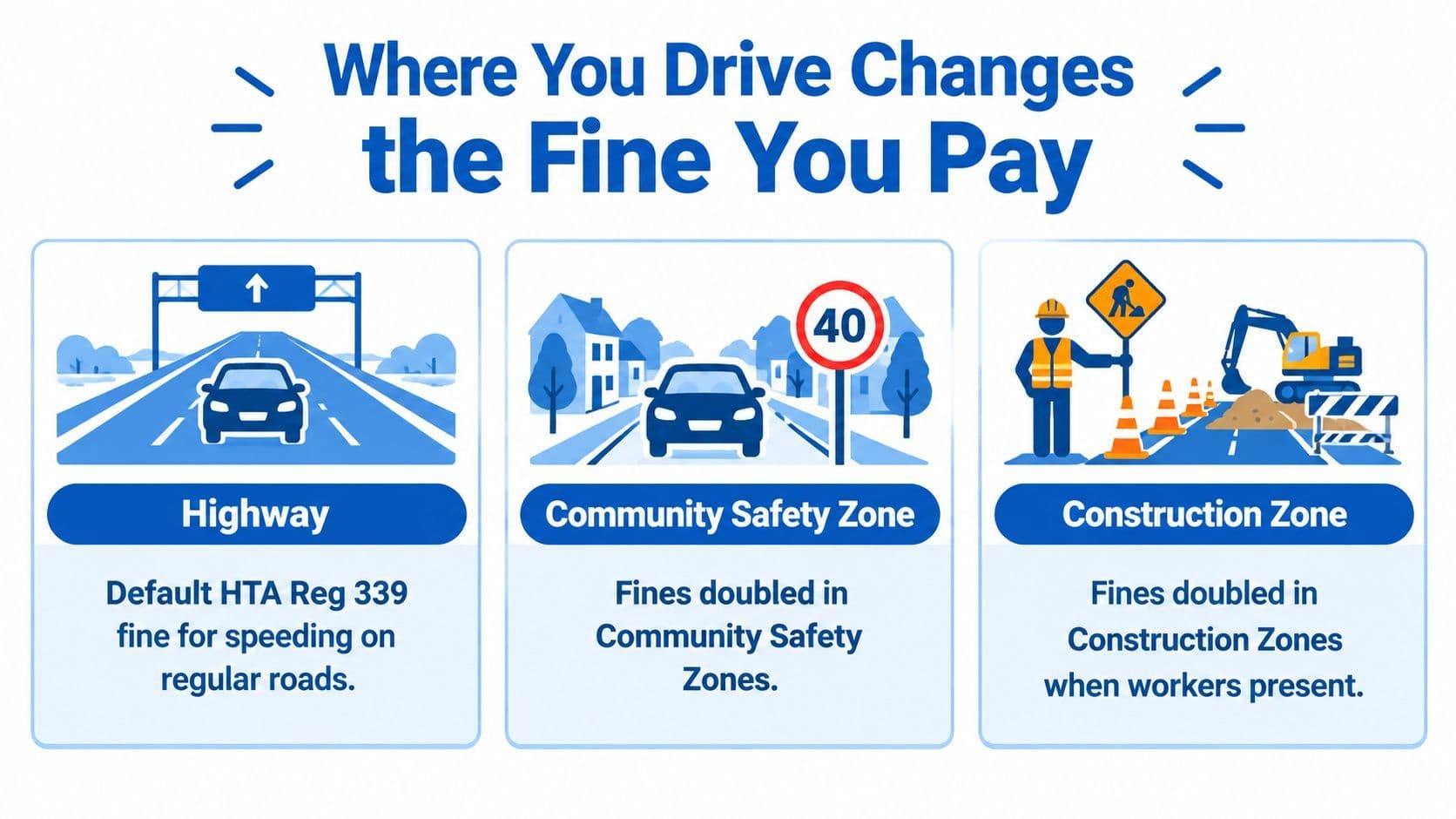
You are driving slightly above the limit and see a community safety zone sign. The speed may place the offence in the same demerit-point band, but the fine can change because of where the road is located. Ontario legal guidance explains that fines may be doubled in a designated community safety zone, while points remain tied to the speed band (Ontario speeding-fine context).
For a G1 or G2 driver, read the situation in two columns: the point table shows licence risk, and the road signs can affect the financial penalty. A community safety zone may be near a school, park, or area with more pedestrian activity. The designation must be posted and legally applicable, so the presence of a school or park alone does not settle the issue.
Compare the practical effect
Location Financial treatment Point treatment Regular road Ordinary set-fine schedule applies Based on the speed band Designated community safety zone Fine may be doubled under the applicable schedule The speed-band point value remains the relevant measure Designated construction zone with workers present Fine may be doubled under the applicable rules The speed-band point value remains the relevant measure
Construction-zone treatment depends on the legal designation and whether workers are present. A road beside construction does not automatically receive the same treatment. Read the signs and check the location recorded on the ticket.
The ticket amount may also reflect a court process rather than the ordinary set-fine schedule. If the zone or amount is unclear, compare the ticket with the current official schedule before deciding how to respond. For the G1 test, remember the practical rule: location can change the fine, while the speed band determines the relevant points.
What Happens After You Are Convicted
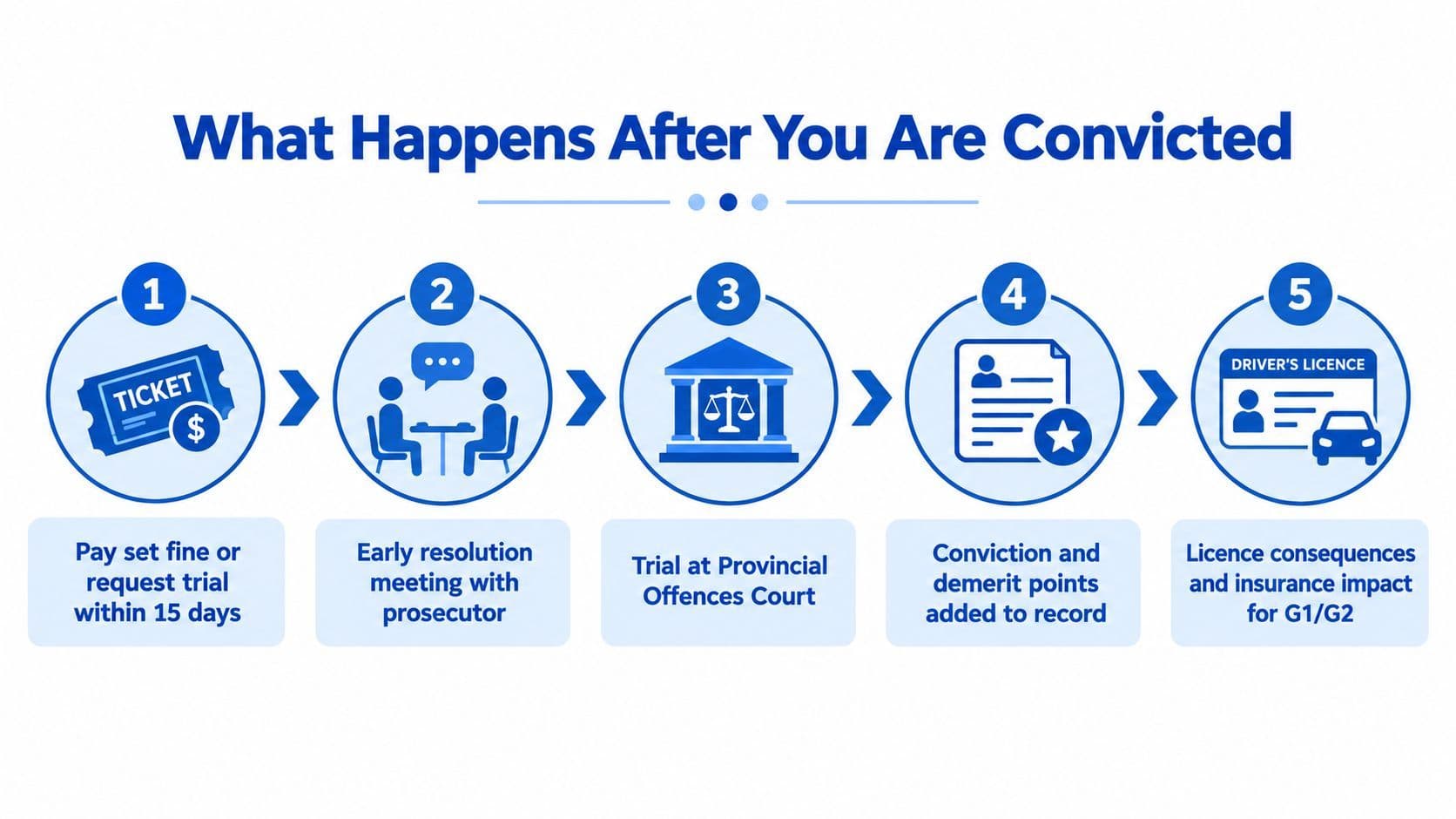
A ticket handed to you by an officer is not automatically a demerit-point event. The key change occurs after a guilty plea or conviction. You can generally pay the set fine or dispute the charge within the response period printed on the ticket. In the provincial-offence process, that period is commonly 15 days, but the notice controls the exact deadline and method.
Your response choices
Paying the fine normally acts as a guilty plea. Disputing the charge may lead to an early-resolution opportunity, communication with the prosecutor, or a trial in Provincial Offences Court. Check the ticket before choosing. Missing its deadline can remove response options that were available earlier.
What the Ministry records
After a guilty plea or conviction, the offence is sent to the Ministry of Transportation. The Ministry records the conviction, applies the prescribed points, and assesses the effect on your licence class. For a G1 or G2 driver, the same conviction can create a licence consequence that differs from the outcome for a fully licensed driver.
The point-retention period runs from the offence date, not the court appearance date. A novice driver who reaches the applicable threshold may receive a suspension notice or other Ministry communication. A G2 driver may also face restrictions tied to novice licensing.
The fine is only one part of the result. Insurers may assess convictions shown on your driving record, so a low dollar amount does not necessarily mean the offence has little practical effect.
For a study routine linking defensive habits with Ontario knowledge-test preparation, review this Ontario defensive driving course guide.
Keep the process in order:
- Ticket issued.
- Response made by the stated deadline.
- Early resolution or court process.
- Guilty plea or conviction.
- Ministry record, points, and licence consequences.
For G1 learners, this sequence connects a test rule to its real-world result. A question about speeding, stopping, yielding, or sharing the road is also testing whether you understand what can follow a conviction.
Connecting HTA Penalties to G1 Test Topics
The most efficient way to study fines and points is to connect each penalty to the rule that creates it. A question about a red light belongs with traffic lights and right-of-way. A question about a stop sign belongs with stopping position and intersection safety. A speeding question belongs with speed management, signs, and the consequences of driving over the limit.
Study by offence cluster
Road signs and traffic lights should include stop signs, red lights, school-zone markings, and community safety-zone signs. Don't treat those signs as interchangeable. A stop sign requires a complete stop, while a red light governs the signal-controlled intersection and may involve different right-of-way situations.
Rules of the road should connect fail-to-yield questions with improper turns, lane changes, following distance, and passing. Following too closely isn't just a ticket category. It tests whether you can maintain enough space to react to traffic ahead.
Sharing the road includes pedestrian right-of-way and school-bus safety. A school-bus stop-arm question is asking you to recognise a high-consequence decision, not merely memorise a visual detail.
Safe driving practices should include distracted driving, aggressive driving, and the boundaries around impaired driving. The test expects a learner to understand that attention, speed, space, and judgment work together.
Mistakes that cost learners points
Learners often confuse a warning letter with an actual suspension. They may also remember the fully licensed threshold and overlook the stricter novice rules. Another common mistake is memorising “speeding” as one category rather than learning that different speed bands carry different point values.
Use the Ontario driver-test point-system guide as a study prompt, then test yourself without looking at the answer. Ask: Which rule was broken, what conviction could follow, and how would the result affect a G1 or G2 driver?
Quick Reference Table of Common Ontario Offences
A G1 learner leaves a stop sign without fully stopping and later wonders what the ticket means for a novice licence. The fine is only one part of the result. The conviction, demerit points, offence date, and novice-driver threshold must be read together. Use this table as a study map for the offence categories that appear in G1 questions, not as a substitute for the exact ticket, current set-fine schedule, or legal advice. Ontario's broad Highway Traffic Act penalty provision allows a fine of not less than $60 and not more than $2,500 for contravening regulations on conviction, subject to the specific offence and applicable legislation.
Offence Fine range CAD Demerit points Novice consequence Speeding 1 to 15 km/h over Depends on set-fine schedule Point value depends on the conviction Adds to the active total. Location may affect the fine. Speeding 16 to 29 km/h over Depends on speed and location 3 Contributes toward the novice suspension threshold. Speeding 30 to 49 km/h over Depends on speed and location 4 Can create a novice suspension pathway, particularly with existing points. Speeding 50 km/h or more over Court-based penalty 6 High-impact conviction with serious licence risk. Stop-sign violation About $110 in the cited Ontario summary 3 Adds to the active total and may combine with earlier tickets. Red-light violation About $325 in the cited Ontario summary 3 A conviction affects both the point balance and driving record. Following too closely Depends on charge and schedule Point value depends on conviction Tests whether you left enough space to react, and contributes to suspension risk. Careless driving $400 to $2,000 for simple careless driving in the cited summary 6 One conviction can put a novice licence in serious jeopardy. Stunt driving Can rise to $10,000 6 May involve direct licence action and a severe novice consequence. Distracted driving About $615 for a first-offence penalty in the cited summary Point outcome depends on conviction Creates significant financial and licence concerns. Failure to move over for emergency vehicles Depends on charge and schedule Point value depends on conviction A safety-related conviction adds to the active novice record. Improper passing of a school bus Depends on charge and circumstances Point value depends on conviction Carries serious safety implications and possible licence consequences. Seat-belt infraction Depends on schedule 2 Lower points still matter when other convictions are active. Driving without a valid permit Depends on charge and circumstances Point value depends on conviction May create a separate licence and vehicle-compliance problem.
The table's point column is a learning aid, because the result can depend on the conviction recorded. Speeding questions show why categories matter: the speed band changes the point value and the licence risk. Stop-sign, red-light, following-distance, pedestrian, and school-bus questions test the same practical habit: identify the rule before choosing the consequence.
A court appearance depends on the charge, ticket instructions, and whether the matter proceeds through a set-fine process or summons. Insurance disclosure also depends on the conviction and the insurer's process. Paying a fine at a counter does not automatically mean the matter has no record consequence.
Sources and Next Steps for Ontario Drivers
Start with the official consolidated Highway Traffic Act, Ontario's demerit-point regulation, and the Ministry of Transportation's demerit-points guidance. For test preparation, use the current Ontario Driver's Handbook and match each chapter to an offence cluster, such as signs, traffic lights, right-of-way, safe following distance, and sharing the road.
Before booking a road test, review the official rules again and check the current set-fine information for the offence involved. Then practise by topic, use timed mixed questions, and return to every mistake until you can explain both the driving rule and the licence consequence.
Keep one principle in mind: a ticket is not only a price on paper. For a G1 or G2 driver, the conviction, point value, offence date, and novice threshold all belong in the same decision.
G1ready.ca offers Ontario-focused G1 practice exams, targeted quizzes, mixed tests, explanations, hints, and progress tracking to help you study traffic rules such as demerit points, speeding, stopping, and right-of-way. Visit G1ready.ca to practise the offence topics that connect Highway Traffic Act rules with the questions you'll face on test day.


