

In Ontario, a Keep Right traffic sign is a mandatory regulatory instruction directing traffic around an obstruction or into the appropriate lane, not a general suggestion to move right. The general keep-right lane rule is related, but it governs ordinary travel on multi-lane roads.
You're approaching a traffic island, or travelling on a multi-lane road with a faster vehicle behind you. A keep-right instruction appears ahead, and the practical question is what it applies to: the obstruction, your lane choice, or both? The answer depends on the road layout and the specific instruction.
For a new driver, spotting the sign is only the first step. Read its symbol, identify the obstruction or lane it concerns, check the nearby markings and controls, then make the required movement when it's safe. In Ontario, signs, signals, pavement markings, and lane-use rules work together, but each gives you different information.
Reading a Keep Right Instruction on the Road
You're driving towards a traffic island that splits the road. A sign points right, but you're unsure whether it means to keep right for the rest of the road or to pass the island on that side. Look at the feature beside the sign: if it marks an obstruction, the direction is about the path around that obstruction.
Now consider a different scene. You're travelling on a multi-lane road and aren't preparing to turn left or pass. The general lane-use rule applies: Ontario guidance expects drivers to use the right-hand lane for ordinary travel on multi-lane roads, with exceptions for preparing to turn left or passing another vehicle. The sign at the island and the lane-use rule can both affect your driving, but they don't do the same job. Ontario's guidance on driving along describes that broader lane-position expectation.
Read the road in context
Use a simple sequence when you meet a keep-right instruction:
- Identify the instruction. Work out whether it directs you around a road feature or relates to lane use.
- Locate what it concerns. Look for an island, obstruction, lane marking, or other feature the sign may apply to.
- Check the controls. Read nearby signs, signals, pedestrian signals, and pavement markings.
- Choose a safe response. Make the required move only when you've checked that the path is clear.
A new driver might see the arrow and begin steering before checking for pedestrians or confirming which lane continues past the island. That's backwards. First work out what the sign directs, then check the road and the traffic around you before moving.
This approach also helps with G1 questions. Don't match a symbol to a memorized phrase and stop there. Ask what the sign controls in that particular road scene.
What the Keep Right Traffic Sign Means
Start with the immediate task: a Keep Right sign directs you to use the side shown to pass an obstruction or follow the intended path through a roadway feature. For example, if an island separates traffic, the sign tells you which side to take around it. It isn't advising you to prefer the right-hand lane in every situation.
Ontario's general keep-right lane rule is broader. It guides ordinary travel on multi-lane roads, while allowing drivers to use another lane when preparing to turn left or pass. The instruction around an obstruction controls a specific path; the lane-use rule controls how drivers position themselves during normal travel.
Core principle: Follow the keep-right sign for the road feature it addresses, and follow the general lane rule for ordinary travel. Check both against the markings and controls in front of you.
The distinction matters when two directions appear close together. A driver might need to pass an island on its right while also checking which lane continues beyond it. The sign gives the required path around the feature, but lane markings and other controls still help determine where the vehicle should go next.

A right turn has its own positioning expectations. Ontario guidance says a right turn should normally begin and end near the right side of the road, and the driver should move into the right-hand lane only when it's safe. The MTO handbook's sign guidance supports that distinction between positioning for a manoeuvre and moving without checking.
As you read the sign, put together three clues: its arrow or symbol, the road feature or lane nearby, and the markings that show where traffic travels. That combination tells you more than the words or symbol alone.
Comparing Ontario Keep Right Signs
On a G1 question, two signs can look like the same instruction until you name the job each one is doing. Ontario's sign index separates KEEP RIGHT, numbered Rb-25, from THROUGH TRAFFIC KEEP RIGHT, numbered Rb-27, and both sit inside the wider group explained in the guide to regulatory signs in Ontario. The Ontario sign index lists Rb-25 and Rb-27 as distinct standardized signs.
Sign Road problem it solves Driver response KEEP RIGHT, Rb-25 A feature or obstruction requires a definite path Pass on the indicated side and rejoin the normal lane when clear THROUGH TRAFFIC KEEP RIGHT, Rb-27 Through movement could block space needed by turning traffic Keep the through path to the right as directed Keep to the right of a traffic island A physical island splits the available route Go around the island on the marked side
Rb-25 answers a position question around a thing: an island, median, or work area. Read the arrow, choose the side it marks, then check markings for where the lane continues. Rb-27 answers a lane-use question near an intersection: keep through movement right so vehicles waiting to turn are not trapped behind straight-going traffic.
The general keep-right habit is different again. It is a lane choice for ordinary travel, while Rb-25 and Rb-27 are posted instructions tied to a feature or a movement.
For review, use a three-step check: say the number, name the job, then picture one road scene. Rb-25 is “around the object.” Rb-27 is “through lane stays right.” The island instruction is “circle the divider correctly.” Keep those jobs separate and the similar wording stops blurring together.
When the Keep Right Rule Applies
On a multi-lane road, right is the expected lane for ordinary travel unless you're preparing to turn left or passing another vehicle. That's the general rule, not a direction to weave into the right lane regardless of traffic or road conditions.
The rule is especially important for slower traffic. When a slower vehicle stays in the left lane, it can impede traffic moving at a higher speed. Keeping slower vehicles to the right leaves the left lane available for passing and makes approaching drivers' choices more predictable. Ontario's keep-right guidance for slower traffic emphasizes that practical purpose.
Use another lane for a reason
Suppose you're travelling in the right lane and need to pass a slower vehicle. You can use the left lane for the passing manoeuvre, then return to the right when it's safe. Similarly, if you're preparing to turn left, you may position yourself for that turn rather than remain in the right lane just because it's the usual lane for ordinary travel.
The important distinction is that these are specific manoeuvres, not reasons to stay left indefinitely. Once you've passed, check that the right lane is clear and return when safe. If you're approaching a left turn, position yourself for it while continuing to watch markings, signs, and other traffic.
A permitted lane choice still requires a safe lane change. The rule gives you a reason to use another lane, not automatic permission to move into it.
Keeping lanes predictable helps other drivers understand what you're doing. A slower driver who remains right gives faster traffic a clearer opportunity to pass on the left. A driver using the left lane to pass or prepare for a left turn can focus on that manoeuvre, then reassess lane position when it's complete.
Keep Right Near Intersections and Obstacles
A keep-right instruction doesn't give you permission to turn, merge, or change lanes without checking the surroundings. Ontario's handbook treats traffic signs, signals, pedestrian signals, and pavement markings as parts of the traffic-control system; a keep-right direction must be read alongside them. It doesn't cancel a stop, a yield, or a posted turn prohibition. Ontario's guidance on changing directions makes that combined reading essential.

Right turns need checks, not assumptions
If you're preparing for a right turn, position yourself near the right side when it's safe, signal in advance, and check for pedestrians and traffic before turning. The sign or lane position doesn't grant priority over someone crossing or travelling through the intersection.
At a red light, a right turn is allowed only after a complete stop and when the way is clear, unless a sign prohibits the turn. A right-turn signal from your vehicle doesn't change those conditions. Stop first, check the crossing area and traffic, and proceed only when permitted and safe.
Left turns and islands are different situations
If you're preparing to turn left, being in an appropriate lane doesn't remove your responsibility to check oncoming traffic, pedestrians, and the intersection controls. Lane position helps you make the intended movement, but it doesn't decide when you may go.
A traffic-island instruction addresses a physical obstruction. Follow the side indicated by the arrow or symbol, while also checking lane markings and the space around your vehicle. If the road narrows or an obstruction affects your lane, read the signs and markings before changing position. The pavement-narrows-ahead guide can help you practise interpreting a changing roadway.
Legal Status and Enforcement Considerations
Ontario classifies the instruction to keep to the right of a traffic island as a regulatory sign. Its direction must be obeyed, the same way a stop sign or speed limit must be obeyed. The MTO's regulatory sign guidance places the traffic-island instruction within that category.
That legal weight is worth understanding before your G1 test. On the exam and on the road, a regulatory sign is a requirement, so sign recognition means more than matching a symbol to a label. You need to identify the required path, spot the island or lane the instruction concerns, and check the surrounding controls before acting. A driver who memorises "keep right" without reading the road scene can still miss what the sign requires.
Regulatory status also doesn't flatten the differences between keep-right situations. A sign directing you around an island addresses one specific feature, while the general lane-use rule governs ordinary travel on multi-lane roads, and a through-traffic instruction keeps a lane clear of turning vehicles. Read each instruction in its setting and obey any other signs, signals, and markings that apply. Our overview of traffic control regulations in Ontario explains how these controls combine.
This article doesn't provide a fine amount or make claims about automated enforcement. For current penalty information, consult official Ontario material rather than relying on an unverified figure. The practical lesson is straightforward: treat a regulatory direction as mandatory, and make the required movement safely.
Practice Questions for the Ontario G1 Test
These illustrative questions practise the reasoning behind keep-right instructions. They aren't presented as items from the official test bank.

Question 1: You're on a multi-lane road, travelling at a slower pace than surrounding traffic, and you aren't preparing to turn left or pass. What's the best choice?
Answer: Travel in the right-hand lane when it's safe. The cue is that this is ordinary travel on a multi-lane road, not a passing or left-turn manoeuvre. Choosing to stay left only because the lane is available misses the general rule.
Question 2: A keep-right sign directs you around a traffic island. Does that sign mean you should always remain in the right-hand lane after passing the island?
Answer: No. Follow the indicated path around the island, then read the lane markings and other controls for what to do next. The sign concerns the obstruction; it doesn't automatically determine your lane for the rest of the journey.
Consider another common trap: assuming that a sign directing through traffic to keep right has the same job as an island instruction. It doesn't. One concerns the lane through traffic should use; the other directs vehicles around a physical feature.
Check the controls before you act
Question 3: You're in position for a right turn at a red light. A pedestrian is crossing, and no sign prohibits the turn. What should you do?
Answer: Remain stopped until the way is clear. A right turn on red requires a complete stop first, and you must yield to pedestrians and traffic before proceeding. A turn signal or suitable lane position doesn't give you priority.
A tempting distractor is to turn because the vehicle is already in the right lane. That confuses positioning with permission to proceed. The intersection controls and the crossing pedestrian determine whether it's safe and allowed.
Question 4: A regulatory sign directs you to keep to the right of a traffic island. Which action best follows the sign?
Answer: Pass the island on the indicated right-hand side, while also following lane markings and checking that your path is clear. Treating the instruction as a suggestion is incorrect, and moving based only on the sign without checking the road would ignore the surrounding conditions.
For additional practice, use a mix of sign-recognition and rule-based questions. The useful habit is to name the cue that decides your answer: the island, the through lane, the lane markings, or the intersection control.
Before moving on to another practice item, watch how the instruction fits into an actual road scene.
A Simple Decision Guide for G1 Review
Use four questions whenever you see a keep-right instruction:
- What kind of instruction is it? Decide whether it concerns a traffic island, through traffic, or ordinary lane use.
- What feature or lane does it apply to? Locate the obstruction, lane, or route indicated.
- What else affects the manoeuvre? Check for passing or turning movements, signals, pedestrians, signs, and pavement markings.
- Can you make the move safely and lawfully? Check the path before changing position or proceeding.
Keep the sign types distinct in your mind. The general keep-right rule concerns ordinary lane use on multi-lane roads. Rb-25 identifies KEEP RIGHT, while Rb-27 identifies THROUGH TRAFFIC KEEP RIGHT. A traffic-island direction tells you which side of that physical feature to use.
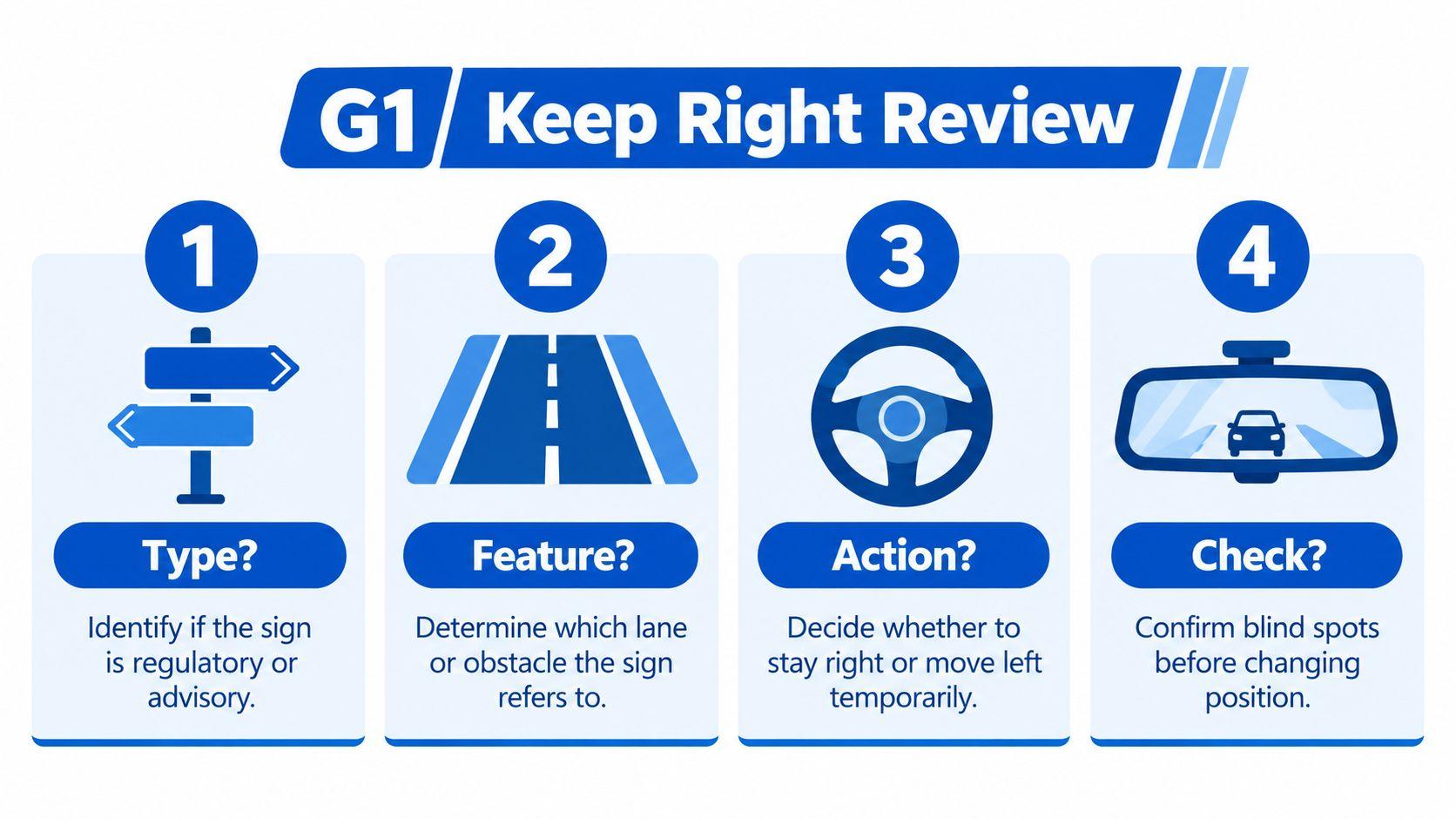
For G1 review, study the relevant sign illustrations in the current MTO handbook and practise varied road situations rather than memorising isolated symbols. Then use the same four questions to explain why an answer fits the sign, lane, and surrounding controls.
Practise Ontario road-sign questions with G1ready.ca, which offers targeted quizzes, mixed practice, and questions with immediate explanations. Use it to test your understanding of keep-right signs and related lane decisions, then revisit any question where the road context changed your answer.


