
The pavement narrows ahead sign is a yellow diamond warning that lanes may merge or the usable road width may decrease, so slow down, check your mirrors, and prepare to yield right of way. Ontario's traffic standards distinguish a lane reduction from a narrower roadway, and recognising that difference helps you choose the safest response.
You're driving through an unfamiliar Ontario neighbourhood as a new G1 licence holder. A yellow diamond appears beside the road, and the pavement ahead looks ordinary. Your first instinct might be to keep your speed and wait until the road becomes narrow, but the sign is there precisely so you can prepare before the change reaches you.
What the Pavement Narrows Ahead Sign Means
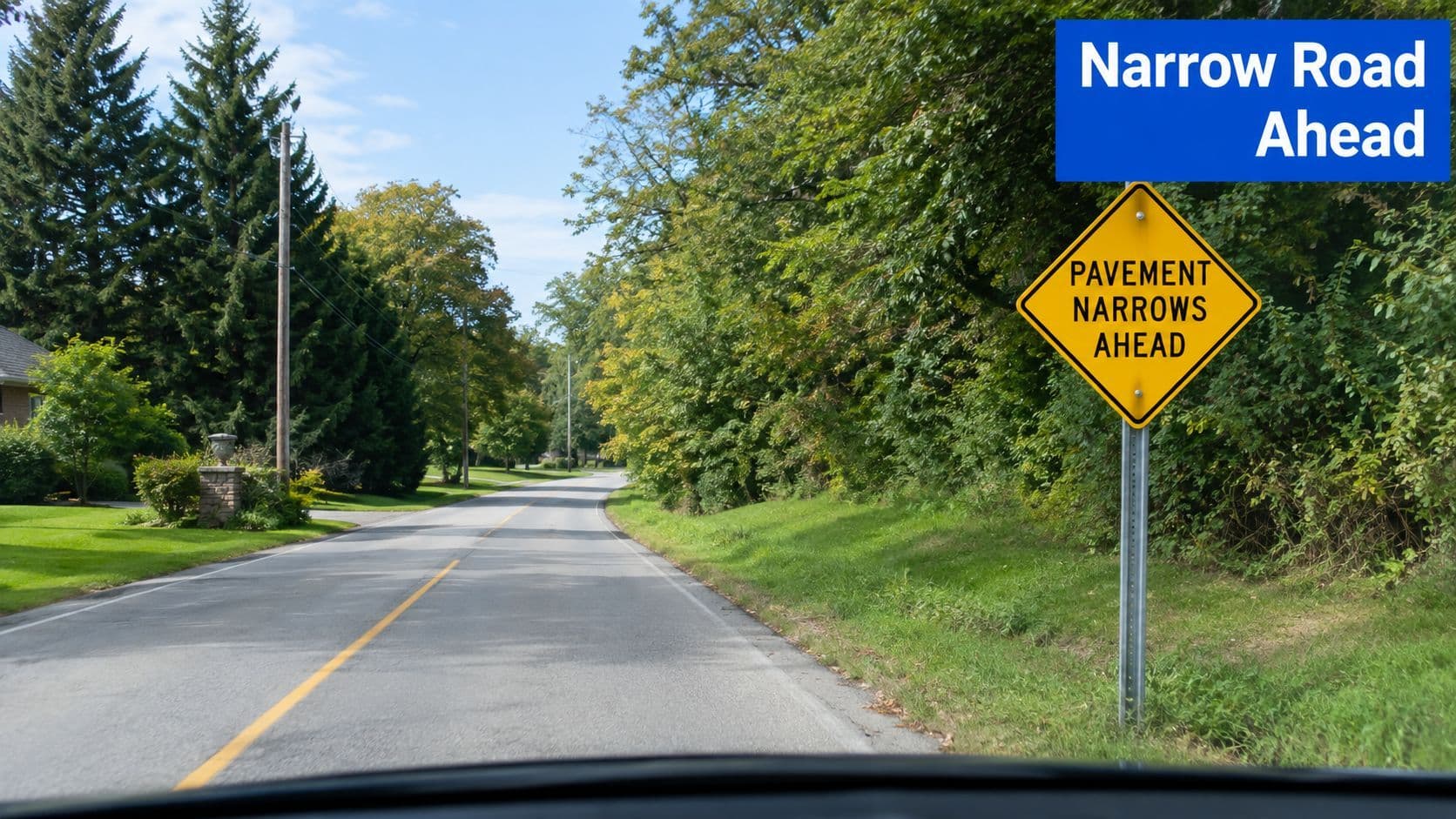
The pavement narrows ahead sign is a diamond-shaped warning sign with a yellow background and black letters or symbols. It alerts you to a reduction in the actual or usable width of the pavement ahead. Depending on the road layout, that reduction may mean lanes moving in the same direction must merge, or that the roadway will provide less space for vehicles to pass safely.
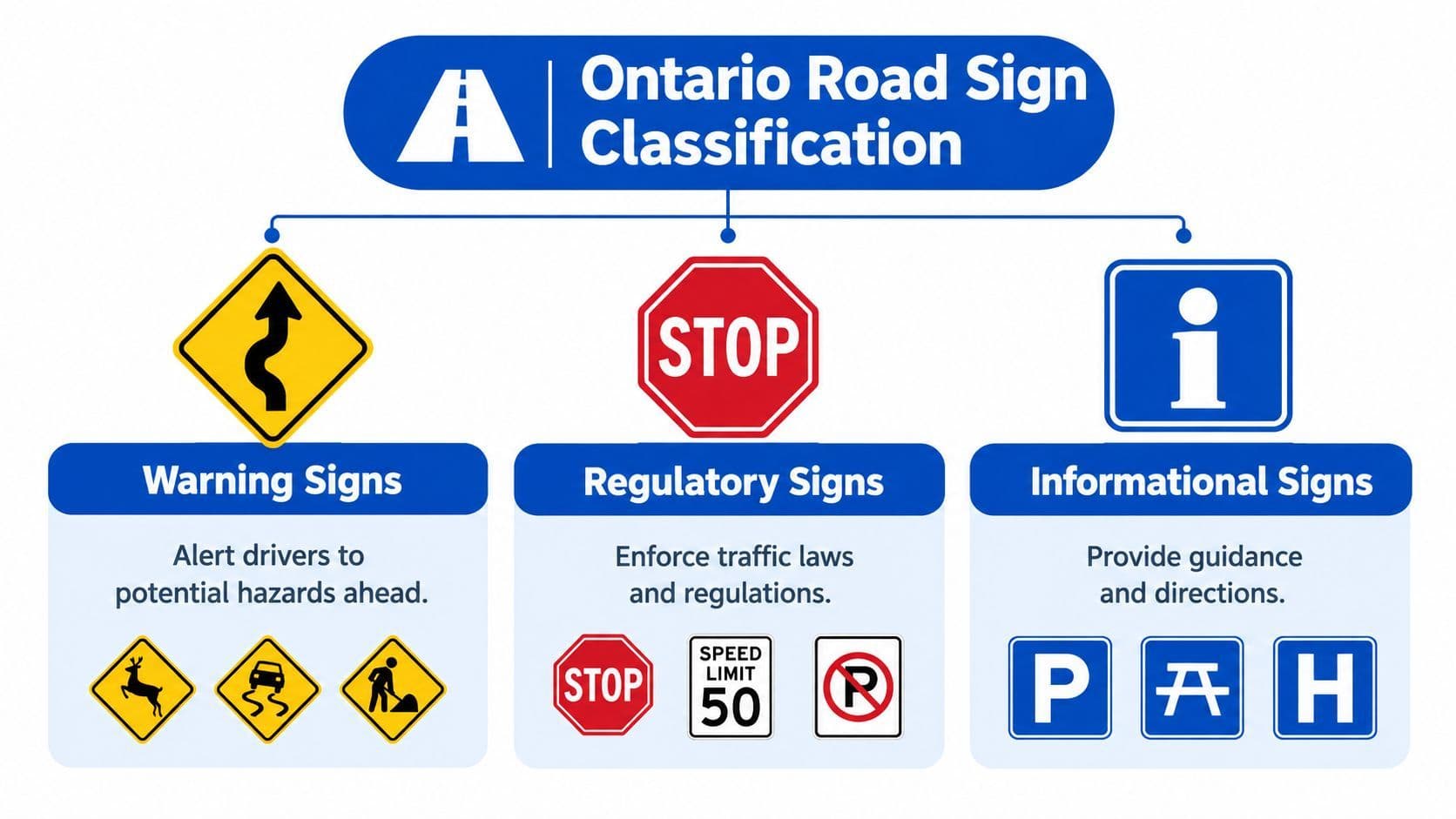
Ontario's official driver-sign system treats this as a warning, not as a regulatory command such as a stop or maximum-speed sign. The Ontario road-sign guide for G1 learners helps put that distinction into context. A warning sign tells you to anticipate a hazard and adapt your driving before you reach it.
The first response
When you see the sign, ease off the accelerator. Don't brake sharply unless traffic or another hazard requires it. A gradual reduction gives the driver behind you time to react and gives you more control while you assess the road.
Then check your mirrors in a calm sequence:
- Look in the rear-view mirror for following traffic.
- Check the side mirror on the side where the road appears to narrow.
- Scan the lane and shoulder ahead for vehicles, cyclists, pedestrians, parked cars, or barriers.
- Identify the lane that continues if a merge is developing.
You may need to move within your lane, merge, or yield to traffic already travelling in the continuing lane. The sign itself doesn't tell you to stop, but it does tell you not to enter the narrowing section without a plan.
Practical rule: Treat the sign as extra thinking time. Use it before the roadway becomes tight, not after another vehicle is beside you.
The message also matters for G1 preparation. Ontario warning signs use a consistent visual language, and this sign belongs with advance notices for hazards such as curves, dips, and sideroads. Learn the shape, colour, message, and driving response together. Memorising only the words can leave you uncertain when the sign appears in a photograph without much road context.
Understanding Ontario Road Sign Classification and Design
Ontario's sign design gives you useful information before you read the wording. A yellow diamond signals a warning about a hazard or unusual road condition ahead, while the black symbol or message identifies the type of risk. The shape and colour work together so drivers can recognise the category quickly, including in poor visibility or when they have only a brief glance.
The Official MTO Driver's Handbook sign information classifies warning signs as part of Ontario's core risk-anticipation system. The handbook groups narrowing-road warnings with advance notices for curves, dips, and sideroads. That placement is deliberate. Drivers should recognise the warning before entering the narrower section, allowing time to reduce speed and adjust position.
The engineering distinction
Ontario's transportation standards identify the PAVEMENT NARROWS sign as Wa-28. It applies where lanes travelling in the same direction must merge because the actual or usable pavement width is reduced. The manual specifically lists its use at urban intersections with far-side lane drops, where a lane disappears after the intersection rather than before it.
That detail explains a common Toronto-style situation. You cross an intersection in a lane that appears to continue, then notice that the far side provides fewer usable lanes. The warning gives you time to identify the continuing lane, observe nearby traffic, and merge without forcing another driver to brake.
The related ROADWAY NARROWS sign has a different purpose. It indicates that the roadway becomes narrower, but the number of lanes doesn't decrease. Vehicles may still have the same lane count while receiving less lateral space, increasing the need for lower speed and careful lane placement. Ontario's manual says advance warning gives drivers time to reduce speed and avoid risks such as head-on collisions or leaving the road.
Why placement matters
Sign placement changes the decision you need to make. A pavement warning may require a lane merge, while a roadway warning may require you to remain in your lane but create more space and reduce speed.
For G1 questions, don't answer from the yellow diamond alone. Read the message, look at the road illustration, and ask whether the problem is fewer usable lanes or less width within the existing lanes. That distinction turns a visual memory exercise into a driving decision.
How to Drive Safely When the Road Narrows
Seeing the warning early gives you options. Your response should be smooth, visible to other road users, and based on the actual lane markings and traffic around you.
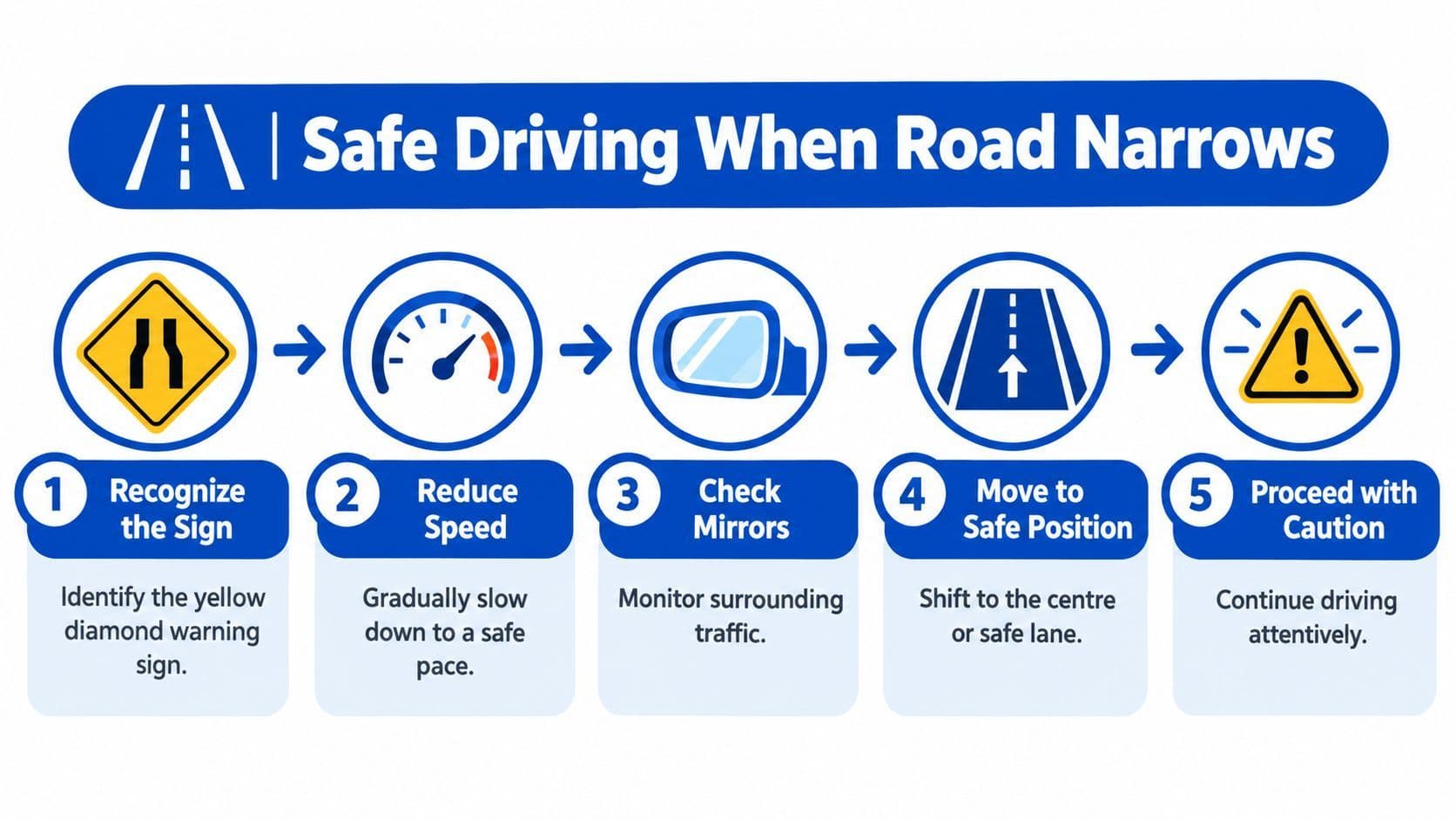
A controlled five-step response
1. Recognise the warning. Confirm that you're looking at the yellow diamond pavement-narrows message. Don't make an abrupt manoeuvre just because you've seen the sign. First, observe how the lane lines, curb, shoulder, and traffic pattern change.
2. Reduce speed gradually. Lift your foot from the accelerator and brake progressively if needed. Lower speed gives you more time to judge a merge and makes steering corrections less severe. It also helps you respond if a cyclist, pedestrian, parked vehicle, or work barrier occupies part of the remaining space.
3. Check your mirrors. Start with the rear-view mirror, then check the side mirror beside the narrowing area. Look for a vehicle in your blind spot before any lateral movement. A mirror check tells you what's behind, but it doesn't replace a shoulder check immediately before changing lanes.
4. Move to a safe position. Stay centred in your lane when the road is merely tighter. If a lane ends or two same-direction lanes must merge, move into the continuing lane when it's safe. Avoid hugging the curb, crossing the centre line, or drifting toward another vehicle to create space.
5. Proceed with caution. Keep scanning rather than staring at the sign or the vehicle ahead. Maintain a steady path through the narrowed section and be prepared for oncoming traffic, roadside obstacles, or a vehicle that hasn't noticed the warning.
Merging without pressure
A driver already established in the continuing lane generally has priority over traffic entering that lane. If your lane ends, you must yield and merge only when there's a safe gap. Don't assume another driver will make room, and don't accelerate aggressively to reach the front of a merge.
A driver in the continuing lane should still cooperate when safe. That may mean maintaining a predictable speed or creating space, but it doesn't mean braking suddenly or moving into another lane without checking.
The Ontario defensive driving course guide reinforces the habits that matter here, including observation, space management, and anticipating what other road users may do. Practise the sequence until it feels routine: slow, mirrors, shoulder check, position, proceed.
Pavement Narrows vs Roadway Narrows vs Lane Ends
These signs can look similar in study materials because each warns that available space will change. The safest way to separate them is to ask two questions: Does the number of lanes change? And does a specific lane terminate?
Sign What changes ahead Typical driving response Pavement Narrows Usable pavement width is reduced, and same-direction lanes may need to merge Reduce speed, assess the continuing lane, check mirrors and blind spots, then merge or adjust position safely Roadway Narrows The roadway becomes narrower, but the number of lanes doesn't decrease Stay alert within your lane, reduce speed, maintain position, and watch for oncoming traffic or a reduced shoulder Lane Ends A specific travel lane terminates Identify the continuing lane, signal, shoulder check, yield, and merge when a safe gap exists Narrow Bridge A bridge or raised structure provides limited width Slow down, hold a steady line, and allow adequate space for opposing or adjacent traffic
A simple decision test
Suppose two lanes in your direction approach an intersection, and the lane on the far side disappears. That is the pavement-narrows situation. You need to plan a same-direction merge.
Now suppose the road continues with the same lane count, but construction barriers or a bridge reduce the space available to each vehicle. That is closer to roadway narrowing. You may not need to change lanes, but you do need to slow down and keep a precise position.
A lane-ends sign focuses on your particular lane. It tells you that the lane you occupy won't continue, so your attention should move quickly to the lane you must enter. The pavement-narrows message is broader. It describes a reduction in usable pavement and may require a merge, but the sign alone doesn't identify every detail of the lane arrangement.
Why the difference matters
Ontario's traffic standards separate pavement narrowing from roadway narrowing because the hazards differ. A lane reduction creates merging conflicts. A narrower roadway can reduce clearance and increase the risk of a head-on conflict or leaving the road.
Don't rely on a single memorised phrase. Match the sign to the road layout, then choose the manoeuvre that layout requires.
Ontario Driving Scenarios and G1 Practice Questions
A sign becomes easier to remember when you connect it to a decision. Consider a busy urban intersection where two lanes travel in the same direction, but the far side of the intersection has only one usable lane. You see the pavement-narrows warning before the intersection.
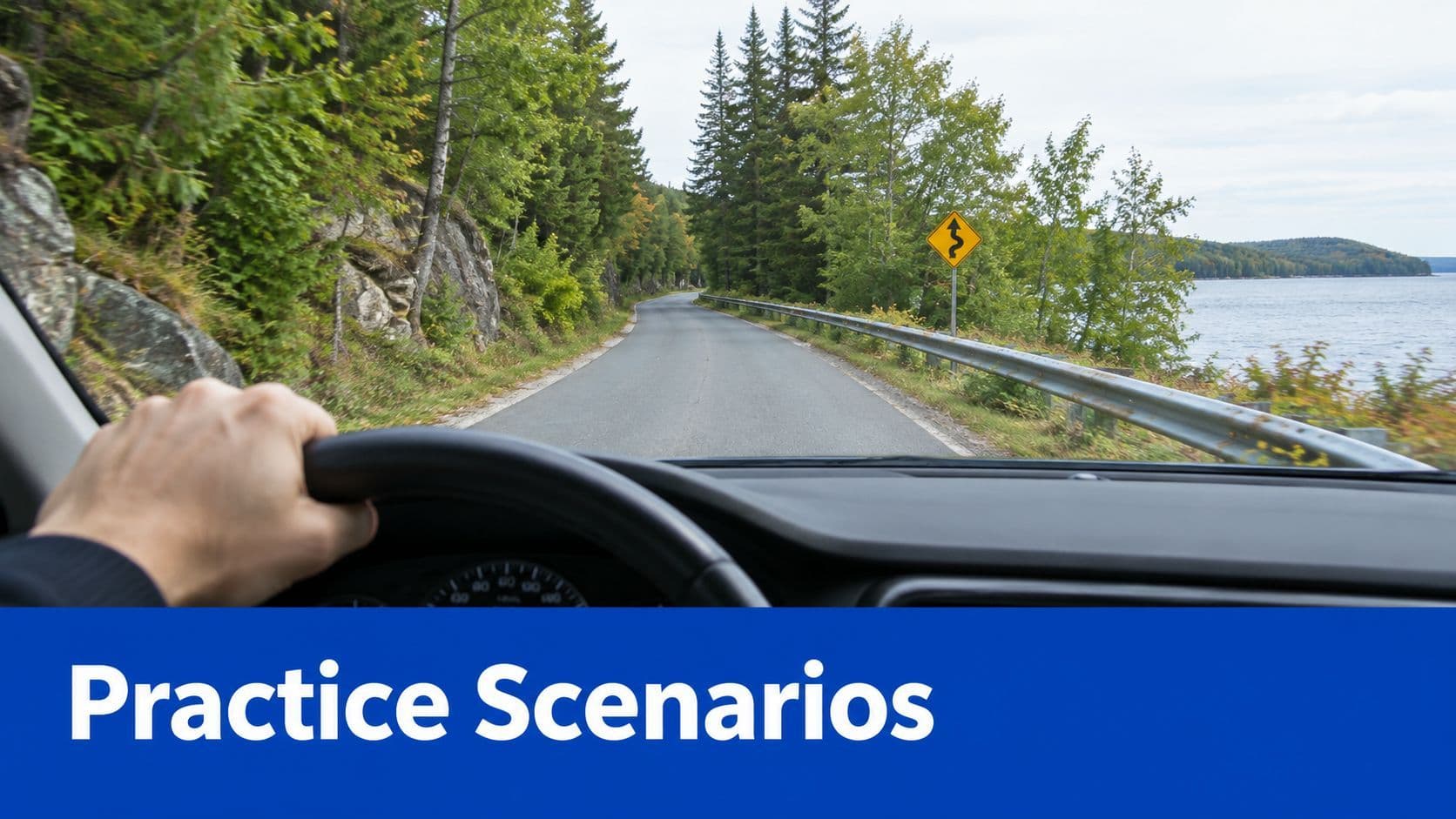
Scenario one
You're in the lane that appears to disappear beyond the intersection. The safe thought process is:
- Slow early: Reduce speed before reaching the intersection.
- Look ahead: Identify which lane continues.
- Check behind: Use the rear-view and side mirrors.
- Check the blind spot: Shoulder check before moving.
- Yield as required: Wait for a suitable gap instead of forcing the merge.
The dangerous response is to continue at the same speed and move over at the last moment. That leaves less room for you, the driver beside you, and anyone entering from a side street.
Scenario two
You're travelling along a residential street where construction barriers reduce the usable pavement. The lane count hasn't changed, but the space feels tighter and an oncoming vehicle is approaching.
Here, don't treat the sign as an automatic lane-change instruction. Slow down, maintain a controlled position, and make sure both vehicles have enough room. If the narrowed space can't accommodate both safely, be prepared to stop and let the other vehicle pass when appropriate.
Practice questions
Question: What does a yellow diamond pavement-narrows sign warn you about?
Answer: A reduction in actual or usable pavement width ahead. Same-direction lanes may need to merge, or the road may provide less space for vehicles.
Question: What should you do first after seeing the sign?
Answer: Reduce speed gradually and assess the road, traffic, lane markings, and available space.
Question: Your lane ends and a vehicle is already travelling in the continuing lane. Who should yield?
Answer: The driver whose lane ends should yield and merge only when it's safe.
Question: Does the pavement-narrows sign always mean the number of lanes decreases?
Answer: No. Ontario distinguishes pavement narrowing, which can involve a same-direction lane merge, from roadway narrowing, where the lane count remains the same.
The Ontario traffic-rules question guide can help you practise the reasoning behind sign questions rather than relying only on visual recall. On test day, read every option carefully. The correct answer usually combines sign recognition with the safe action it requires.
Key Takeaways and Final Safety Checklist
The pavement narrows ahead sign gives you advance information about changing road space. It's a yellow diamond warning sign, not a command to stop, but it requires an active response: lower your speed, inspect the traffic around you, understand the lane layout, and prepare to adjust position or yield.
Ontario's formal classification matters because similar signs describe different problems. Pavement narrowing can involve a same-direction merge. Roadway narrowing can reduce width while keeping the same number of lanes. Lane ends identifies a travel lane that won't continue.
Quick review before your G1 test
- Recognise the design: Yellow background, diamond shape, black warning message or symbol.
- Name the hazard: Usable pavement width will decrease ahead.
- Slow smoothly: Don't wait until the road becomes tight.
- Check all around: Rear-view mirror, side mirror, blind spot, then the path ahead.
- Read the lane layout: Decide whether you need to merge or hold a careful line.
- Respect priority: Traffic already in the continuing lane has priority over merging traffic.
- Separate similar signs: Pavement narrows, roadway narrows, lane ends, and narrow bridge don't mean the same thing.
- Expect context: The warning may appear near an urban intersection, a bridge, construction, or a constrained residential road.
Remember: The sign doesn't predict that the road is impossible to use. It tells you that the available space is about to change, and you must reassess before entering it.
Practise identifying the sign from its shape and wording, then say out loud what you would do. That small habit connects G1 knowledge-test recognition with the observation and space management you'll need behind the wheel.
G1ready.ca offers free, registration-free Ontario G1 practice exams, targeted quizzes, explanations, and road-sign questions that can help you review narrowing-road warnings alongside other handbook topics. Visit G1ready.ca to practise the decisions behind the signs and build a focused study routine before test day.


