
You're at a suburban four-way stop during your first driving lesson. Your hands are tight on the wheel, the other vehicle arrived at nearly the same time, and both drivers seem to be waiting for the other person to move. That small pause shows why traffic control regulations in Ontario matter. Signs, signals, markings, and directions from authorised traffic-control personnel create a common system so drivers don't have to rely on guessing or courtesy waves.
Ontario's rules come from a legal framework that connects provincial law, technical standards, municipal bylaws, and temporary work-zone controls. Once you understand how those layers fit together, an unfamiliar intersection becomes easier to read. You can identify which instruction applies, decide who has priority, and respond deliberately instead of reacting at the last moment.
Why Ontario Traffic Rules Matter on Your First Drive
At the four-way stop, start with the most important fact: your vehicle must come to a complete stop. A slow crawl isn't enough. After stopping, look for the stop line, crosswalk, pedestrians, cyclists, and vehicles approaching from every direction. If another vehicle clearly stopped first, let it proceed. If you stopped first, proceed only after confirming that the intersection is safe.
The uncertainty usually comes from treating the stop sign as a simple symbol instead of a legal instruction. Ontario's stop-sign rule requires a complete stop at the stop line when one is marked. Without a stop line, the stopping sequence moves to the crosswalk, the sidewalk edge, and then the intersection edge, as described in the Ontario stop-sign guidance. You don't choose the most convenient stopping point. You use the first applicable location and move only when the way is clear.
Practical rule: Stop completely, identify the correct stopping point, scan in every direction, and proceed only when you can do so safely.
These details matter beyond the lesson. A learner who misses a stop-sign procedure can lose marks on the G1 knowledge test, but the same mistake on the road can also lead to enforcement under the Highway Traffic Act. The legal system treats traffic-control devices as instructions that organise road use, not as optional suggestions.
The habit you're building is broader than memorising isolated answers. You're learning to read the intersection before entering it, notice what other road users may do, and connect a sign or marking to a specific action. That approach helps with stop signs, traffic lights, pedestrian crossings, railway signals, lane changes, and work zones.
By the time you sit the official MTO written test, you should be able to explain why an answer is correct. That's more reliable than selecting an option because its wording feels familiar. Clear reasoning also makes your first independent drive calmer, because you'll have a repeatable process for unfamiliar situations.
The Legal Framework Behind Every Sign You See
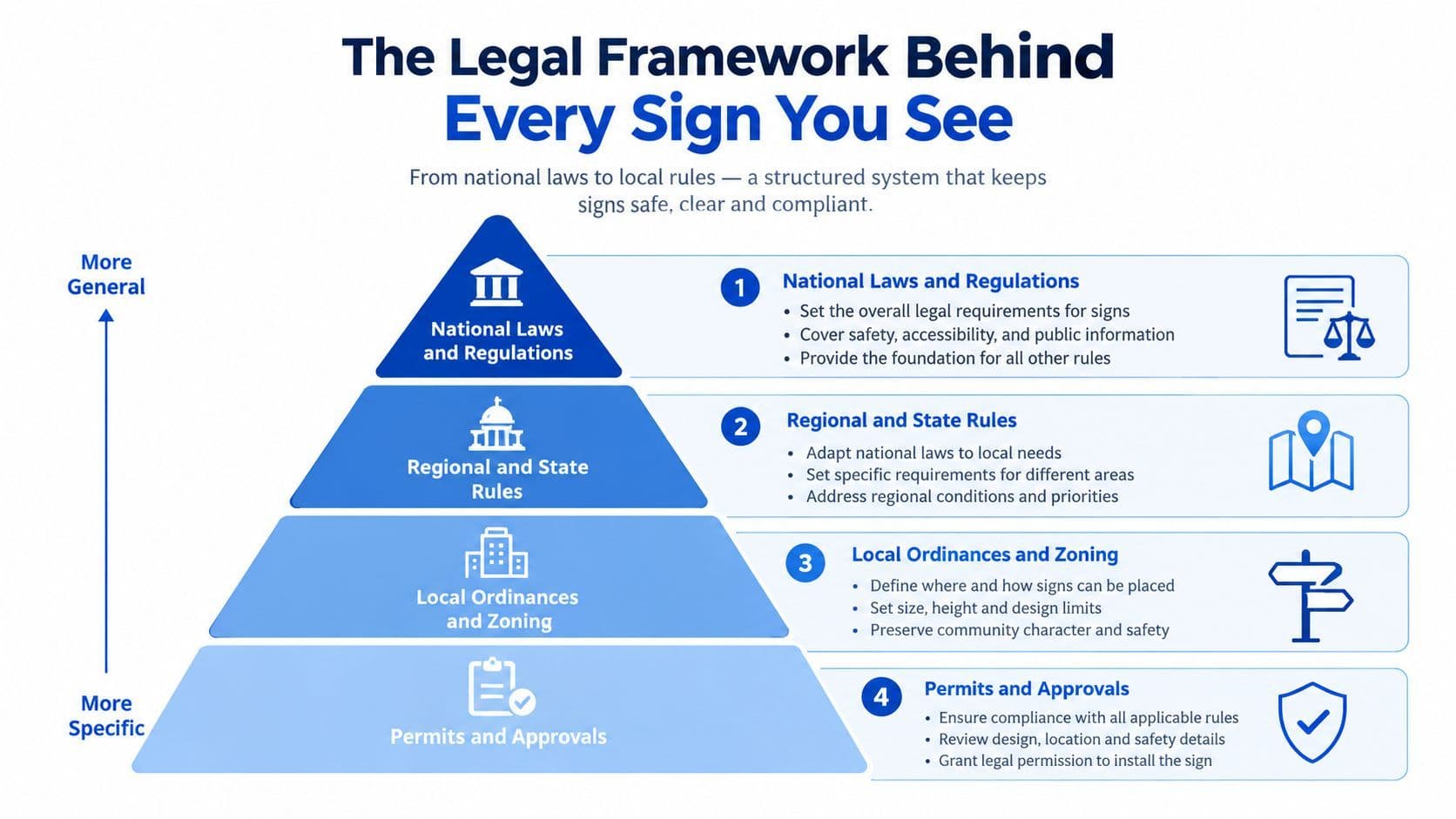
Think of Ontario's driving framework as a layered system. The Highway Traffic Act, Ontario legislation, supplies the legal rules that govern conduct on highways. The Ontario Traffic Manual, commonly called the OTM, supplies technical guidance for designing, applying, and operating traffic-control devices and systems.
The Ontario Traffic Council explains that the OTM promotes uniform treatment across Ontario and is intended to remain consistent with the intent of the Highway Traffic Act. It also supports road authorities as they update their own guidelines and standards through the Ontario Traffic Manual overview.
A useful analogy is to compare the HTA with the constitution of driving and the OTM with the engineering drawings. The HTA establishes the legal obligation. The OTM helps road authorities translate that obligation into signs, signals, pavement markings, and work-zone layouts that drivers can recognise consistently.
Provincial law sets the legal duty
When you're asking whether a driver must stop, yield, obey a signal, or respond to a pedestrian-control device, the HTA is a central source. It includes rules of the road as well as provisions concerning traffic-control signal devices and conduct on highways. It also contains subject areas that learners encounter in the handbook, including pedestrian crossovers and school-bus signals.
The OTM doesn't replace the law. It helps explain how traffic-control systems are organised so the legal instruction is visible and understandable on the road.
Ontario continues to update the regulatory framework. For example, O. Reg. 185/22, filed March 11, 2022, addresses portable traffic-control systems and automated flagger assistance devices. That update illustrates why learners should use current material rather than rely on an old summary or advice from a driver who learned years ago.
Municipal and regional rules add local detail
Municipalities and regional road authorities may control matters such as parking, local speed limits, temporary signs, and road operations within their jurisdiction. Those rules can be more specific than the province-wide framework, but they can't turn a provincial legal requirement into an optional one.
This distinction helps when a newcomer sees a temporary sign outside a construction project or a parking restriction on a city street. Ask three questions:
- Is this a provincial traffic rule?
- Is it a municipal or regional bylaw?
- Is it a temporary work-zone instruction supported by the provincial system?
That simple classification prevents a common mistake, assuming every sign comes from the same authority. Ontario drivers need to follow the instruction that applies to their situation, regardless of whether it comes from a permanent provincial standard, a local bylaw, or an approved temporary traffic-control arrangement.
Signs, Signals, and Markings Explained
Ontario traffic-control devices work as a visual language. The Official MTO Driver's Handbook explains that traffic signs, pedestrian signals, and pavement markings tell road users what they must do in particular situations. It groups signs into regulatory, warning, temporary-condition, and information or direction categories.
Signs usually answer one of three questions. A regulatory sign tells you what is required or prohibited. A warning sign tells you that a hazard or change is ahead. An information or direction sign helps you understand where the road leads or which route to follow.
Shape and colour help you interpret a sign before you've read every word. An octagonal red stop sign signals a mandatory stop. A red circle with a line through it means the activity shown isn't allowed, while a green circle means you may or must perform the activity shown inside the ring, according to the MTO signs guidance.
Signals manage movement through time
Traffic lights divide conflicting movements into phases. A green light permits left, straight, or right movement, but you still yield to vehicles and pedestrians already in the intersection. A yellow light warns that the red light is about to appear. Stop if you can do so safely. A red light requires a complete stop at the marked stop line, crosswalk, sidewalk edge, or intersection edge, depending on what's present.
A protected left-turn arrow gives a different message from a standard green light. It indicates a controlled turning phase, but you must still watch for pedestrians and follow the displayed signal. Flashing indications and pedestrian signals add information that can change how you approach the junction.
Markings position your vehicle
Pavement markings show where vehicles should travel and where movements begin or end. Solid and dashed lines can separate lanes or indicate whether a lane change is appropriate. Directional arrows show permitted travel. Stop bars identify where a vehicle should halt at a signal or stop sign.
Crosswalk markings, bicycle lanes, high-occupancy-vehicle diamonds, and turning arrows all supplement the signs and signals above them. If snow, glare, or a large vehicle blocks one cue, look for the others rather than relying on memory.
Device Type What It Communicates Typical Example Sign A regulation, warning, temporary condition, or direction Stop sign, warning sign, speed-limit sign Signal Which movement has priority at a particular time Red, yellow, or green traffic light Pavement marking Lane position, stopping point, or turning permission Stop bar, crosswalk, lane arrow
A single intersection may combine all three. A stop sign establishes the requirement to stop, a stop bar shows where to stop, and a crosswalk identifies a space where pedestrians may be crossing. Reading them together gives you a fuller picture than focusing on one object alone. For additional practice identifying information signs, use this Ontario information signs guide.
Stop Signs, Traffic Lights, and Right of Way in Practice
At the suburban four-way stop from your first lesson, use the same sequence every time. Ease off the accelerator, position the vehicle under control, and stop completely at the correct stopping point. Pause long enough to confirm that the vehicle has stopped, then scan left, right, ahead, and toward the sidewalks.
The legal stopping locations are precise. Stop at the stop line if it's marked. If there isn't one, stop at the crosswalk, then the sidewalk edge, then the edge of the intersection. Don't stop beyond the crosswalk just because you have a better view. Stop where the rule places you, then creep forward only when necessary and safe for visibility.
Read the signal before choosing your movement
At traffic lights, apply the MTO traffic-light instructions physically:
- Green: Proceed straight, turn left, or turn right when permitted, while yielding to vehicles and pedestrians already in the intersection.
- Yellow: Prepare to stop. Stop if you can do so safely, rather than accelerating to beat the red.
- Red: Stop completely at the applicable stop line, crosswalk, sidewalk edge, or intersection edge.
- Left-turn arrow: Follow the displayed arrow and check the path before moving. Don't assume a regular green light gives the same protection.
- Flashing indication: Identify the meaning of the signal and proceed with the required caution or stop.
- Dark signal: Treat the intersection carefully, look for other controls, and don't enter until you've established that proceeding is safe and lawful.
The signal controls movement, but it doesn't remove your responsibility to check the path. Ontario's handbook says signals must be given well before a manoeuvre, and signalling alone isn't enough. You must also confirm that the path is clear before turning, changing lanes, stopping, or leaving a parked position, as explained in the MTO signalling guidance.
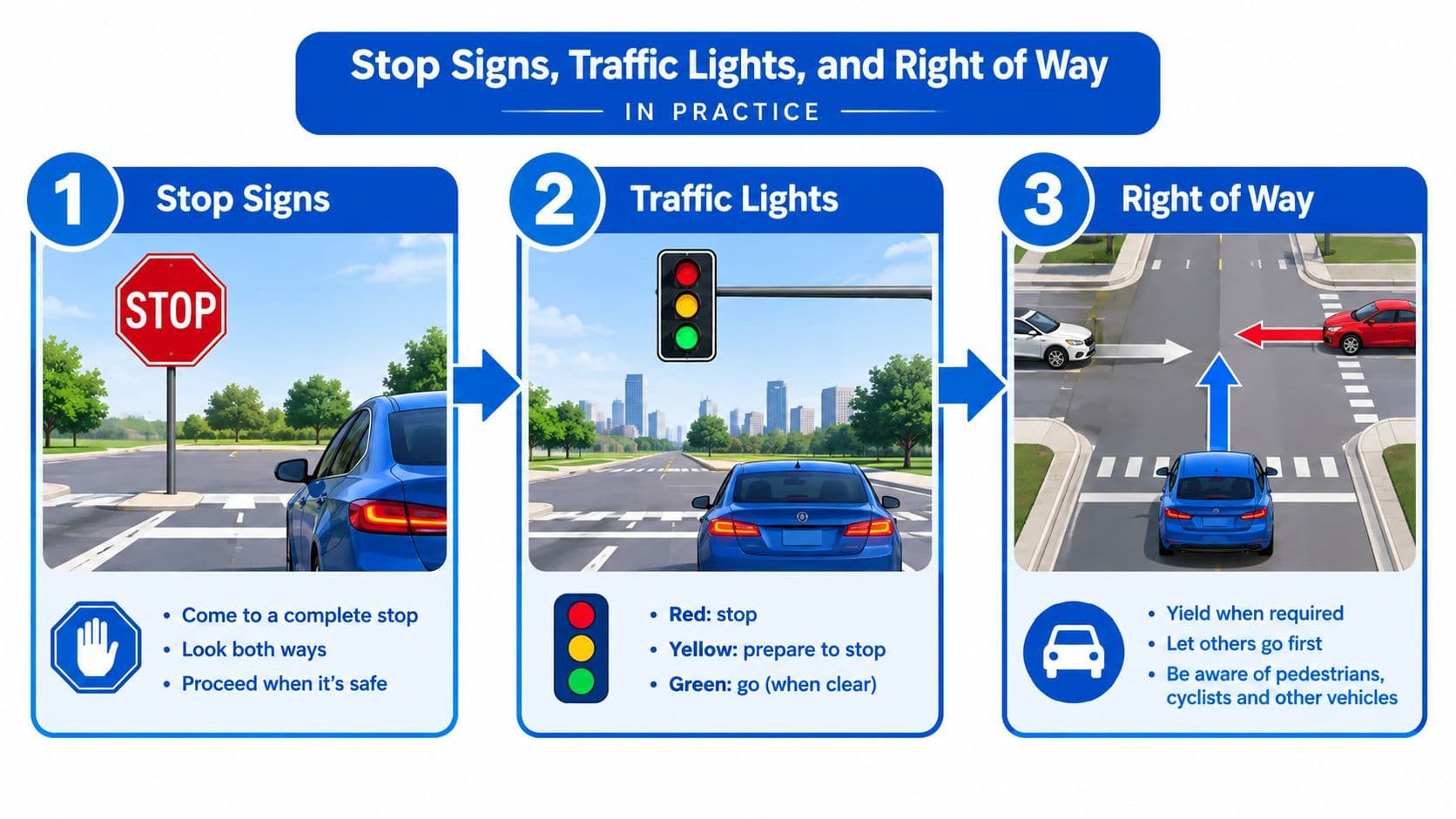
At the four-way stop, the vehicle that arrived first normally proceeds first. If vehicles arrive together, communicate clearly through position and observation, then yield when another vehicle has a more obvious priority. Never force your way forward because you believe someone should have yielded.
At an intersection, right of way is something you yield, not something you seize.
Give priority to pedestrians lawfully crossing, vehicles already in the intersection, and emergency vehicles requiring the road to clear. Keep watching even after you begin moving. A driver who has priority can still face a hazard, such as a pedestrian entering late or another motorist failing to stop.
For targeted practice with these situations, review the G1 right-of-way rules guide.
Work Zones and Temporary Conditions Drivers Often Miss
You're driving near a school and see a temporary sign, a crossing guard, and children waiting near the roadway. The permanent road layout may look familiar, but the temporary instruction changes how you approach. Slow down, obey the posted control, and follow the crossing guard's direction. School Crosswalk signs and other temporary controls exist to manage a situation that ordinary intersection rules may not cover safely.
Ontario's traffic-control system also includes detailed standards for equipment. Ontario Regulation 94/08 on highway closings specifies that a closure can require a minimum of three traffic-control devices, or two devices of certain prescribed types, arranged in a line at right angles to approaching traffic with no more than one metre between adjacent devices. It also prescribes minimum dimensions, including cones at least 45 centimetres high, rectangular signs at least 90 centimetres high and 20 centimetres wide, and barricades at least 100 centimetres by 100 centimetres, as set out in the Ontario highway-closing regulation.
Those measurements are mainly a work-zone compliance issue, but they teach learners an important lesson. Temporary traffic control isn't improvised decoration. Authorities regulate device type, placement, size, and reflective design so drivers can recognise a controlled route in changing conditions.
A highway work zone needs a different reading pattern
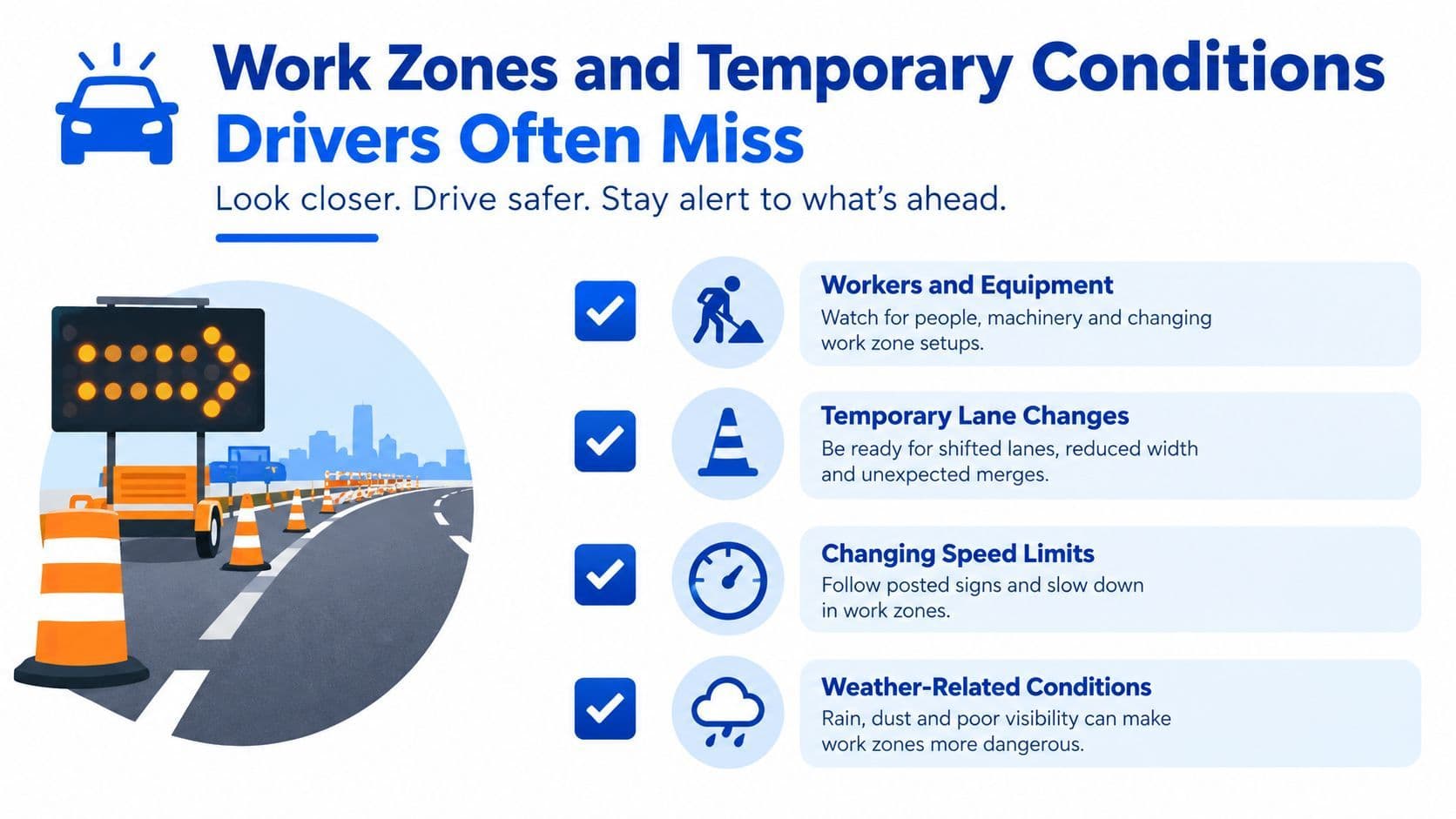
On a 400-series highway, orange diamond signs warn that the normal road environment is changing. Lane Closure signs, cones, barriers, flag persons, and reduced-speed regulatory signs may appear together. Read the sequence early, create space, and avoid sudden lane changes near workers or equipment.
A flag person's direction deserves immediate attention. Don't try to interpret a hand signal while continuing at your usual speed. Reduce speed, watch the person's position and paddle, and follow the instruction that controls your lane.
Ontario's sign rules have also been amended through O. Reg. 275/25 and O. Reg. 138/26, showing that sign regulations continue to change. Regional rules can add another layer. York Region's 2026 sign bylaw, for example, contains detailed requirements for temporary signs, including placement, size, timing, permits, removal, weekend posting windows, setback distances, and identifier stickers.
When a temporary instruction conflicts with what you remember about the permanent road, follow the active temporary control until you leave the affected area. Then resume normal driving only after the work-zone signs and devices no longer apply.
How These Rules Show Up on the G1 Test
The G1 test rewards recognition and decision-making. Questions may show a sign, describe an intersection, or ask what action should come first. The safest preparation method is to connect each answer to a physical driving routine.
The test is commonly described in two parts, but the figures supplied for its structure need careful checking against the current official testing material. Use the current Ontario Driver's Handbook and the official DriveTest information before relying on any question-count or pass-mark summary. Requirements can change, and an outdated practice page may teach the wrong test format.
Map each rule to a question type
A stop-sign question may ask where you stop when a line, crosswalk, sidewalk, or intersection edge is present. Don't choose based on which position gives the best view. Recall the required order, then apply it to the image.
A traffic-light question may present a green, yellow, or red indication and ask what you may do. The correct answer depends on both the light and the surrounding traffic. A green light doesn't cancel your duty to yield to vehicles and pedestrians already in the intersection.
Right-of-way questions often use short scenarios. The useful process is to identify who arrived first, whether a vehicle is already in the intersection, whether a pedestrian is crossing, and whether an emergency vehicle requires space. The test is checking whether you can rank those facts before moving.
Test Section Question Count Pass Mark Related Handbook Chapter Rules of the road Verify in current official material Verify in current official material Traffic rules and intersections Signs and situations Verify in current official material Verify in current official material Traffic signs, lights, and markings
Study by topic rather than reading the handbook passively. Read the traffic-sign pages, practise identifying regulatory and warning devices, then work through traffic-light and right-of-way scenarios. After that, use the traffic rules question guide to test whether you can apply the rule without looking at the explanation first.
G1ready.ca offers registration-free Ontario practice exams, targeted quizzes, mixed tests, diagnostic practice, a marathon format, and an exam simulator aligned with the Ontario handbook. Immediate explanations and progress tracking can help you identify which traffic-control topics need another review before test day.
Common Misconceptions Ontario Drivers Should Unlearn
Myth: A rolling stop is acceptable if the road is empty.
Reality: A stop sign requires a complete stop at the correct stopping location. Empty pavement doesn't change the instruction. Stop fully, scan, and proceed only when the way is clear.
Myth: You can make a U-turn anywhere unless a sign prohibits it.
Reality: A U-turn still has to be safe, lawful, and compatible with the road layout and traffic controls. A missing prohibition sign isn't automatic permission to turn across traffic, over a solid line, near a crest, or where other road users can't see you clearly.
Myth: A flashing green pedestrian signal gives a turning driver priority.
Reality: A pedestrian signal doesn't erase the duty to check the crosswalk and yield where required. Before turning, confirm that pedestrians have finished crossing and that your path is clear.
Myth: Yield signs are suggestions.
Reality: A yield sign requires you to reduce speed or stop when necessary and give priority to traffic that has the right of way. Enter only after the movement can be made safely.
Myth: School-zone controls apply only during class hours.
Reality: Don't invent a schedule. Read the sign, follow the posted times or conditions, and obey crossing guards and school-crosswalk controls whenever they're active. Temporary signs and regional bylaws can add details that a general driving rule doesn't show.
Ontario's framework changes through formal updates, including amendments such as O. Reg. 275/25 and O. Reg. 138/26 under the Highway Traffic Act. That's another reason to study current official material instead of relying on an old explanation from a friend.
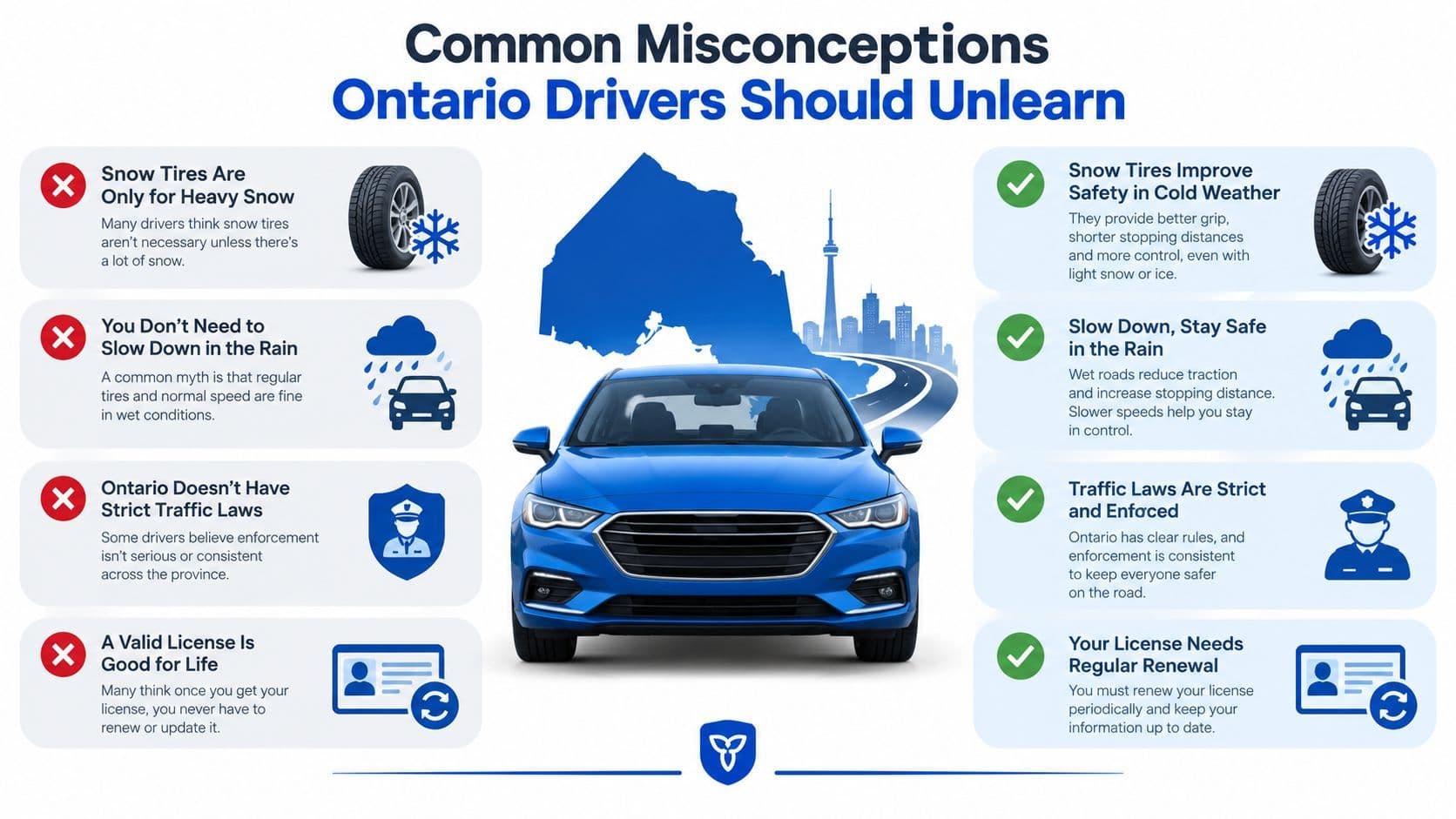
These corrections aren't minor test-day tricks. They help you replace assumptions with actions you can repeat at every intersection. Review the official handbook, practise one traffic-control topic at a time, and use explanations to understand why an answer is correct.
Use G1ready.ca to practise Ontario traffic regulations, signs, signals, and right-of-way questions with targeted quizzes and immediate explanations. Start with the areas that cause you the most hesitation, then repeat mixed practice until you can identify the correct action before checking the answer.


