
You're stopped at a busy Ontario intersection, watching a red light while a green arrow glows beside it. Across the road, another signal flashes yellow, and a pedestrian is waiting near the crosswalk. Which light controls your lane? Can you turn? Should you stop, yield, or continue?
These moments confuse new drivers because Ontario intersections combine several signal systems at once. This guide breaks down Ontario traffic lights in the same practical way a patient driving instructor would, while connecting each rule to the decisions tested on the G1 knowledge test.
Why Ontario Traffic Lights Confuse Even Experienced Drivers
On a Tuesday morning in Mississauga, a learner driver approaches a large suburban intersection in the left lane. The circular signal facing the lane is red, but a green right-turn arrow is illuminated beside it. Across the intersection, a separate signal is flashing yellow. The driver hesitates, unsure whether the arrow applies to the lane, whether the red light still matters, and whether the flashing signal changes the usual rules.
That hesitation is understandable. The problem usually isn't one difficult rule. It's the layering of signals, lane markings, turning permissions, pedestrian movements, and local designs in one place. A driver who understands a solid red light can still become uncertain when an arrow, a flashing indication, or a transit signal appears at the same time.
Instructor's approach: Read the signal that controls your lane and movement first. Then check pedestrians, vehicles, signs, and the condition of the intersection.
Ontario's system has developed from manual traffic direction into standardised signal control. Electric traffic lights reached Canadian streets in 1925, with Hamilton, Ontario, cited as the first Canadian city to adopt them, followed shortly by Toronto. Toronto's first automated traffic signals were installed on August 8, 1925, at Yonge Street and Bloor Street as a trial intended to reduce the number of police constables needed at major intersections, as described by the Historical Society of Ottawa.
The three questions to ask
At any signalised intersection, pause mentally and ask:
- Which signal faces my lane?
- What movement am I making, straight, left, or right?
- Who already has priority, including pedestrians and vehicles in the intersection?
The sections that follow decode circular lights, arrows, flashing signals, pedestrian indicators, and transit priority signals. Learning each type separately makes multi-signal intersections easier to read and makes G1 questions less dependent on guesswork.
Standard Red, Yellow, and Green Lights in Ontario
At a red light, the stop line may sit well before the crosswalk. A new driver who rolls forward to the crosswalk has already stopped too far ahead. Ontario's circular signals follow a simple order, but each colour carries a legal duty. The Ontario Official Driver's Handbook traffic-lights guidance explains the required stopping and when proceeding is allowed.
Red means stop before entering
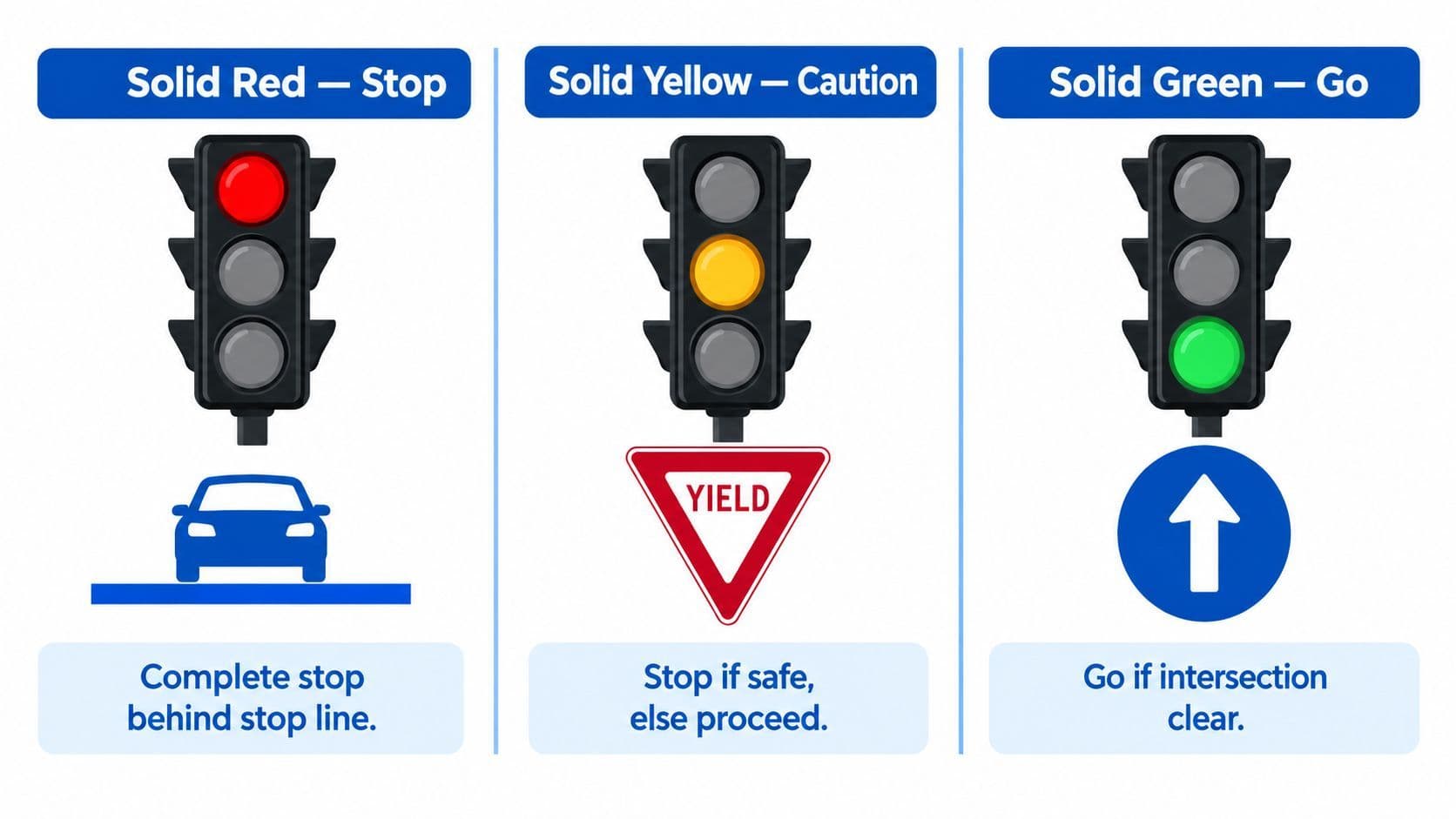
A solid red light requires a complete stop. Stop behind the marked stop line. If there is no line, stop at the crosswalk, the edge of the sidewalk, or the edge of the intersection, depending on which boundary is present.
A right turn on red may be permitted after a full stop. Before turning, yield to pedestrians and vehicles, and check whether a sign prohibits the turn. An empty-looking road does not remove the stop requirement. For G1 questions, the order is easy to remember: stop first, check the restriction, yield, then turn only when the way is clear.
Yellow means decide safely
A solid yellow light warns that the signal is about to turn red. Stop if you can brake safely. If you are already too close to stop without creating danger, continue cautiously through the intersection.
For example, a driver approaching at a normal speed with enough room for smooth braking should stop behind the line. A driver who has entered the intersection as the light changes should avoid hard braking and clear it carefully. The G1 test is checking judgment here, not whether you stop at any cost.
Green permits movement, not automatic priority
A solid green light permits you to go straight or turn, provided the intersection is safe. Yield to pedestrians who are still crossing and to vehicles already lawfully in the intersection. Green gives permission to proceed, not priority over someone who entered legally before you.
A left turn from a dedicated lane on a solid green is permitted, not protected. Wait for a safe gap in oncoming traffic and yield to pedestrians. Treat the green light like an open door, you may move through it only after checking who is already using the space.
Remember: Green means proceed only when the intersection is safe and clear for your movement.
Arrow Signals and Protected Turns
Arrow signals control a particular direction more precisely than a circular light. They're especially important in left-turn lanes, where drivers must distinguish between a protected turn and a permitted turn.
A solid green arrow gives you a protected movement in the arrow's direction. For a left-turn arrow, opposing through traffic is held by a red signal, so you can turn without yielding to opposing vehicles. You still need to watch for pedestrians and make sure the path is open.
A dedicated left-turn lane facing a circular green light is different. That turn is permitted, not protected. You must yield to oncoming traffic, even if the lane marking and position make the turn feel specially authorised. Drivers preparing for the G1 test can review the distinction in these Ontario left-turn rules.
Yellow and red arrows
A solid yellow arrow means the protected phase is ending. If you're still before the intersection, prepare to stop if you can do so safely. If you've already entered the intersection during the protected phase, complete the turn cautiously rather than stopping in the path of traffic.
A solid red arrow requires a full stop and prohibits the arrow movement. This is a frequent point of confusion. A standard red light may allow a right turn after stopping and yielding where no sign prohibits it, but you can't make that turn on a red arrow. The arrow specifically controls the movement shown.
A practical lane example
You're in a left-turn lane and see a red arrow. The opposing lane appears empty, but you must remain stopped because the red arrow prohibits the turn. When the green arrow appears, the protected phase allows the movement. If the signal changes to a circular green without an arrow, the turn may become permitted, but you must now yield to opposing traffic.
Flashing Signals You Will See on Ontario Roads
Flashing signals require drivers to interpret the light's behaviour, not just its colour. A flashing red isn't a weak red, and a flashing yellow isn't permission to ignore the intersection.
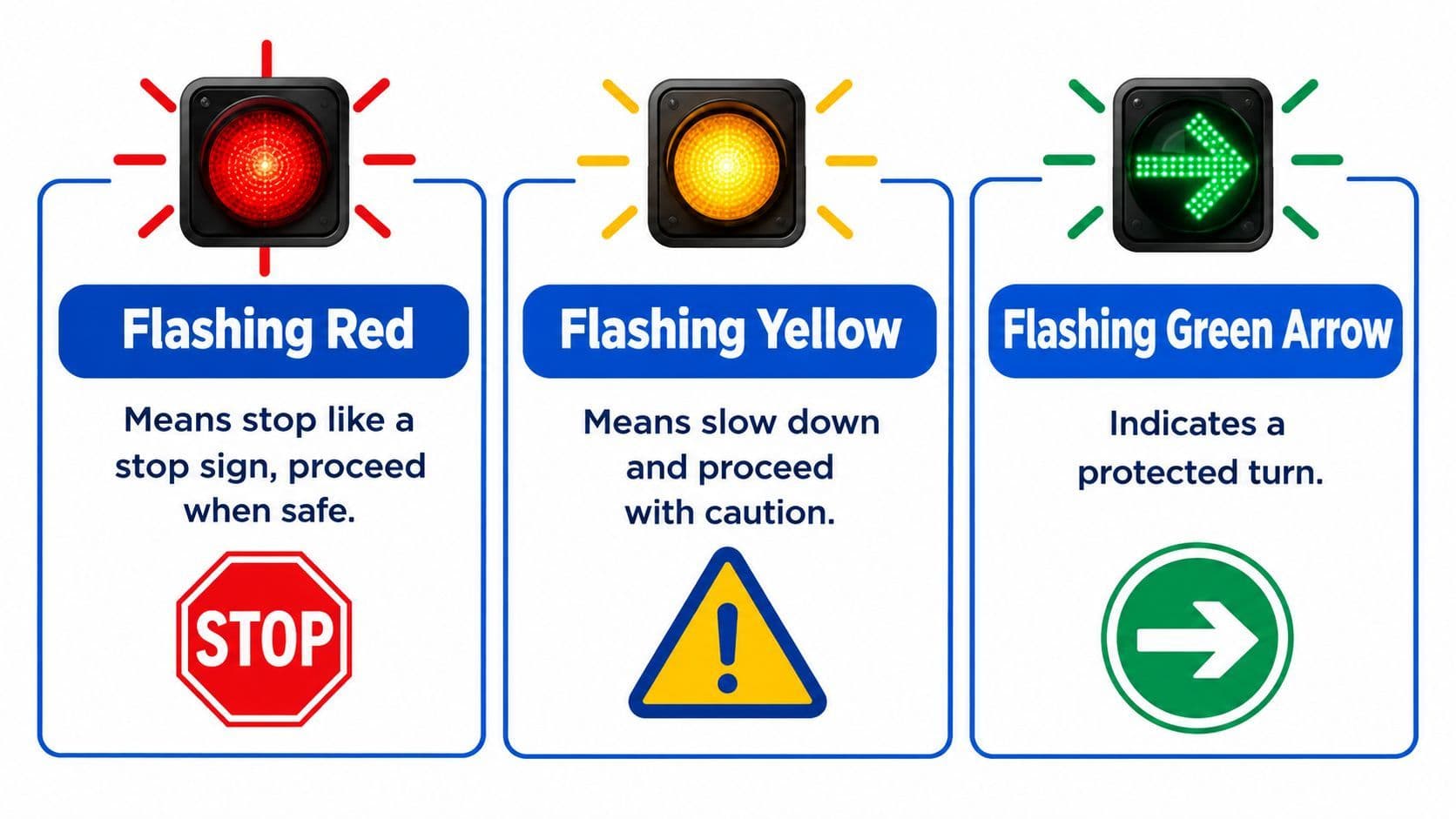
A flashing red light requires a complete stop. After stopping, proceed only when it's safe and give right-of-way as you would at a stop sign. Rolling through because the signal is flashing is a serious mistake.
A flashing yellow light means slow down and proceed with caution. It doesn't normally require a complete stop, but you must reduce risk by checking for vehicles, pedestrians, cyclists, and unexpected movements. If visibility is poor or the crossing is busy, caution may mean waiting.
Where flashing signals cause mistakes
Drivers may encounter flashing red signals at railway crossings, fire-station entrances, pedestrian crossovers, or intersections operating in a special mode. A flashing red can also appear at an intersection during late-night operation after the normal signal cycle has changed.
A flashing yellow may appear where traffic needs a warning rather than a mandatory stop. The setting doesn't change the basic decision. Slow down, scan, and continue only when the path is safe.
The flashing green arrow is a protected left-turn indication used at selected intersections. It isn't the same as a standard green light, and it doesn't mean every movement through the intersection is protected. Follow the direction shown by the arrow and remain alert for pedestrians.
Safety check: If you're unsure whether a flashing signal applies to your lane, identify the signal head positioned over or beside your lane before moving.
Pedestrian Signals and Walk Buttons
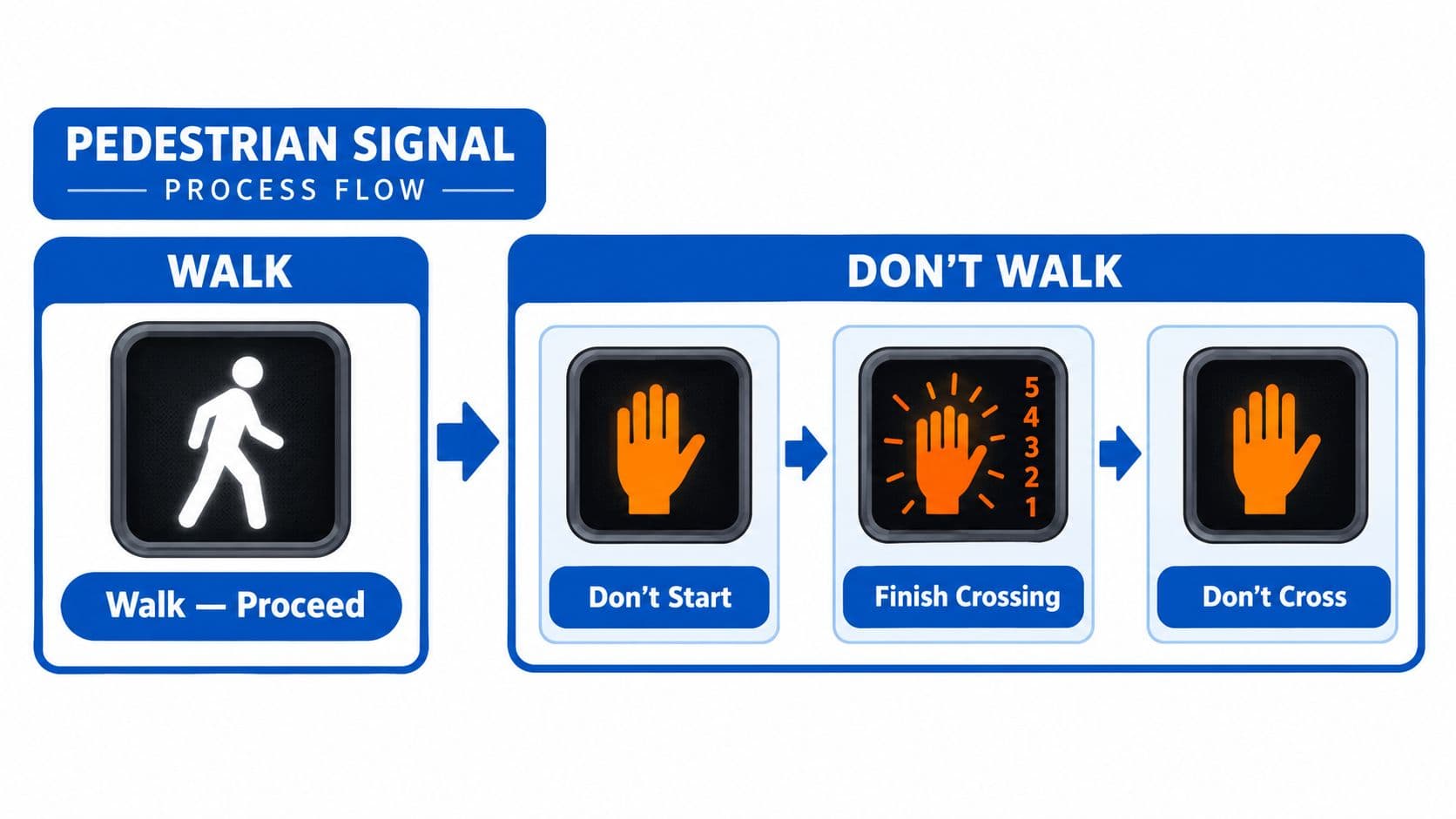
At a signalised intersection, a green vehicle light does not automatically mean the crossing is clear. Read the pedestrian display and scan the full crosswalk before moving. A white walking symbol permits pedestrians to begin crossing when the path is safe. A steady orange hand tells them not to start.
A flashing orange hand means the crossing phase is ending. People already in the crosswalk should continue to a safe area, and drivers must yield until they finish, even if the vehicle signal changes to green.
How to read the phases
Use this order when preparing for the G1 test and approaching a crossing:
- White walking symbol: Pedestrians may begin crossing when the route is clear.
- Flashing orange hand: New pedestrians should wait, while those already crossing should continue to a safe area.
- Steady orange hand: Pedestrians must not cross.
The Ontario government guidance on pedestrian signals confirms that pedestrians who began crossing before the hand appeared retain the right-of-way. If your vehicle light turns green while someone remains in the crosswalk, wait until the person has cleared your path.
Push buttons and crossing types
A pedestrian push button requests a crossing phase where the signal does not provide that movement automatically on every cycle. Other intersections use automatic recall, so the pedestrian phase appears without a button press. Pressing a button does not give a driver permission to proceed. Check the display, the roadway, and the people crossing.
Pedestrian crossovers, or PXOs, work differently from ordinary signalised intersections. A pedestrian activates the crossing, and drivers must respond according to the crossing rules. For the full crossing rules, see the Ontario pedestrian crossing rules guide.
Timing and layouts can vary between Toronto, Ottawa, suburban roads, and wider crossings. Apply the same G1 principle in each setting: identify who has priority, yield, and proceed only after the entire crossing area is clear.
Transit Priority Signals and Regional Variations
Transit priority signals can appear above or beside regular vehicle signals in places served by streetcars, buses, and rapid transit. Toronto drivers may encounter them around TTC routes, while Ottawa uses specialised signals around OC Transpo Transitway operations. Hamilton and York Region also have corridors where transit movements receive dedicated signal phases.
A white rectangular transit indication communicates a transit movement, not a general invitation for every driver to proceed. When general drivers face a red bar or red indication, they must remain stopped. Transit operators receive priority through signal control, but other road users still follow the signal facing their lane.
Ontario's signal framework has a provincial reference in the Ontario Traffic Manual, including Book 12 on Traffic Signals, published by the Ministry of Transportation in 2012. The manual helps standardise traffic-signal guidance while municipalities adapt installations to local roads, transit systems, cycling facilities, and intersection layouts.
Comparing local signal designs
Region Common signal type Driver action Toronto Streetcar and transit-priority signals on TTC corridors Follow the indication facing your lane and remain stopped on a red bar Ottawa Transitway priority signals serving OC Transpo routes Yield to authorised transit movements and obey the vehicle signal Hamilton Transit and bus-lane signal treatments Check lane markings and proceed only when your signal permits York Region Rapidway and bus-priority phases Stay out of bus-only lanes unless permitted and follow the signal shown Other Ontario municipalities Cycling signals, pedestrian signals, and local flashing modes Identify the movement controlled before proceeding
Cycling signals can look different from pedestrian signals because they control bicycle movements through a crossing or lane. A cyclist symbol doesn't automatically authorise a motor vehicle to move. Likewise, a transit phase doesn't override a red signal facing general traffic.
Sample G1 Test Questions About Traffic Lights
G1 questions often present a short intersection scenario and ask what the driver must do. Read the signal, identify the movement, and separate a legal obligation from a courteous choice. The following examples use the same reasoning style.
Question one
You approach a red light and want to turn right. No sign prohibits the turn, and the intersection appears empty. What should you do?
A. Turn immediately because right turns are always allowed on red
B. Stop completely, yield, and turn only when safe
C. Wait for a yellow light before turning
D. Continue straight because red lights prohibit every movement
Correct answer: B
The Ontario driver handbook requires a complete stop at a red light, followed by a yield to pedestrians and vehicles before a permitted right turn. The driver must also stop at the stop line when one is marked, or at the appropriate crossing or intersection edge when it isn't. An apparently empty intersection doesn't remove the stop requirement.
Question two
You're in a left-turn lane facing a flashing green arrow. What does the indication generally mean?
A. The turn is protected
B. The turn is prohibited
C. You must treat it exactly like a flashing red
D. You may turn only after yielding to all oncoming traffic
Correct answer: A
A flashing green arrow indicates a protected left-turn phase at selected intersections. The arrow controls the turn shown. Don't treat it as a general green signal for every direction, and continue checking the crossing area for pedestrians.
Question three
The pedestrian signal changes from the white walking symbol to a flashing orange hand while a pedestrian is still in the crosswalk. Your vehicle light turns green. What must you do?
A. Proceed because the vehicle light is green
B. Sound the horn and continue
C. Yield until the pedestrian reaches a safe area
D. Reverse behind the stop line
Correct answer: C
The Ontario pedestrian-signal rule says pedestrians already crossing when the hand appears should continue to a safe area and retain the right-of-way over vehicles. A green vehicle signal doesn't authorise you to enter the pedestrian's path.
For additional practice with this wording pattern, use the Ontario traffic-rules question guide.
Question four
In Toronto, a transit-priority signal displays a red bar above a lane used by general traffic. What should a regular driver do?
A. Proceed if no bus or streetcar is visible
B. Follow the red indication and remain stopped
C. Follow the transit vehicle's signal instead
D. Use the lane only for a left turn
Correct answer: B
A transit-priority installation may support a special movement for transit operators, but general drivers must obey the indication facing their lane. The recurring G1 pattern is clear: “must” describes a legal duty, while “may” describes permission. Questions usually test the driver's required response in a specific intersection, not a memorised colour list.
Quick Reference and Next Steps for Drivers
Use this checklist before a practice drive or G1 study session. Read each signal as an instruction for your lane, then check pedestrians, cyclists, and vehicles already in the intersection.
Standard lights
- Solid red: Stop completely at the stop line or the appropriate intersection edge.
- Solid yellow: Stop if you can do so safely. Otherwise, continue cautiously.
- Solid green: Proceed only after yielding to pedestrians and vehicles already in the intersection.
Arrow turns
- Green arrow: Make the indicated protected movement.
- Circular green with a left turn: The turn is permitted, but yield to opposing traffic.
- Yellow arrow: The protected phase is ending. Stop safely if you have not entered.
- Red arrow: Stop and do not make the arrow movement.
Flashing indications
- Flashing red: Stop as you would at a stop sign, then proceed when safe.
- Flashing yellow: Slow down and proceed with caution.
- Flashing green arrow: Follow the protected turn shown by the arrow.
Pedestrian signals
- White walking symbol: Pedestrians may begin crossing.
- Steady orange hand: Pedestrians must not begin crossing.
- Flashing orange hand: Pedestrians already crossing should finish, and drivers must yield.
Transit and local signals
- Transit indication: Follow the signal facing your lane and watch for transit vehicles.
- Cycling indication: Respect the bicycle movement shown. It does not automatically control motor vehicles.
- Push button: Activate the pedestrian phase where the intersection requires a request.
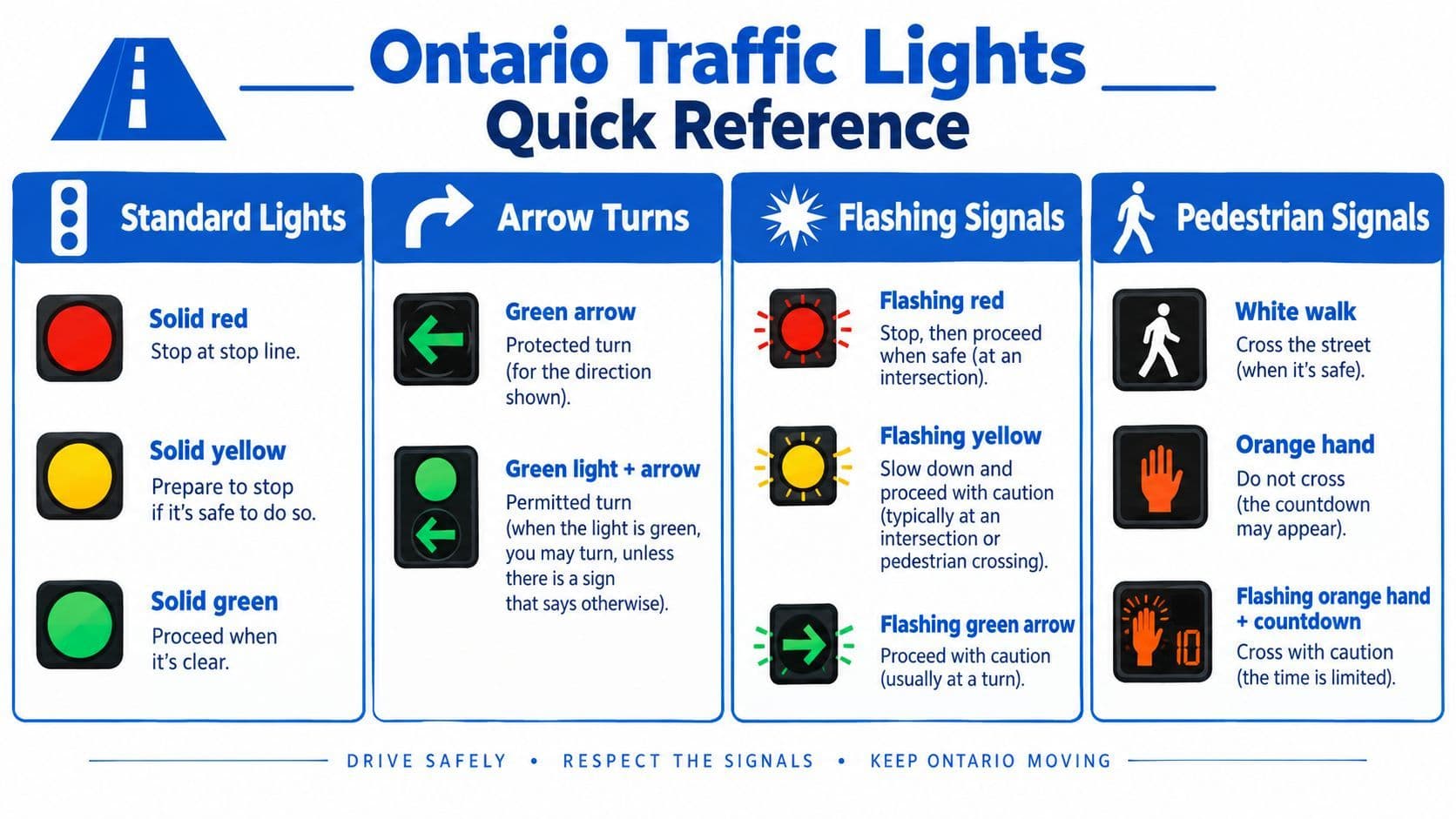
For G1 preparation, review the traffic-light and pedestrian-signal material in the Ontario Official Driver's Handbook, then practise targeted questions rather than only broad mock tests. Focus on permitted left turns, red right turns, flashing signals, pedestrian priority, and arrow indications. These questions often test the action required in a specific situation, not simple colour recognition.
A driving lesson at a busy signalised intersection in your municipality adds the practical layer that book study cannot provide. Ask the instructor which signal controls each lane, where the stop line sits, and how to scan for pedestrians before moving.
G1ready.ca offers free, registration-free practice exams, targeted traffic-regulation quizzes, mixed tests, diagnostic practice, and a G1 exam simulator with immediate explanations and progress tracking. Visit G1ready.ca to practise Ontario traffic-light questions on a phone, tablet, or desktop and turn uncertain intersection decisions into a clear study routine.


