
You're heading home after sunset on a road you know well, but the road doesn't feel the same in the dark. Lane markings fade, headlights from the other direction hit your eyes, and a pedestrian or animal can appear much later than you expect. For a new G1 driver, that's the test, not just steering well, but making smart choices before you even turn the key.
Mastering the Dark: A Guide for Ontario's New Drivers matters because night driving isn't just “driving with less light.” Safety research shows the risk changes sharply after dark, and the gap between how much people drive at night and how many deaths happen at night is large National Safety Council night driving safety data. Ontario learners should treat that as a cue to slow down, scan harder, and build habits that line up with what the G1 test expects: hazard awareness, safe following distance, legal lighting use, fatigue management, and defensive decision-making.
These night driving tips are written for new Ontario drivers who want practical rules they can use. They also connect directly to G1 study, because the exam doesn't just test memorized signs and rules, it tests whether you understand how to drive safely when visibility drops and judgement matters more. Use this as a quick study guide and a real-world checklist.
1. Adjust Your Headlights Properly
Bad headlight aim makes night driving harder than it needs to be. If your low beams point too high, you waste light and bother other drivers. If they point too low, you shrink the distance you can see.
For a G1 driver, the lesson is straightforward. Your headlights are part of your safety margin, and your test knowledge should include when to use low beams, when high beams help, and why “the lights are on” is not enough proof that you can see far enough ahead. A university safety resource says you should never drive so fast that you cannot stop within the distance illuminated by your headlights, and it notes that this visible stopping distance is no more than 350 feet for most vehicles on high beams, with less distance in poor weather university operations night driving guidance.
Practical rule: if your load changes, your beam angle may change too. A full trunk, passengers in the back, or a heavy item in the cargo area can alter where the light falls.
A clean, aligned setup matters just as much as brightness. Keep the lenses clear of dirt and condensation, and test the light spread in a safe, empty area before you head out at night. If the beam pattern looks uneven or you are unsure about adjustment, have it checked professionally instead of guessing.
The G1 connection is direct. You are expected to understand how to keep enough sight distance to respond to hazards, and properly aimed headlights are part of that foundation. A good beam pattern can mean seeing a hazard early instead of seeing it too late on a dark stretch of Ontario road.
2. Reduce Speed and Increase Following Distance
Night driving rewards patience. At night, your eyes need more time to read the road, and that means your speed has to match what you can see, not what feels normal in daylight. The Smart Driving Academy's night-driving visibility guide recommends increasing following distance by 50–100% at night, because low-beam headlights shorten usable sight distance Smart Driving Academy visibility guide.
That advice lines up neatly with the G1 mindset. Safe driving isn't just staying within the limit, it's choosing a speed that gives you room to react. On an unfamiliar road, especially in the dark, hazards don't announce themselves early.
A good habit is to use the 4-second rule behind the car ahead, then stretch it further if the road is wet, snowy, or poorly lit. If traffic is light, there's no prize for staying close. On rural Ontario roads, extra space gives you time to spot wildlife, potholes, or a vehicle turning slowly from a driveway.
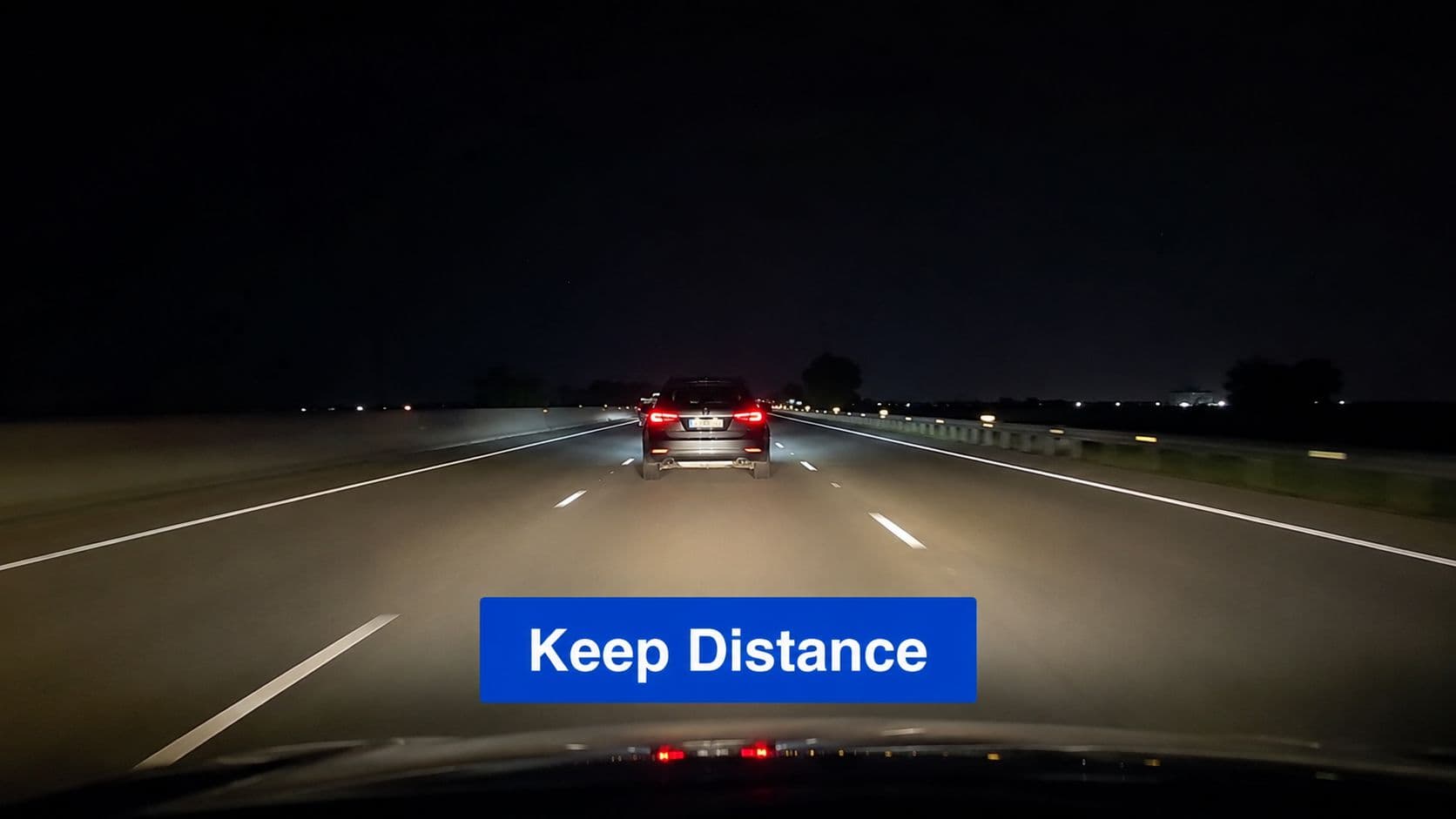
Slower is not timid at night, it's accurate.
The G1 test expects you to understand defensive spacing and speed control, and night driving puts both under more pressure. If you're tired, unfamiliar with the route, or driving in winter conditions, slow down before the road forces the decision for you. For more defensive-driving study support, use G1ready's defensive driving guide alongside your road practice.
3. Clean and Maintain All Vehicle Lights
Night safety starts with the lights other people see. Headlights, taillights, brake lights, turn signals, and fog lights all matter, because one failed bulb can change how clearly your vehicle communicates in traffic. If a light is out, other drivers don't get the signal you thought you gave them.
This is also a maintenance habit G1 learners should learn early. You don't need mechanical expertise to do a basic walk-around, but you do need the discipline to check your car before a night trip. A dirty or oxidized lens can cut into light output, and a dead bulb can leave you invisible from behind.
Use a simple routine:
- Check every exterior light monthly: Make it part of your regular car habit, especially before evening highway driving.
- Have someone watch the signals: Ask a parent, friend, or instructor to confirm brake lights and turn signals are working.
- Clean the lenses properly: Remove grime, salt, and road film so the light can reach the road.
- Replace faulty bulbs promptly: Don't wait until the next trip.
- Schedule seasonal checks: Winter slush and salt are rough on lights and visibility.
A vehicle with working lights doesn't just help you see, it helps everyone around you predict your moves. That's a major part of defensive driving, and it's fair game for G1 study because it connects directly to safe operation, signalling, and night visibility. If your vehicle's lights are inconsistent, treat that as a serious warning, not a minor annoyance.
4. Minimize Glare and Manage Dashboard Brightness
Glare can ruin otherwise careful night driving. Bright interiors fight your eyes' ability to adapt to darkness, and oncoming headlights can make you tense, blink, and look away at exactly the wrong time. The fix isn't fancy, it's disciplined light control inside the car.
Start with the dashboard. Keep it at the lowest comfortable brightness so you can read the gauges without turning the cabin into a mini showroom. Turn off unnecessary interior lights, and keep the cabin dark enough that your eyes stay focused on the road, not on glowing reflections in the glass.
A few practical adjustments help a lot:
- Dim the dash first: Keep only enough light to read speed and warning indicators.
- Kill cabin glare: Turn off dome lights unless you need them.
- Angle mirrors to reduce reflection: Small mirror adjustments can cut glare without losing awareness.
- Look where you want to go: Focus on lane markings and the road edge, not directly into oncoming headlights.
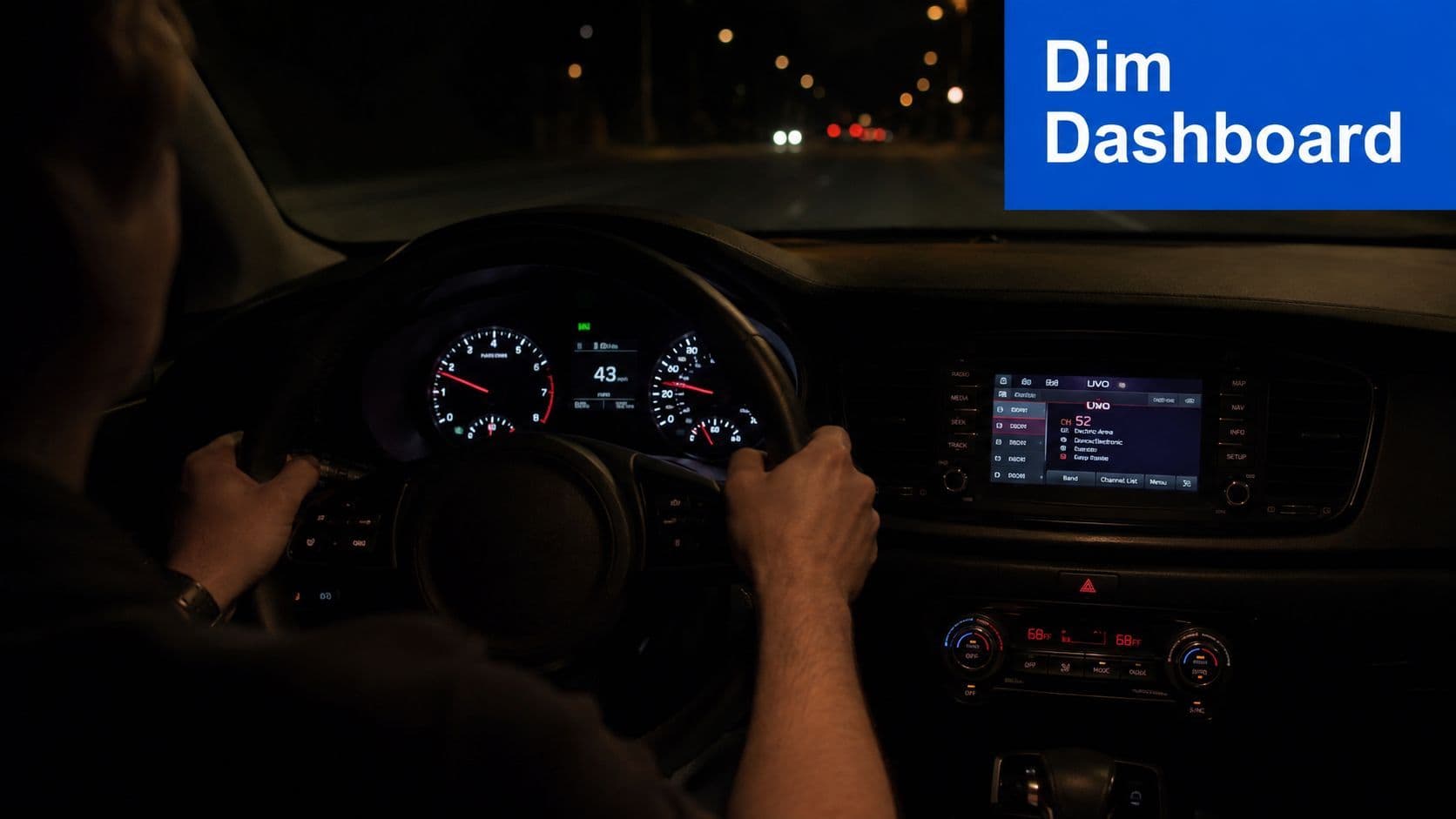
Your eyes need time to settle into darkness. Give them that chance before you start a night trip, and don't keep flipping on bright interior lights once you're moving.
This matters on the G1 test because it's part of broader hazard awareness and vehicle control. A driver who manages glare well is less likely to panic, overcorrect, or miss something important on the roadside. If you wear glasses, keep them clean and in good shape too, because scratched lenses make glare worse.
6. Use High Beams Strategically and Courteously
A dark rural road can make low beams feel weak, especially when there are no streetlights and the edge of the road disappears into blackness. That is the moment to use high beams with judgment, not habit. They give you more reach, more time to spot a pedestrian, animal, or curve, and that extra view matters before you commit to a turn or lane change.
Use them only when the road is clear ahead. Switch back to low beams as soon as another vehicle is approaching or you catch up to traffic in front of you. High beams can wash out another driver's vision, and if you leave them on too long, you create the very hazard you were trying to avoid.
Weather changes the rule fast. Rain, snow, and fog reflect light back toward the windshield, so high beams can make the scene harder to read instead of easier. In those conditions, low beams usually give you better contrast and less glare.
For G1 learners, this topic sits right at the point where courtesy and judgment meet test knowledge. The Ontario test expects you to know when to use high beams, when to dim them, and when they are the wrong choice altogether. That includes residential streets, traffic, and any situation where another road user is close enough to be affected by your lights.
On a practical level, the decision is simple. If low beams give you enough visibility, stay with them. If the road is empty and unlit, high beams can help you see farther. If you are preparing for a road test, the same judgment applies on practice routes and on the G1ready Woodstock drive test guide, where smooth light control is part of showing safe, predictable driving.
6. Use High Beams Strategically and Courteously
High beams are useful, but only when the road conditions support them. On unlit roads, they can extend what you see far enough to give you more time to react. The Smart Driving Academy guide notes that high beams can restore the stopping-distance margin lost on low beam above 60 km/h, which makes the speed and visibility relationship very clear Smart Driving Academy visibility guide.
The catch is simple. High beams can also blind other drivers, so they need to come off early enough. Keep them for dark stretches with no oncoming traffic in view, and switch back to low beams before you meet another vehicle. In rain, snow, or fog, low beams are usually the safer choice because high beams can bounce light back at you and reduce contrast.
Use high beams to expand vision, not to dominate the road.
For G1 learners, this is a high-value topic because it combines courtesy, judgment, and legal awareness. You're not just learning a switch on the stalk, you're learning when visibility improves and when it gets worse. On residential streets, in traffic, or when following another car, high beams are usually the wrong call.
Think of it this way. If you can see the road clearly with low beams, stay there. If the road is empty and unlit, high beams can help. If another driver is coming, or the weather turns rough, bring them down quickly and keep everyone's vision intact.
7. Maintain Proper Vehicle Maintenance for Night Safety
A well-maintained car handles night driving better because it gives you more predictable control. Worn wipers smear rain across the windshield, weak brakes stretch your stopping response, and tired tires lose grip when the pavement is slick. At night, those problems are harder to compensate for because you already have less visibility to work with.
Ontario learners often focus on the driver side of safety and forget the vehicle side. That's a mistake. Your car needs to be ready for darkness, wet roads, and cold weather, especially if you're driving through fall or winter. Fresh wiper blades before wet weather, good tire tread, healthy brakes, and a reliable battery are all part of night readiness.
Use this maintenance mindset:
- Check tires before the season changes: Good tread helps when roads are wet or slushy.
- Inspect wipers before rain and snow: Visibility falls fast when blades streak.
- Watch the battery in cold months: Night trips are a bad time for electrical surprises.
- Keep jumper cables and a flashlight in the car: Small prep can save a major headache.
- Follow the owner's manual: Scheduled maintenance is part of safe driving, not optional upkeep.
For Ontario learners preparing for road tests, G1ready's Woodstock drive test guide is a useful companion to the practical side of vehicle readiness. The G1 test rewards drivers who understand that safe driving includes the condition of the car, not just the skill of the person behind the wheel.
8. Anticipate Hazards and Adjust Expectations for Reduced Visibility
Night driving changes what counts as “normal.” You can't assume a clear road just because you can't see a hazard yet. Pedestrians in dark clothing blend into the background, animals can move suddenly, and potholes, debris, or parked vehicles can appear late enough to limit your options.
That's why your scan has to widen. Don't stare only at the centre of the lane. Check the edges, the shoulders, driveways, and shadowed areas near intersections. Rural roads, unlit corners, and hills all deserve extra caution because they hide more than they reveal.
The G1 mindset matters most. The test is built around safe judgement, and judgement at night means accepting that you don't have full information. If you're approaching an unlit intersection, slow down before you get there. If you're near late-night businesses or bar areas, expect pedestrians. If you're in an area you don't know well, assume the road may present more than what your headlights show.
Don't drive as if the visible road is the whole story. At night, it usually isn't.
Practice on familiar roads first. That gives you a cleaner way to learn how your headlights, mirrors, and speed feel in darkness before you add the pressure of a new route. If you want to sharpen hazard recognition and learn safer judgement patterns, a defensive driving course can be a smart next step, especially for a first-time Ontario driver.
8-Point Night Driving Tips Comparison
Item Complexity 🔄 Resources & Effort ⚡ Expected Effectiveness ⭐ Ideal Use Cases 💡 Key Advantages / Impact 📊 Adjust Your Headlights Properly Low, simple DIY adjustments; pro check for precision Minimal time/cost; occasional professional alignment ⭐⭐⭐⭐, greatly improves forward visibility and reduces glare Night highways, carrying heavy loads, after suspension changes Better road illumination; fewer night collisions; legal compliance Reduce Speed and Increase Following Distance Low, behavioral change; requires discipline No monetary cost; increases travel time ⭐⭐⭐⭐⭐, high reduction in collision risk and stopping distance Unfamiliar roads, rural/unlit routes, poor weather More reaction time; reduced crash severity; safer margins Clean and Maintain All Vehicle Lights Low–Medium, routine checks; some professional replacements Low cost; monthly checks; keep spare bulbs ⭐⭐⭐⭐, restores illumination; ensures signaling and legality Older vehicles, pre-night-trip checks, winter months Improved visibility to others; prevents fines; reliable signaling Minimize Glare and Manage Dashboard Brightness Low, adjust settings and mirror position; optional upgrades Minimal time; possible cost for coatings or tinting ⭐⭐⭐, reduces eye strain and aids dark adaptation Long night shifts; drivers sensitive to glare; urban night driving Reduced fatigue; better night vision; fewer headaches Stay Alert to Fatigue and Plan Regular Breaks Medium, requires planning and self-monitoring Time cost for breaks; minimal monetary cost ⭐⭐⭐⭐, significantly lowers drowsiness-related crash risk Long-distance night trips, shift workers, solo drivers Fewer drowsy-driving incidents; improved attention and decision-making Use High Beams Strategically and Courteously Low, habit-based; requires attentiveness No cost; attentive switching when needed ⭐⭐⭐⭐, greatly extends visibility on unlit roads if used properly Rural/unlit roads with no oncoming traffic Earlier hazard detection; increased wildlife awareness; no equipment cost Maintain Proper Vehicle Maintenance for Night Safety Medium, scheduled mechanical checks and parts replacement Moderate cost/time; professional service often needed ⭐⭐⭐⭐, ensures reliable lighting, braking, and traction Seasonal prep, pre-long-trip inspections, winter driving Prevents mechanical failures; consistent performance; peace of mind Anticipate Hazards and Adjust Expectations for Reduced Visibility Medium–High, continuous vigilance and cognitive adjustment No monetary cost; mentally demanding; practice required ⭐⭐⭐⭐, improves hazard recognition and avoidance Unlit rural areas, areas with pedestrians/animals, unfamiliar routes Fewer surprise hazards; stronger defensive driving; reduced claims
Your Checklist for Confident Night Driving
Safe night driving is built, not guessed. You build it by checking your lights, setting your speed for the conditions, managing glare, and staying honest about fatigue before it becomes a problem. You also build it by understanding that your car and your environment both change after dark, so your habits need to change with them.
If you're preparing for the G1 test, these habits aren't extras. They're the practical side of the same knowledge the exam is trying to confirm, that you can read risk, use your vehicle properly, and make safe decisions when visibility drops. That's why night driving practice matters even before you're fully licensed, because the best drivers don't just know the rules, they know when the road demands more caution.
Keep this guide close and use it before every evening trip. Check the headlights, clean the lenses, dim the dash, leave more space, and slow down sooner than you think you need to. When in doubt, treat the dark like a higher-risk driving environment, because that's exactly what it is.
G1ready.ca gives Ontario learners a practical way to build the same judgement these night driving tips rely on, with free practice exams, targeted quizzes, and full G1-style simulations that match the handbook. If you want to turn tonight's safety habits into test-day confidence, visit G1ready.ca and start practising with a tool built for Ontario drivers.


