

You've got the G1 pass in hand, the road-test date is getting closer, and now the big question is simple. What can you do once you hold a G2 licence in Ontario, and how do you avoid the mistakes that trip people up after the test is over?
That mix of excitement and uncertainty is normal. One moment you're preparing for the examiner, the next you're thinking about solo drives, highways, passengers, and the rules that still apply when you're no longer a learner. A clear plan helps, especially when each practice step lines up with what Ontario expects on test day and on ordinary Tuesday errands.
Use this guide like a patient driving instructor beside you in the passenger seat. It connects test prep, everyday G2 rules, and the kind of habits that make driving feel calmer and safer. It also points you toward practice routines that match those stages, so you can build confidence without guessing what to study next.
Introduction to G2 in Ontario
A G2 licence is the moment your driving starts to feel real. You are no longer only showing that you can memorize road rules, you are proving that you can apply them while driving on your own, without a supervising driver beside you. That matters in everyday life, whether you are running errands, giving a family member a ride, or planning a trip that includes faster roads.
What G2 really changes
Ontario treats G2 as a full licence stage within the graduated system, not just another classroom step. The province says G2 drivers can drive on their own and operate Class G motor vehicles, with vehicle-class limits such as no air-brake vehicles under G2 (Ontario Regulation 340/94). In simple terms, G2 gives you real independence, but that independence still sits inside a set of rules that guide how, when, and where you drive.
A lot of learners expect G2 to feel like “almost G1,” then realize it works differently. It is a separate stage with its own privileges and its own limits. That affects everyday decisions, like who can ride with you, whether your vehicle fits the trip, and how carefully you need to drive when traffic gets heavy.
Practical rule: G2 is the point where your mistakes affect you alone first, then everyone else in the car. That is why scanning ahead, keeping a steady speed, and using seatbelts properly matter so much.
Clear rules lower the stress. Once you understand what G2 allows, what it restricts, and how examiners judge your driving, practice stops feeling vague and starts feeling manageable. Focused preparation helps here, especially topic-based study and test-style drills that connect directly to the driving habits you need on test day and on ordinary streets.
Understanding G2 Licence and Privileges
A learner's first real surprise often comes after the G1 stage. G2 feels like the moment you are finally driving on your own, yet you are still working inside rules that shape how safely and how predictably you use that freedom. The licence is the bridge between supervised practice and full independence.
Ontario lets G2 drivers drive alone and on Ontario roads, including highways, because the G2 stage removes the G1 requirement for a fully licensed accompanying driver (G1ready.ca guide). That includes 400-series highways and other provincial highways, which catches many learners off guard because they expect a new driver stage to stay limited to local streets. G2 does not keep you off faster roads, it asks you to meet the rules that make those roads manageable.
Where drivers often get confused
Highway access is one of the clearest signs that G2 is a real licence stage. A new driver may assume “solo licence” still means short neighbourhood trips only, but Ontario's framework allows more than that. If your route to school, work, or a weekend visit includes a highway, G2 is the stage where that becomes legal, as long as the rest of the driving rules are followed.
Highway permission does not mean highway comfort. A trip can be legal and still be a poor match for your current skill level.
That distinction matters because the licence and the driving skill are not the same thing. Merging, lane position, spacing, and steady speed all become part of your responsibility the moment you use those faster roads. Learners who prepare with G1ready.ca modules often do better when they connect each lesson to a real task, such as a highway merge, a left turn across traffic, or a lane change in heavier flow. If you want the booking step later, the G2 road test booking guide shows how that part fits into the process.
Everyday life with a G2 licence
The simplest way to understand G2 is through ordinary trips. A solo commute to work, a ride to class, or a family visit across town now falls within your driving privileges. The licence no longer has a supervising buffer, so each decision sits with you from the first start of the engine to the last parked stop.
Passenger limits and nighttime rules matter for the same reason. They are not random add-ons. They shape the situations where a newer driver is most likely to feel pressure, such as late-night rides with friends, a tired drive home, or a car packed with people who are talking while you are trying to concentrate. Those rules work like guardrails on a narrow road. They keep the trip within a range that G2 drivers are expected to handle.
Clear rules lower stress because they turn the licence into something concrete. Once you know what G2 allows, what it limits, and how examiners judge your driving, practice stops feeling vague and starts feeling manageable. Focused preparation helps here, especially topic-based study and test-style drills that connect directly to the habits you need on test day and on ordinary streets.
Eligibility and Timeline from G1 to G2
A learner often feels ready long before the calendar agrees. That is the main thing to watch with G2 in Ontario. Skill matters, but the licence follows a timeline, so the date on your G1 slip matters as much as the hours you spend practising. If you track the dates early, you avoid the common problem of feeling prepared but still not eligible to book.
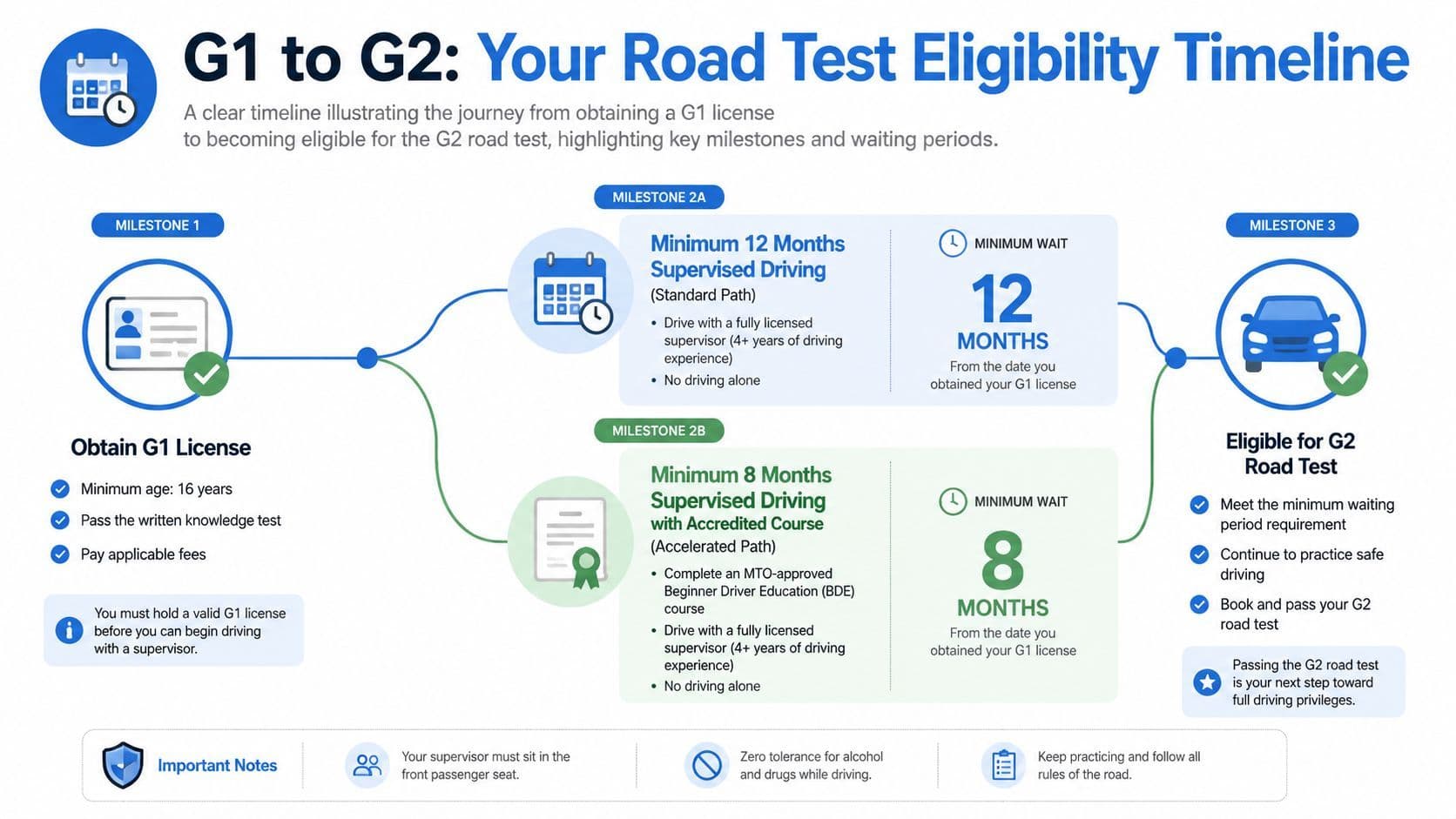
The two paths to eligibility
Ontario uses two main timelines for the move from G1 to G2. The standard waiting period is 12 months of supervised driving before you can take the G2 road test. If you complete an accredited driver-education course, that waiting period can drop to 8 months. The difference is straightforward, and it tells you which calendar you are following before you start planning the test itself.
That time gap is not just paperwork. It gives you space to practise the same real-world habits the road test expects, such as checking mirrors before a lane change, keeping your speed steady, and making smooth stops. A learner who knows the waiting rule can tie practice to a visible target instead of guessing. That makes each drive feel less random and more like part of a process.
A simple note on your phone or a paper reminder helps more than many new drivers expect. Write down your G1 issue date, your course completion date if you took one, and the first day you are eligible to book. Those three points are enough to keep the timeline clear when the dates start blurring together.
What to track while you wait
Use the waiting period as practice time with a purpose. Keep a small record of what feels easy and what still needs work. If low-speed turns feel awkward, or lane changes start to feel rushed in traffic, those are the habits to revisit before test day. That kind of note is like a checklist for your driving, it shows you where the weak spots still are.
- G1 issue date: Mark it right away so the waiting period stays clear.
- Course completion date: Keep proof if you completed an accredited class.
- Earliest booking date: Treat this as the first day you can book, not a day to hurry.
- Problem areas: Note what still needs practice, such as mirrors, lane position, or smooth stopping.
The Canadian Business Counts data is listed here, but it does not help with G1 to G2 eligibility, so it does not belong in your study plan. For this topic, the better habit is to track your own dates and driving progress with the same care you would use for any important appointment. Clear records remove guesswork.
Why the wait period matters
The waiting period exists so you can build comfort before the pressure of the test. Repetition turns basic actions into habits, and those habits matter when an examiner is sitting beside you and asking for steady, predictable driving. A route change or a parking manoeuvre feels less surprising when you have already practised the same skills in normal traffic.
That is where G1ready.ca modules fit naturally into the process. They help you connect the timeline to the kind of practice that matters on real roads, so the waiting period becomes preparation rather than idle time.
G2 Test Structure Scoring and Booking
A G2 road test rewards steady habits more than flashy moves. Examiners look for a driver who keeps the car under control, reads the road early, and makes decisions without sudden corrections. Those skills matter because they match the same routines you use once you are driving on your own.
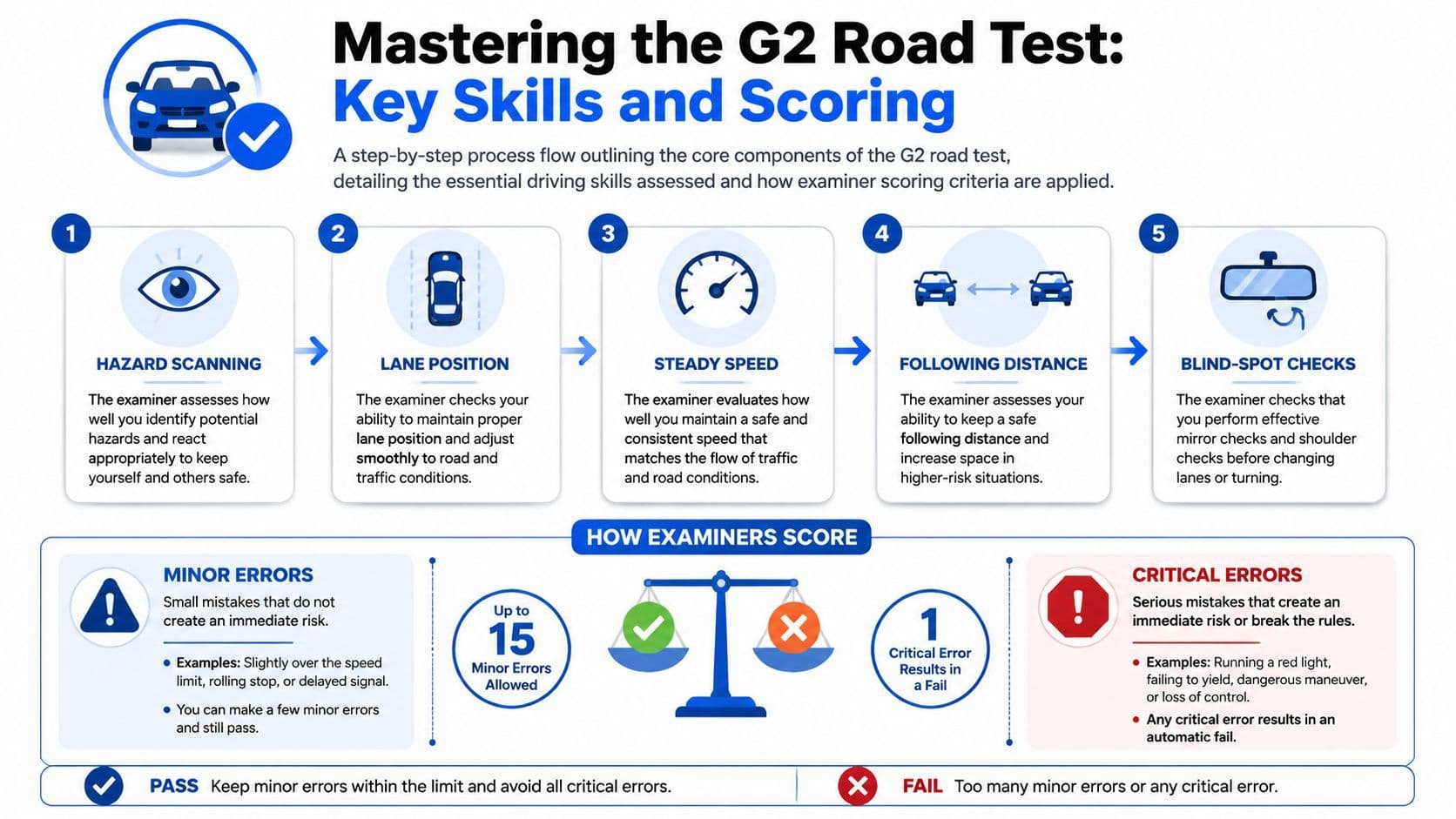
The skills examiners watch closely
Ontario's handbook puts G2 road-test focus on hazard scanning, lane position, steady speed, safe following distance, and blind-spot checks. It also guides drivers to look 12 to 15 seconds ahead and keep a 2 to 3 second following gap (Ontario Driver's Handbook). These are not classroom phrases. They are the same habits that help you notice a brake light, a changing lane, or a parked car before it forces a quick correction.
The order matters. Scan first, steer second, adjust speed third. If you are already reading traffic far enough ahead, the drive feels less abrupt because you are responding early instead of reacting late.
A still head can make a calm driver look uncertain. Keep your eyes and head moving naturally so the examiner can see that you are checking mirrors, traffic, and blind spots in a regular rhythm.
Booking your test without scrambling
Booking should feel like setting up a practical appointment, not like guessing your way through a form. Use the DriveTest system, choose a centre that gives you time to prepare, and avoid picking a date just because it is open. A clear booking plan works better than a rushed one.
If you want a guided walkthrough of the process, this G2 booking guide lays out the booking steps in a way that is easy to follow before you commit to a date.
Choose a time of day when you are usually calm, and pick a location where you can practise the same kinds of turns, stops, and lane changes you expect on test day. Leave room for one more practice drive before the appointment. That extra session often matters because the final polish is what turns nervous habits into reliable ones.
What the vehicle category means
Ontario's Class G2 lets you drive any Class G motor vehicle, including combinations with towed vehicles, except vehicles equipped with air brakes (Ontario Regulation 340/94). That wording shows the licence is tied to a real legal driving category, with clear vehicle limits instead of a vague training label.
The practical takeaway is simple. The test is checking whether you can drive predictably in normal traffic, not whether you can pull off dramatic manoeuvres. Smooth steering, good awareness, and lawful choices carry the drive.
Required Documents Fees and Test Day Checklist
Test day goes better when you stop treating it like a mystery. The right documents, a test-ready vehicle, and a calm arrival window remove most avoidable stress before you even get near the examiner. This is similar to checking a backpack before school, if you forget one important thing, the rest of the day gets harder fast.
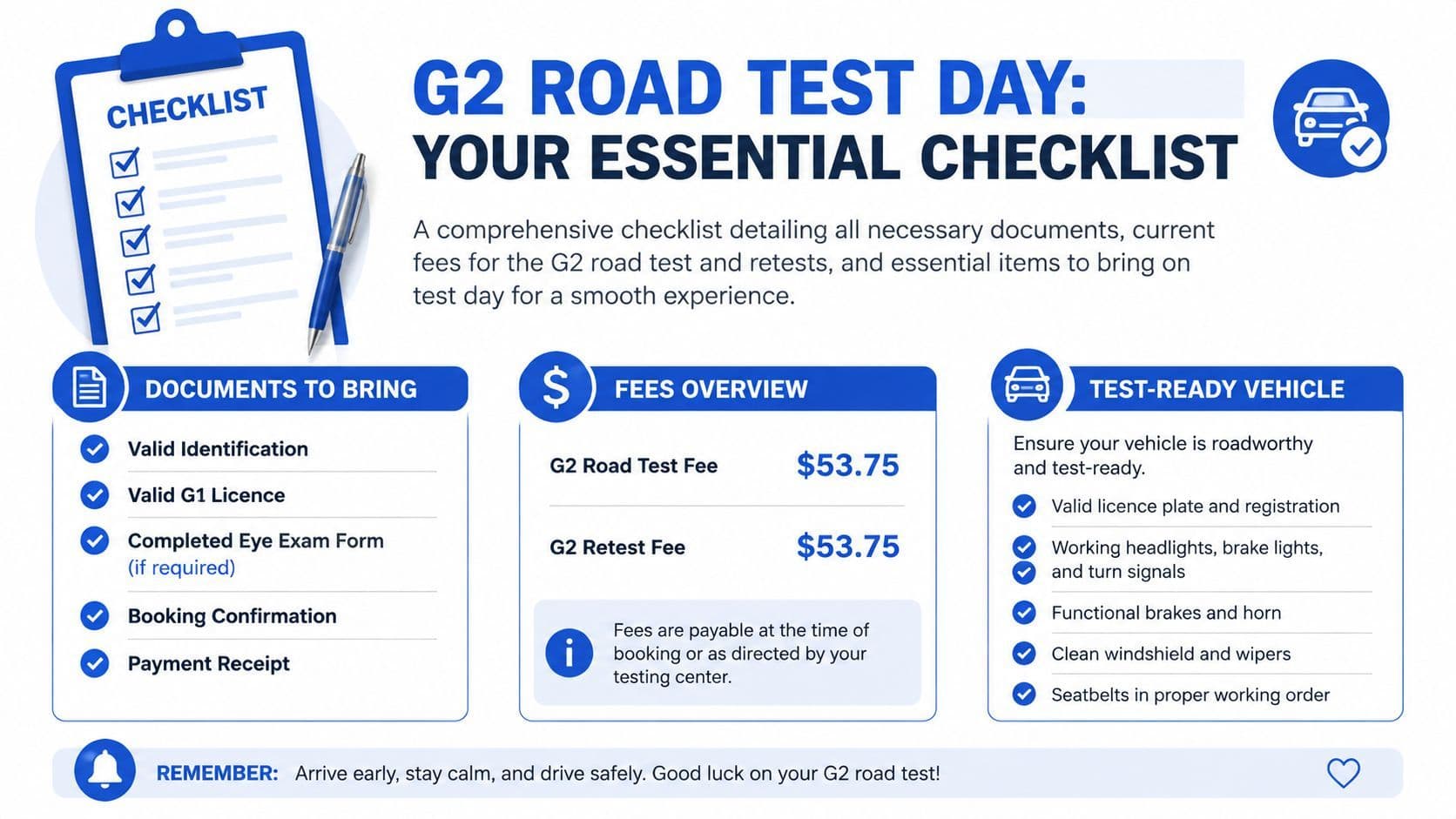
What to bring
Bring the items that prove your identity, your eligibility, and your booking. If something is missing, you can lose the attempt before the drive even starts.
- Valid identification: Make sure it matches the booking information.
- Valid G1 licence: You'll need this as your current licence.
- Completed eye exam form, if required: Don't wait until the last minute if you've been told to provide it.
- Booking confirmation: Keep the details easy to find.
- Payment receipt: Save proof in case there's a question at check-in.
Fees and payment
The G2 road test fee is $53.75, and the G2 retest fee is $53.75 (DriveTest fee details in the infographic brief). Those amounts are worth planning for in advance, because test nerves are much easier to handle when money isn't a surprise on the same morning.
Vehicle and personal readiness
Your car should be mechanically sensible, not perfect. Check lights, signals, and tires, and make sure the vehicle is clean enough that the examiner can move comfortably and see what they need to see. The point is to present a car that functions normally, not one that has you apologising before you start.
- Test-ready vehicle: Confirm that lights, signals, and tires are in working order.
- Clothing choice: Wear something comfortable that doesn't restrict movement.
- Arrival timing: Get there early enough to breathe and settle in.
- Mental prep: Take a few slow breaths before check-in and stop cramming new information on the way.
A calm candidate usually drives better than a frantic one. The route doesn't change because you're nervous, so your breathing and attention need to stay steady anyway.
Common Restrictions and Real-World Rules for G2
A G2 licence does not turn off the rules, it changes where those rules show up. The test is over, but now the decisions happen in real life, with passengers in the car, a route to plan, and evening driving that can bring extra limits into play. That is why post-test driving needs the same attention as test prep.
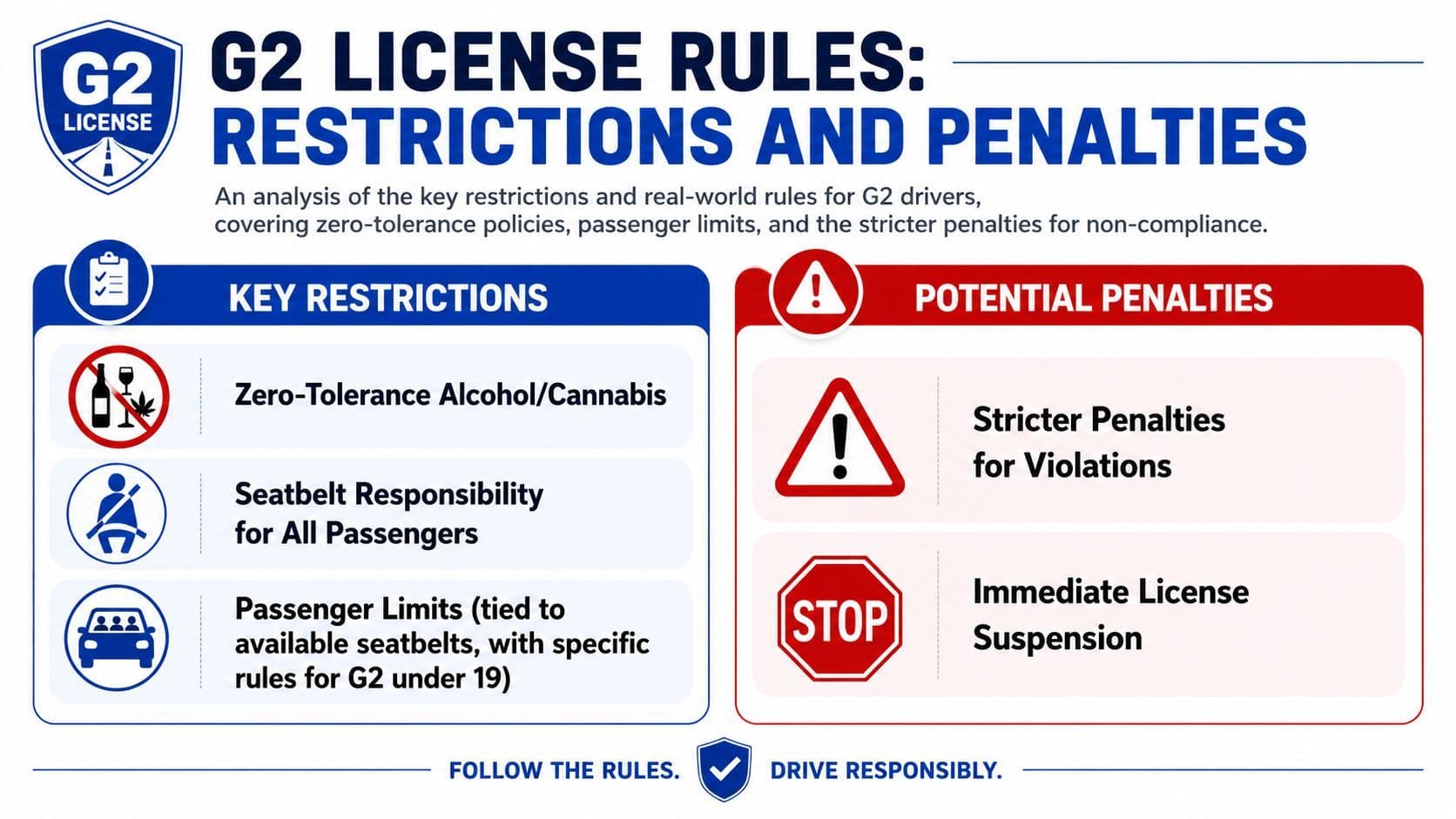
The restrictions that matter every day
Ontario G2 rules include a zero blood-alcohol requirement, a zero cannabis rule, and a seatbelt responsibility rule. The G2 driver must make sure passengers are belted, and the number of passengers cannot be greater than the number of working seatbelts in the vehicle. If the car has fewer usable belts than people, the trip plan has to change to match the car, not the other way around (Ratehub's Ontario G2 licence restrictions summary).
Drivers 19 or under have an extra limit during the night. Between midnight and 5 a.m., the passenger rule is stricter for the first six months after getting G2, when they may carry only one passenger aged 19 or under. After that, the limit rises to three passengers aged 19 or under (Ratehub's Ontario G2 licence restrictions summary).
These rules affect ordinary plans in ways learners sometimes miss. A ride home after an event, a highway trip with friends, or a food run with several passengers can all feel normal, yet still run into G2 limits. If the vehicle does not have enough working seatbelts, or if the late-night passenger rule applies, the plan has to be adjusted before anyone gets in the car.
The responsibility also sits with the driver, not the passengers. That is what makes G2 driving feel different from practice driving with an instructor. You are expected to watch occupancy, watch for impairment risk, and check seatbelts as part of normal driving, the same way you would watch mirrors and signals before making a lane change.
If the trip only works by bending the rules, it is the wrong trip for that time and driver.
A highway rules guide for G2 drivers helps connect those legal limits to real planning choices, especially when a route includes highway driving and more than one possible passenger arrangement.
Common Fail Reasons and Remedial Tips
Most G2 mistakes come from rushing the basics. People fail because they drive as if the examiner is judging the destination, when the examiner is really watching how the car is controlled from moment to moment. If your habits are choppy, the test will feel choppy too.
The errors that show up again and again
Improper scanning is one of the fastest ways to look unready. If you glance only forward and forget mirrors, blind spots, or cross-traffic, the examiner can't see a driver who's building safe awareness. Jerky speed control causes the same problem, because sudden acceleration or braking suggests you're reacting late rather than staying ahead of the traffic flow.
Unsafe turns and late shoulder checks are another common issue. The turn itself might be technically legal, but if the car drifts, the speed changes too sharply, or the blind spot isn't checked properly, the drive loses the smoothness examiners want.
How to fix those habits
- Practice smoother steering: Keep both hands calm on the wheel and avoid over-correcting.
- Hold a steady pace: Choose a speed that matches the road and keep it there instead of constantly nudging up and down.
- Build a scan routine: Mirror, mirror, blind spot, road ahead. Repeat it until it feels automatic.
- Use quiz-based review: Simulator-style drills help you recognise weak areas before they become test-day surprises.
You can also practise with a passenger who knows how to give calm, specific feedback. Ask them to watch for scanning, not just for whether you stayed in the lane. That turns a ride into useful coaching instead of general encouragement.
After a failure, don't scatter your practice
A failed attempt doesn't mean you need to start over mentally. It means you need to isolate the weak skill and drill it directly. If scanning was the issue, work on scanning. If turns were messy, practise turns in quieter traffic until your steering feels less rushed.
Keep the feedback specific. “Drive better” doesn't help much. “Check the left blind spot before every lane change” does. That kind of clarity makes the next attempt more likely to feel familiar instead of frightening.
Targeted Study Resources and Next Steps
A learner who only rereads notes can still miss the part that matters on test day, which is how the rule works in motion. Ontario's G2 road test checks judgement as much as memory, so the right practice tool should show you where your answers, and your driving habits, need work. If practice feels like guessing, it is a sign that the rule has not yet become a habit.
What to use in practice
The most useful study tools are the ones that make patterns obvious. Diagnostic quizzes show what you miss, topic-specific drills tighten weak areas, marathon practice builds stamina, and a 40-question simulator gives you a test-style run that feels close to the actual test. The value is not only in answering questions, it is in reading the explanations after each mistake so the correction sticks.
A structured option is G1ready.ca practice tests, which can help you rehearse the material in a repeatable way. That kind of practice works like a driving lesson for your study time, because it shows whether you understand the rule or only recognise it after reading the answer.
What happens after you pass
Ontario's official handbook says G2 drivers can drive on their own, but they still have to follow restrictions such as the zero-alcohol requirement, seatbelt compliance, and careful turning and traffic-check rules (Ontario official driver's handbook). Passing changes your role from supervised learner to solo driver, but it does not remove the habits the road test was measuring.
The goal after passing isn't freedom without structure. It's freedom with habits you can trust.
The easiest way to understand this stage is to treat each rule as a real-world driving habit, not a test-only fact. The zero-alcohol rule is part of every trip, seatbelts are part of every ride, and the scanning and turning habits you used on test day still matter in normal traffic. Late-night passenger limits and highway privileges also fit into that same pattern, because each one shows how the licence changes your driving situation without changing the need for judgment.
After that, your next milestone is the full G licence, which brings you closer to unrestricted driving. Until then, keep your routines simple, keep your scanning active, and be honest about the roads and conditions you choose. That is how G2 becomes a stable stepping stone instead of a stressful middle stage.
If you want practice that matches Ontario's licence stages, use G1ready.ca to work through targeted quizzes, realistic test simulations, and review tools that help you spot weak areas before test day. A few focused sessions can make your G2 prep feel much more organised, and that confidence carries into the car when it counts.


