For Drivers Ed Milton, you're probably in one of two situations right now. You're a teen staring at the Ontario licensing process and wondering where to start, or you're a parent trying to make sense of classes, test rules, fees, and booking headaches before your child gets overwhelmed.
That feeling is normal. In Milton, the process can seem more confusing than it should be because local searches often mix up driving schools, test centres, and licence steps. A lot of broad Ontario guides explain the rules, but they don't answer the local questions people in Milton have, like where to take the test when the town doesn't even have its own DriveTest Centre.
This guide is built for that exact moment. It gives you a practical local roadmap, from choosing a school to preparing for the written test and planning the trip to Oakville or Burlington. If you're already wondering where the nearest test sites are, this quick guide to Ontario G1 test locations near Milton is a useful starting point.
Your Local Guide to Getting Your License in Milton
A typical Milton family often starts the same way. Someone types "drivers ed milton" into Google, opens a few tabs, and quickly ends up with more questions than answers. Is that the name of a school? Which course is approved? Do you write the test in Milton, or somewhere else?
The answer is that the local process is manageable once you separate it into pieces. First, you need to understand how Ontario licensing works. Then you choose a school if you want formal training. After that, you prepare for the G1 knowledge test, book the right location, and build a practice plan that fits Milton roads and your schedule.
Why Milton learners need a local plan
Milton has its own rhythm. Some learners spend most of their early practice time on quiet residential streets. Others need to get comfortable with busier corridors, rural routes on the edges of town, and trips into neighbouring communities for testing. A guide written for downtown Toronto or for Ontario in general won't always help with those day-to-day decisions.
That local gap matters most when parents assume every town has the same setup. It doesn't. In Milton, little details such as where you book, when you leave, and how you schedule lessons around school or work can shape the whole experience.
The smoother path usually isn't the one with the most information. It's the one with the clearest order.
A calmer way to approach the process
Think of the journey in four simple stages:
- Learn the system so the G1, G2, and full G stages don't blur together.
- Choose training that fits your timeline and comfort level.
- Prepare properly for the written test instead of cramming road signs the night before.
- Handle logistics early, especially test travel and booking.
Once you see it that way, Drivers Ed Milton stops feeling like one big mystery and starts feeling like a checklist you can work through.
What Is MTO-Approved Drivers Ed and Why It Matters
Not every driving course is the same. In Ontario, the phrase MTO-approved drivers ed usually means a Beginner Driver Education course that meets provincial standards. That approval matters because it affects how quickly a learner can move forward and how well prepared they may be when real driving pressure starts.
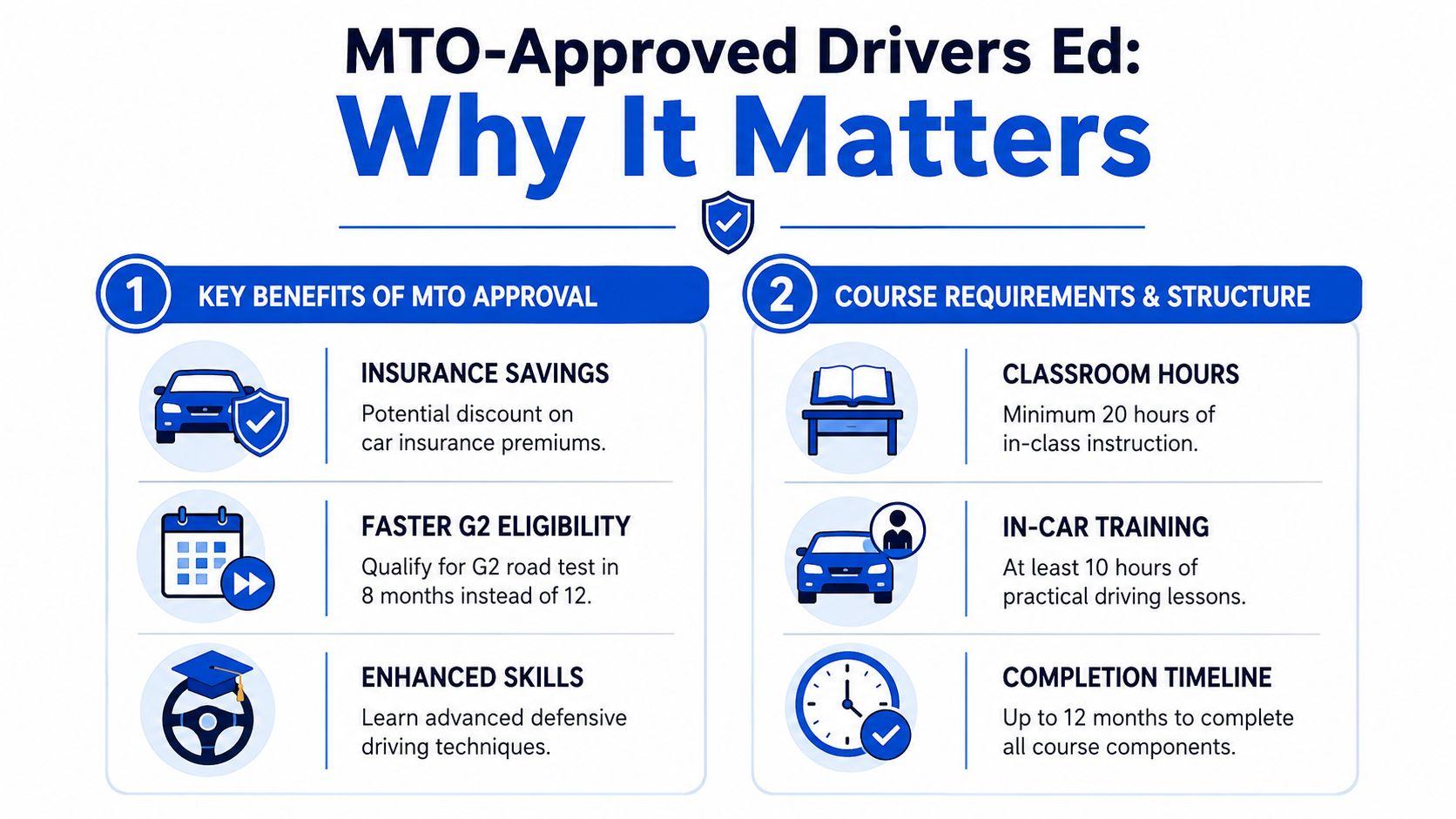
A big practical reason families choose an approved course is timing. Under Ontario's graduated licensing rules, a G1 driver normally waits 12 months before taking the G2 road test, but that wait can drop to 8 months with an approved school. That's one of the clearest benefits of formal training because it gives learners a structured route instead of leaving everything to last-minute family practice.
Why approved training changes the experience
The value isn't just about qualifying earlier. Good driver education gives a learner repetition, correction, and a routine. That matters because new drivers often don't know what they're missing. A parent might teach the basics well, but an instructor usually notices habits that families overlook, such as rolling stops, incomplete mirror checks, or late signalling.
There's also a measurable testing advantage. Students from MTO-approved schools pass the G2 test at a 78% rate, compared with 52% for learners who do not attend a driving school, according to this Ontario driving school summary. That gap doesn't mean school guarantees success. It does suggest that organised practice and professional instruction make a real difference.
For learners who want extra context around hazard awareness and skill-building, this overview of an Ontario defensive driving course is also worth reading.
What you're usually getting in the course
The approved course structure is fairly standard, and the core pieces are familiar to most families:
- Theory training helps learners understand signs, rules, right-of-way, and decision-making.
- In-car lessons turn that knowledge into habits under supervision.
- Completion standards give students a defined path rather than a vague plan to "get more practice later."
Practical rule: Drivers ed works best when the learner treats it as training, not as a shortcut.
Why this matters more than people think
A lot of new drivers assume the main goal is to pass the next test. That's too narrow. Driving school is really about lowering confusion early, building safer habits, and making the jump from classroom knowledge to real traffic less intimidating.
In Milton, where learners often move between suburban streets and busier regional routes, that structure can be especially helpful. It gives the student a steadier foundation before family practice starts to fill in the rest.
Navigating Ontarios Graduated Licensing System
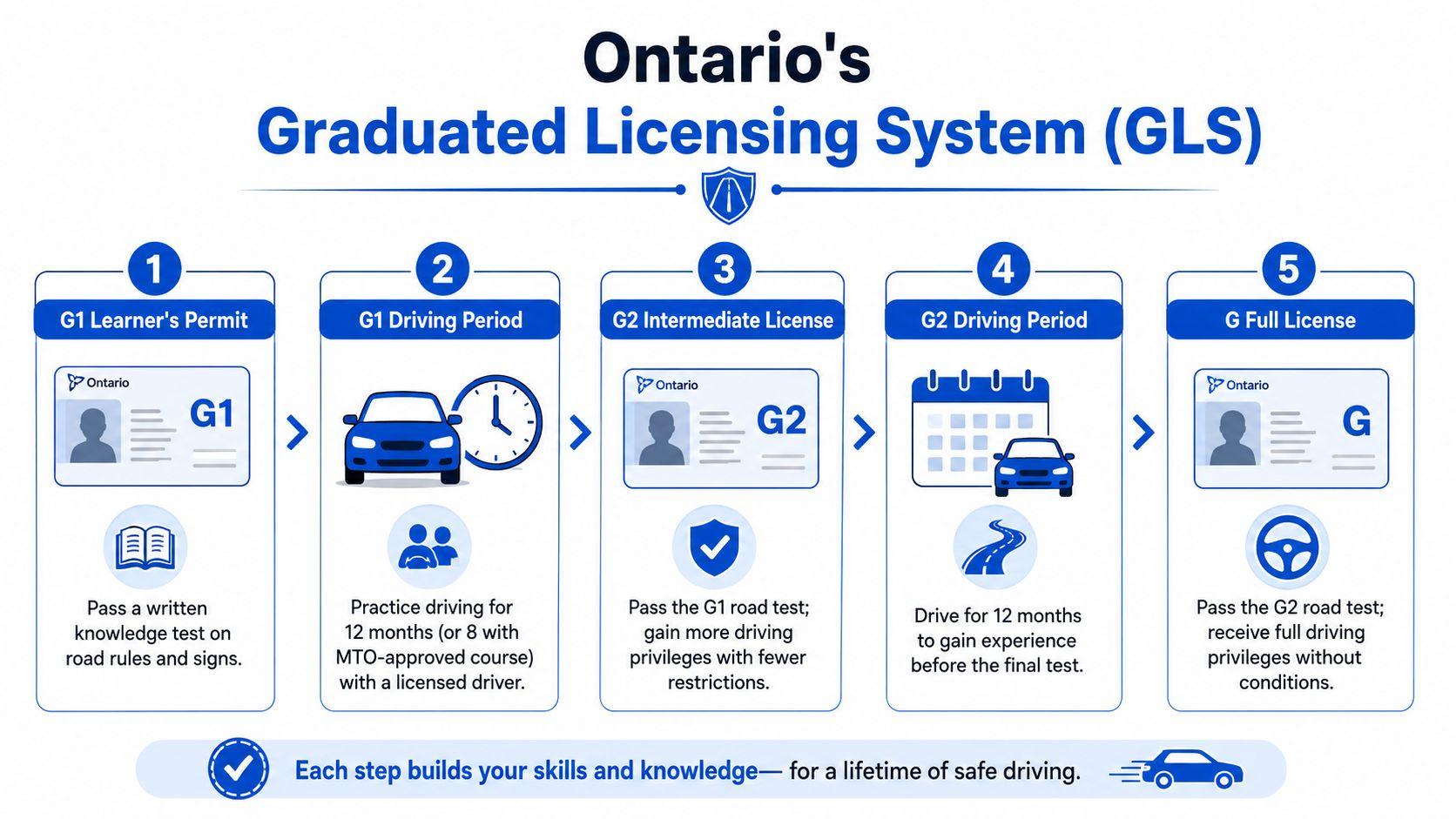
Ontario's licensing path is easier to understand when you stop viewing it as one long process and start seeing it as three separate licence stages. Each stage gives you more freedom, but only after you've shown that you can handle more responsibility.
A visual overview helps many learners keep the stages straight.
Stage one is the G1
The G1 is your learner's licence. You earn it by passing the written knowledge test and a vision test. Once you have it, you can start practising, but only under the rules that apply to learners.
The official G1 test has 40 questions and a 60-minute time limit, split into two sections of 20 questions each, as outlined in this Ontario G1 test explainer. That structure matters because you're not just trying to "do well overall." You're writing two distinct parts in one sitting.
If you'd rather hear the system explained visually, this walkthrough is helpful:
Stage two is the G2
After your G1 period, you move toward the G2. This is the stage where you start driving with more independence after passing the road test required for that upgrade. It often feels like the biggest confidence jump because the learner goes from supervised-only driving to much more personal responsibility.
The waiting period before that road test depends on whether you've completed approved driver education. Some families plan their entire first year around that difference, especially when the learner wants to be road-ready as soon as they're eligible.
Stage three is the full G
The full G licence is the final step. A driver reaches it after more real-world experience and a second road test. By then, the goal isn't just proving you know the rules. It's showing that you can drive smoothly, predictably, and safely in a wider range of situations.
A simple way to remember the path
Here's the cleanest way to think about the system:
Stage What you do What it means G1 Pass the written and vision tests You begin learning under restrictions G2 Pass the first road test after the required wait You gain much more driving independence G Pass the final road test You earn full driving privileges
Most stress comes from mixing up the stages. Keep asking one question: what do I need to do for the next licence, not the final one?
Where learners get mixed up
People often confuse the written G1 test with a road test, or they assume all milestones happen in the same town where they live. They also blur together the names G1, G2, and G because the labels are short and similar.
That confusion is normal. What helps is treating the process like a ladder. One step at a time. First the knowledge test. Then supervised practice. Then the first road test. Then more experience. Then the final road test.
Finding a Driving School in Milton
Drivers Ed Milton is frequently assumed to be the name of a school. It isn't, at least not in any publicly available local listing. There is no publicly available facility or program specifically named "Drivers Ed Milton" in Milton, Ontario. The primary accredited driving school in the area is Young Drivers Milton Driving School, which offers flexible driver education lessons, according to the Young Drivers Milton location page.
That one point clears up a lot of confusion. You're usually not looking for a single business called Drivers Ed Milton. You're looking for actual driving schools serving Milton.
Start with the real school names
Once you drop the generic search phrase and look for actual providers, the options become easier to compare. In Milton, families often come across names such as Young Drivers Milton Driving School and DriveWise Milton. The goal isn't to pick whichever one sounds most familiar. It's to compare how each school fits your learner's needs.
Some students want a traditional structure with a clearly paced program. Others need flexibility because of sports, shift work, exams, or family schedules. Parents should also check whether the school's communication style feels organised and easy to deal with. That part matters more than people expect.
What to compare before you enrol
Use a simple checklist when reviewing local options:
- Course format. Does the school offer online theory, in-person lessons, or a blend of both?
- Scheduling style. Can the student book weekday, evening, or weekend sessions?
- In-car availability. How quickly can lessons begin after registration?
- Local familiarity. Does the school appear comfortable teaching in Milton and nearby test-route areas?
- Communication. Do they respond clearly to questions from both parents and learners?
A good school doesn't just teach turns and parking. It gives the learner a repeatable routine and gives the family fewer surprises.
Avoid one common mistake
Many families choose a school first and think about test logistics later. In Milton, that's not ideal. Since testing doesn't happen in town, the best school choice is often the one that works well with your likely travel plan, your preferred lesson times, and your learner's comfort level on the kinds of roads they'll face outside Milton.
So when you compare schools, think beyond the brochure. Ask yourself whether this program fits the learner you have, not the perfectly calm, always-available student every parent wishes existed.
Drivers Ed Costs Enrollment and Scheduling Explained
This is the part families usually want in plain language. What do you pay first, what does the course include, and how does the schedule work when school, work, and sports are already packed?
The one fixed government cost you can plan for right away is the G1 package fee. As of 2025, the mandatory fee to take the G1 knowledge test, which also includes the vision test and issuance of the initial G1 licence, is $159.75 CAD, according to this guide to Ontario G1 test requirements. That payment is separate from whatever you pay a driving school.
What a course usually includes
Driving school packages vary, but the structure is usually built around theory instruction and in-car training. Before you sign up, ask for the full breakdown in writing so you know exactly what is included and what might cost extra later.
A few practical questions help immediately:
- What's part of the base package. Ask whether the quoted price covers theory, in-car sessions, and completion processing.
- How lesson booking works. Some schools let you book in blocks. Others release times gradually.
- What happens if you need to reschedule. Families often overlook this until a conflict appears.
How enrolment tends to unfold
Most students go through a simple sequence. They register, complete the theory portion, begin in-car lessons, and then wait for course completion to be recorded. The easiest path is the one where the learner starts theory promptly and the family doesn't delay booking in-car sessions.
A common issue isn't lack of motivation. It's drift. A student signs up, finishes part of the course, then lets weeks pass before scheduling the practical lessons. That can make the whole program feel longer and more stressful than it needs to be.
Scheduling in a way that actually sticks
The best schedule is the one your learner can maintain without constant battles at home. For some students, that means weekend driving with one weekday lesson. For others, short consistent sessions work better than long gaps followed by cramming.
You don't need a perfect calendar. You need a realistic one.
If a learner is busy and slightly nervous, simple scheduling usually beats ambitious scheduling.
Parents can help by choosing fixed windows for practice and course work. Keep it organised, but not punishing. The goal is steady progress, not burnout.
How to Prepare for and Pass Your G1 Test
For most learners, the G1 test feels bigger than it is. That's because it's the first official hurdle. Once you understand the format, it becomes far less intimidating.
The pass rule is straightforward. You must answer at least 16 out of 20 questions correctly in both the Rules of the Road section and the Road Signs section, which means a maximum of 4 wrong answers per section, according to this Ontario G1 passing guide. You can't make up for a weak score in one section by doing better in the other.
Don't study the handbook like a novel
A lot of students read the handbook from start to finish and assume that's enough. It helps, but it isn't the strongest method on its own. The written test asks you to recognise rules and signs accurately under time pressure, so active practice matters more than passive reading.
A better routine looks like this:
- Read in short blocks so the rules don't blur together.
- Practise by category such as signs, right-of-way, and penalties.
- Review wrong answers immediately so mistakes don't harden into habits.
- Finish with mixed practice that feels closer to the final test.
If you want a clearer sense of the kinds of questions learners work through, this collection of Ontario driving test questions gives a helpful overview.
Where learners usually slip
Road signs often feel easier at first, but small visual differences can trip people up. Rules questions can also be sneaky because the wrong options often sound almost right. That's why pattern recognition matters. You want to spot what the question is testing, not just what sounds familiar.
Two habits make a real difference:
- Slow down on wording. Questions about what you must do and what you should do aren't always asking the same thing.
- Study signs visually. Don't only memorise names. Match shape, colour, and meaning together.
Study reminder: If you're consistently missing one type of question, stop doing full mock tests for a while and repair that weak area first.
How to feel ready on test day
Confidence usually comes from repetition, not from one lucky practice score. By the time you go to write, you should feel comfortable switching between signs and rules without panicking.
The night before, don't try to relearn everything. Review your toughest categories, get rest, and arrive with the mindset that the test is checking whether you understand the basics well enough to begin supervised driving. That's a much smaller mountain than many learners imagine.
Essential Tips for Milton Learners and Parents
The biggest local issue isn't a tricky road sign or a confusing rule. It's logistics. Milton has no DriveTest Centre, so residents must travel about 30 to 40 minutes to Oakville or Burlington to take their G1, G2, or G tests, according to DriveWise Milton's local FAQ. A lot of frustration starts when families discover that too late.
That one fact changes how you should plan everything. You aren't just preparing for a test. You're preparing for a test day trip.
Build your test plan before the pressure starts
If you wait until the learner feels "almost ready," you're more likely to run into schedule stress. Start early. Decide which nearby centre makes the most sense for your family, how you'll get there, and what time of day gives you the calmest trip.
A simple pre-booking checklist helps:
- Choose your likely centre early. Pick Oakville or Burlington based on your household routine and comfort with the route.
- Drive the route in advance. That cuts down nerves on test day.
- Leave margin for traffic. Rushing before a knowledge or road test is one of the worst ways to start.
Practise like a Milton driver
Milton learners benefit from variety. If all practice happens in one quiet subdivision, the student may feel good until the road gets faster, wider, or busier. Parents should gradually expose learners to different conditions, including turns at larger intersections, lane changes on busier roads, and transitions toward surrounding regional routes.
The key word is gradual. Don't throw a nervous learner into the hardest drive of their life on day three.
What parents can do that actually helps
Parents don't need to act like examiners. They need to be steady coaches. Give one correction at a time, keep practice sessions focused, and avoid turning every drive into a lecture.
The learner usually remembers the tone of practice long after they forget the specific route.
If a session goes badly, end it, reset, and try again another day. Calm repetition beats tense overcorrection every time.
If you're getting ready for the written test, G1ready.ca is a practical place to practise with Ontario-focused G1 questions in a format that feels close to the actual exam. It's especially useful if you want a structured way to spot weak areas, build confidence, and walk into test day feeling prepared rather than guessing.