You're probably in the same place most new G1 drivers start. You know getting your licence matters. You also know the written test is the gatekeeper, and the advice you keep hearing is frustratingly simple: read the booklet.
That advice isn't wrong. It's just incomplete.
The driving test Ontario booklet matters because it's the source code for the exam. But source code alone doesn't help much if you never test whether you understand it. The people who struggle usually do one of two things. They either skim the handbook and assume they'll “figure it out,” or they grind through random practice questions and memorise patterns without learning the rule behind the answer.
A better approach is to pair the official handbook with deliberate practice. Read the rule, test the rule, review the mistake, then go back and fix the gap. That feedback loop is what turns the booklet from a stack of pages into a passing result.
Your First Step on the Road to a G1 Licence
You might start with mixed energy. You're excited to move toward independence, but the process can feel bigger than it should. There's the handbook, the test centre, the practice questions, the rules, the signs, and a lot of conflicting advice from people who took the test years ago.
Start by simplifying the whole thing. The first job isn't to study everything at once. The first job is to accept that the handbook is the foundation, then build a study routine around it. If you're still sorting out where you'll write the test, it helps to check Ontario G1 test locations early so the process feels real and organised.
What to focus on first
Don't begin by hunting for shortcuts. Begin by understanding what the G1 is asking you to prove. You're not being tested on whether you can recognise recycled online questions. You're being tested on whether you know Ontario road signs, rules, and basic safety expectations well enough to start as a learner.
A solid first step looks like this:
- Get the official handbook: This gives you the actual language and rules the test is built from.
- Choose a study format: Some learners retain more with paper and highlighting. Others do better with searchable digital notes.
- Break the workload down: Study signs and rules as separate jobs, because your brain handles them differently.
- Practice right away: Don't wait until you “finish the book” before checking what stuck.
Practical rule: If you can't explain a rule in plain language, you don't know it well enough yet.
The good news is that the G1 isn't a mystery. It rewards organised preparation. If you treat the booklet like your main reference instead of background reading, the whole path gets easier.
What Exactly Is the Ontario Driving Test Booklet
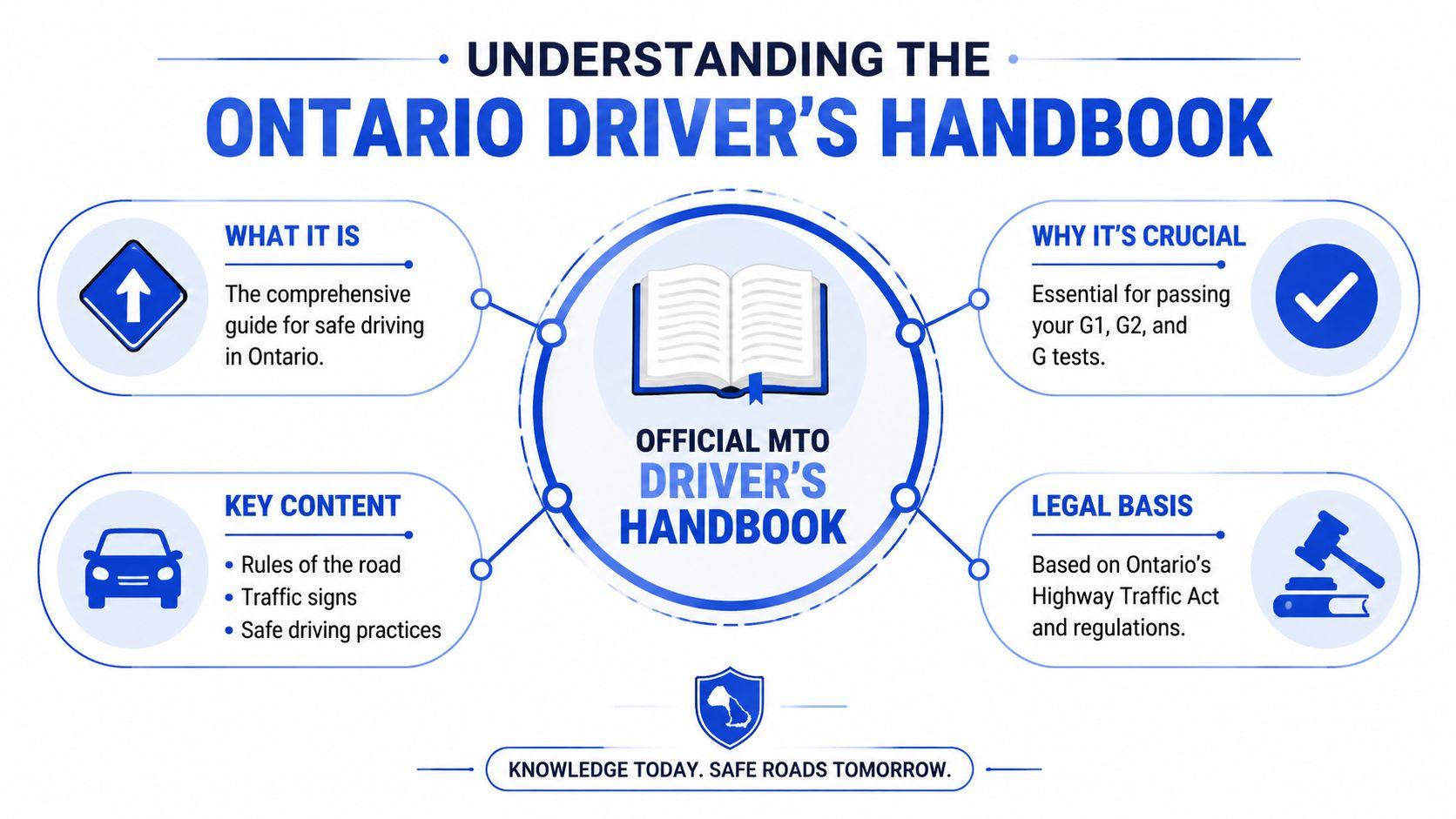
The phrase “driving test Ontario booklet” usually means the Official MTO Driver's Handbook. That's the book that matters. It isn't a summary, a cheat sheet, or a collection of guesses. It's the official rulebook for the knowledge test.
The biggest mistake I see is people treating third-party summaries as if they're interchangeable with the handbook. They're not. Helpful summaries can support studying, but they can't replace the official source because the test is built from that source.
Why this booklet matters so much
The G1 knowledge test consists of 40 multiple-choice questions split into two 20-question sections, one on road signs and one on rules of the road, and the official handbook is the exclusive source for all test questions according to this G1 test study guide.
That single fact changes how you should study. If a detail appears in the handbook, it's fair game. If a topic is explained vaguely in a random summary site, that site hasn't made the test easier. It has just removed context you may need.
The handbook is the rulebook of the game
Think of it this way. If you were preparing for a sport, you'd want the actual rules, not a friend's memory of the rules. The Ontario handbook is the codified version of what new drivers need to know about signs, right-of-way, safe driving, and legal duties on the road.
For some learners, getting and using that handbook isn't as simple as people make it sound. Data from community forums shows frequent questions like “How do I pass the G1 without the handbook?”, highlighting that 30% of Ontario newcomers and first-time drivers report difficulty accessing the official MTO Driver's Handbook due to cost, language barriers, or lack of digital literacy, as discussed in this Ontario Reddit thread about handbook access.
A lot of G1 frustration starts before studying even begins. The learner doesn't need more motivation. They need a clearer path to the right material.
If that's you, don't interpret the obstacle as a sign you're bad at this. It usually means you need a simpler setup, not more pressure.
How to Get the Official MTO Driver Handbook
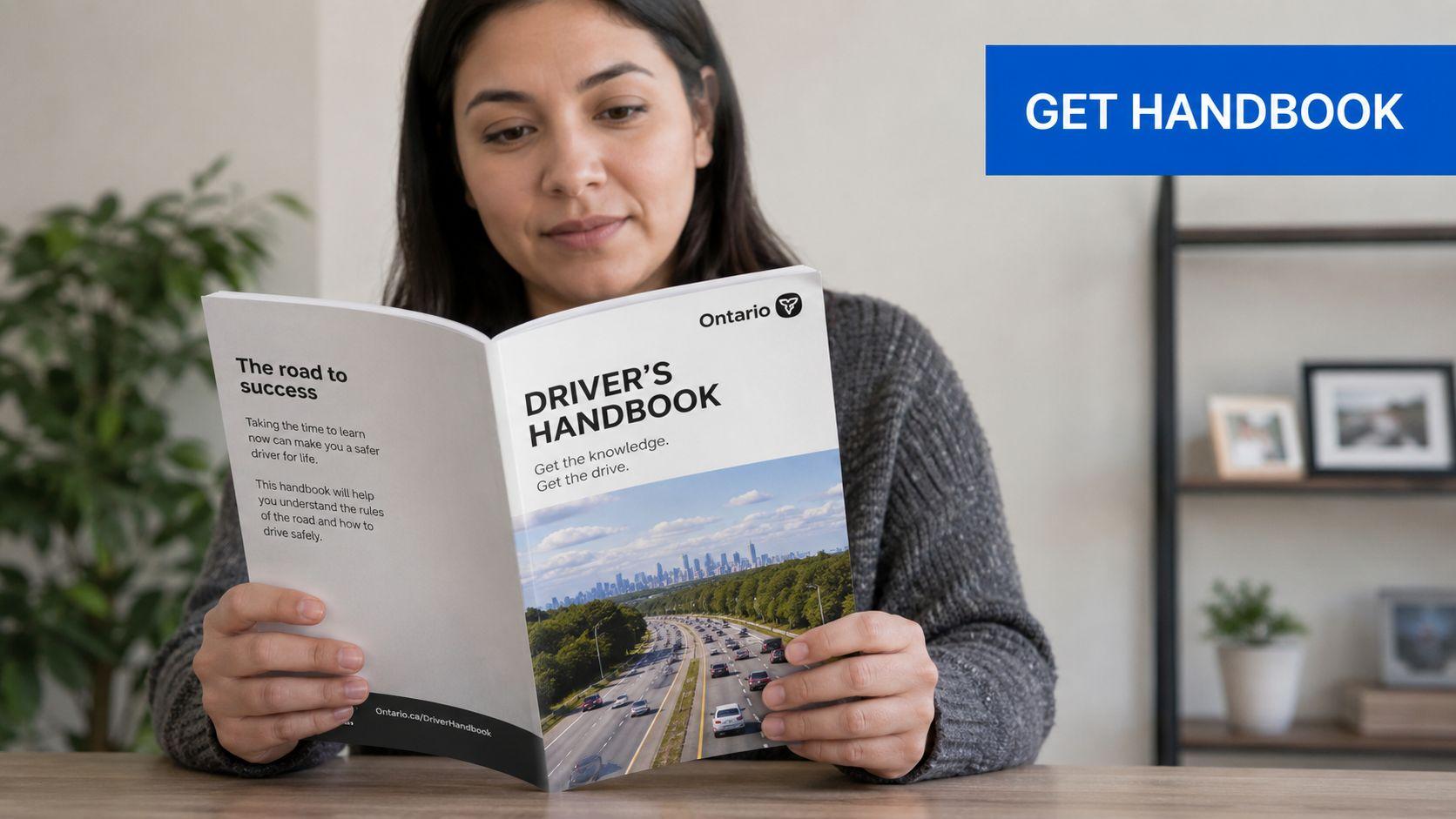
There are two practical ways to get the handbook. You can get a physical copy or use the official digital version. Neither is universally better. The right choice depends on how you study when you're tired, busy, or distracted.
Physical booklet versus digital copy
A printed handbook works well if you like to underline, flag pages, and study away from your phone. It also helps learners who get pulled into notifications every time they open a browser tab.
A digital copy works well if you want search, portability, and quick access from anywhere. If you study in short bursts on breaks, transit, or evenings on the sofa, digital can be more realistic.
Here's the trade-off in simple terms:
Format What works well What tends not to work Physical handbook Easier to annotate, fewer distractions, better for focused reading Less convenient if you study in short spare moments Digital handbook Searchable, portable, easy to reopen anytime Easier to skim without retaining, more screen distractions
How to choose the format that suits you
Use a physical copy if you know you learn by writing notes in the margins. Use digital if your real study habit is “a few minutes whenever I can.” Be honest about your pattern, not your ideal self.
A practical middle ground works for many learners:
- Read on paper when learning new material
- Use digital search when reviewing confusing terms
- Keep a short note list of rules that keep tripping you up
If you already know you avoid big blocks of reading, don't promise yourself you'll sit down and read the whole booklet cover to cover in one heroic push. You won't need heroics. You need repeatable sessions.
Decoding the Handbook A Chapter by Chapter Guide
The handbook feels heavy when you treat it like one long reading assignment. It gets much easier when you sort it by the way the test thinks. The G1 doesn't care whether you remember chapter order. It cares whether you understand signs, rules, and safe driving responses.
Read by test theme, not by page count
The easiest way to decode the driving test Ontario booklet is to group its content into three study themes.
First is traffic signs and lights. This is visual memory plus meaning. You need to know what signs mean, but also what shapes and colours are telling you before you've even read the symbol or word.
Second is rules of the road. It covers right-of-way, lane use, turns, intersections, stopping, and legal responsibilities. These questions punish fuzzy understanding. If you half-know a rule, the wrong answer can look tempting.
Third is safe driving practices. This includes the details learners often skip because they seem “practical” rather than “testable.” That's a mistake. The handbook contains specific standards you're expected to know.
The handbook mandates a legal minimum tire tread depth of 6 mm, a mandatory 5-metre stopping distance from pedestrian crosswalks, and a zero blood alcohol concentration policy for G1 drivers, all of which are identified as testable facts in this video explanation of handbook-based rules.
Use the handbook like a marker would
When you read, ask two questions beside every section:
- Could this become a direct fact question?
- Could this become a scenario question?
That approach changes your focus. Instead of passively reading, you start spotting what an examiner would pull from the page.
Here's a practical breakdown.
Topic Category Key Concepts to Master G1 Test Section Traffic signs and lights Sign meanings, sign shapes, sign colours, signal interpretation Road Signs Rules of the road Right-of-way, lane rules, turning rules, stopping rules, legal duties Rules of the Road Safe driving practices Alcohol rules for G1 drivers, vehicle safety standards, winter response basics Rules of the Road
A few topics deserve extra care because learners often read past them too quickly:
- Right-of-way situations: Intersections, turns, and pedestrian interactions need clear decision-making, not guesswork.
- Stopping rules: Distances and legal positions matter because the test often checks whether you know where a vehicle must stop.
- Vehicle safety facts: Tire condition and similar handbook details may feel minor until they appear as a straightforward question.
- Winter hazard response: If a scenario mentions slippery conditions, your answer should reflect calm, smooth control rather than sudden action.
Don't just mark what looks important. Mark what would be easy to misunderstand under pressure.
If you study the handbook this way, the pages stop feeling random. You begin to see what's informational and what's examinable.
Your Smart Study Strategy Handbook and Practice Tests
Reading alone builds familiarity. It doesn't reliably build recall. That's why many learners finish the booklet and still miss questions they “know they've seen before.”
The most reliable method is a feedback loop. Learn the rule in the handbook, test your recall right away, then return to the rule when you get something wrong. That's how you move from recognition to understanding.
The read test review loop
Use a simple three-step cycle.
- Read one focused chunk of the handbook. Keep it narrow. Signs. Intersections. Stopping rules. Don't read huge sections just to feel productive.
- Take matching practice questions immediately after. The point is to test fresh learning before it fades.
- Review every mistake by returning to the handbook. Don't just note the correct option. Find the rule that makes it correct.
A useful resource in this context is the G1ready.ca's Ontario driving test questions guide. It fits this loop because it points learners toward practice by topic, which makes it easier to pair a handbook section with a corresponding quiz instead of doing random mixed questions too early.
Why memorising answer banks fails
Rote memorisation feels efficient at first because scores often rise quickly. Then the wording changes slightly, or a scenario blends two rules together, and the learner stalls.
That happens because the G1 isn't only checking whether an answer looks familiar. It's checking whether you understand the principle behind it. If you only memorise “the answer that usually goes with this question,” you're vulnerable as soon as the framing shifts.
A stronger method looks slower, but it saves time overall:
- Read for meaning, not completion: Stop when a rule is unclear and resolve it before moving on.
- Use mistakes as study targets: A wrong answer tells you exactly where your knowledge is weak.
- Separate recognition from mastery: Getting one question right once doesn't prove you own the concept.
- Repeat hard categories: Repetition matters most where your errors cluster.
If a practice question surprises you, that's useful. It has exposed a gap while the stakes are still low.
This loop also helps with awkward topics that learners commonly find harder, like roundabouts, intersections, and right-of-way logic. Those aren't good memorisation topics. They need step-by-step understanding.
A Simple G1 Study Plan and Checklist
You don't need a complicated schedule. You need one that you'll follow after school, after work, or when your energy is average instead of perfect.
Start with this visual checklist, then turn it into short study blocks.
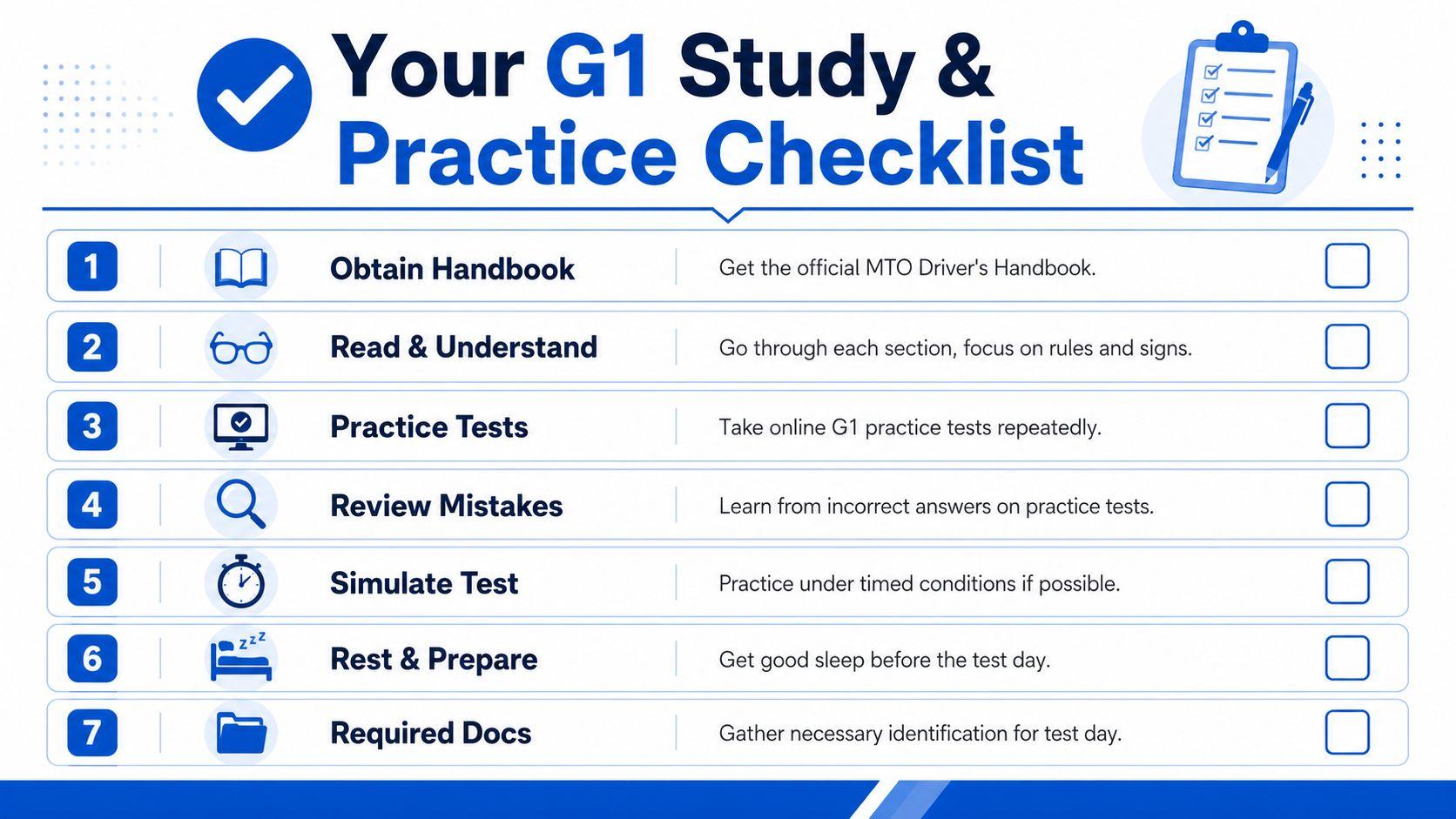
A practical routine you can actually follow
A simple routine works better than an ambitious one you abandon.
- Step one: Get the official handbook and decide whether paper, digital, or a mix suits you best.
- Next: Read one focused topic at a time. Signs should be studied differently from legal rules, so keep those sessions separate.
- Then: Follow each reading session with practice questions on the same topic.
- After that: Keep a mistake list. If you miss a question on stopping rules or right-of-way, write down the rule in plain language.
- Later sessions: Revisit your mistake list before starting new material.
For a more structured routine, the how to study for the G1 test guide is a useful companion because it helps turn scattered studying into a repeatable habit.
Here's a simple flow you can repeat:
- Read a short section.
- Take a short quiz.
- Review errors.
- Re-read the exact rule.
- Retry later, not immediately.
This video can help reinforce that routine before you start your next study session.
Your test day prep list
The best study plan also removes last-minute friction. Before your test day, check these basics:
- Handbook review: Revisit your weak topics, not the pages you already know well.
- Rest: A tired brain makes avoidable mistakes on simple questions.
- Documents: Gather your ID and anything else you need the day before.
- Route planning: Know how you're getting to the test centre and when you're leaving.
- Calm review: Do a light recap, not a panic cram.
A calm, steady plan usually beats the “all weekend, all at once” approach.
Common Questions About the G1 Handbook and Test
A few questions come up constantly, especially from first-time drivers and newcomers.
Do I need the newest handbook
Yes. Use the most current official handbook you can get. Road rules, wording, and test emphasis can change. Studying from an older copy might not ruin your prep, but it can leave you with outdated wording or missed updates.
Is the handbook enough on its own
The handbook is the official learning source. Therefore, it is a crucial resource. But reading alone often isn't enough for effective preparation, because test performance depends on recall and application, not just exposure.
The strongest setup is handbook first, practice second. The booklet teaches the rule. Practice shows whether you can recognise and apply it under question pressure.
How old do I need to be and where do I take the test
A candidate must be at least 16 years old to apply for a G1 licence, and both the eye test and the written knowledge test are administered at a DriveTest Centre according to this Ontario G1 licence requirements guide.
What should I do if I keep getting one topic wrong
Don't keep doing mixed tests and hoping it fixes itself. Go back to the exact topic in the handbook. Re-read the rule slowly, explain it in your own words, and then return to targeted questions on that category.
That method is especially important for rules that involve judgment, such as intersections, turns, and yielding. When a topic keeps hurting your score, that isn't bad luck. It's a study signal.
If you want a practical way to turn handbook reading into active prep, G1ready.ca gives you a straightforward place to practise by topic, review mistakes, and keep your study routine moving without registration getting in the way.