
You're on your first drive, approaching a stop sign on a quiet residential street. Your palms are sweaty, and several questions arrive at once: Do you need to stop completely? Can you turn right on red? Who goes first if a pedestrian is crossing? These decisions become easier when you understand what the sign is legally telling you, rather than relying on a vague memory of its picture.
Ontario's Driver's Handbook uses a simple rule: regulatory signs give a direction that must be obeyed. The Ontario Traffic Manual, especially Book 5, provides the more detailed rules behind that short definition. Once you connect the handbook's shapes, colours, and symbols with the required driving action, regulatory signs Ontario questions become much more manageable.
Starting at the Stop Sign on Your First Drive
A stop sign doesn't mean “slow down and look around.” It means your vehicle must come to a complete stop at the correct stopping point. After stopping, you check traffic, pedestrians, cyclists, and the intended path before proceeding. The octagonal shape helps you recognise the sign even when weather, darkness, or another vehicle makes the wording difficult to see.
That distinction matters on the G1 test because many wrong answers come from treating a regulatory sign as advice. A warning sign alerts you to a possible hazard. An information sign helps you find a destination or understand road services. A regulatory sign tells you what you must do or must not do.
Practical rule: Read the sign as an instruction. Then identify the road user behaviour it controls.
The Ontario handbook groups traffic signs into four sign families, regulatory, warning, temporary conditions, and information or direction signs. Within the regulatory family, you'll encounter signs controlling right-of-way, speed, movement, parking, stopping, and lane use. The visual system is designed to help you recognise the instruction quickly, before you've had time to read every word.
By the time you finish studying, you should be able to:
- Identify a regulatory sign from its shape and colour.
- Explain whether a symbol permits an action or prohibits it.
- Separate province-wide rules from signs connected to local traffic control.
- Apply the legal instruction to a realistic driving situation.
- Avoid common pairs that look similar, such as No Standing and No Stopping.
Ontario's official handbook says regulatory signs must be obeyed, while OTM Book 5 explains that these signs communicate what road users must or must not do in particular circumstances. That is the bridge between memorising sign images and answering scenario questions correctly.
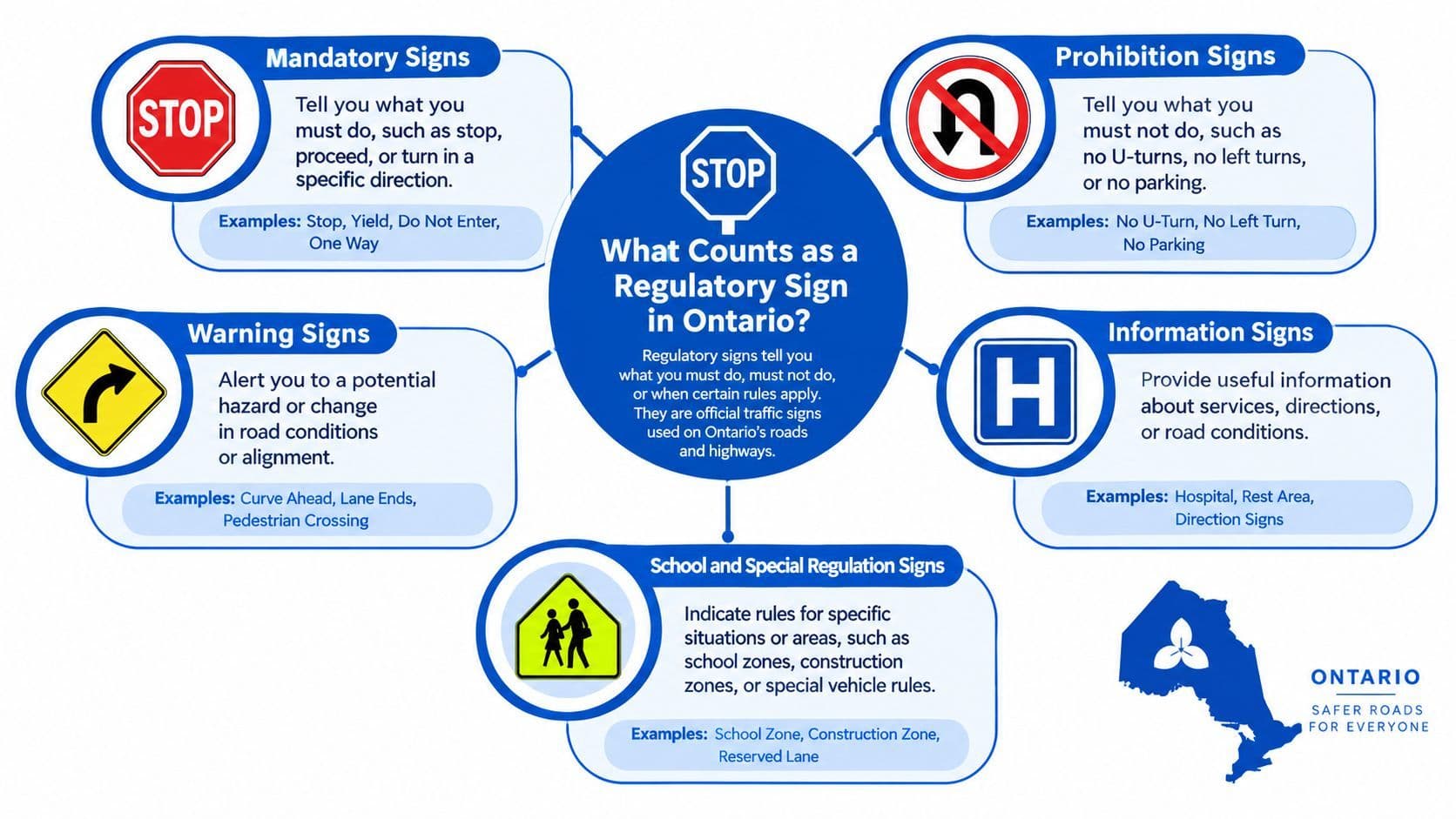
What Counts as a Regulatory Sign in Ontario
A regulatory sign controls traffic movement or parking. Ontario's official handbook describes regulatory signs as signs that give a direction that must be obeyed, and the Ontario Traffic Manual Book 5 explains that they tell road users what they must do or must not do under particular circumstances. Disregarding one would usually constitute an offence under the manual's legal and operational framework. (Ontario's official traffic-sign guidance)
The category includes familiar signs such as Stop, Yield, Speed Limit, No Parking, No Stopping, No Standing, One-Way, and lane-designation signs. These instructions apply to drivers, cyclists, and other road users when the sign governs the road situation in front of them.
Read the visual language first
Most regulatory signs are rectangular or square. They commonly use a white or black background with black, white, or coloured lettering. That shape is different from the diamond used for warnings and should immediately prompt you to look for an instruction.
The symbols also carry a consistent meaning:
- A green circle identifies an action that is permitted or required. For example, a green directional symbol can indicate that traffic may move in the shown direction.
- A red circle with a diagonal slash identifies an action that's prohibited. A turn symbol crossed by the slash means that turn isn't allowed.
- A red octagon is the important shape exception. It identifies Stop, regardless of whether the lettering is easy to see.
Think in families, not isolated pictures
The handbook organises regulatory signs around broad groups covering right-of-way, speed and movement, parking and stopping, and lane control. School and community safety zones need extra attention because the sign's instruction can be connected to posted times, special zones, or provincial and municipal enforcement rules.
For a G1 question, start with three checks. What shape do you see? Does the colour or symbol permit an action or prohibit it? What exact behaviour must happen before you continue?
The Five Families of Regulatory Signs You Must Know
Regulatory signs become easier when you sort them by the behaviour they control. The five-family approach below adds school and community safety zones as a separate study group, because those signs combine ordinary movement rules with special local or zone-based controls.
Right-of-way and direction control
These signs determine who proceeds and where vehicles may travel. Stop requires a complete stop before entering the intersection or crossing area. Yield requires you to give the right-of-way and proceed only when it's safe. Do Not Enter, Wrong Way, One-Way, Keep Right, and Keep Left control entry and direction.
The key question is not “What does the picture look like?” Ask, “Does this sign control my access, my direction, or another road user's priority?” A One-Way sign tells you the permitted direction of traffic. A Do Not Enter sign prevents you from entering from that approach.
Speed and movement control
Speed Limit signs establish the maximum permitted speed under the posted rule. Other signs control turns, lane movements, and vehicle positioning. Examples include No U-Turn, prohibited-turn signs, lane-use arrows, and signs directing trucks to use the right lane.
The action is usually immediate. If a sign prohibits a U-turn, you can't make that turn because the road looks empty. If an arrow marks a mandatory movement lane, you must follow the direction shown rather than continue straight.
Parking and stopping
These signs regulate what a vehicle may do at the curb or roadside. Common examples include No Parking, No Stopping, No Standing, timed parking, accessible parking, and school bus loading signs.
Their wording matters because “parking,” “standing,” and “stopping” aren't interchangeable in test questions. A sign may allow a brief activity while prohibiting waiting or leaving a vehicle in place. Always identify the exact curb activity allowed by the sign.
Lane control and turns
Lane-control signs assign a required or restricted movement to a specific lane. You may see mandatory turn lanes, arrows for a two-way left-turn lane, Centre Lane Only, bus lanes, and taxi lanes.
Look at the arrow and the lane it applies to. An arrow pointing left in a lane can require a left turn. A shared through-left lane may permit more than one movement, but only if the sign's markings show that combination.
School, community safety, and time-of-day zones
This group includes school-zone speed-limit signs, community safety zone signs, school crossing signs, and pedestrian crossover signs. These signs can apply to a special location, a posted time, or a defined zone. Ontario Regulation 615 defines specific sign classes, including speed-limit signs and community safety zone school signs. (Ontario's regulation library)
OTM Book 5 is the technical provincial standard for the selection and application of regulatory signs. Municipalities may use signs for local traffic control, but the sign still communicates an enforceable instruction when properly established and posted.
Family Shape & Colour Common Examples Required Driver Action Right-of-way and direction Red, white, or black regulatory designs, including the red octagon Stop, Yield, One-Way, Keep Right Stop, yield, enter, or travel only as directed Speed and movement Usually white rectangular or square signs, with prohibition symbols where applicable Speed Limit, No U-Turn, turn restrictions Stay within the limit and follow permitted movements Parking and stopping White signs with black wording and red prohibitory symbols No Parking, No Stopping, No Standing Park, wait, load, or stop only where permitted Lane control and turns White signs with arrows, lane symbols, or wording Mandatory turn lane, bus lane, Centre Lane Only Use the lane and movement shown School and community safety zones Regulatory signs with zone, crossing, or time information School-zone speed limit, Community Safety Zone Follow the posted restriction and watch for vulnerable road users
OTM Book 5 describes regulatory signs as controls that tell road users what they must do or must not do, and says that disregarding one would usually constitute an offence. (Ontario Traffic Manual Book 5)
Regulatory Signs vs Warning and Information Signs
A quick classification habit can save you from choosing the wrong answer. Regulatory signs command or prohibit. Warning signs alert you to a hazard. Temporary-condition signs communicate a changed road situation, often connected to construction. Information and direction signs guide you without normally ordering a specific driving action.
Sign Type Shape and Colour Driver Action Required Legal Force Regulatory Usually white rectangles or squares, with black, white, coloured, or red symbol elements Obey the instruction or restriction Enforceable control Warning Usually yellow diamonds with black symbols Slow, observe, and prepare for a hazard Alert, not normally a direct command Temporary condition Often orange diamonds or rectangles Follow the temporary road arrangement Applies to the temporary condition Information and direction Often green, blue, or white rectangles Use the information to navigate or identify services Guidance rather than a direct command
A yellow diamond showing a sharp bend doesn't order a particular turn. It warns you that the road ahead changes. A green direction sign helps you find a route or destination. A white sign saying No Left Turn, however, directly prohibits a movement.
The official handbook places warning, temporary-condition, information or direction, and regulatory signs in separate families. The distinction is practical because each family answers a different question: What must I do, what danger should I expect, what temporary condition applies, or where am I going?
Use the two-second sorting check
- Shape: Is it an octagon, diamond, rectangle, or square?
- Colour: Does the colour suggest a warning, temporary condition, information, or rule?
- Symbol: Is an action permitted, required, or prohibited?
- Wording: What exact behaviour does the sign control?
- Context: Does it apply to a lane, curb, school zone, time period, or direction of travel?
For a broader comparison with non-regulatory signs, review this Ontario information-sign guide. The aim isn't to memorise colour alone. It's to combine appearance with the legal action described by the sign.
Common G1 Traps That Trip Up New Drivers
Many learners recognise a sign family but miss the exact instruction. The most difficult questions often use signs that share a similar layout and ask what a driver may still do.
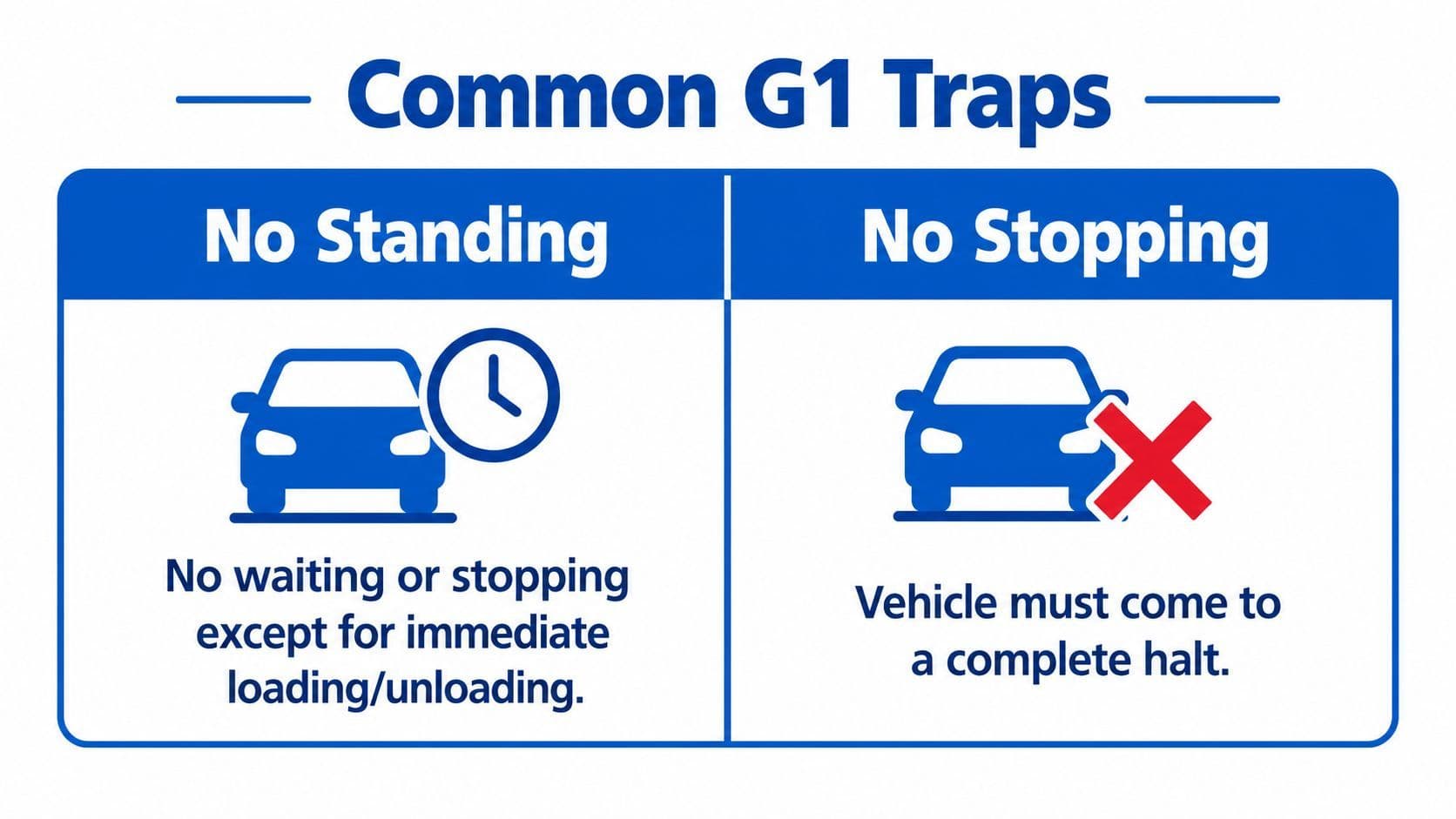
No Parking, No Standing, and No Stopping
These three signs are easy to confuse because they often use a black letter or symbol inside a red circle and slash. Their restrictions are different.
No Parking generally prevents leaving a vehicle parked, while allowing a brief stop for a permitted activity where the sign and local rule allow it. No Standing is stricter about waiting, but may allow a brief stop to pick up or drop off passengers. No Stopping is the most restrictive of the three. It prohibits bringing the vehicle to a halt except where an emergency or another specific legal exception applies.
The exact wording and any supplementary panel matter. Don't answer from the colour alone. Ask whether the driver is waiting, leaving the vehicle, loading, unloading, or stopping at all.
Do Not Enter and Wrong Way
Do Not Enter faces traffic approaching an entrance that must not be used. It prevents entry. You should choose another route instead of crossing the sign.
Wrong Way warns that your vehicle is already travelling against the permitted direction, often after entering a one-way road incorrectly. It confirms a dangerous mistake rather than just marking an entrance restriction. If you see it, stop making forward progress and correct the situation safely without moving deeper into opposing traffic.
School-zone and community-zone signs
A school-zone sign may display a reduced speed limit with a supplementary panel showing when that limit applies. Read the posted time information rather than assuming the lower limit applies all day. Community safety zone signs also carry special legal context, and Ontario uses them to identify areas where traffic enforcement can have increased consequences.
The important G1 habit is to connect the main sign with the panel beneath it. A time panel changes when the rule applies. A zone designation changes the legal context of the location.
Lane arrows
Lane arrows don't decorate the pavement or sign. They assign movements. A left-turn arrow can require a left turn from that lane. A combined through-and-left arrow can allow both movements when the markings show both directions. A bus or taxi lane restricts use to the vehicles or circumstances identified by the sign.
When a question includes an arrow, identify the lane first, then read the direction. Don't assume that a left-facing arrow means a turn is optional.
Legal Meaning and What Happens If You Disregard a Sign
The handbook's phrase “must be obeyed” carries legal weight. OTM Book 5 says regulatory signs communicate what road users must do or must not do and explains that disregarding one would usually constitute an offence. That makes a Stop sign different from a polite roadside reminder or a courtesy marking.
A police officer can enforce a regulatory instruction when the sign applies to your movement. Running a Stop sign, entering against a Do Not Enter sign, or ignoring a posted movement restriction can create legal consequences. The precise consequence depends on the offence and circumstances, so learners should use official Ontario sources for current penalties rather than memorising figures from an unofficial practice question.
Remember: A regulatory sign controls conduct on the road. It isn't optional because traffic appears light.
The sign's condition also matters to the province's maintenance framework. Ontario's minimum maintenance standard requires regulatory signs to be inspected for retro-reflectivity once per calendar year, with inspections no more than 16 months apart. A sign that is illegible, improperly oriented, obscured, or missing must be repaired or replaced within the prescribed time after the municipality becomes aware of the problem. (Ontario's minimum maintenance standard)
That maintenance rule explains why road authorities treat legibility and orientation as operational issues, not cosmetic details. It also helps explain the difference between a properly posted regulatory sign and an informal notice.
G1 learners don't receive a special exemption from road rules. The learner licence changes who may supervise you and where or when you may drive, but it doesn't turn a mandatory sign into a suggestion. If a question asks whether you can ignore a sign because you're a beginner, the answer is no. Use the Ontario demerit-points guide to review the broader consequences of convictions without relying on outdated penalty figures.
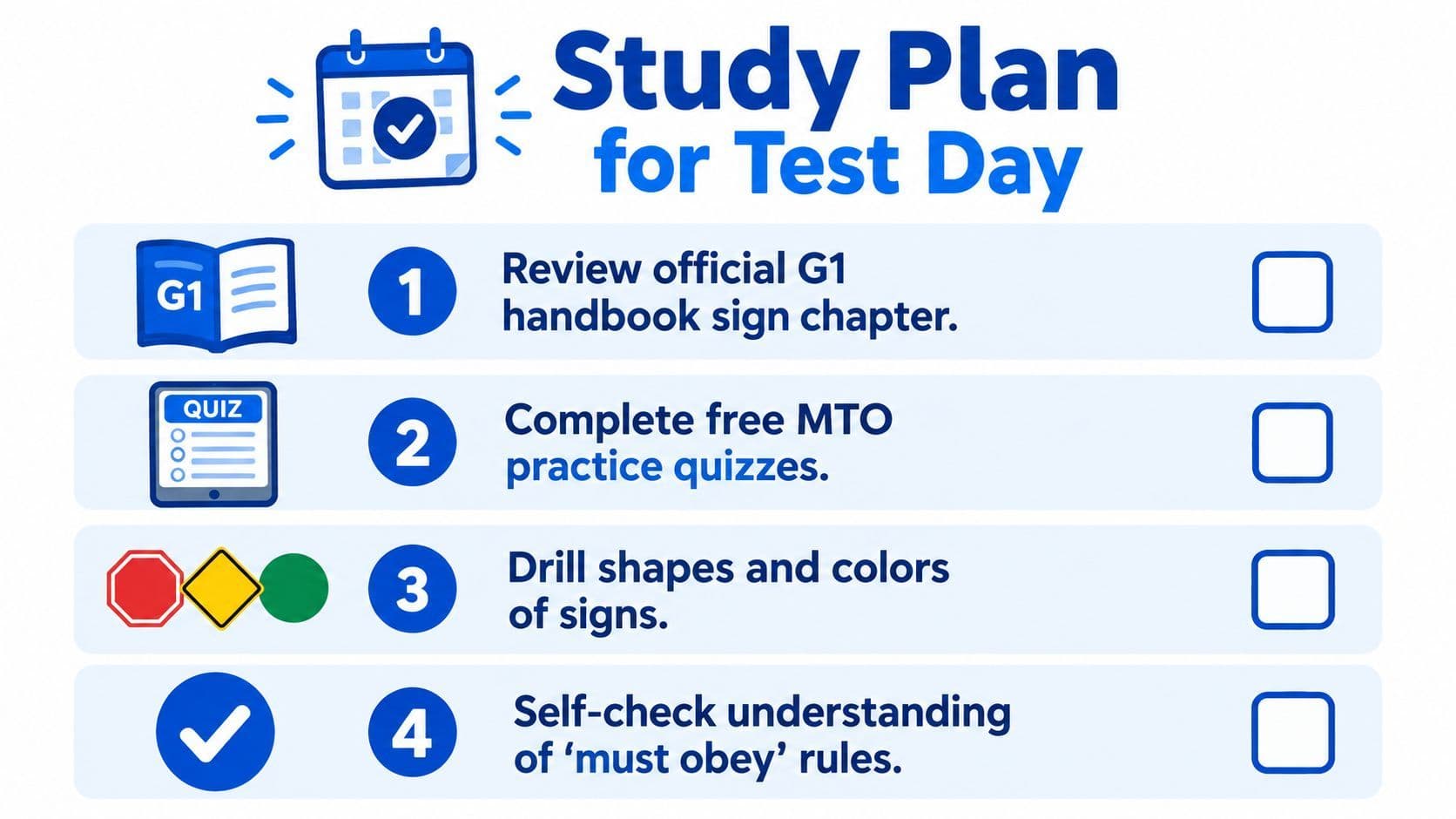
Study Plan and Self-Check for Test Day
Start with the official G1 handbook's traffic-sign chapter. Learn the visual system before trying to memorise every sign. Identify the shape, background colour, circle, slash, arrow, and any supplementary panel, then attach the required action.
A short, organised routine works better than repeatedly rereading the same pages. Use practice questions that follow the handbook, including the Ontario road signs test, and review every wrong answer immediately.
Build your routine around four passes
- Visual recognition: Drill signs by shape and colour until the family becomes obvious at a glance.
- Meaning: State the instruction in plain language, such as “I must stop” or “I can't turn left.”
- Scenario: Place the sign on a real road situation. Ask what your vehicle does next.
- Confusion check: Pair similar signs, especially No Parking, No Standing, No Stopping, Do Not Enter, Wrong Way, and lane arrows.
Work in focused 20-minute blocks across a week, mixing flashcards with scenario questions. Keep a simple record of which family causes mistakes. If school-zone panels are weak, study time-based signs together rather than scattering them across unrelated sessions.
The G1 knowledge test has two sections with 20 questions each, and you need 16 correct answers in each section to pass. Regulatory-sign questions appear within the rules-of-the-road material, so picture recognition alone isn't enough. You need to know the action the sign requires.
Before test day, check that you can:
- Identify a sign's shape and colour within two seconds.
- Name the legal action required.
- Explain the difference between No Standing and No Stopping.
- Distinguish Do Not Enter from Wrong Way.
- Read school-zone time panels correctly.
- Interpret mandatory, optional, and shared lane arrows.
- Explain why regulatory signs must be obeyed.
G1ready.ca offers free, registration-free practice exams, targeted regulatory quizzes, mixed tests, diagnostic practice, and an exam simulator aligned with the Ontario G1 handbook. Use those tools to practise sign recognition and review explanations, then visit G1ready.ca to turn your weakest regulatory-sign topics into a focused test-day study routine.


