
You've got the booking email, the handbook is open on your phone, and the problem isn't understanding that you need a licence. The problem is knowing which rules still matter, which ones changed, and what the DMV or DriveTest desk will ask for before you even get to the test itself. For a newcomer, an immigrant, or an adult trying for a first licence, that uncertainty is often the hardest part.
Ontario's new drivers license rules can feel intimidating because they're not just about driving. They're about the order of the process, the documents in your hand, the restrictions that stay in place while you learn, and the details that can stop an application before the examiner ever looks at your file. A calm, step-by-step view makes the path easier to follow.
Why Ontario's Driver Licensing Rules Are Getting Attention in 2026
A first-time applicant walks into a DriveTest centre with a folder, a passport, and a lot of nerves. At the counter, the key question is not, “Do you know how to drive?” It's, “Can you prove who you are, where you live, and whether your paperwork matches your current legal status?”
That's why Ontario's new drivers license rules are getting so much attention right now. The licensing path still follows the province's staged model, but the pressure point for many readers has shifted from the road test itself to the paperwork that gets them into the system in the first place. For newcomers, immigrants, and adults applying for a first licence, that difference matters more than most general guides admit.
Why the confusion feels so personal
If you're new to Ontario, the rules can feel scattered. One page talks about the G1 knowledge test, another about identity documents, and another about licence restrictions after you pass. The result is a very common mistake, people prepare for the test before they confirm they're eligible to book it.
Ontario's official teen-driver roadmap still shows the familiar G1 to G2 to full licence progression, but that roadmap also reinforces a broader point, licensing is a staged process, not a single test event. That's useful for first-time adults too, because the same logic applies, you advance only after you've completed the required steps in order.
Practical rule: Before you study harder, make sure your identity documents, status documents, and Ontario address all line up cleanly.
This matters in 2026 because the licensing conversation has become more document-heavy and more policy-aware. Many people still search for “new driver” advice as if it only applies to teens. In practice, the bigger friction for newcomers is often administrative, not mechanical. You may know the road signs already, but still lose time because one document doesn't match your current name or immigration record.
The safest approach is simple, check eligibility, gather documents, study the official handbook, and only then move toward booking. That order saves a lot of anxiety, and it keeps you from having to rebook when the office asks for something unexpected.
How Ontario's Graduated Licensing System Works
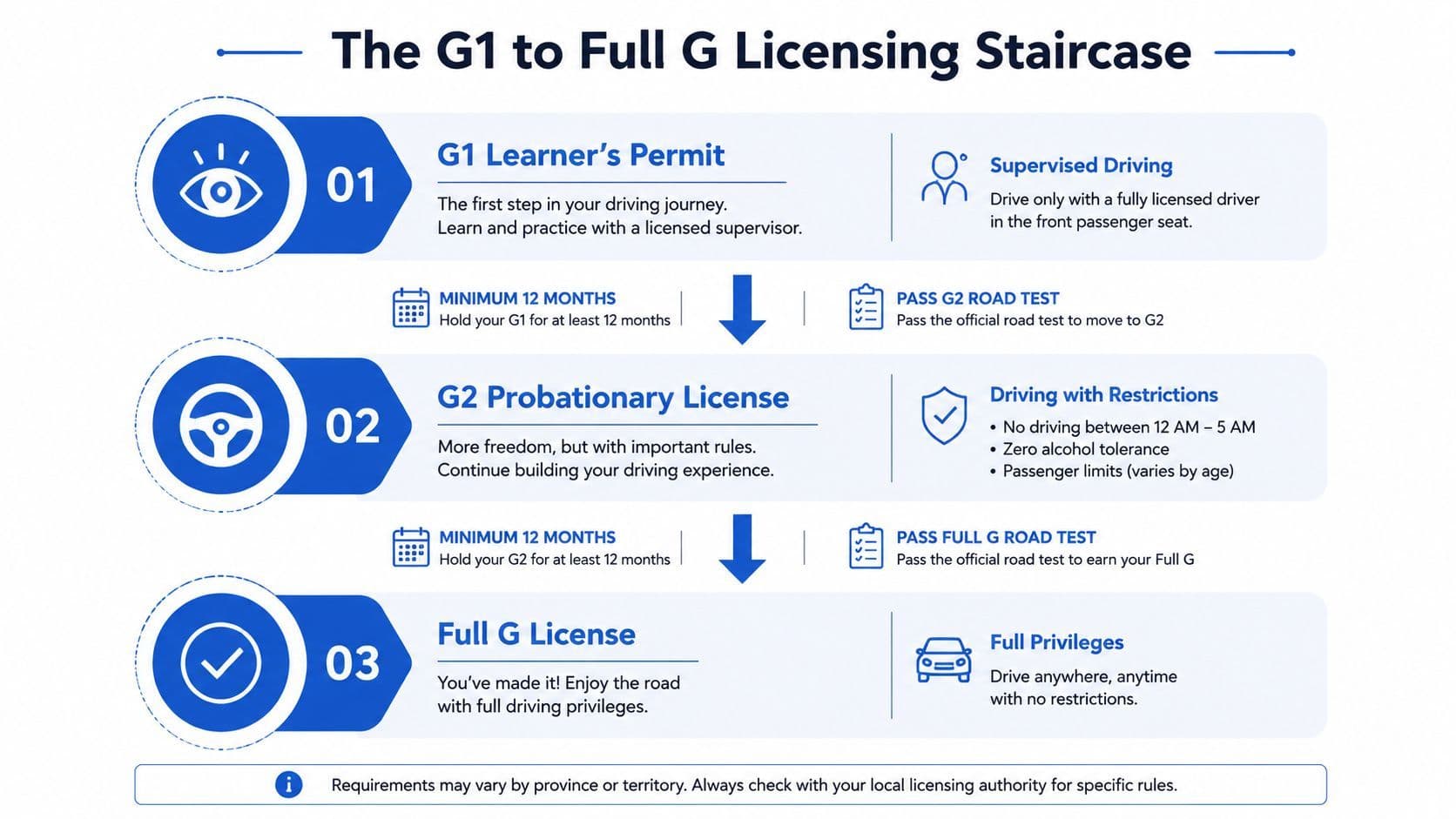
Ontario's licensing system works like a staircase. You do not jump straight to the top floor. You move up one level at a time, and each step gives you a little more freedom only after you have shown you can handle the last one. That structure is the heart of the province's graduated licensing model.
For a detailed breakdown of each stage, see our guide on Ontario's graduated licensing system.
The G1 to G2 path in plain language
The first step is G1. That is the learner stage, and it is where you start building real road experience under supervision. Ontario's official roadmap shows the progression clearly, knowledge test first, then G1, then road test and G2, then the final road test for full licensing. The province's handbook remains the governing study source for what is tested on the knowledge side, so broad Canadian driver-ed material will not get you there by itself. Ontario's official teen-driver roadmap lays out that staged path.
The next step is G2. In Ontario's two-stage system, new drivers move from G1 to G2 after passing a road test, then hold G2 for a minimum of 12 months before the final road test for full licensing. That waiting period is not busywork. It is part of the exposure-control design that keeps higher-risk driving conditions restricted until you have built enough experience.
Why the staged system exists
The point of graduated licensing is simple, lower risk while drivers are still learning. Ontario restricts high-risk driving conditions during the learning phases so crash risk is reduced before full solo privileges are granted. That means the rules are doing two jobs at once, teaching skill and limiting exposure.
For a nervous first-time applicant, the staircase model is reassuring because it makes the process predictable. You are not expected to know everything on day one. You are expected to move through the steps, prove competency at each stage, and stay within the restrictions that match your licence class.
Stage What it means What matters most G1 Learner stage Supervised practice and test preparation G2 Probationary stage Road skill with restrictions still in place Full G Full licensing Full privileges after meeting all requirements
The main thing to remember is that Ontario's system is built for progression. If you treat it as a ladder instead of a hurdle, the rules make a lot more sense.
What Changed in Ontario's Driver Licensing Rules This Year
The biggest change in 2026 is not that Ontario abandoned graduated licensing. The framework is still the same. What has changed is the pressure around identity checks, the way learners think about the knowledge test, and the level of care people need when they assume a “new driver” path is only about first-time teens.
Identification rules matter earlier than they used to
For many first-time applicants, the newest friction point is document readiness. Ontario's licensing ecosystem has been shaped by stronger identity-document expectations, and that means a learner can now run into problems before a test is ever booked. People often discover too late that a name change, a status update, or an old address record can create a mismatch at the counter.
That's why a lot of first-time applicants ask the wrong question first. They ask, “What should I study?” before they ask, “Will my application be accepted?” In 2026, that order matters. If your legal name, residency proof, or immigration record is not traceable, the application can stall even if you're ready for the handbook test.
The G1 test is still handbook-led, but the content feels more practical
Ontario's G1 knowledge test is still built around the province's road rules and signs content, and the official handbook is the source that governs what's tested. The useful shift for learners is not a change in the test's purpose, it's the growing need to study the actual provincial material rather than relying on generic driving advice or recycled internet summaries.
That's especially important for newcomers. If you learned driving rules in another country, some basics may feel familiar, but Ontario tests on Ontario rules. The safest assumption is that familiarity helps with confidence, not with eligibility.
Restrictions and timelines still control how quickly you move
The graduated licence timeline itself remains strict. California's teen GDL rules, by comparison, show how licensing systems often use supervised driving and restrictions to manage risk, but Ontario's own process is the one that matters here. Ontario keeps the staged model in place, and the logic is the same, you earn more freedom only after the system sees steady progress.
Bottom line: The change isn't that Ontario made licensing easier or harder in a dramatic way. The real shift is that first-time applicants need to think about documents, handbook accuracy, and licence progression together.
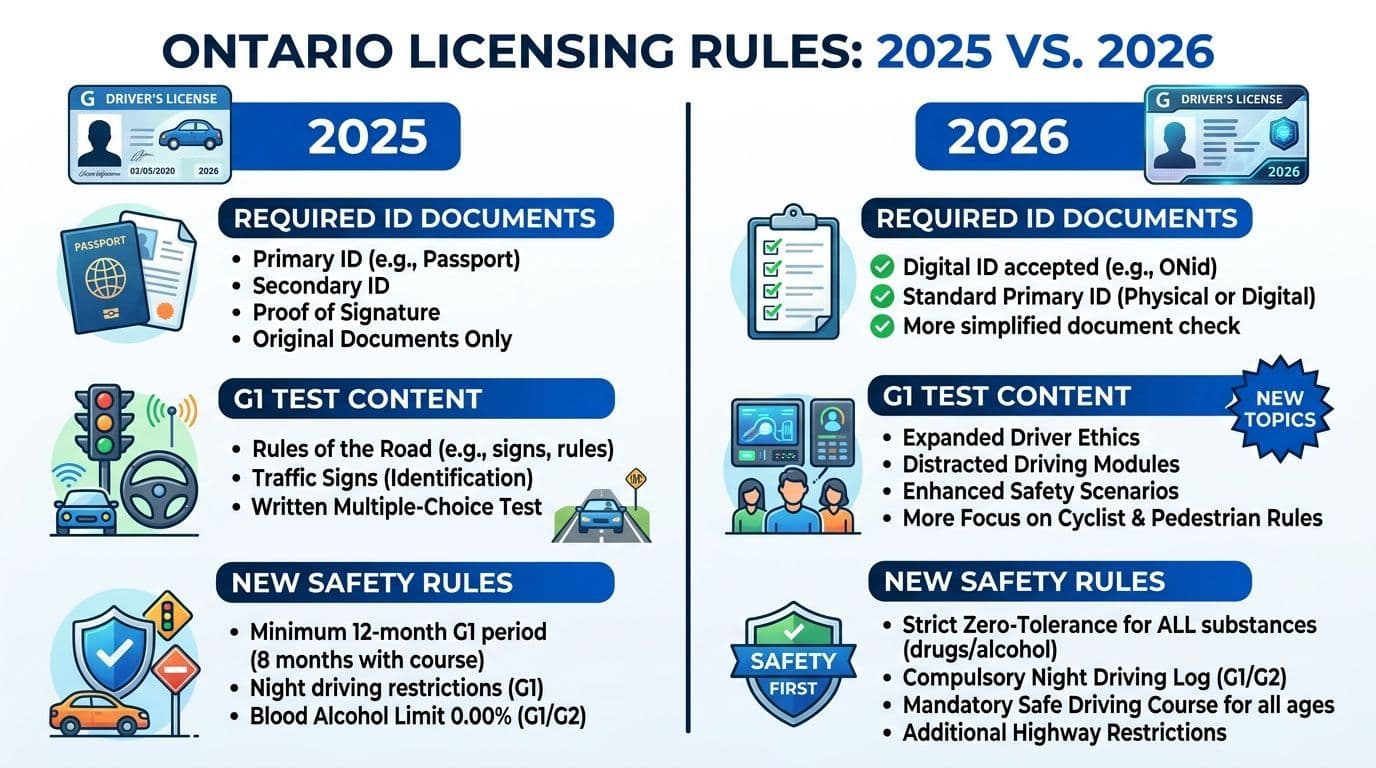
If you're comparing old advice with current guidance, focus on whether the source speaks to Ontario's official pathway. Old habit, copied summaries, and generic “new driver” checklists are where most confusion starts.
Required Documents for First-Time Applicants and Newcomers
Before you think about test questions, think about the folder you'll carry into the office. For many first-time applicants, the delay is not the knowledge test, it's a document mismatch that sends them home. A smooth appointment starts with identity, residency, and legal-status paperwork that fits together cleanly.
What to bring and why it matters
You'll usually want primary identification, proof of Ontario residency, and, if applicable, immigration or legal-status documents. That means a passport may satisfy one part of the check, but it won't solve everything by itself. If your current name is different from the name on older documents, bring whatever links the records together so the clerk can trace the change without guessing.
For newcomers, this is the part that catches people off guard. A work permit, study permit, or permanent resident card may be valid, but if the rest of your file doesn't match, the application can still pause. The office is looking for a complete identity picture, not just one strong document.
Keep every document current, consistent, and easy to read. If the clerk has to search for a missing link, you've already made the visit harder than it needs to be.
Common rejection causes to fix before you book
The most common problems are practical, not dramatic:
- Name mismatch: Your passport, residency proof, and status document don't show the same legal name.
- Expired papers: One of the documents you planned to use is no longer valid.
- Missing residency proof: You can't show a current Ontario address.
- Unclear status records: Your immigration or legal-status document doesn't line up with the application details.
- Unreadable copies or damaged originals: The office needs clean, legible proof.
If any of those apply to you, fix them before your appointment. If a document is in a previous name, bring the record that shows the legal change. If your address has changed recently, update your proof of residency first rather than hoping the counter staff can work around it.
For a fuller checklist, this Ontario G1 document guide is useful as a companion while you assemble your file.
How to Prepare for the G1 Test Under the New Rules
The easiest way to waste time is to study random questions without checking whether they match the Ontario handbook. The better approach is structured, short, and tied to the official material. That way, you're learning the rules the province tests, not the ones that happen to be popular online.
Start with the handbook, then test yourself
Read the official Ontario handbook first. Not passively, either. Mark the sections that feel shaky, especially road signs, right-of-way, lane use, and any rule you'd struggle to explain aloud. If English isn't your first language, slower reading is fine. Accuracy matters more than speed.
Next, move into practice testing. A good practice tool should give you immediate feedback, show the correct answer, and explain why the answer is right. That matters because memory improves faster when the correction is immediate, not delayed until the end of a long session.
A simple weekly routine works well:
- Take a diagnostic test to see what you already know.
- Study one weak topic at a time using the handbook.
- Do topic-specific quizzes until the rule feels familiar.
- Mix the topics together so you can switch between signs, rules, and scenarios.
- Finish with a full-length simulator to rehearse test-day focus.
Why structured practice helps newcomers
If you're new to Ontario, your problem may not be the rules themselves. It may be the wording. The handbook uses provincial language, and practice tools help you get used to that phrasing before the actual test. For teens balancing school and homework, the same structure helps because it breaks study into manageable blocks instead of one long cram session.
Study the way the test works. A few focused rounds beat a tired hour of guessing every time.
Progress tracking is useful here because it shows which topics keep producing mistakes. That gives you a real study plan instead of an emotional one. If you keep missing the same sign category or rule type, you know exactly where to spend the next session.
For learners who want a handbook-aligned practice path, G1ready.ca's study guide fits that kind of structured routine well, especially when you want to move from diagnostic work to mixed test practice without losing track of weak spots.
Common Misconceptions About the New Driver Licensing Rules
Many first-time applicants lose confidence because they start with wrong assumptions. The rules are less mysterious once you separate what's true from what people repeat at work, in parking lots, or online.
Foreign licence does not automatically skip Ontario steps
Some newcomers assume a licence from another country means they can jump straight to full local driving privileges. That isn't a safe assumption. Ontario's licensing path still depends on the province's own eligibility, testing, and progression rules, so a foreign licence may help in some situations, but it doesn't erase the local process.
Passing once does not mean you can stop learning
Another common myth is that the G1 test is the only moment that matters. It isn't. The staged system exists because the province wants drivers to build experience in layers, with restrictions still in place while skill develops. If you treat the first pass as the finish line, you'll miss the point of the licence ladder.
The test is not just trivia
People also assume the G1 exam is only a multiple-choice memory test with no real-world reasoning. That mindset usually leads to shallow preparation. The handbook and practice questions are designed to check whether you understand Ontario road rules well enough to apply them in everyday driving situations.
The G2 wait does not disappear because the rules changed
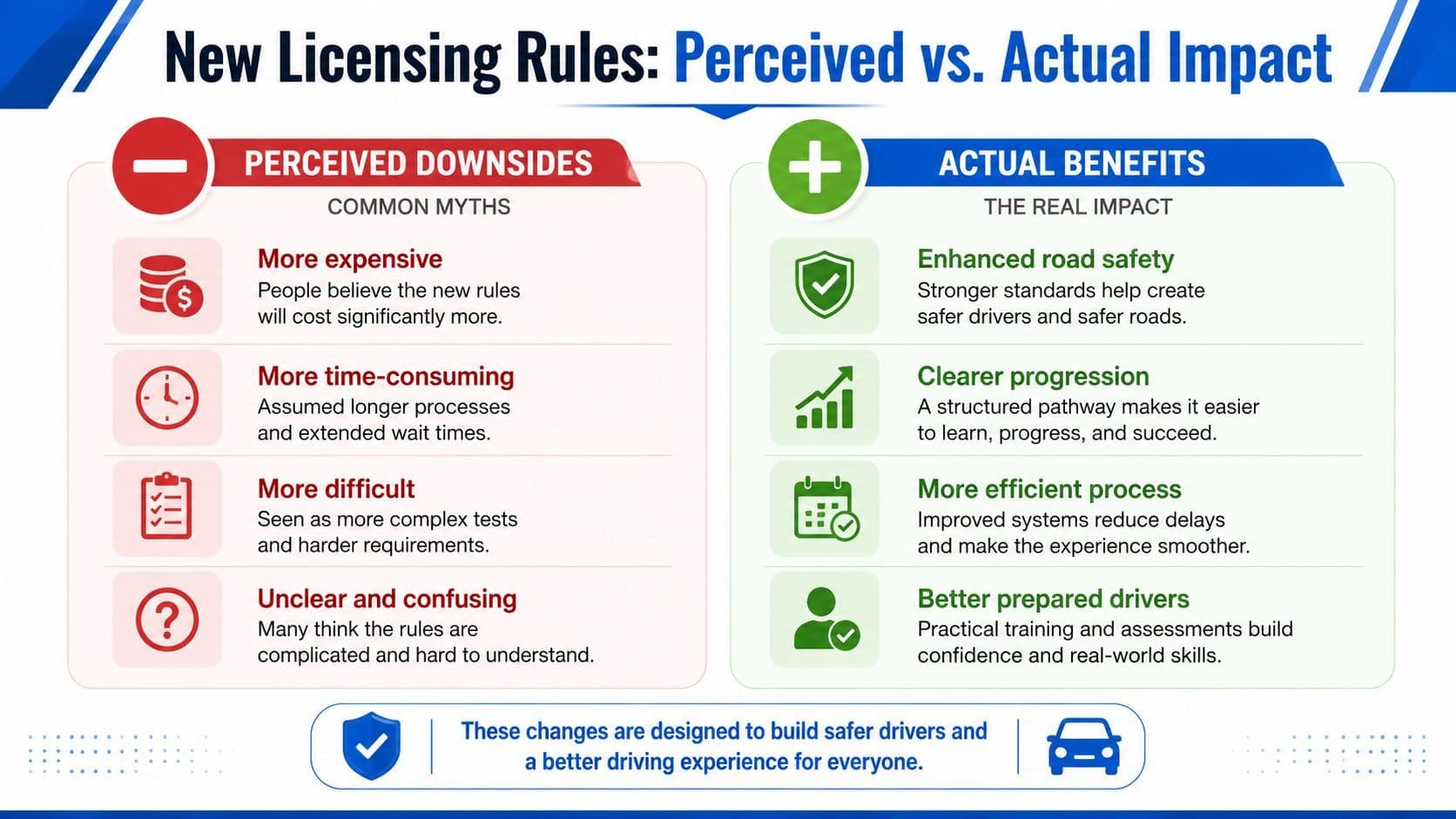
Some learners hear “new rules” and assume the waiting periods must have become shorter. Ontario's graduated system still uses staged progression, and the G2 minimum of 12 months remains part of that structure. The timeline is there for a reason, it gives you real driving exposure before the final road test.
Don't build your plan on shortcuts that sound convenient. Build it on the actual handbook, the actual timeline, and the actual documents you need.
The upside of clearing up these myths is simple. Once you stop expecting the wrong thing, the process feels less hostile and more predictable.
Your Next Steps Toward a Confident Test Day
Start with eligibility and documents, not questions and guesses. If your ID, residency, and status records are ready, move straight into handbook study and use a practice tool that shows you where you're weak. Then do one full simulator session under timed conditions so test day feels familiar instead of sudden.
If you're still sorting your file, book only after the paperwork is clean. If your study is the problem, keep practising before you book. The right order saves money, time, and stress because you're not trying to fix two problems at once.
A steady routine works best, short study blocks, immediate feedback, and repeat practice on the topics you miss most. That's the path I'd recommend to a nervous first-time applicant walking into the process for the first time.
If you want a structured way to prepare for Ontario's G1, G2, and full-licence pathway, G1ready.ca gives you handbook-aligned practice exams, topic quizzes, and a simulator that helps you spot weak areas before test day. It's built for first-time drivers and newcomers who need a clearer study routine, so visit G1ready.ca and start with a diagnostic practice test today.


