
You're holding an Ontario G1 application and looking at a list of letters that seems to have no obvious logic. Maybe you're a teenager in Brampton preparing for your first licence, or a newcomer deciding whether your overseas experience changes the process. You may be wondering whether a regular car needs a G1, G2, or G, and whether a pickup truck belongs in a completely different category.
The answer becomes much clearer once you stop treating the system as alphabet soup. Ontario matches the licence class to the vehicle type, vehicle weight, and braking system. The class tells you what you're legally allowed to operate, while the graduated stages show how much independent driving experience you've demonstrated.
Why Ontario Has Twelve Driver Licence Classes
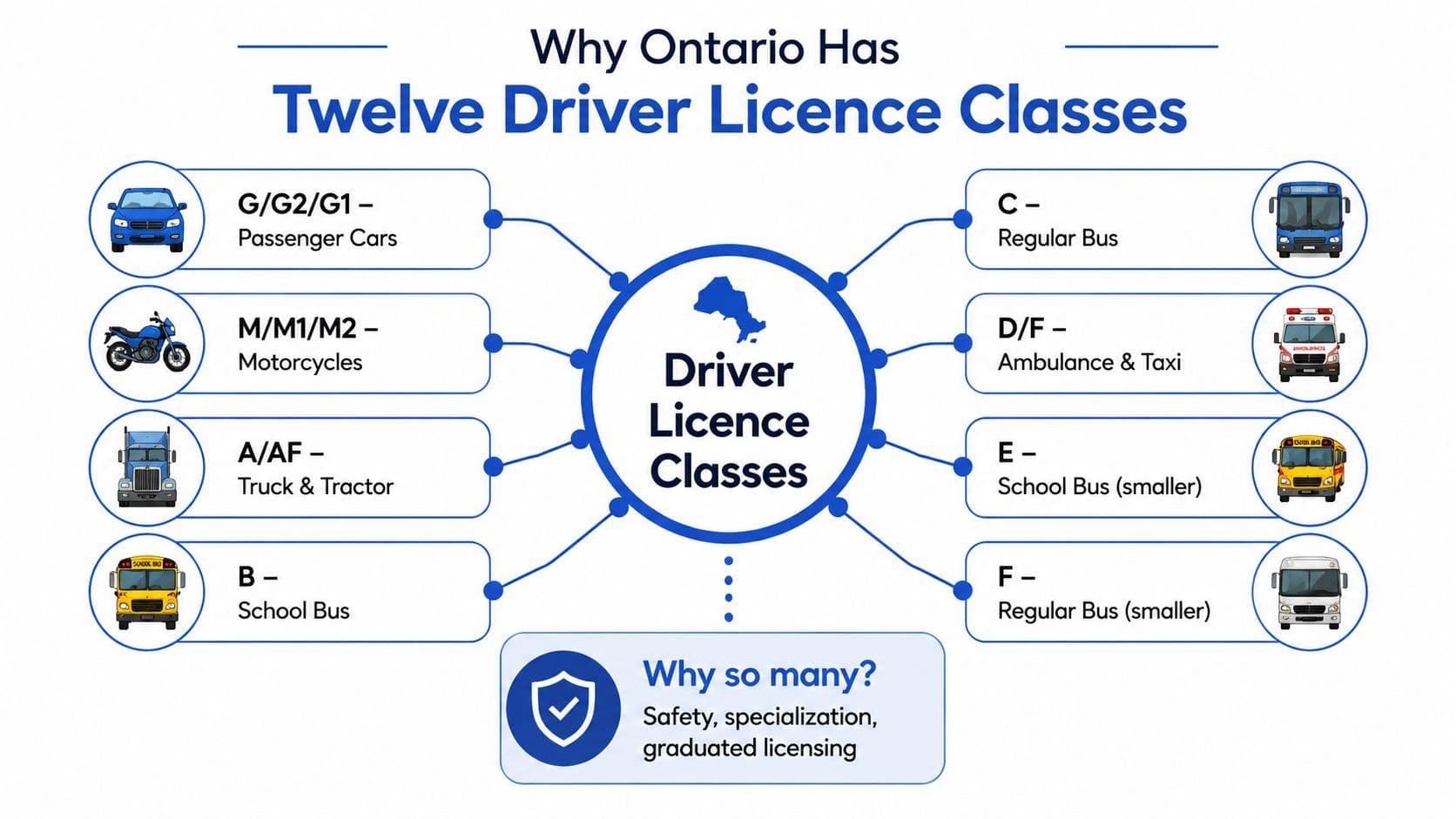
Ontario has 12 driver licence classes, and the province's rules connect each class to a particular type of vehicle and driving privilege. Class G covers cars, vans, and small trucks, while G1 and G2 are graduated stages within the Class G pathway, not separate vehicle categories. The Ontario Ministry of Transportation licence-class guide explains this structure.
A motorcycle follows the M-class family. Heavy vehicles and passenger-carrying vehicles use commercial classes such as A, B, C, D, and F, with additional categories connected to buses, ambulances, taxis, and school buses. The important question isn't, “How experienced is the driver?” It's also, “What does this vehicle weigh, and how does it stop?”
The vehicle determines the starting point
For an ordinary family car, minivan, or small pickup, the relevant family is Class G. A driver begins with G1, progresses to G2, and eventually qualifies for the full G licence. That progression reflects testing and independence, but the underlying vehicle category remains Class G.
The technical dividing lines become more important with commercial vehicles. Ontario defines Class D around vehicles over 11,000 kg gross weight or registered gross weight, while Class A applies to tractor-trailer combinations where the towed vehicles exceed a total gross weight of 4,600 kg. Those thresholds appear in Ontario Regulation 340/94.
Practical rule: Choose the licence by the vehicle you'll operate, not by the vehicle you hope to drive later.
Brakes can change the legal answer
A vehicle's braking system matters as much as its size. G1 and G2 authorize Class G vehicles but exclude vehicles equipped with air brakes, and a full G licence doesn't automatically authorize heavy combinations or air-brake vehicles. That's why a learner moving from G1 to G2 to G still may need a commercial class or endorsement for a work vehicle.
Once you understand those three filters, the letters become easier to read. G means passenger vehicles, M means motorcycles, and the commercial classes divide larger or specialized vehicles according to their design and use.
The G1, G2, and G Pathway for Passenger Vehicles
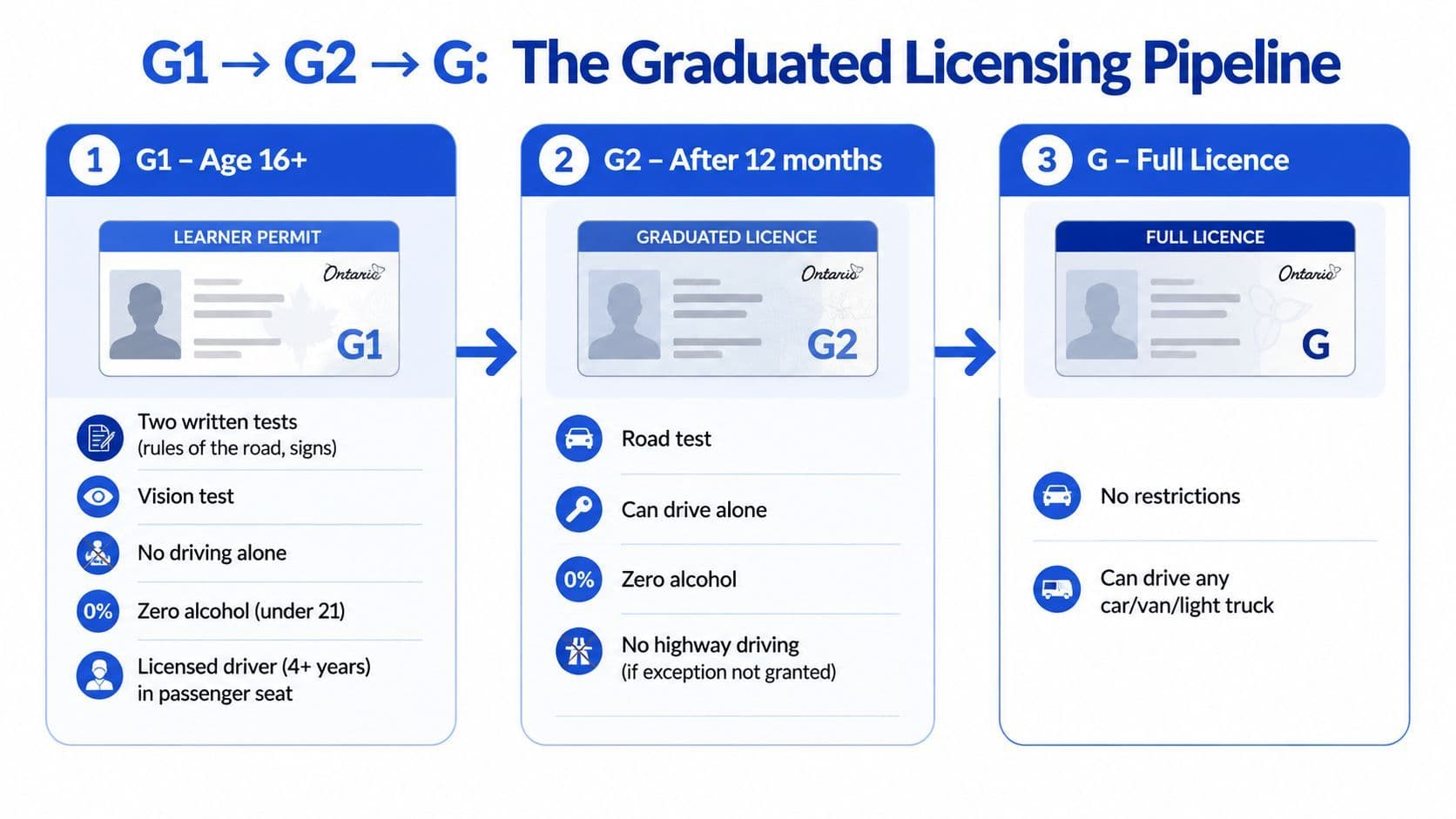
The G pathway is a staged system for cars, vans, and small trucks. It starts with knowledge and supervision, moves to independent driving, and ends with a full Class G licence after another road test.
Starting at G1
You must be at least 16 years old to apply. You'll need to pass a vision test and knowledge tests covering the rules of the road and traffic signs before entering Level One and receiving a Class G1 licence, as described in Ontario's official licensing information.
G1 is a learner licence, so it doesn't provide unrestricted driving. You must drive with an accompanying fully licensed driver who has at least four years of driving experience, seated beside you. This supervised period gives you the chance to practise observation, lane positioning, speed control, turns, and hazard management before driving alone.
Moving to G2
You can book the G2 road test after 12 months, or after 8 months if you complete an approved driving safety course, according to Ontario's official driver handbook. The road test checks whether you can control the vehicle and make safe decisions without constant coaching.
Practise the skills that cause learners the most difficulty:
- Parking: Complete parallel parking and other parking manoeuvres with steady observation.
- Turning: Use proper setup, speed, steering, and checks through the turn.
- Three-point turns: Choose a safe location and complete the manoeuvre without creating unnecessary risk.
- Traffic management: Handle intersections, lane changes, following distance, and merging where required.
A G2 licence lets you drive independently, but it still carries novice-driver conditions. Your habits at this stage matter because the full G test evaluates whether those habits remain safe in more demanding traffic.
Earning the full G licence
The Level Two road test is the final major checkpoint in the graduated pathway. Passing it gives you full Class G driving privileges, including the ability to drive Class G vehicles without the graduated restrictions that apply to G1 and G2 holders.
Prepare for more than basic manoeuvres. The examiner needs to see consistent city driving, safe lane changes, appropriate speed selection, highway or higher-speed route skills where included, and calm responses to changing traffic conditions. Treat the test as evidence that you can manage risk independently, not as a collection of tricks to memorize.
Motorcycle Classes M1, M2, and M Explained
Motorcycle licensing follows a similar graduated idea, but the vehicle creates different risks and skill demands. M1 is the learner stage, M2 is the intermediate stage, and M is the full motorcycle licence.
Stage Eligibility Tests Required Key Restrictions Validity M1 Applicant must meet Ontario's minimum age requirement Vision and motorcycle knowledge testing Restrictions apply to passengers, night riding, and higher-speed highways Check the licence conditions and Ontario's current rules M2 M1 rider progressing through the graduated pathway Motorcycle road test or an approved exit route where available Fewer learner restrictions, but novice conditions still apply Must progress within the applicable licensing period M Rider completing the final competency requirement Full motorcycle road test, or an eligible M1 exit option followed by the required progression Full motorcycle privileges subject to the licence class and applicable law Complete the final requirement within the licence's validity period
M1 riders face restrictions designed to reduce exposure while they learn. These include limits on night riding, passengers, and highways with speed limits above 80 km/h. The purpose is practical: early motorcycle practice should focus on control, scanning, braking, cornering, and traffic awareness before adding every possible road environment.
The M1-to-M2 step
A rider must wait 60 days before attempting the M2 road test. The assessment focuses on motorcycle-specific control, including low-speed manoeuvres, swerving, and braking technique. These skills aren't interchangeable with car driving. A rider must manage balance, throttle control, clutch use where applicable, and braking forces while remaining visible and stable.
M2 riders can continue developing road experience before pursuing the full M licence. Ontario also provides an M1 exit test option that may allow an eligible rider to bypass the final road test under specific conditions. Riders should confirm the current requirements with Ontario before choosing that route.
Completing the motorcycle pathway
The final M road test is held at DriveTest centres and evaluates more advanced riding decisions. The M licence can stand alone or be held alongside a G-class licence, so a person may hold motorcycle and passenger-vehicle privileges together.
Check the expiry details on your licence and plan the final test before that period ends. The central lesson is the same as with the G pathway: each stage represents a change in demonstrated competency, not merely a new card in your wallet.
Commercial Classes A, B, C, D, and E at a Glance
Commercial classes are easier to understand when you begin with the vehicle's weight, configuration, and braking system. A person driving a delivery vehicle doesn't automatically need the same class as someone operating a tractor-trailer, even if both vehicles are used for work.
Class Vehicle Type & Weight Braking System Typical Use A Tractor-trailer combinations where the towed vehicles exceed a total gross weight of 4,600 kg Air-brake requirements may apply through the vehicle and endorsement rules Long-haul and heavy combination trucking B Heavy straight trucks over 4,600 kg, with the relevant bus and vehicle permissions Depends on the vehicle, with air-brake qualifications where required Large straight trucks and certain passenger vehicles C Eligible vehicles connected to the commercial thresholds and regular buses below the Class D threshold Vehicle-specific Commercial transport and some bus operations D Vehicles over 11,000 kg gross weight or registered gross weight, including applicable bus operations Vehicle-specific, with air-brake requirements where applicable Heavy buses and large commercial vehicles E A legacy school-bus-related category that has been absorbed into current class and endorsement structures Depends on the vehicle Historical or transitional school-bus permissions
The Class A threshold concerns a combination and its towed weight. The Class D threshold concerns a vehicle's gross weight. Those are different questions, which is why a driver should inspect the manufacturer's information, registration details, trailer arrangement, and braking equipment before selecting a class.
Where endorsements fit
An endorsement can add a specialized permission to a base class. Air brakes are the clearest example. A driver with an ordinary G licence cannot assume that experience in a car permits operation of a vehicle fitted with air brakes.
School-bus work also requires attention to the specific class and authorization rather than relying on a general commercial licence. The right choice depends on the actual vehicle and job duties, so confirm the requirements with Ontario or an authorized licensing provider before paying for training.
Testing Requirements, Fees, and Typical Timelines
The G-class process has a clear order. First, you complete the vision and knowledge requirements for G1. Next comes the G2 road test after the required waiting period. The final G road test follows the applicable progression rules.
Bring original identity documents, proof that you live in Ontario, and any required consent documentation if you're under 18. Newcomers should also check whether an existing foreign licence affects the route they can take, because exchange and credit rules depend on the issuing jurisdiction and the documents accepted by Ontario.
A simple planning calendar
The official waiting-period rule is 12 months between receiving G1 and booking the first G2 attempt, or 8 months with an approved driver education course. Ontario's materials also describe graduated restrictions at each stage, so passing one test doesn't mean every driving condition disappears.
Use the waiting period for deliberate practice rather than passive time:
- Study first: Learn the rules and signs before your knowledge appointment.
- Practise with supervision: Build repetition in quiet areas, residential streets, busy intersections, and changing weather.
- Review test skills: Work on parking, turns, observation, lane changes, and merging instead of practising only familiar routes.
- Book with flexibility: Test availability changes, so keep several suitable dates open.
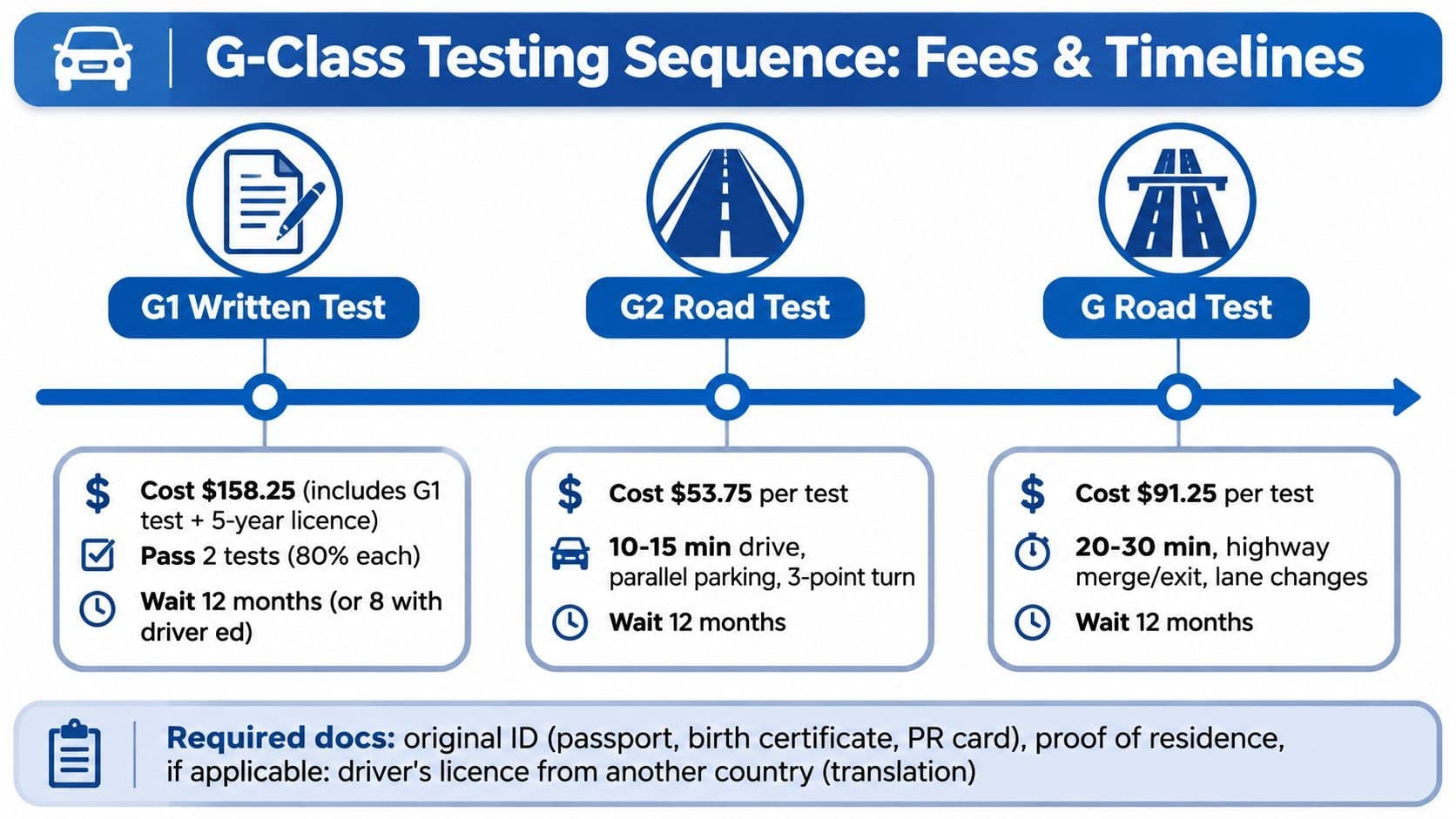
Fees change, so verify the current amount before booking. For a focused explanation of Ontario test pricing, review this Ontario driving test price guide. Commercial applicants should expect separate requirements, which can include medical declarations, vision reports, and different testing fee tiers.
Don't plan around an invented “average” timeline. Your schedule depends on study pace, access to a suitable supervising driver, practice conditions, test availability, and whether you need another attempt. A calendar built around the legal waiting periods is more reliable than a promise that licensing will take a fixed number of weeks.
Key Restrictions at the G1 and G2 Stages
Restrictions protect the learner and everyone sharing the road. Read them before your first practice drive, then check your licence conditions whenever you're unsure.
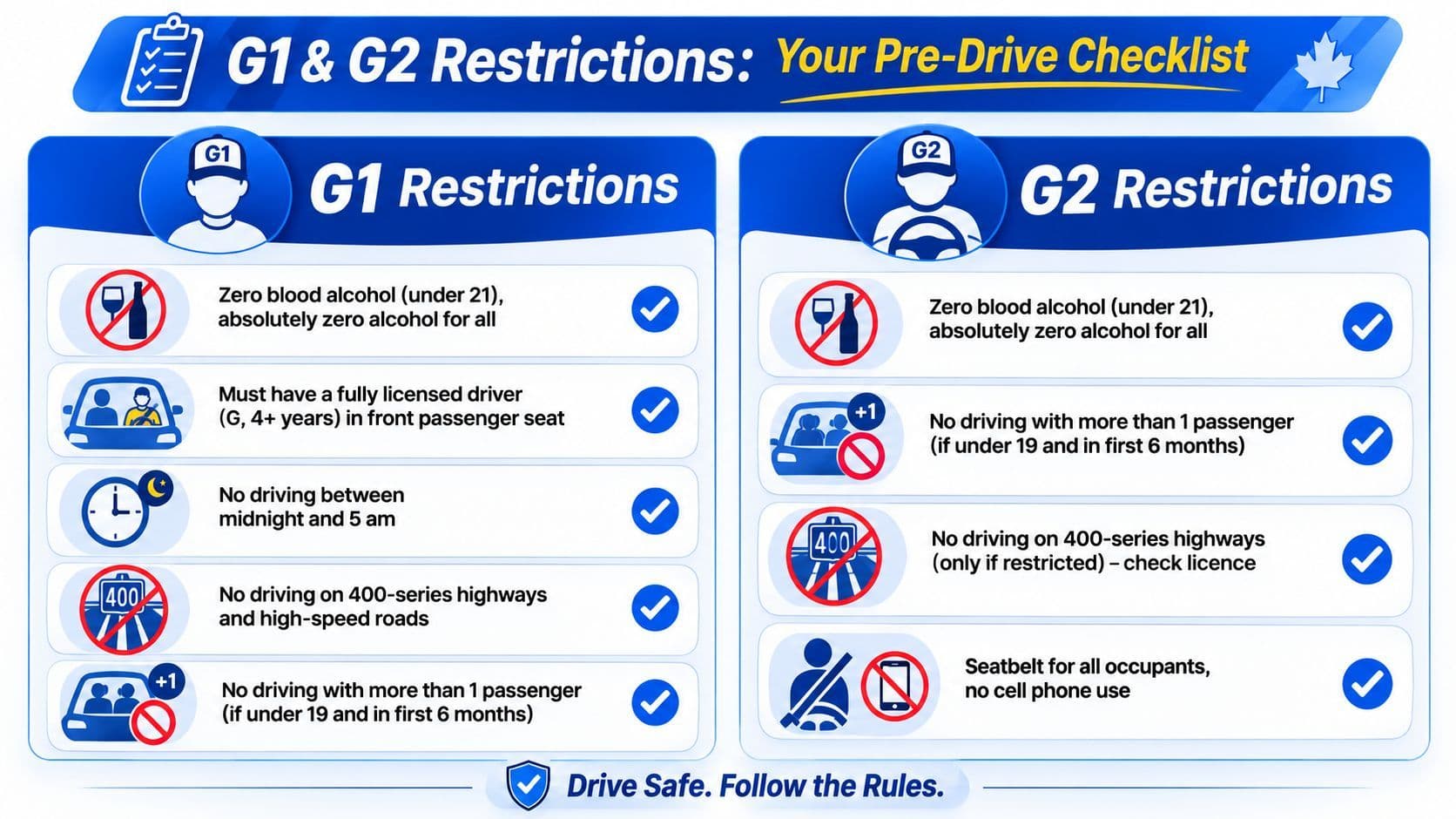
G1 pre-drive checklist
The Ontario G1 restrictions for new drivers include the following practical rules:
- Drive with supervision: A fully licensed accompanying driver with at least four years of driving experience must sit in the front passenger seat.
- Keep alcohol at zero: G1 drivers must maintain a zero blood-alcohol level. The rule is especially important for drivers under 21, and novice drivers should treat zero alcohol as the only safe choice.
- Secure every passenger: Everyone in the vehicle must wear a properly working seatbelt.
- Respect the overnight restriction: G1 drivers can't drive between midnight and 5 a.m.
- Stay off restricted highways: G1 drivers can't use 400-series highways or high-speed expressways such as Highway 401, the QEW, or the Gardiner Expressway, subject to the applicable exceptions.
These rules change the way you plan practice. A supervising driver must be available, your route must avoid restricted roads, and an evening lesson needs to finish before the overnight restriction begins.
G2 still means novice driver
G2 allows independent driving, but it isn't the same as a full G licence. Zero-alcohol conditions continue to matter, and passenger restrictions can apply to young G2 drivers, particularly during the early part of the G2 stage. Highway conditions may also depend on the specific restriction attached to the licence.
Before taking a route, review the current conditions on your licence and the official rules. This guide to G2 highway rules can help you identify the questions that need confirmation.
Keep this glove-box summary: licensed supervisor for G1, zero alcohol, seatbelts for every passenger, no midnight-to-5 a.m. G1 driving, and no restricted high-speed roads.
Violating graduated conditions can lead to serious consequences, including suspension or a longer path through the licensing system. The safest approach is simple. If a restriction is unclear, don't guess before driving.
Preparing for the G1 Knowledge Test with Practice Tools
Start with the official MTO Driver's Handbook. Read it as a rulebook, not as background material. The G1 knowledge test checks whether you understand traffic signs and rules well enough to begin supervised driving.
A useful study routine is more active than rereading. Read one chapter in a sitting, write notes by hand on right-of-way and speed-limit rules, then complete a short quiz that evening. Mark every uncertain answer, including guesses that happened to be correct.
Build practice around weak topics
A focused tool can help you separate signs, rules of the road, and driving practices instead of mixing every topic immediately. G1ready.ca offers Ontario-focused practice exams, targeted quizzes, mixed tests, a diagnostic test, marathon practice, and an exam simulator. Its questions provide immediate feedback, hints, explanations, and topic-based progress information.
Use practice results as a study map:
- Signs remain difficult: Review shapes, colours, symbols, and the action each sign requires.
- Right-of-way causes mistakes: Return to the handbook and write out who proceeds first in several different situations.
- Rules blur together: Study one topic at a time before returning to mixed questions.
- You rely on memory alone: Explain the answer aloud and identify the safety reason behind it.
Spread sessions across two to three weeks rather than cramming, using the G1 licence study material guide to organize your review. The aim isn't to memorize isolated answers. It's to recognise the rule when the wording or road scene changes.
Rehearse the appointment
The day before your test, complete a timed practice run lasting 30 minutes, then stop studying when you've reviewed the questions you consistently miss. On test day, bring two pieces of identification and arrive 30 minutes early so document checks and the testing environment don't add avoidable pressure.
Read each question carefully. Eliminate answers that conflict with the handbook, then choose the option that follows the safest legal rule. If you don't know an answer immediately, stay calm and use the wording to identify what the question is really testing.
Choosing the Right Class and Planning Your Next Steps
Your first decision should match the vehicle you plan to operate:
- Car, van, or small truck: Follow the G1, G2, and G pathway.
- Motorcycle: Start with the M series, either alone or alongside a G-class licence.
- Tractor-trailer: Investigate Class A and the required air-brake qualifications.
- Heavy bus or other large commercial vehicle: Compare Class D and the other commercial categories against the vehicle's weight and use.
- School-bus work: Confirm the applicable base class and endorsement rather than relying on a general licence category.
Newcomers with foreign licences shouldn't assume they must repeat every step or that their existing licence transfers automatically. Ontario may offer an exchange pathway for some jurisdictions, while applicants from other countries may need to begin with G1. Check the current documentation and eligibility rules before surrendering an overseas licence or booking a test.
For most first-time car drivers, the practical next move is the G1 knowledge appointment. Passing G1 enables supervised practice and puts the waiting-period calendar in motion. Keep your documents organised, schedule practice with a qualified accompanying driver, and reserve the first road-test window far enough ahead to respect the applicable waiting period.
Use this checklist:
- Confirm your identity documents: Make sure your original documents and Ontario residency evidence are ready.
- Choose the correct family: G for passenger vehicles, M for motorcycles, or a commercial class for specialised vehicles.
- Book the knowledge test: Treat G1 as the first competency gate, not a paperwork formality.
- Practise regularly: Use short nightly quizzes and handbook review to correct weak areas.
- Plan the road test: Start considering dates eight to twelve months ahead, while checking the exact legal waiting period that applies to you.
G1ready.ca offers free Ontario G1 practice tests, topic quizzes, diagnostic practice, mixed tests, and a realistic exam simulator aligned with the Ontario handbook. Visit G1ready.ca to identify your weak areas, practise the rules and signs, and arrive at your G1 appointment prepared.


