
A 16-year-old learner and a parent sit at the kitchen table, laptop open, trying to make sense of G1, G2, G, and “S.” The licence classes look like a sequence of letters, but each one represents a different level of driving responsibility. Understanding that sequence makes the process much less intimidating.
Ontario's graduated licensing system works like a staged training program. You begin with the G1 learner's licence, progress to the G2 intermediate licence, and eventually qualify for the full G licence. The “S” reference belongs to a different licensing context, not to the ordinary G1-to-G2-to-G path.
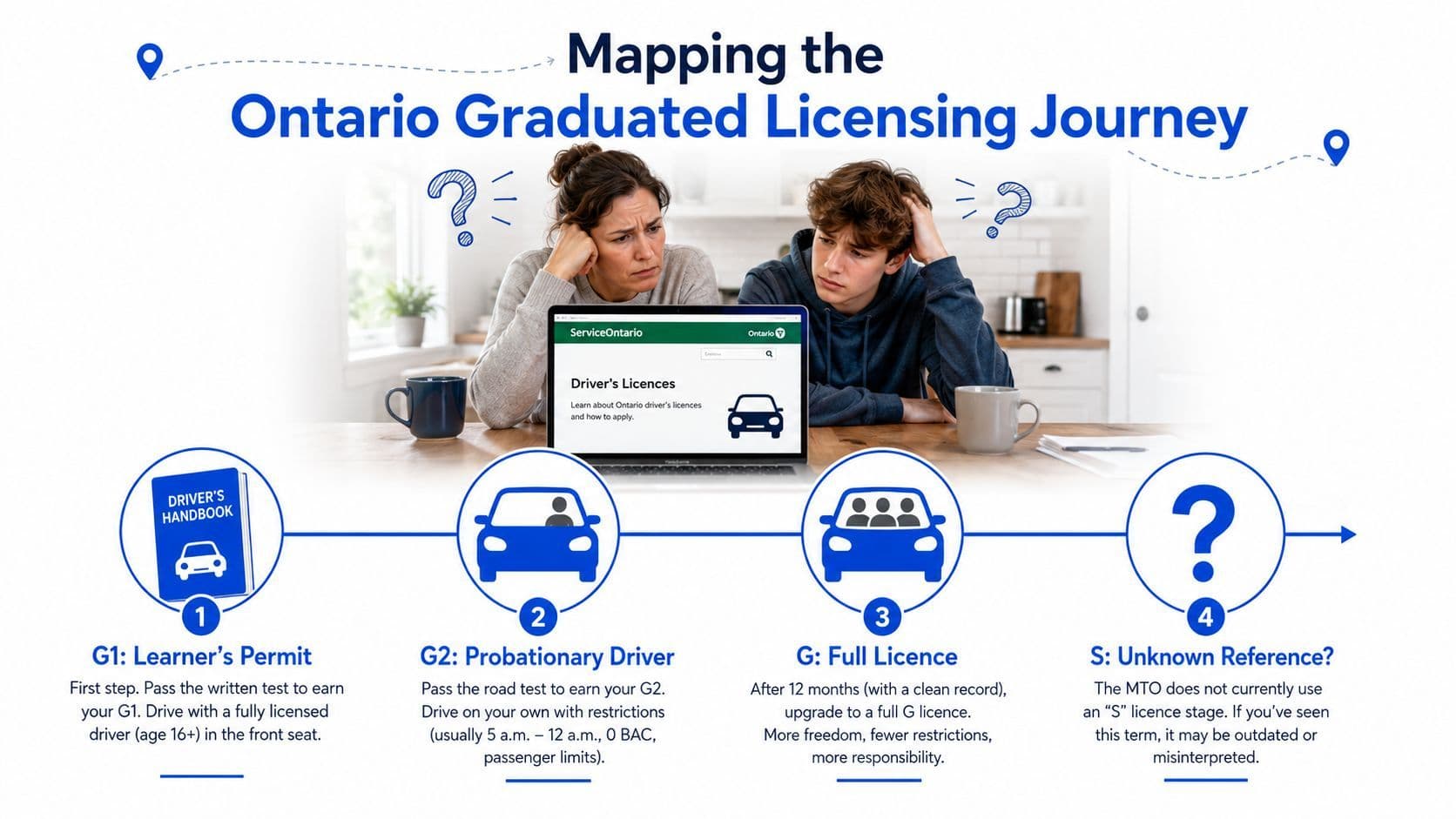
Mapping the Ontario Graduated Licensing Journey
The first milestone is the G1. It lets a new driver practise, but only under carefully controlled conditions. The learner studies the official handbook, passes a vision test and knowledge test, then gains supervised driving experience before attempting the first road test.
The next milestone is G2, which gives the driver much more independence. A G2 driver can drive alone and use roads that were unavailable during the G1 stage, but certain safety restrictions remain. The driver is still building experience and hasn't yet earned the unrestricted privileges of a full G licence.
The final milestone is the G licence. Passing the full road test demonstrates more advanced judgment, traffic management and hazard awareness. At that point, the driver has completed the graduated licensing path for ordinary passenger vehicles.
The timing in plain language
Ontario's official handbook describes the G1 stage as the first part of the province's graduated licensing program. A G1 driver normally waits at least 12 months before taking the road test, although an approved driver education course can shorten that wait to 8 months. The G2 stage then involves a minimum 12-month period before the full G road test.
An approved driver education course can also reduce the G1 waiting period before the G2 road test to 8 months, and the G1 road-test stage is often referred to as the G2 exit test. Taken together, the journey typically takes 20 months or more, depending on training, readiness, test availability and whether a driver passes each milestone.
Licence Main purpose What the driver is practising G1 Supervised learning Basic vehicle control, signs, traffic rules and safe decisions G2 Independent but probationary driving Real-world driving with remaining restrictions G Full passenger-vehicle licence Advanced road skills, hazard management and independent judgment S reference Separate designation or condition Usually connected with a special licence context, not the ordinary progression
The Ontario Driver's Handbook remains the core public reference for the knowledge test and the rules learners need to understand. Treat each licence stage as a training milestone, not just an administrative step.
G1 Licence Rules and Knowledge Test Requirements
A person must be at least 16 years old to apply for a G1 licence. The process includes a vision test and a written knowledge test based on Ontario's official handbook. The knowledge test checks two separate areas, road signs and rules of the road.
The exam contains 40 multiple-choice questions, divided into 20 road-sign questions and 20 rules-of-the-road questions. A learner must answer at least 16 questions correctly in each section, which is an 80% threshold per section. A strong result in one section can't make up for a weak result in the other.
DriveTest says the knowledge test is available without an appointment and is marked on the spot. That immediate result makes focused preparation useful because learners can identify whether signs or road rules need more work before returning.
G1 restrictions at a glance
The G1 isn't a licence for casual solo driving. It creates a controlled environment in which a new driver can practise with an experienced supervisor.
Restriction Details Alcohol The driver must have zero blood-alcohol concentration. Supervision The driver must be accompanied by a fully licensed driver who has at least four years of driving experience. Time of day The G1 driver must not drive between midnight and 5 a.m. Road access The driver must not drive on 400-series highways or high-speed expressways. Seatbelts Every occupant must wear a seatbelt.
These restrictions shape the study plan. A learner shouldn't just read the handbook once and assume the information will stick. Road-sign questions can look similar, while right-of-way rules often depend on the exact situation shown in the question.
Start with a diagnostic practice test. Mark every missed question by category, then study that category before taking another mixed test. If sign recognition is weak, review sign shapes, colours and meanings separately. If rules are the problem, work through right-of-way, safe following, lane use and traffic-control situations with active recall.
Practical rule: Don't book the knowledge test because the handbook looks familiar. Book it when you can repeatedly meet the required standard in both sections during practice.
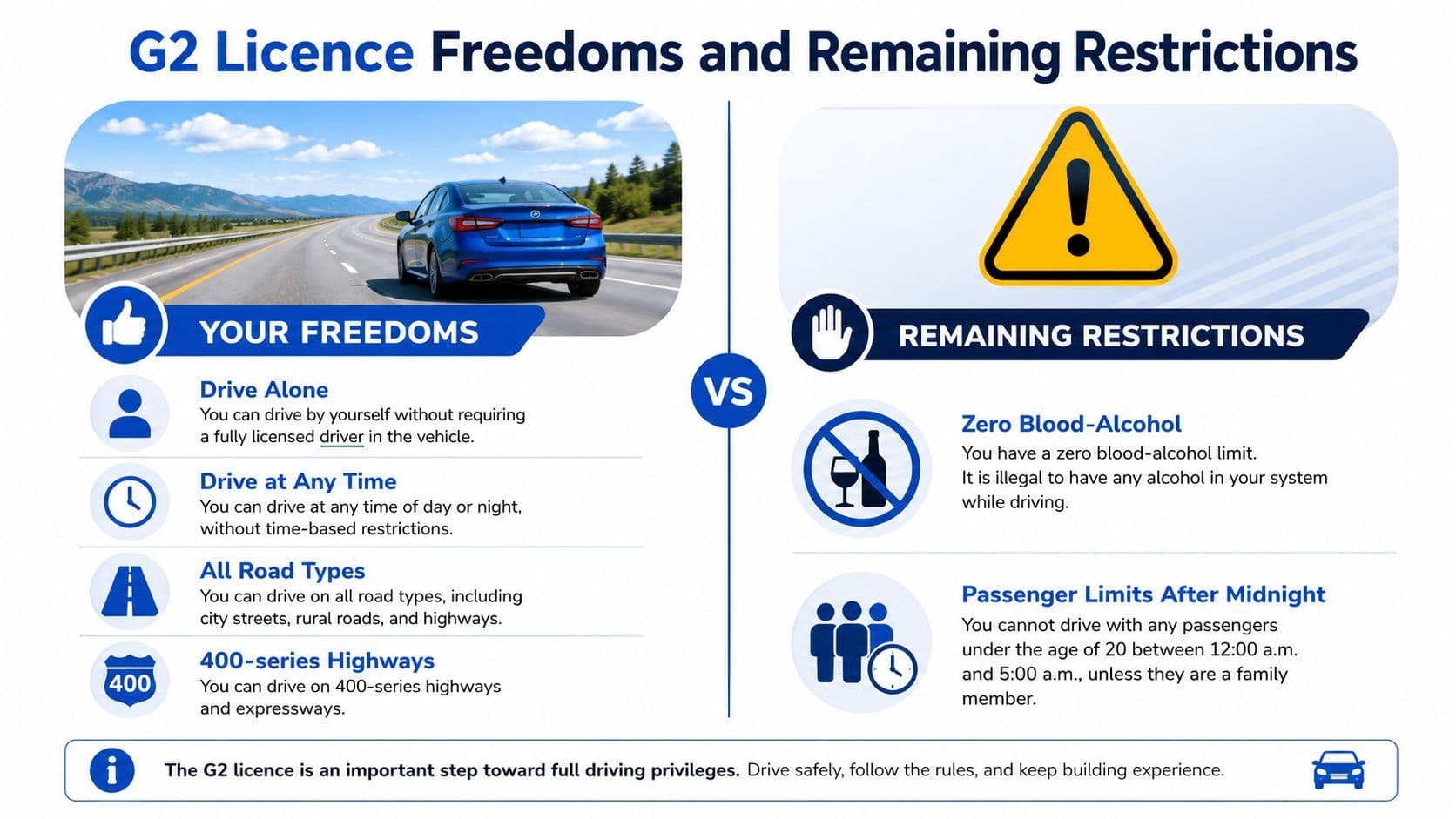
G2 Licence Freedoms and Remaining Restrictions
The jump from G1 to G2 feels substantial. A G1 driver needs an accompanying qualified driver, while a G2 driver can drive alone. G2 drivers can also drive at any time of day and use all roads, including 400-series highways.
That freedom doesn't remove every condition. G2 drivers must maintain zero blood-alcohol concentration, and all passengers must wear seatbelts. Drivers aged 19 and under also face passenger restrictions during the first six months. Between midnight and 5 a.m., they may carry only one passenger aged 19 or under, unless a parent accompanies them or the passenger is an immediate family member.
The road-test transition
The G1 road test, commonly called the G2 exit test, checks basic driving skills in traffic. The examiner may assess turns, lane changes, stops and parking, but the test isn't just a demonstration of steering and braking. The driver must show observation habits, safe decisions and appropriate responses to other road users.
The usual wait before attempting the G2 road test is 12 months. Completing an approved driver education course can reduce that period to 8 months. The Ontario G2 licence guide can help learners and parents organise the requirements and restrictions around this transition.
Practise more than the quiet neighbourhood route. Include busy intersections, lane changes, parking manoeuvres, merging and decisions around vulnerable road users. A supervising driver should watch for mirror checks, shoulder checks, speed control and the timing of decisions, not just whether the car reaches the destination.
This video can provide another visual reference for the transition from supervised learning to more independent driving.
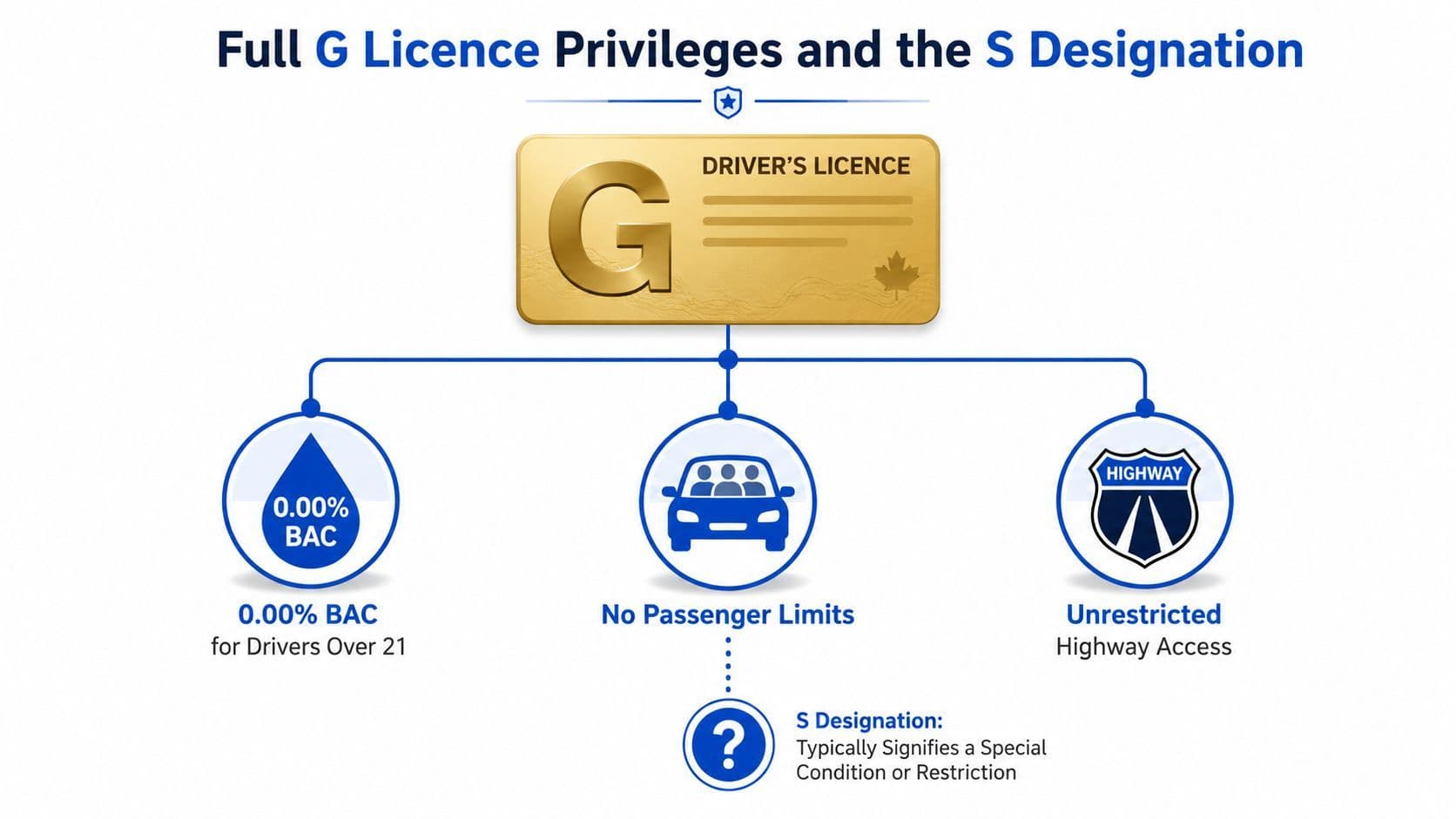
Full G Licence Privileges and the S Designation
A full G licence removes the ordinary G2 passenger restrictions and permits unrestricted highway access at any time. Drivers over 21 still need to observe Ontario's zero-blood-alcohol requirements for novice drivers and other applicable impaired-driving rules. The full G test is intended to confirm that the driver can manage more complex traffic situations independently.
The guide to the Ontario Class G licence is useful for separating the full G privileges from the conditions attached to earlier stages. Parents often assume that passing the G2 test means the process is finished, but the full G road test remains a separate milestone.
What “S” usually means
The phrase “G1 G2 S” creates confusion because “S” isn't the next ordinary passenger-vehicle licence after G2. In Ontario, an S endorsement is associated with school-bus driving. It belongs to a specialised licensing path rather than the standard learner-to-full-licence sequence.
Eligibility for the S endorsement involves holding a full G licence, completing a medical examination, taking a school-bus driver improvement course, and passing knowledge and road tests specific to bus operation. Those requirements are different from the ordinary G1 knowledge test and G2 or G road tests.
An “S” reference can also appear in discussions of conditional licence codes connected with medical or vision restrictions. In that setting, the designation describes a condition attached to the driver's licence. It doesn't grant extra driving privileges. The wording and code on an individual licence card should be checked with the Ministry of Transportation or DriveTest because the practical meaning depends on the specific designation recorded.
The simple takeaway is this: if you're a new passenger-vehicle learner, your ordinary target is G1, then G2, then G. You don't need an S designation to complete that route.
Why Many Learners Fail and How to Avoid It
Many learners prepare broadly but not diagnostically. They read the handbook, recognise the general topics and then discover on test day that they can't distinguish similar signs or apply a right-of-way rule to a new situation.
Ontario's Auditor General reported that from January 2018 to March 2023, more than 1.9 million novice drivers passed the knowledge test, while almost 10% passed only after more than three failed attempts in one visit and 1% took the test more than five times. These figures are reported in the summary of Ontario knowledge-test results. They point to a practical lesson: repeated attempts don't automatically correct the underlying mistake.
The two G1 failure patterns
The G1 exam has two independently scored sections. A learner who performs well on road signs but misses too many rules questions still fails, and the same is true in reverse.
Test stage Top failure reason Secondary failure reason Retake wait period G1 knowledge test Treating the exam as one overall score Passive reading without reviewing mistakes Confirm current retake details with DriveTest G2 road test Weak observation and decision-making Limited practice in varied traffic Confirm current booking and retest rules with DriveTest G road test Inconsistent advanced judgment Difficulty managing hazards under pressure Confirm current booking and retest rules with DriveTest
For road tests, vehicle control is only one part of readiness. A driver can know how to turn the wheel and still lose marks by failing to check mirrors, missing a shoulder check, entering a turn too quickly or yielding incorrectly.
A missed question is useful only when it tells you what to practise next.
Create a mistake log with categories such as signs, right-of-way, lane use, observation and speed management. Review the explanation immediately, close the material and answer the question again from memory. That process is more useful than repeating a test until familiar wording produces a comfortable score.
Building a Practice Test Strategy for Each Stage
Each milestone needs a different practice method. The G1 is primarily a knowledge and recognition challenge, while the G2 and G tests require observable driving behaviour.
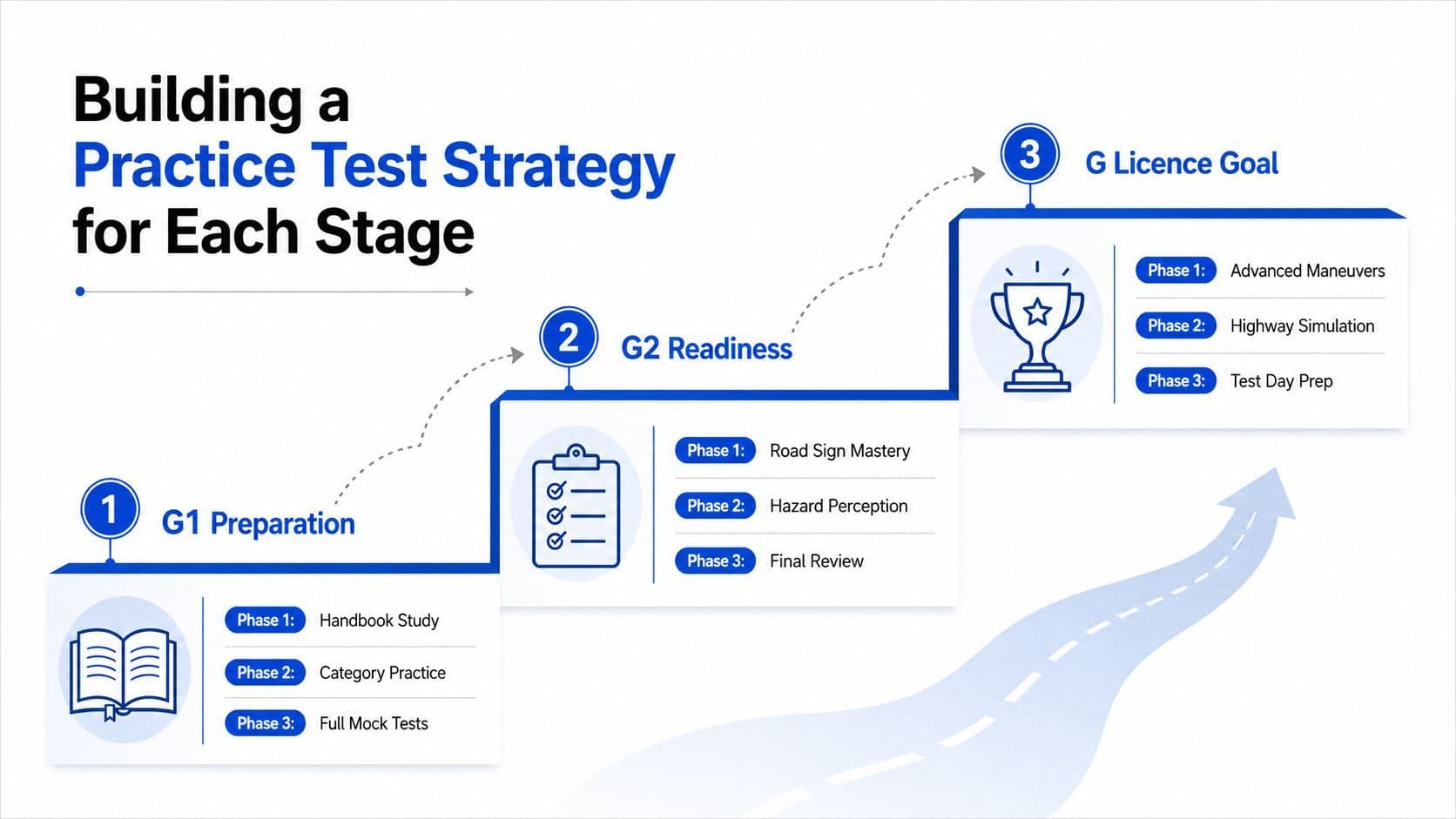
G1 preparation
Use three phases rather than one long reading session:
- Handbook familiarisation: Read the official material slowly and write down rules you couldn't explain in your own words.
- Category practice: Complete separate sign and rules quizzes. This reveals which half of the exam needs attention.
- Full simulations: Take mixed tests under quiet, timed conditions. Aim for consistent scores of at least 80% in each section, matching the official section threshold described by DriveTest and the Ontario handbook.
A platform such as G1ready.ca offers registration-free practice exams, diagnostic and topic-based quizzes, immediate explanations, progress tracking and a G1 exam simulator. Use it alongside the official handbook, not as a replacement for the provincial source.
G2 readiness
For the G2 road test, ask a supervising driver to use a checklist. Practise left turns at uncontrolled intersections, parallel parking, lane changes, merging and controlled stops. The supervisor should record whether you checked mirrors early, checked the blind spot, chose a safe gap and completed the manoeuvre smoothly.
G licence preparation
The full G stage calls for more advanced traffic management. Practise lane changes in heavier traffic, three-point turns, highway driving and hazard perception. The supervising driver should create situations that require planning rather than just following a familiar route.
A simple weekly pattern works well during the waiting periods:
- Early period: Learn or refresh one skill category at a time.
- Middle period: Mix familiar routes with unfamiliar roads and traffic conditions.
- Final period: Run complete simulations, review the checklist and correct the last recurring errors.
The Ontario driving quiz resource can support the knowledge-test portion of that routine. On every practice session, review missed items immediately and occasionally change question sources so you're recalling the rule rather than memorising a test bank.
Common Misconceptions About Ontario Licence Classes
“The G1 test is easy enough to wing.” The format makes that risky. Because the test has separate sign and rule sections, a learner can't rely on a strong general impression of the handbook. Similar signs, unfamiliar wording and right-of-way scenarios can expose gaps that casual reading leaves hidden.
“A G2 licence has no meaningful restrictions.” G2 drivers gain solo and highway access, but zero blood-alcohol rules, seatbelt requirements and passenger limits for drivers aged 19 and under still matter. A teenager should understand those conditions before inviting friends into the car, especially late at night.
“S is the next level after G.” It isn't part of the ordinary G1-G2-G progression. The S reference generally points to a school-bus endorsement or a conditional code, depending on the context. It doesn't create a shortcut to full passenger-vehicle privileges.
“The fastest route is always the best route.” The G1 stage normally requires a 12-month wait before the road test, with an approved course able to reduce it to 8 months. The G2 stage also involves a 12-month period before the full G test. Those periods give learners time to practise without rushing into a test before their observation and judgment are reliable.
“A failed road test proves I'm a bad driver.” A failed test identifies performance that didn't meet the examiner's standard on that attempt. Treat it as information. Ask what happened, practise the specific behaviour and return when the correction is consistent.
G1ready.ca offers Ontario learners free, registration-free practice tests, topic quizzes, diagnostic feedback, explanations and an exam simulator aligned with the Ontario G1 handbook. Visit G1ready.ca to identify weak areas, review missed questions and build a structured routine before booking your knowledge test.


