
Seeking a G1 practice test in Windsor, Ontario, you're probably in one of two spots right now. Either you've opened the handbook, realised how much detail is in it, and don't know where to start. Or you've already tried a few questions online and noticed something frustrating: you can do well overall and still feel shaky in one category.
That second feeling matters. The Ontario G1 isn't a loose general-knowledge quiz. It's a structured licensing test, and Windsor learners face the same standard as everyone else in the province. The people who usually walk in calm aren't the ones who studied the longest. They're the ones who studied in a way that matches how the test is scored.
Why Smart Windsor Learners Use G1ready.ca
Reading the handbook is necessary. Relying on the handbook alone is where many learners stall.
In Windsor, I see the same pattern often. A learner reads pages of rules, recognises most of the sign shapes, and still freezes when the wording changes slightly in a practice question. That's because the key challenge isn't just recall. It's applying the rule quickly, without second-guessing yourself.
Practice exposes the weak spot faster
The Ontario knowledge test is split into two separate buckets. If signs are strong and rules are weak, or the other way around, that gap matters on test day. Practice questions make that visible early. You stop guessing about whether you're ready and start seeing a pattern in your errors.
That's where a structured tool helps. G1ready.ca offers diagnostic tests, topic-based quizzes, a realistic exam simulator, immediate explanations, and progress tracking. Used properly, it gives you something the handbook can't give on its own: a feedback loop.
Practical rule: Don't judge readiness by how familiar the handbook feels. Judge it by whether you can answer mixed questions correctly without hesitating.
What works and what doesn't
Some study habits move learners forward fast. Others waste a week.
What works in practice:
- Starting with a baseline test: You need to know whether signs or rules are costing you marks.
- Reviewing wrong answers carefully: The explanation matters more than the score.
- Repeating narrow topic sets: Focused repetition fixes confusion faster than random browsing.
- Using full simulations near the end: Mixed tests reveal whether your knowledge holds up under pressure.
What usually doesn't work:
- Reading passively: If you only skim, you'll recognise content without being able to use it.
- Memorising isolated answers: The test changes wording. Understanding travels better than memorisation.
- Studying only signs: Many learners do this because signs feel easier to drill.
- Cramming late at night: It raises anxiety and makes simple questions look harder than they are.
Why this matters in Windsor
Windsor learners aren't preparing in a vacuum. You're dealing with a busy local driving environment, cross-border traffic awareness, commercial traffic around major routes, and the normal nerves that come with any DriveTest visit. Good G1 prep should build useful road knowledge, not just help you scrape by.
If your practice routine doesn't show you why an answer is right, it won't help much when the wording changes on test day.
That is why smart preparation for a G1 practice test Windsor Ontario search starts with simulation, diagnosis, and correction. Not just reading.
Your Actionable G1 Study Plan for Windsor
You don't need a complicated study system. You need a short, disciplined plan that fits real life in Windsor.
I tell learners to study in the same order the test punishes weak spots. Learn the material first. Then use practice results to sort out whether signs or rules are costing you marks. The G1 is section-scored, so balance matters. A passing grade requires 80% in each section, which means you can make a maximum of 4 mistakes per section, as outlined in this breakdown of common G1 mistakes.
A Windsor-specific plan also needs to be practical. Many learners are fitting this around school, shift work, or family schedules, and long study blocks usually fall apart by Day 3. Short sessions with clear targets work better. G1ready.ca helps because its diagnostics show exactly which category keeps dragging your score down, so you can spend your time where it counts.
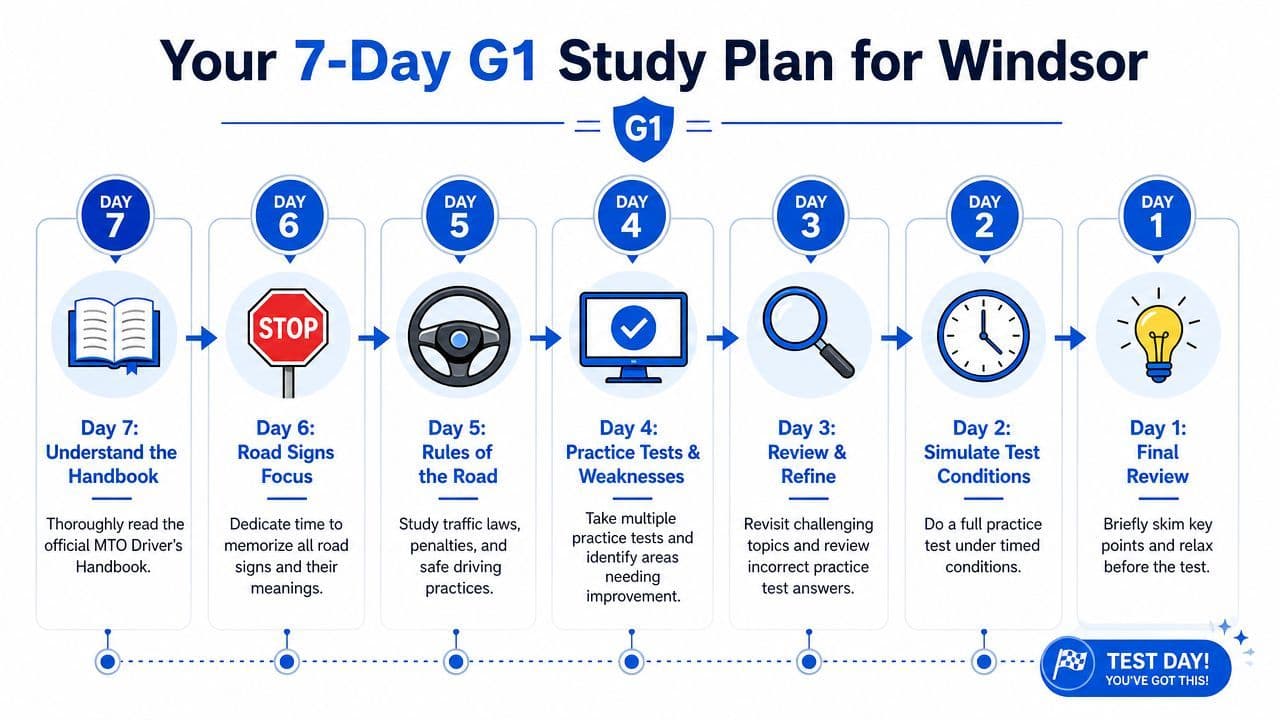
Your seven-day countdown
A week is enough if you stay consistent and stop changing methods halfway through.
- Day 7
Read the Ontario Driver's Handbook once with full attention. Keep notes beside you and mark any rule that makes you pause. In my experience, the second read is faster because you already know where the friction is. - Day 6
Study only road signs. Break them into small sets. Separate warning signs, regulatory signs, and temporary signs in your notes so they stop blending together under pressure. - Day 5
Switch to rules of the road. Put extra time into right-of-way, stopping distances, school buses, lane changes, and shared-road questions. Those are common failure points because the wording is close and rushed readers talk themselves into the wrong option. - Day 4
Take a full diagnostic test on G1ready.ca and review it properly. Do not chase the score alone. Look for patterns. If you missed three sign questions from one category, that is a study problem you can fix quickly.
How to use practice properly
Practice tests should guide your next session.
Days 3 and 2 are for targeted repair. If the diagnostic shows weak road-sign recognition, stay on signs until your misses become predictable and explainable. If rules are the issue, work those questions in tight sets and review every explanation. A structured resource like how to study for the G1 test helps keep the process focused instead of random.
Use this review pattern after every session:
- Wrong because you didn't know it: Return to the handbook and read that rule again.
- Wrong because you rushed: Slow down and read every option before choosing.
- Wrong because two answers seemed close: Write the difference in plain language in your own notes.
That last step matters more than people expect.
Learners in Windsor often improve fastest when they stop doing endless mixed quizzes and start fixing one repeated mistake at a time. Ten well-reviewed wrong answers usually do more for your score than fifty fast guesses.
The final stretch
Day 1 should be light. Take one full mixed simulation, check the categories that still feel shaky, and then stop studying.
On test eve, protect your concentration. Do not stay up late trying to squeeze in one more round. The learners who pass comfortably usually arrive with a calm routine, a clear head, and a study record that already showed them where they were ready and where they needed one last correction.
Mastering G1 Question Types and Tricky Scenarios
You are sitting at the Windsor DriveTest centre, halfway through the test, and a question appears that looks familiar enough to answer quickly. That is exactly where good learners drop marks. The G1 usually punishes fast assumptions, not lack of effort.
Ontario's G1 knowledge test has 40 multiple-choice questions, split into 20 road-sign questions and 20 rules-of-the-road questions. You must get 16 correct in each section, which equals 80% per section, and a learner who scores 15 in one section fails even with a perfect score in the other, according to this overview of the Ontario G1 practice test format.
What the test is really checking
The test checks whether you can connect a sign or rule to the action a driver must take. That difference matters.
In Windsor, I see the same pattern every week. Learners often know the general topic, but they miss the exact duty. A yield sign becomes a full stop in their head. A school bus question gets answered from memory instead of from the actual Ontario rule. A lane question turns on one word, and they skip right past it.
That is why random repetition only gets you so far. A better approach is to work through Ontario driving test questions that reflect common G1 traps, then review why the wrong options looked believable in the first place. G1ready.ca helps with that because the diagnostics show whether your misses come from sign recognition, rule confusion, or rushed reading. That gives Windsor learners a cleaner repair plan than generic mixed quizzes.
Road signs that catch people out
Sign questions are often lost before the learner finishes reading the choices. They recognise the colour or shape, assume they know it, and answer from instinct.
The signs that cause the most trouble usually fall into a few buckets:
- Signs that look familiar but carry a different legal instruction
- Warning or temporary signs that call for caution, not an immediate command
- Regulatory signs where one word changes what is allowed
- School-zone and community-safety signs that trigger habit instead of rule-based thinking
The practical fix is simple. Tie every sign to a driving action on a real Windsor route. If you saw it near a school zone, on Huron Church, or coming off a busy arterial road, what would you do next? Learners remember actions better than symbols.
The easiest sign questions are the ones you translate into a driving decision before you answer.
Rules questions that punish rushed reading
Rules questions expose a different weakness. Learners answer from real-world driving behaviour instead of the written rule, or they skim the condition that changes the correct answer.
These topics deserve extra caution:
Question area Why learners miss it Four-way stops They answer from habit instead of right-of-way order School bus rules They remember the general idea, not the exact duty to stop Cyclist sharing They underestimate how specific Ontario rules can be Lane and turn questions They miss the key word that changes which move is legal
This is where a data-driven study plan pays off. If your G1ready.ca results show repeated misses in one of these categories, treat that pattern as a warning, not a fluke. I tell Windsor learners to slow down most on the questions they think they already know. Those are the ones that cost first attempts.
Video review can help when you need a change from reading. This explainer is a useful way to reset your focus before another practice round.
When a learner tells me, "I knew that one, I just read it wrong," I treat that as a test-skill problem. On the G1, careful reading gets better results than quick confidence.
Windsor DriveTest Centre Logistics and Booking
A Windsor learner can study well all week, then lose control of the day by showing up late, bringing the wrong ID, or guessing how the centre works. I see that more often than wrong-answer problems.
The provincial fee for the Ontario G1 is $158.25, and some sources describe the written test as taking about 20 to 30 minutes, while others say there is no fixed time limit, as noted in this Ontario G1 test cost and format summary. That cost changes the trade-off. A casual first attempt gets expensive fast, so the smarter approach is to treat logistics the same way you treat studying.
Use G1 test locations across Ontario to confirm the current Windsor centre details before you leave home. Addresses, hours, and check-in details can change, and learners who rely on memory create avoidable stress.
Detail Information Centre Windsor DriveTest Centre What to confirm before leaving home Current address, hours, and check-in process What to bring Accepted identification, payment method, and anything else listed by DriveTest Test components to expect Knowledge test and vision screening Booking approach Check current appointment options first, then compare them with walk-in timing Best preparation move Finish your studying before test day and bring organised documents
Windsor adds its own practical wrinkles. Traffic near busier corridors can slow you down. Cross-city trips take longer than learners expect. If you are coming from the east side, LaSalle, or Amherstburg, build in extra time instead of planning for a perfect drive.
I tell learners to make two decisions early. First, decide whether you need the certainty of a booked slot or whether your schedule is flexible enough for a walk-in attempt. Second, decide what day and time give you the calmest trip, not just the earliest opening you can find.
That is where the Windsor-specific plan and the G1ready.ca study system work together. If your diagnostic results show you are consistently test-ready, book the earliest realistic date and protect it. If your scores are still uneven, wait a few more days, fix the weak categories, and avoid paying for a rushed attempt you could have delayed.
One more local point matters. Do not stack your G1 visit beside work, class, a border errand, or another appointment. The learners who do best in Windsor give the test its own block of time, arrive settled, and walk in knowing the day is under control.
Your G1 Test Day Checklist and Final Tips
You wake up on test morning, check your pocket, and cannot remember where you put your ID. That is the kind of mistake that turns a prepared Windsor learner into a rattled one before the first question even appears.
A good test day is boring. That is the target. No scrambling, no last-minute guessing, no avoidable stress.
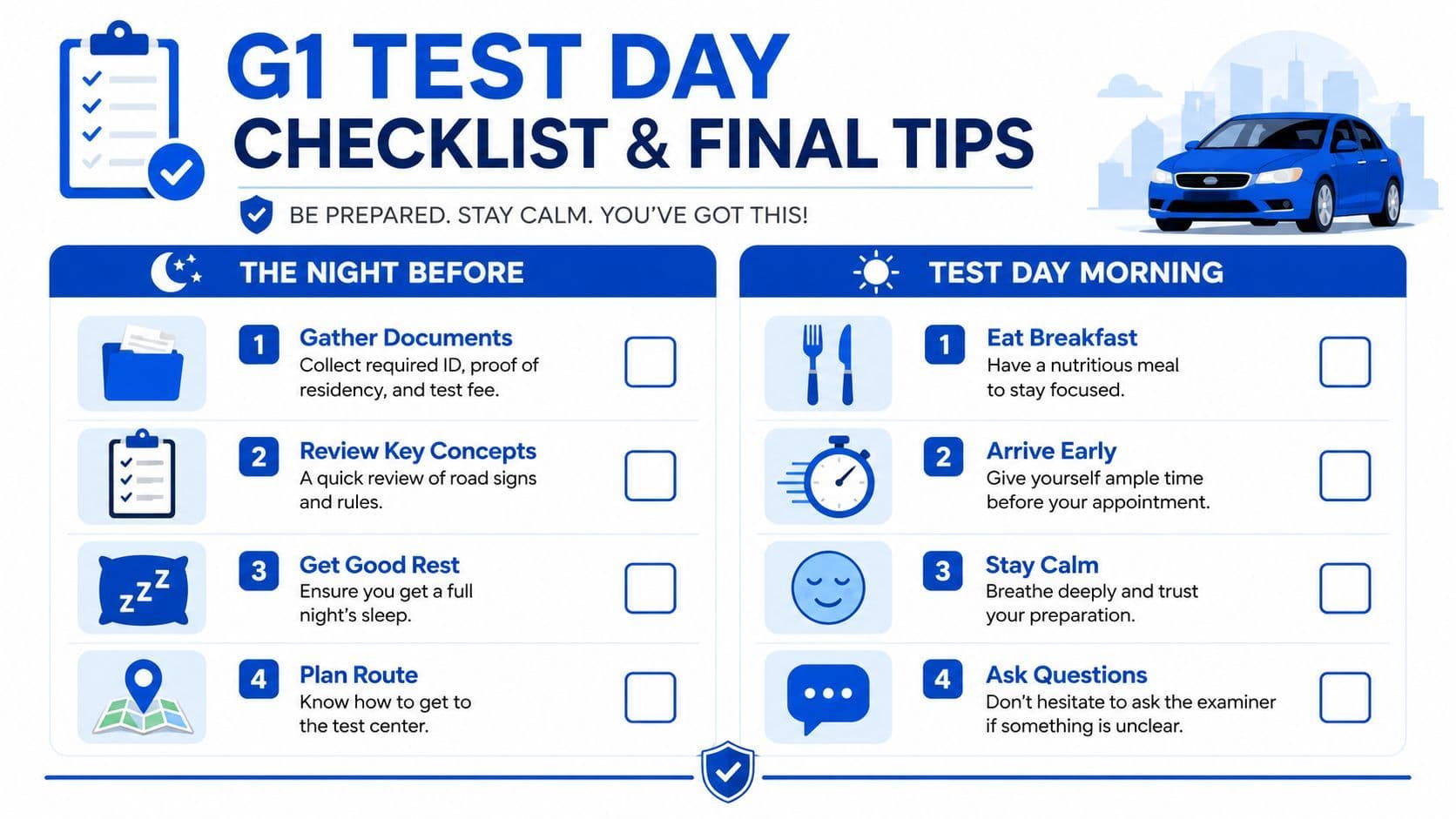
The night before
Set yourself up so the morning runs on autopilot.
- Put every document in one spot: ID, payment method, glasses or contacts if you use them, and anything else you need for check-in.
- Review lightly: Spend a few minutes on signs and any rule category that still gives you trouble. If your G1ready.ca diagnostics have been pointing to one weak area, review that and stop.
- Decide your departure time: Windsor trips can look short on a map and still get delayed by busy corridors, school traffic, or a slow cross-city drive.
- Cut off studying at a reasonable hour: Tired learners misread simple questions.
I have seen strong learners hurt themselves by treating the final night like a rescue mission. It rarely works. By test day, the job is not to cram more facts into your head. The job is to show what you already know without noise around it.
The morning of your test
Keep the routine plain and repeatable.
- Eat something light: Enough to stay focused, not enough to feel sluggish.
- Get there early: Give yourself time to park, check in, and settle.
- Use one short warm-up only if it helps: A brief practice set can steady your nerves. Ten random quizzes can do the opposite.
- Read each question all the way through: Ontario knowledge questions often punish rushing more than lack of knowledge.
- Move on from a sticky question: Protect your focus for the rest of the test.
- Check your answers before you submit: Careless misses are common, especially when nerves are high.
Trust the routine you built before test day. Calm beats last-minute effort.
One final Windsor-specific tip matters more than learners expect. Protect your mental space. Do not book your G1 attempt on a day already packed with work, class, family errands, or a border run. The learners who pass most smoothly are usually the ones who gave themselves a clear block of time, followed their study data, and walked in feeling settled rather than rushed.
That local planning piece is what generic advice misses. In Windsor, passing on the first try is not just about memorizing signs. It is about pairing a realistic trip plan with a study schedule that has already shown you where you are ready and where you are not.
Walk into Your Windsor G1 Test with Confidence
A good result on the G1 rarely comes from luck. It comes from a study method that matches the way Ontario scores the test, plus a test-day plan that keeps your head clear.
For Windsor learners, that means three things. Study the handbook with purpose. Use practice to find the category that's dragging you down. Handle the DriveTest logistics early so you're not wasting energy on paperwork, timing, or last-minute confusion.
If you've been looking for a practical answer to the search for a G1 practice test Windsor Ontario routine, that's it. Keep it structured, keep it local, and keep it honest. Don't chase perfect scores in random quizzes. Chase consistency in the areas that determine whether you pass.
You don't need to feel fully relaxed before you go. Most learners don't. You just need to know you've prepared in a way that makes the test familiar.
If you want a straightforward place to start, try a practice session on G1ready.ca and use the result to decide what to study next.


