
Many Ontario learners spend their study time memorizing isolated answers, yet the province's testing volume shows why a more deliberate system matters. In 2022, Serco conducted 1.17 million knowledge tests in Ontario, and over 1.9 million novice drivers passed the Ministry's knowledge test from 2018 to March 31, 2023. Nearly 10% of those passers needed more than three failed attempts within one visit, while about 1% needed more than five attempts, according to the Ontario Auditor General's driver examination report.
The strongest g test tips therefore go beyond cramming. A reliable routine combines handbook study, targeted practice, visual and scenario questions, realistic full tests, explanation-led review, and a calm test-day routine. The seven steps below move from learning the rules to diagnosing gaps, applying knowledge, correcting mistakes, simulating the exam, and arriving prepared. G1ready.ca adds the practice layer with registration-free exams, targeted quizzes, diagnostic testing, progress tracking, immediate feedback, hints, and explanations aligned with the Ontario G1 handbook.
1. Master the Ontario G1 Handbook Content Systematically
The Ontario official driver handbook isn't background reading. It remains the Ministry of Transportation's core reference for learner drivers, and the G1 knowledge test is built around its road rules and road signs. Ontario's licensing process expects learners to demonstrate this knowledge before moving to on-road testing, so handbook mastery gives you the same standards used to assess readiness. You can study the Ontario G1 study material alongside the official Ontario driver handbook.
Read by topic instead of jumping randomly between pages. Start with traffic signs and symbols, then work through right-of-way rules, speed limits, parking regulations, vehicle safety, and novice-driver restrictions. After each topic, explain the rule in your own words and connect it to a situation you might meet on an Ontario road.
For example, don't only memorize that a stop sign requires a complete stop. Ask where the stop must happen, what you need to check before proceeding, and how the rule applies when visibility is limited. This turns a fact into a decision process.
Build a usable study system
Create a short note for each rule that includes the sign or situation, the correct action, and the reason behind it. Mark rules you confuse, especially those involving intersections, pedestrians, emergency vehicles, parking, and licence restrictions.
Practical rule: If you can't explain why an answer is correct, you haven't finished studying that topic.
This method takes more time than last-minute cramming, and the handbook can feel dense. Its advantage is coverage. You reduce the chance of practising only familiar material while overlooking the regulations the province uses to assess learner knowledge.
2. Use Practice Exams That Mirror the Actual G1 Test Format
A practice quiz is useful only when it tests the same kind of thinking as the actual assessment. Ontario's G1 knowledge test contains 40 multiple-choice questions, divided into 20 road-sign questions and 20 rules-of-the-road questions. You need at least 16 correct answers in each section, so a strong total score can't compensate for a weak section. These requirements are documented in the Ontario G1 test FAQ.
Choose a simulator that preserves that two-section structure and gives you a clear result for each area. G1ready.ca provides free Ontario G1 test practice designed around the Ontario handbook, with mobile-friendly access and repeated attempts.
The point isn't to chase a high score on one familiar quiz. Complete a full test without checking notes, record the topics behind your mistakes, and repeat the process after reviewing those rules. A realistic format helps you practise reading carefully, choosing among plausible answers, and staying composed when questions change wording.
Treat scores as evidence, not permission
A passing practice result is encouraging, but it isn't proof that every topic is secure. Compare results across different attempts and look for stable understanding in both sections. If you repeatedly miss signs, return to visual recognition. If rules questions cause trouble, revisit the relevant handbook topic before taking another full exam.
A simulator won't reproduce every possible question variation. It can, however, reveal whether your knowledge holds up when questions arrive in a mixed order and you can't predict the next subject.
3. Identify and Target Your Weak Areas With Diagnostic Testing
Starting with a diagnostic test prevents you from treating every topic as equally difficult. The first assessment should cover the full G1 knowledge range, then separate performance by subject. That breakdown tells you whether your next study session should focus on parking, right-of-way, traffic signs, vehicle safety, or another rule category.
G1ready.ca's G1 diagnostic test can serve as this starting point. Use the result as a map, not a judgment. A weak score doesn't mean you can't pass. It means your study time has a clear destination.
Turn the result into a study priority
Rank weak areas by two questions:
- How often does the mistake appear? A topic that causes repeated errors deserves immediate attention.
- Why are you missing it? You may have forgotten a rule, confused two similar signs, or misunderstood a scenario.
Review one weak topic at a time, then test it with a targeted quiz. Keep the original error in a log and write the corrected principle beside it. When you return to a mixed test later, check whether the same mistake has disappeared.
This approach also protects your motivation. Learners often spend too long reviewing easy questions because familiar material feels comfortable. Diagnostic feedback shows what you've already handled and directs effort toward the gaps that still affect performance.
4. Study Traffic Signs and Symbols Through Visual Recognition Practice
Traffic signs test recognition, meaning, and response. Reading a written description can help you understand a sign, but it doesn't guarantee that you'll identify it quickly when its colour, shape, symbol, or wording appears in a question.
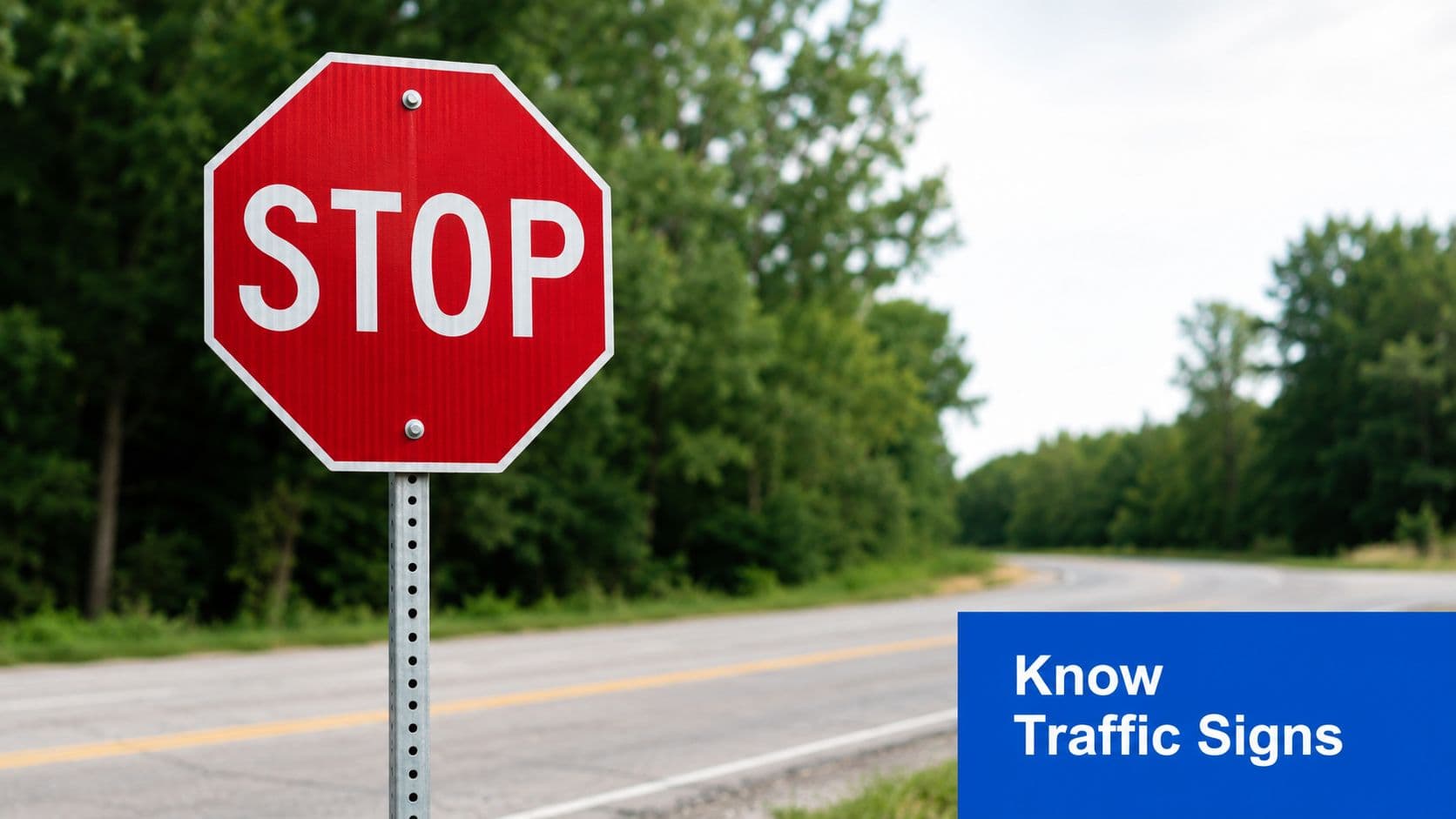
Study signs as visual groups. Compare warning signs with regulatory signs, identify how shape communicates purpose, and practise stating the required driver response. A red octagonal sign, for example, should trigger a complete-stop decision, not merely the word “stop” in your memory. Then ask what you must observe before continuing.
Use active recognition instead of passive reading
Cover the explanation and identify the sign from its image. Next, describe what the sign requires and where you might encounter it. Finally, answer a question that places the sign in a realistic road context.
Short visual sessions work well because they let you revisit confusing signs without rereading an entire handbook chapter. G1ready.ca's targeted quizzes can support this process by giving immediate feedback, hints, and explanations when recognition fails.
A sign you've seen once is familiar. A sign you've identified correctly in different contexts is usable knowledge.
Pay special attention to similar-looking signs and to signs whose meaning depends on the road situation. If you confuse two symbols, place them side by side in your notes and write the difference in plain language. Don't move on until you can explain both the sign and the action it requires.
Visual practice also has a real driving purpose. Faster sign recognition gives you more time to notice traffic, pedestrians, cyclists, road markings, and changing conditions. The G1 test is a knowledge assessment, but the knowledge should support safer decisions after licensing.
5. Practise Scenario-Based Questions to Build Real-World Application Skills
A rule can seem obvious in isolation and become difficult when several road users and conditions appear together. Scenario questions expose that difference. They may require you to interpret an intersection, determine who has the right of way, respond to a pedestrian or cyclist, or adjust your decision for weather and road conditions.
Read each scenario in stages. First identify the road layout and the people involved. Then find the rule that controls the situation. Finally choose the action that protects safety while complying with Ontario law.
Explain the decision before checking the answer
Suppose a question describes vehicles approaching an intersection with a pedestrian nearby. Don't select an answer because it sounds cautious. Ask which road user has priority, what each driver can see, and what action the rule requires. This process helps you distinguish a correct answer from a vague option that merely sounds safe.
Scenario practice also reveals rote memorization. You may remember a right-of-way phrase but fail to apply it when the order of events changes. When that happens, return to the handbook principle and create a similar example using different road positions.
Newcomers and parents should pay close attention to novice-driver restrictions. Ontario requires novice drivers to maintain a zero blood-alcohol concentration while driving, and the official handbook treats new drivers as higher-risk than experienced drivers. Those G1-specific rules are easy to blur with later licence stages, so study them as legal requirements, not optional test details. The official MTO driver handbook is the reference point for these distinctions.
Don't limit scenarios to intersections. Include parking, lane positioning, signs, pedestrians, cyclists, road conditions, and vehicle safety. The more clearly you connect a rule to a decision, the less likely you'll rely on guesswork.
6. Create a Structured Study Schedule and Maintain Consistent Practice Habits
Cramming makes every topic compete for attention at the same time. A structured schedule gives each rule space for first learning, later review, and application in mixed questions.
Assign a specific topic to each study session. Begin with handbook reading, follow with targeted questions, and finish by recording mistakes. Later sessions should revisit older topics instead of introducing new material every time. This creates a practical spaced-review cycle without requiring long, exhausting study blocks.
Use a simple progression
- Start with coverage: Read the handbook topics and mark unfamiliar rules.
- Add diagnosis: Take a broad assessment and identify the areas producing repeated errors.
- Build application: Use sign and scenario questions to test recognition and judgment.
- Measure readiness: Complete mixed practice tests under quiet, exam-like conditions.
- Adjust the plan: Give extra attention to mistakes that continue appearing in your log.
Consistency matters more than a heroic single session. Short, regular practice makes it easier to notice patterns, while irregular studying encourages you to review only what feels easy.
Ontario's official safety data gives this preparation a wider purpose. The Ontario Road Safety Annual Report recorded 9 fatalities among drivers aged 16 to 19 in 2020 and 9 again in 2021. From 2002 to 2021, casualties among drivers in that age group declined by 73%, and the casualty rate declined by 74%, but preliminary 2024 statistics still reported 24 killed and 1,399 injured drivers aged 16 to 19. The lesson isn't to study from fear. It's to treat rules, supervision, and sound judgment as part of becoming a safe driver.
7. Review Detailed Explanations and Learn From Every Incorrect Answer
An incorrect answer is useful only if you understand what caused it. Checking the correct letter and immediately starting another question leaves the original misunderstanding intact. Explanation-led review shows the rule, the reasoning, and the tempting error behind the wrong option.
After every mistake, write three short notes: what you chose, what the correct answer requires, and what you'll look for next time. If the question involves a sign, describe its visual feature. If it involves right of way, sketch the order of vehicles. If it involves a restriction, return to the relevant handbook wording and restate it plainly.
Build a mistake log that changes your next session
Group errors by cause rather than only by topic. “Forgot the rule,” “misread the question,” and “confused two signs” require different fixes. A learner who repeatedly misreads scenario wording needs slower reading and deliberate identification of facts. A learner who knows the rule but confuses exceptions needs focused comparison.
G1ready.ca includes immediate feedback, hints, and clear explanations, so you can correct an answer while the question is still fresh. Its progress tracking and performance statistics can help you see whether a weak area is improving or merely being repeated.
Review rule: Never count a question as learned until you can explain why the wrong options fail.
This step takes longer than clicking through answers, but it prevents repeated errors. It also helps you handle unfamiliar wording on test day because you're learning principles, not memorizing the appearance of one question.
7-Point G1 Test Prep Comparison
Approach 🔄 Complexity (implementation) 📊 Resource needs ⭐ Expected outcomes (effectiveness) 💡 Ideal use cases ⚡ Key advantages Master the Ontario G1 Handbook Content Systematically High, thorough, structured reading and organization High time (weeks); official MTO handbook; note-taking ⭐⭐⭐⭐⭐ Comprehensive mastery; minimal knowledge gaps Foundational learning; first-time learners; long-term retention Deep understanding; covers all topics; supports other methods Use Practice Exams That Mirror the Actual G1 Test Format Medium, setup of timed, realistic mocks and repeat attempts Moderate, realistic simulators, device, time for multiple full tests ⭐⭐⭐⭐ Improves pacing, familiarity, and test-day confidence Final-stage prep; pacing practice; assessing readiness Simulates exam conditions; instant scoring; measurable progress Identify and Target Your Weak Areas with Diagnostic Testing Low–Medium, single assessment plus analysis and follow-up Low, diagnostic tool, time to review and plan focused study ⭐⭐⭐⭐⭐ Efficient targeted improvement; higher study ROI Early in prep to prioritize topics; limited study time Pinpoints gaps; saves time; personalizes study focus Study Traffic Signs and Symbols Through Visual Recognition Practice Low, repetitive image drills and short sessions Low, image bank/flashcards, brief focused practice blocks ⭐⭐⭐⭐⭐ Rapid, accurate sign recognition on test day Visual learners; sign-heavy review; quick accuracy gains High transfer to real driving; efficient coverage of sign items Practice Scenario-Based Questions to Build Real-World Application Skills High, multi-rule application and deeper reasoning Moderate, scenario banks, time to analyze explanations ⭐⭐⭐⭐ Builds decision-making and applies rules to contexts Developing applied skills; addressing conceptual weaknesses Enhances practical judgment; uncovers hidden misconceptions Create a Structured Study Schedule and Maintain Consistent Practice Habits Medium, planning and consistent adherence over weeks Moderate, calendar/planner, regular 45–60 min sessions, practice tests ⭐⭐⭐⭐⭐ Better long-term retention; steady progress to test day Learners who can commit 4–6 weeks; spaced-repetition approach Prevents cramming; builds habits; balanced coverage Review Detailed Explanations and Learn From Every Incorrect Answer Low–Medium, disciplined review and logging of errors Low, explanation content, mistake log, time per review ⭐⭐⭐⭐ Converts errors into lasting understanding; fewer repeats After practice tests; when eliminating recurring mistakes Clarifies misconceptions; reinforces concepts; tracks error patterns
Turn Practice Into Test-Day Confidence
Your final preparation should reduce uncertainty, not create another source of pressure. Start by reviewing the handbook areas that still appear in your mistake log. Focus on the rule behind each error, then use a targeted quiz to confirm that you can apply it without relying on the original wording.
Complete one final realistic simulator without notes, interruptions, or answer-checking between questions. Use the result to confirm consistency across road signs and rules of the road, rather than celebrating one lucky score. If a topic still causes repeated errors, review it calmly instead of taking endless full tests.
Prepare the practical details before leaving home. Ontario-oriented test-day guidance recommends bringing proof of Ontario address, such as a utility bill, bank statement, or lease, and corrective lenses if you wear them. The standard Ontario G1 package fee is $159.75, covering the written knowledge test, the G2 road test, and a five-year licence period. An Ontario source also lists a $15.75 retake fee when the knowledge test must be rewritten, so check the Ontario licence information before your appointment.
Don't cram immediately before the assessment. Read your short error notes, breathe, and answer each question based on the handbook rule. A calm routine won't replace knowledge, but it can stop avoidable rushing from interfering with knowledge you already have.
G1ready.ca can provide a structured final path: use targeted quizzes for specific regulations, mixed tests for broad coverage, the diagnostic test to reassess gaps, marathon practice for extended review, and the simulator for exam-style sessions. Immediate explanations and hints support correction, while progress statistics help you decide what deserves one more review. The platform is available on phones, tablets, and desktops, with registration-free practice and unlimited retakes for flexible preparation.
Use G1ready.ca to combine Ontario handbook study with targeted quizzes, diagnostic testing, mixed practice, simulator sessions, explanations, hints, and progress tracking. Start with a diagnostic test, work through your mistake log, and finish with a realistic practice exam before booking or attending your G1 knowledge test.


