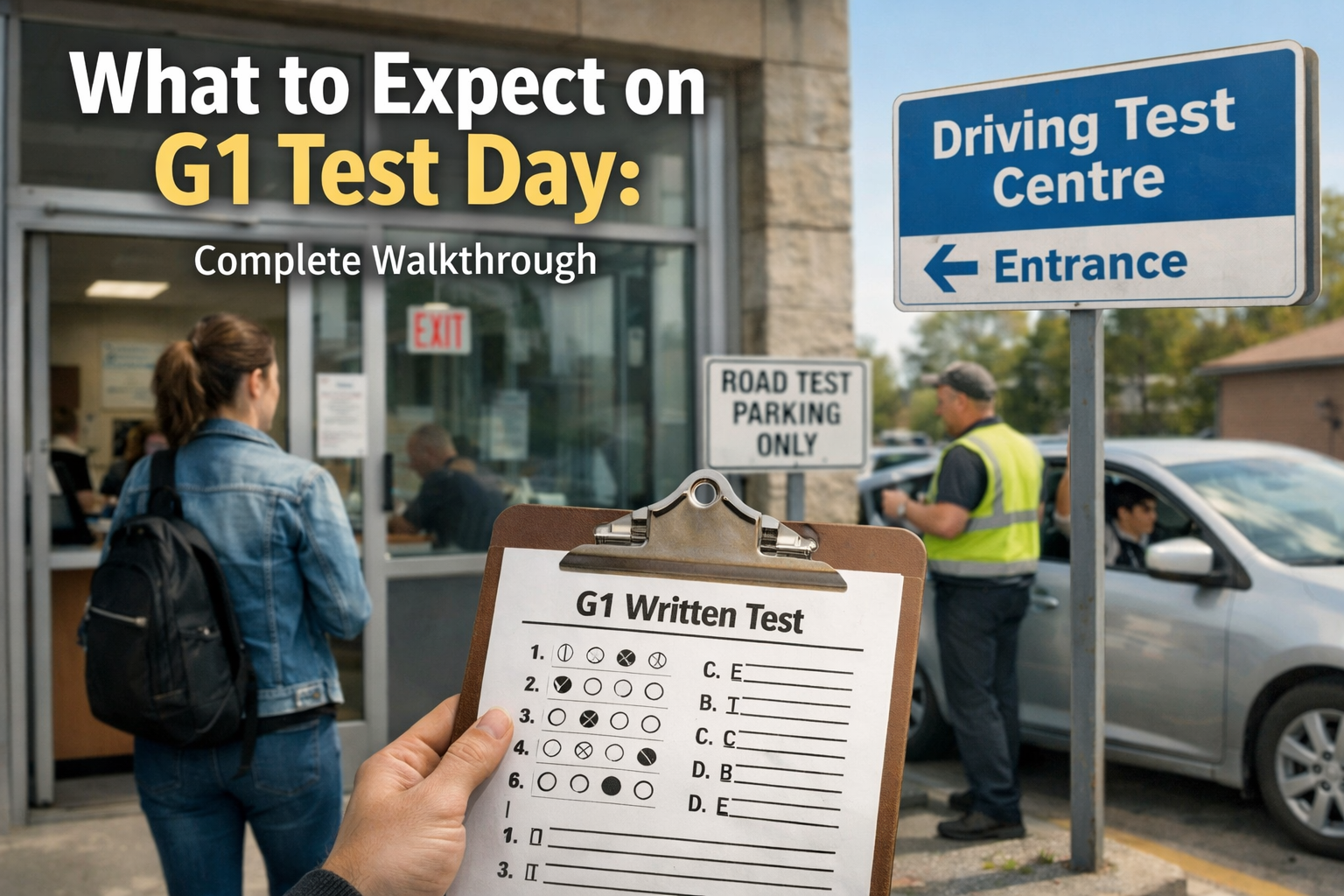
In almost all of Ontario, you can't book a G1 knowledge test appointment at a DriveTest Centre. The one exception is the ServiceOntario Bay and College location in downtown Toronto, where appointments can be booked up to four weeks in advance.
If you're on the DriveTest website right now looking for a booking button and wondering if you're missing something, you're not. It is often assumed the G1 works like other government services. It usually doesn't. For nearly everyone, the actual process is simple but inconvenient: you show up, take a number, wait your turn, and write the test when staff can process you.
That sounds annoying because it is. It also means the smartest move isn't hunting for a non-existent online slot. It's planning your walk-in properly so you don't lose half a day to a line that could've been avoided.
Searching for an Appointment That Isn't There
The usual pattern goes like this. You're ready to get your licence, you search for an Ontario G1 test appointment, you land on DriveTest-related pages, and then you start clicking around for "Book now". Nothing appears. After a few minutes, it starts to feel like the site is broken.
It isn't broken. The process is just built around walk-ins for the G1 knowledge test at DriveTest Centres, not the appointment flow people expect from passport, health card, or ServiceOntario services.
That mismatch causes most of the confusion. The phrase "Ontario G1 test appointment" sounds normal, but for most applicants it's the wrong mental model.
Practical rule: Stop looking for a general online booking system for DriveTest G1 knowledge tests. In most places, your real decision is which centre to visit and when to arrive.
If you're still choosing where to go, it helps to review a list of Ontario G1 test locations before you leave home. That alone can save you from showing up at the wrong site or picking a busier centre than necessary.
What actually happens at most centres
At a typical DriveTest visit, you arrive, check in, present your documents, complete the intake steps, do the vision screening if required, and then wait for access to the testing area. The test itself isn't the hard part logistically. The line is.
Official guidance around the process says applicants should arrive 30 minutes before their scheduled time to start processing, and the knowledge test itself usually takes 20 to 30 minutes. It is also a non-timed, multiple-choice test, and the knowledge test fee is $10.00, according to this overview of the G1 exam process. The key catch is that this "scheduled time" idea doesn't reflect how tests are commonly accessed at DriveTest Centres. They walk in.
The G1 Appointment Myth Walk-In vs Booking Explained
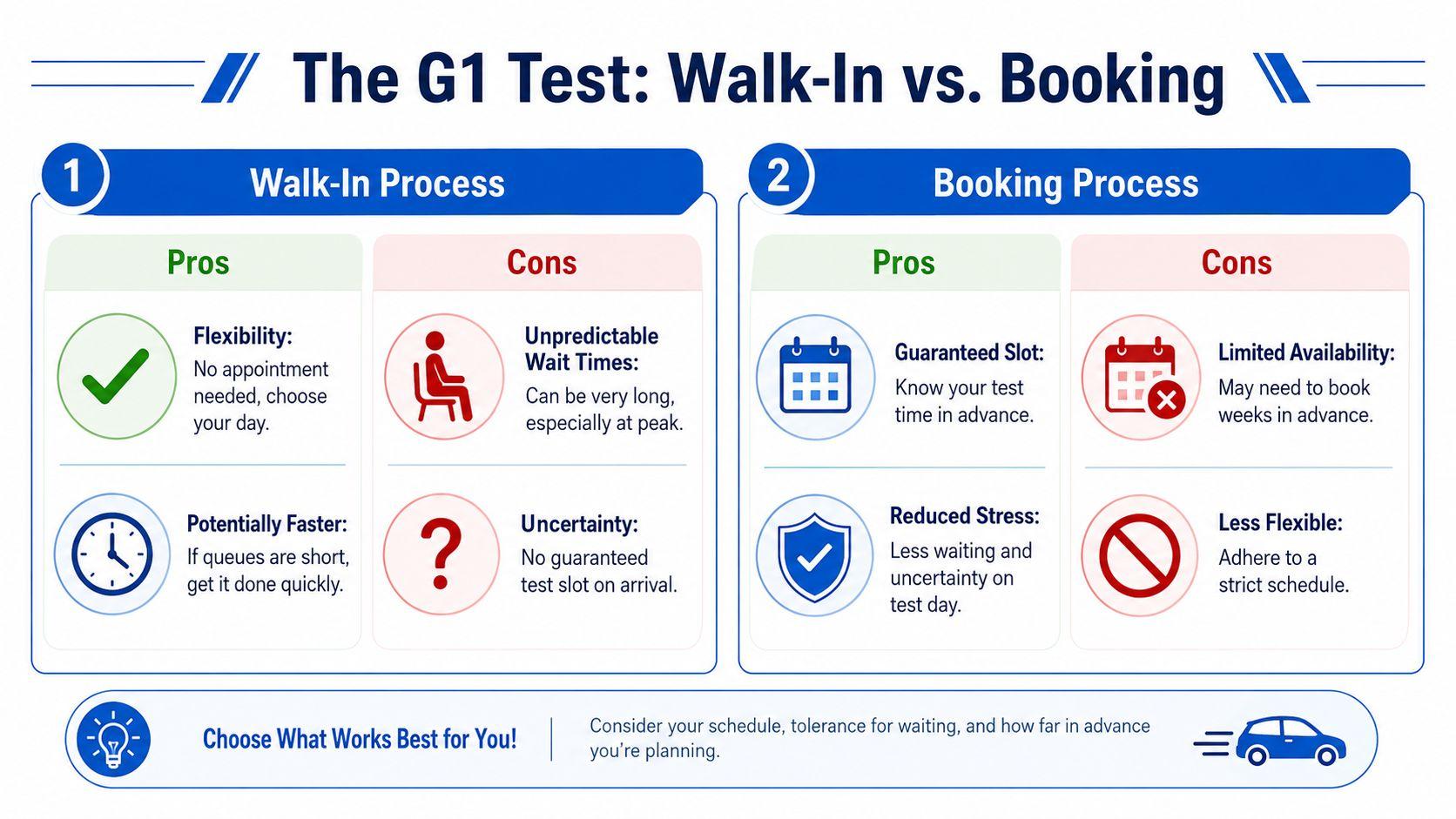
Most Ontario drivers don't book a G1 knowledge test because they can't. At DriveTest Centres, the G1 knowledge test is handled on a first-come, first-served walk-in basis, not through standard appointment booking.
What actually happens at most centres
Several Ontario drivers have run into the same issue: they assume appointments exist because that's how other services work, but the G1 knowledge test at DriveTest doesn't follow that model. Reports about locations such as Downsview, Scarborough, Mississauga, and London describe the process as first-come, first-served, with appointments no longer available there and the computer room for G1 testing effectively operating as a walk-in process, as discussed in this Toronto discussion about G1 booking confusion.
What matters in practice is simple. If you're going to a DriveTest Centre for your G1 knowledge test, act like you're attending a busy walk-in clinic, not reserving a time slot.
Feature DriveTest Centre (Walk-In) ServiceOntario Bay & College (Appointment) How you access the test First-come, first-served Booked in advance Slot certainty No guaranteed time on arrival Reserved time Flexibility Choose your day and show up Must use available booking times Best use case Most Ontario applicants Downtown Toronto applicants who want a scheduled visit
The one place that works differently
There is one exception that causes even more confusion because people hear about it second-hand and assume it applies everywhere. It doesn't.
The Ontario government states that the only Ontario location where a G1 knowledge test appointment can be scheduled is the ServiceOntario Bay and College site in downtown Toronto, and appointments there are available up to four weeks in advance, unlike DriveTest Centres where no appointments are possible, as noted on the Ontario page for getting a driver's licence as a new driver.
If you don't live near Bay and College, your plan should start with walk-in strategy, not appointment hunting.
That single exception is useful for some Toronto applicants. For everyone else, it's mostly noise. The fastest path is accepting the system as it is and planning around it.
A Strategic Plan for Your Walk-In Test Day
Treat your G1 test day like a queue-management problem, not just a test day. People who underestimate the line are usually the ones who get frustrated first.

Why timing matters more than people think
Official guidance has suggested a 20-minute wait for applicants, but reported real-world experience has been much rougher. CBC documented cases where waits ran 2 to 4 hours at busy centres, including a location in Ottawa with a wait of over 4 hours. The same reporting noted that arriving at 7:00 AM could reduce the total turnaround to about 30 minutes, although that result isn't guaranteed, as covered in CBC's reporting on Ontario DriveTest wait times.
That gap between the official expectation and the actual queue is the whole reason strategy matters. If you show up mid-morning at a busy site, you're gambling.
A better walk-in routine
A stronger approach looks like this:
- Choose an early arrival. If a centre opens in the morning, aim to be there before doors open or around the earliest practical time.
- Avoid treating every day as equal. Mid-week often feels easier than the start or end of the week because fewer people stack errands around it.
- Bring your full set of documents and payment. A missing document turns a long wait into a wasted trip.
- Protect your schedule. Don't plan a tight work shift, class, or school pickup right after.
Some people finish quickly. Some wait for hours. The only part you control is how early and how prepared you arrive.
After you've handled the line, this short walkthrough can help you visualise the process before you go:
One more practical point. Staff generally recommend arriving early enough to complete intake without rushing. If your nerves are already high, shaving uncertainty off the logistics helps more than any last-minute cramming.
Your G1 Test Day Checklist What to Bring
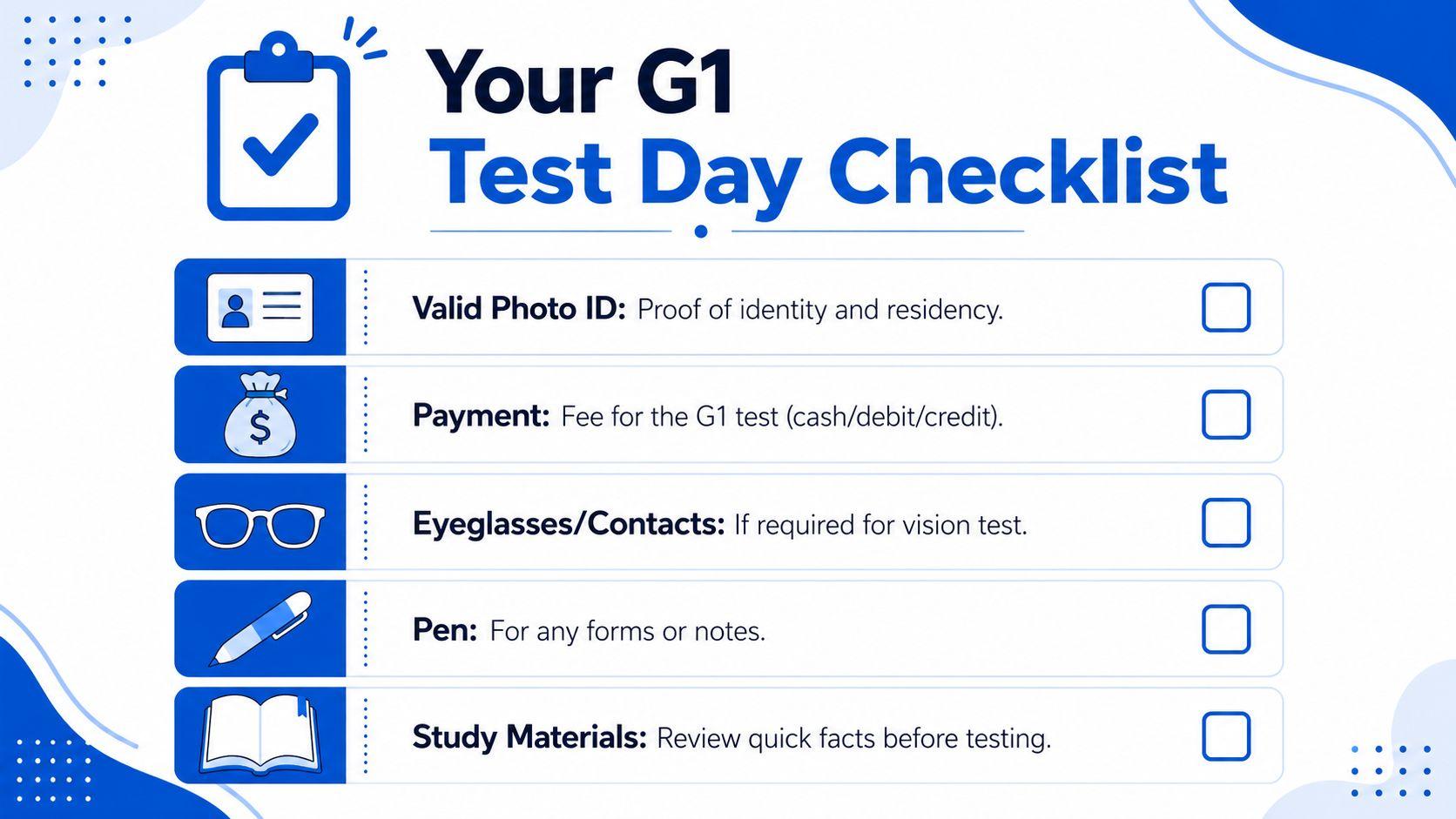
A lot of failed G1 test days have nothing to do with the test. People get turned away because they forgot documents, payment, or the glasses they normally wear.
Documents
Bring original identification that proves who you are. Staff need to verify your legal name, date of birth, and signature. In practice, people often use documents such as a passport or immigration-related identity documents, but your safest move is to confirm the exact accepted list before you leave by checking this guide on what documents you need for the G1 test.
If your documents don't line up cleanly, sort that out first. DriveTest staff can't guess what you meant to bring.
Fees and payment
The most useful number to remember is the package price. The G1 test package fee is $18.25 CAD, and it covers the written exam, your future G2 road test fee, and a 5-year licence. If you need to retake the written portion, the fee is $16 CAD, based on the details shared in this Ontario DriveTest discussion about booking and fees.
Bring a payment method that the location accepts and don't assume every counter handles every option the same way.
Small things people forget
Use this quick check before you leave:
- Corrective lenses: If you wear glasses or contacts, bring them. Vision screening is part of the process.
- A charged phone: Useful for directions, notes, and any wait-time updates.
- A snack or water: Helpful if the queue stretches longer than expected.
- Study notes: Not for the counter, but for a final review while you wait.
The best G1 walk-in is boring. You arrive early, have everything ready, wait less than expected, and leave with no surprises.
How to Pass the G1 Test and What to Expect
You've made it through the line, handed over your documents, and now the part people tend to overhype is in front of you. The G1 test is usually less intimidating than the wait to get it.
What the test feels like
The knowledge test is a multiple-choice exam on road rules and traffic signs. You answer it at the test centre, and the format is simple enough that the main risk is careless mistakes, not time pressure.
That catches a lot of first-time applicants off guard. They expect a stressful government exam with trick wording on every screen. In practice, the questions are clear if you studied the handbook properly. They feel frustrating only when you half-remember the rule and start guessing between two similar answers.
A better way to approach it is to expect precision. If a question asks about right-of-way, penalties, stopping distances, or sign meanings, one small detail can change the correct answer.
Why preparation changes everything
CBC's analysis of Ontario DriveTest pass rates shows a noticeable share of first-time G1 applicants do not pass, and rates vary a lot by location. That does not mean the written test is secretly easy in one city and hard in another. It usually points to differences in preparation.
I would treat the G1 like a memory test with consequences. If you study casually, plenty of questions will look familiar but still trip you up. If you study until the rule makes sense, the same test feels routine.
Use a study approach that is boring on purpose:
- Read the Official Driver's Handbook closely: Focus on signs, right-of-way rules, penalties, and suspension-related questions.
- Do practice questions in batches: Keep going until you can explain why the right answer is right.
- Repeat weak areas: If regulatory signs or demerit-point rules keep coming up wrong, review those again the same day.
- Slow down on the actual test: Read every option fully before you tap an answer.
If you want a clearer picture of the flow once you reach the counter, this guide to what to expect on G1 test day is a useful preview.
The goal is familiarity. By the time you sit down to write, nothing on the screen should feel new.
Frequently Asked Questions About the G1 Test
What happens if you fail the G1 test
You can rewrite the knowledge test, but you will have to pay the retake fee. That catches people off guard because the hardest part is often not the test itself. It is getting back to a DriveTest centre and waiting again. Check the fee details listed earlier in this guide before you go, so there are no surprises at the counter.
Can I take the test in a language other than English
Yes. The G1 knowledge test is available in multiple languages. As noted earlier, it is a multiple-choice test on a computer, and it is typically completed fairly quickly by those who have studied well.
If language support matters to you, confirm availability with your specific DriveTest location before you head out. That small check can save a wasted trip.
Do I need to bring my own vehicle
No. You do not need a car for the G1 knowledge test.
You only need your identification, the required fee, and the documents listed earlier in the checklist section. A vehicle becomes relevant later, when you book a road test for G2 or G.
If you want to practise before you line up at DriveTest, G1ready.ca is a useful place to start. It offers free Ontario G1 practice tests that mirror the actual exam format, with targeted quizzes, instant explanations, and mobile-friendly study sessions that fit around school, work, or commute time.