You open a Chinese practice set the night you mean to book, and the first school-bus question looks like one you already got right. Your teenager can read every option. So can you, if you drove for years before moving to Ontario. The trouble starts on the next version, when a median appears in the middle of the road, or an emergency vehicle comes from behind instead of ahead. A G1 practice test Chinese learners can trust only pays off when every translated question ends in the Ontario rule and the trigger that makes that rule apply. Say that rule back in one sentence, in Chinese and then in English, before you spend the booking fee. The pass mark comes before the questions, because a strong signs score cannot rescue a weak rules score.
Ontario G1 Test Format and Pass Marks at a Glance
Ontario's G1 knowledge test is multiple choice, and it is marked as two separate sections: road signs and rules of the road. Each section has 20 questions. You pass a section only when you answer at least 16 of those 20 correctly. Write that line down before you open another quiz, because the marker does not blend the two piles into one average.
Section Questions Pass mark Typical topics Road signs 20 At least 16 correct Regulatory, warning and guide signs Rules of the road 20 At least 16 correct Right-of-way, speed, lane changes, parking, demerit points
A learner who scores 19 on signs and 14 on rules still fails. The signs section cannot donate its spare correct answers to the rules section. Families often celebrate a combined total that looks close to 32 out of 40, then learn the result is a fail because one half missed the line. Practise with the two scores written side by side, the same way the test is marked.
The knowledge test is offered in Chinese. You can work through a question in the language you think in, while the content stays Ontario-specific. Chinese removes the pause over an unfamiliar English word. It does not change the sign, the speed rule, or the restriction the question is testing.
What you need before a G1 is issued
Applicants must be at least 16 years old, pass a vision test, and demonstrate knowledge of traffic signs and the rules of the road before a Class G1 licence is issued. The Ontario page on getting a G driver's licence places that test at the start of a graduated system introduced in 1994 for people applying for a first car or motorcycle licence. The system has two learning levels, G1 and G2, and it requires two road tests before full Class G privileges. The minimum path takes at least 20 months: Level One normally lasts 12 months, followed by at least 12 months at Level Two. An approved driver-education course can shorten that first waiting period to 8 months.
Those months exist for supervised practice on the road. The knowledge test itself is about signs, traffic laws, safe-driving principles, and G1 restrictions. Leave parking manoeuvres and lane changes in a real car for later. A practice set that drills three-point turns will not raise a rules-section score.
Practical rule: Count each section on its own. Nineteen correct signs plus fourteen correct rules is a fail, not a near pass.
Set a target of 16 out of 20 in each section. On three separate attempts, write how many more correct answers the weaker section still needs. If signs already sit at 18 and rules sit at 13, the next sitting belongs to rules.
Sample Questions and Why Each Answer Is Correct
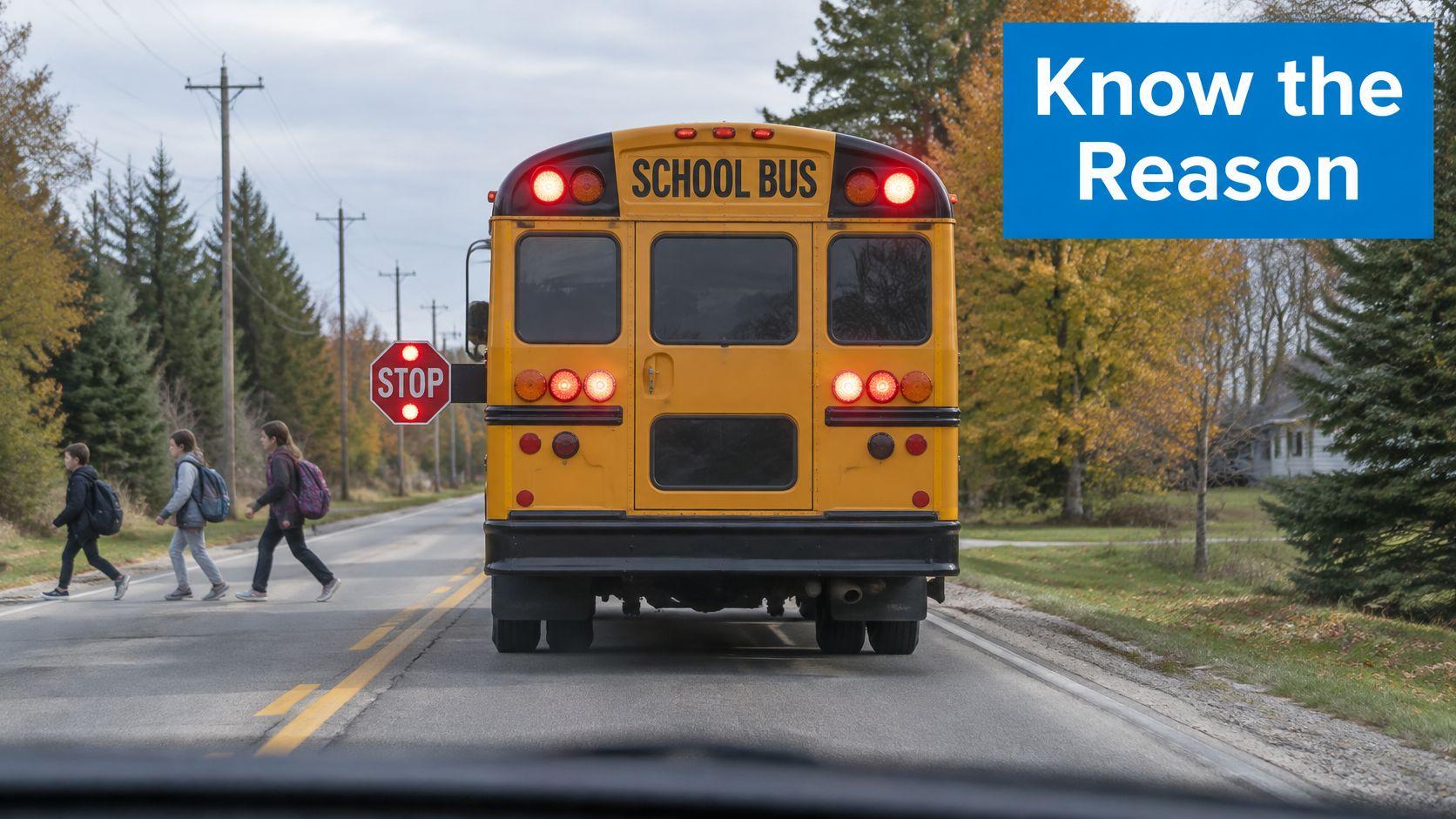
A school bus stops ahead, its red lights flashing and stop arm extended. Before choosing an answer, identify the detail that activates the Ontario rule. Each worked question below ends with a Chinese sentence you can say back without looking. Use it to connect the situation, the trigger, and the required action.
School bus with lights and a stop arm
Sample A. A school bus ahead of you on a two-lane road has flashing red lights and an extended stop arm. What do you do?
Answer: Stop and remain stopped until the red lights stop flashing and the stop arm folds in.
The trigger is the flashing red lights and extended stop arm. You do not wait until you see children. On a road without a median, traffic approaching from both directions must stop.
An incorrect option might say, “Only vehicles behind the bus must stop; oncoming drivers may slow down and pass.” That treats the bus like an ordinary parked vehicle. Its red lights and stop arm create a stopping requirement for approaching traffic on both sides of an undivided road.
遇到校车闪红灯并伸出停车臂时,没有中央分隔带的道路上双向车辆都必须停车,直到红灯停止闪烁且停车臂收回。
The same bus when a median divides the road
Sample B. Keep the same bus, lights, and stop arm, but add a raised median. You are approaching from the opposite direction, across that median. Must you stop for the bus?
Answer: No. Only traffic on the bus's side of the median must stop.
The changed detail is the raised median, which physically separates the opposing traffic flows. In this situation, oncoming traffic across the median does not have the same stopping requirement.
Compare the questions like two nearly identical pictures: the median is the difference that changes the answer. Choosing “everyone stops” carries the first answer into a scene where its condition no longer applies. The English term divided highway helps you recognise that distinction.
道路有中央实体分隔带时,只有与校车同侧的车辆必须停车,分隔带另一侧的对向车辆不必为该校车停车。
Watch how the bus's lights and stop arm signal the stopping requirement:
An emergency vehicle coming from behind
Sample C. On a two-lane road, an emergency vehicle with flashing lights and a siren approaches from behind. What do you do?
Answer: Pull to the right edge as soon as it is safe, and stop.
The trigger is the approaching emergency vehicle's lights and siren. Your response should clear its path predictably. On the two-lane road described, that means moving safely to the right edge and stopping.
“Speed up so it can pass” is an incorrect answer because accelerating keeps your vehicle moving in the emergency vehicle's path. Stopping in the middle of the lane also leaves that path obstructed. The English phrase yield to an emergency vehicle means taking the required action to give way, rather than reducing speed.
在双向两车道道路上,后方有闪灯并鸣笛的紧急车辆接近时,应在安全的情况下尽快靠右侧路边停车让行。
Nine points and a novice licence
Sample D. A novice driver asks how many demerit points lead to a suspension within a two-year period.
Answer: Nine or more demerit points for a G1 or G2 driver.
Start with whose licence the question names. A Level One driver holds a G1 licence; a Level Two driver holds a G2 licence. Both are novice drivers, so the novice threshold applies.
The trigger here is a licence category rather than something visible on the road. Using the fully licensed driver's threshold would answer a different question. Likewise, choosing a smaller number remembered from another penalty rule mixes up separate consequences. Match the licence category to the suspension threshold before selecting an answer.
G1或G2新手驾驶员在两年内累积九分或以上的记分处罚,会被暂停驾驶资格。
A complete answer names both the trigger and the action it requires.
For each topic you study, write practice questions and answer them first in Chinese, then in English. Ask a parent, classmate, or instructor to check whether both versions identify the same condition and response. If your explanation says only “stop” or “give way,” add the detail that tells you when that action is required.
Why the Chinese Version Still Tests Ontario Rules
The myth is simple, and it is expensive. A Chinese translation feels like preparation for Ontario rules. It is a study aid. Ontario offers the G1 knowledge test in several languages, including Chinese, so newcomers can read the questions. The Ontario announcement on additional G1 test languages supports that access. The requirement that remains is knowledge of Ontario signs, rules of the road, and road safety, not skill at matching a translated sentence to a memorised bubble.
Think of a Chinese explanation as a map drawn in your own language. The street names become readable. The streets are still Ontario's. A right-of-way habit from another city can send you down the wrong one even when every word on the map is clear. A guide to G1 test languages is useful for choosing Chinese at the centre. It does not replace the rule behind the wording.
Four errors that cost the most points
1. Mixing up must, should, and may. In a translated option, a recommended habit can look like a legal order. Must is the duty. Should is advised practice. May is permission, not a command. Fix it by writing the English legal word beside the Chinese every time those three appear. If the English word is "should," do not pick the option that says you are required to act.
2. Memorising the translated question. You recognise yesterday's answer and miss today's scene. The school-bus pair above is the pattern: same lights, different road, different duty. Rewrite every question you miss as one sentence that includes the trigger, such as flashing red lights, a siren from behind, or a median. If the sentence still works after you swap one fact, you learned a slogan, not a rule.
3. Importing a foreign habit. Right-of-way, school zones, and emergency vehicles are where this shows up most. The Ministry warns that driving customs vary by jurisdiction and tells experienced international drivers to study Ontario's handbook even when they already hold a foreign licence. A legal pass in another country does not answer an Ontario school-zone question. When a practice item feels "obvious," pause and ask which Ontario rule makes it obvious.
4. Treating demerit points as trivia. They are a licence risk from the first day you hold G1. The official MTO handbook on keeping your driver's licence states that a Level One or Level Two driver will have the licence suspended after accumulating nine or more demerit points within a two-year period. That threshold differs from the rules for fully licensed drivers. A question about points is asking whether you know the novice consequence, not whether you can recite a general chart.
Translation lowers the language barrier. It can also raise false confidence if you never have to interpret Ontario's own wording.
Run a transfer test on any item you got right. Cover the options and change one condition: add a median, move the siren from ahead to behind, or change the driver from G1 to a full licence. If your answer only survives because you have seen that exact question before, the rule is not learned yet. Book after the altered question still produces the right sentence.
Topic Areas to Master Before Test Day
Drilling random items before you know the map wastes the short sessions most families have. The official MTO driver's handbook section on getting your driver's licence sets out a checklist that can be examined: seatbelts, traffic signals, emergency vehicles, headlights, speed limits, freeway entry and exit, streetcars, school buses, demerit points, passing, collision reporting, road sharing, and bicycle-related passing rules. Five groups make that list something you can finish.
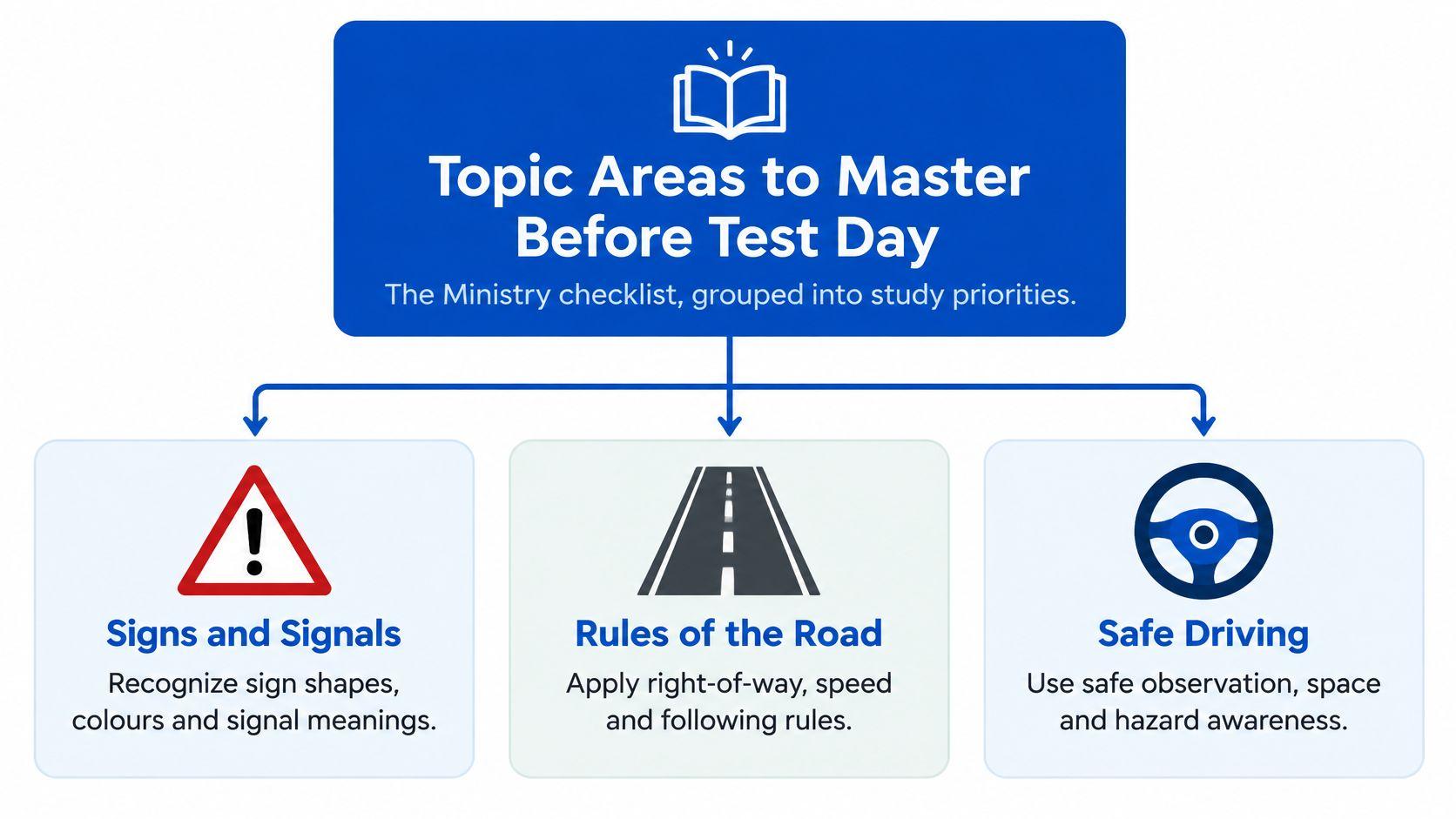
Domain Official topics Rule type Practice focus Signs and signals Regulatory, warning and guide signs, traffic signals, emergency vehicles Mandatory Read shape and colour first, then state the required action Speed and freeways Speed limits, freeway entry and exit, safe speed Mandatory plus judgement Match the number to the road type and the conditions Sharing the road Streetcars, school buses, right-of-way, bicycle-related passing rules Mandatory Name the trigger that starts the stop or yield Vehicle and safe driving Seatbelts, headlights, passing, lane changes Mandatory Separate the legal minimum from safe practice Penalties and procedures Demerit points, collision reporting Mandatory Nine points in two years suspends a Level One or Two driver
How the five groups differ in practice
Signs and signals are the fastest win. Regulatory, warning, and guide signs, plus traffic signals and emergency vehicles, reward short daily sets. Start with shape and colour, then say the action. A yellow diamond is a warning to prepare, not an order to stop. Pair that habit with a closer look at Ontario regulatory signs, where a red circle or an octagon is giving an order.
Speed and freeways ask for a number and a judgement together. Match the limit to the road type, then ask whether rain, a curve, or a ramp means the safe speed is lower than the posted one. Freeway entry is a match of speed to the gap, not a stop at the end of the ramp unless a sign says so.
Sharing the road is almost pure trigger practice. A streetcar loading passengers, a school bus with its arm out, a cyclist you intend to pass, or two vehicles arriving at an intersection: name what starts the stop or the yield before you pick.
Seatbelts, headlights, passing, and lane changes look like common sense, which is why translated options blur the line. The legal minimum, such as a seatbelt worn, is not the same sentence as a tip about checking the mirror twice. Passing has conditions that forbid it. A smooth lane change that ignores a blind spot can still be the wrong option on the test.
Penalties and procedures close the list. Demerit points and collision reporting are mandatory knowledge, not background reading. Know what gets reported and what a novice suspension looks like, then stop. You do not need a second handbook chapter to recognise those items.
Must, should, and may
The Ministry's own sample questions use scenes, not vocabulary lists: skids, lending a licence, entering a highway, lane changes, and safe speed. You can understand the picture and still miss the category. Must binds you. Should recommends. May allows. When a Chinese option sounds polite and sensible, check which of those three English words the rule uses. Sensible is not always required.
Study signs first, in short sessions, because recognition is quick to test. Move next to scenario rules, where a flashing signal, a school bus, or a private-road entrance decides the action. The day before the test, review one page that lists only triggers and the action each one starts. Leave new topics off that page.
How to Build a Four-Week Study Routine
Thirty to forty minutes a day is enough if each week has one job. Mixing diagnosis, rereading, and timed quizzes into every evening is how people study for a month and still miss the same section.
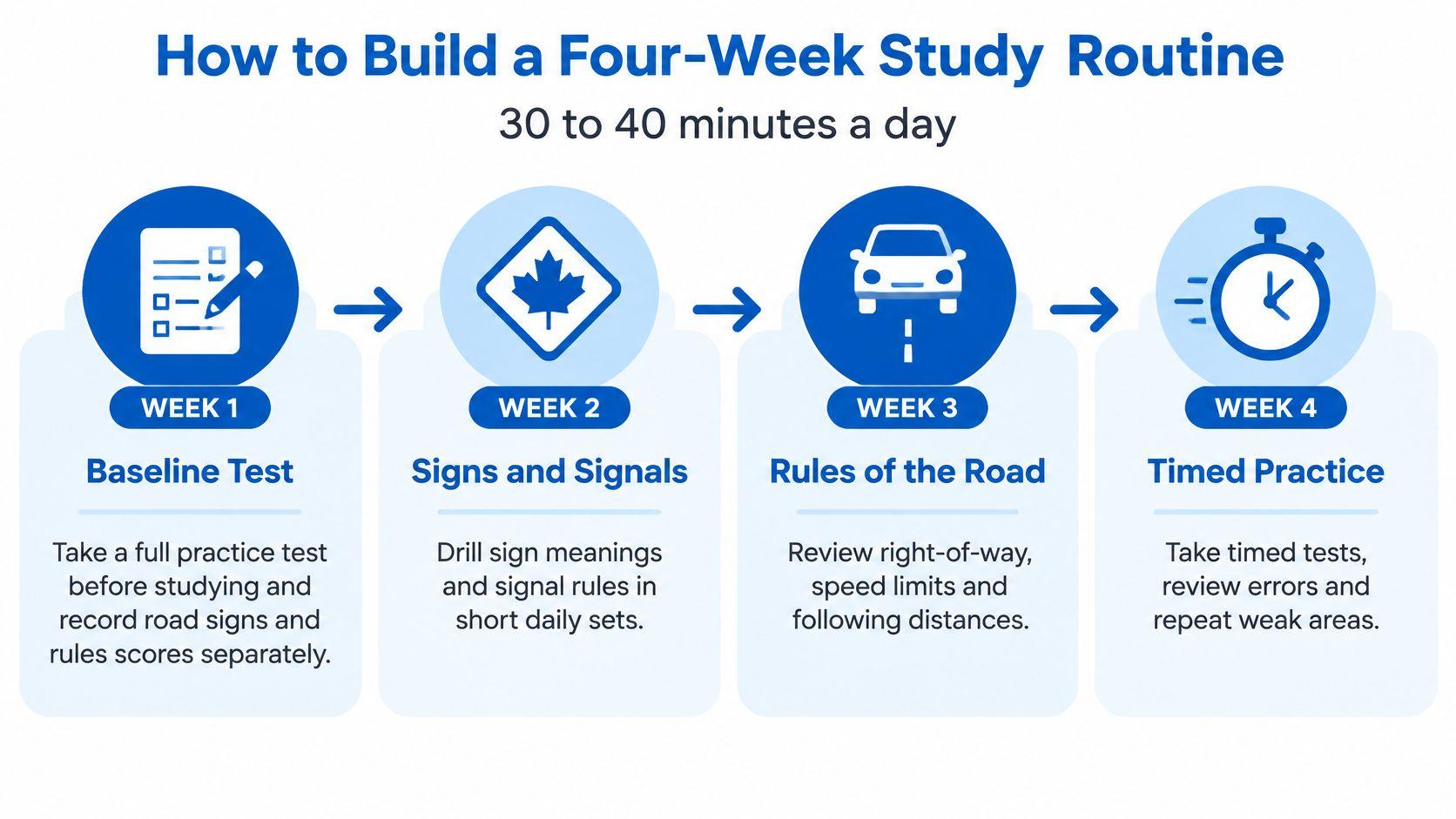
Week one diagnoses. Take a full practice test before you study anything new. Record the road-signs score and the rules score separately, and write down every question you missed, including the one you guessed right but could not explain. Do not repair the misses yet. A baseline you edit on the spot hides the weak half.
Week two is for understanding, not speed. Sort the misses by the five domains. For each one, read the rule and name the trigger, then write one English sentence and one Chinese sentence. If you cannot finish the Chinese sentence without looking at the options, you do not have the rule yet. Keep the pile small. Three rewritten misses beat twenty items you only reread.
Week three mixes the two sections. Run quizzes that jump from a sign to a right-of-way scene to a freeway entry, the way a real paper does. Aim for at least 16 correct in each section on two separate attempts. A single lucky run does not count. You are checking whether the sentences from week two still work when the topic changes every question.
Week four is timed confidence. Complete two full practice tests on consecutive days, with a clock, and no notes. Then rest the day before the test. A light look at your trigger page is enough that morning. New material the night before crowds out the rules you already rebuilt.
The log that shows whether to go back
Keep three columns: the date, the two section scores, and the three topics that caused the most errors. A way to track G1 practice progress only helps if those three topics are specific, such as "school bus with a median" or "yielding to a siren from behind," rather than "rules."
If a score drops after week three, go back to the topic review for that section. Do not add a new chapter to compensate. The drop means a trigger is still loose. Cramming questions without reading the rule produces the opposite of readiness. You will recognise an old answer and miss the scene that changed one fact.
Each week has one job. Diagnosis, then sentences, then mixed recall, then a timed test and a rest.
Book Your G1 Test When Practice Scores Stay High
Book from scores, not from how many weeks you have owned the handbook. You are ready when you reach at least 16 out of 20 in both road signs and rules of the road on two consecutive full practice tests, taken with a timer and without notes. If one section stays under 16, give that topic group one more week before you choose a date.
Before you look at the score sheet, confirm three practical points. Check that the centre offers the Chinese version when you book. Bring identification. Bring glasses or contacts if you wear them, because the vision test is part of the same G1 application visit.
Once both scores hold, book through Ontario's official channel and leave enough calendar time to rebook if a section goes badly. Practice tests that mirror the official format, with separate scoring for signs and rules, are what show the target in each half. G1ready.ca offers free G1 practice tests with no registration, instructor-reviewed answers, and unlimited retakes, so you can keep testing until those two scores stay put. Parents and instructors can run the same score rule with a learner instead of guessing from how confident the kitchen-table session felt.
Take a full practice test today. Record both section scores. Compare each one with 16 out of 20, and book only after the weaker section has cleared that line twice in a row.
G1ready.ca gives Ontario learners free practice that separates road signs from rules of the road, with a clear explanation after every miss so a Chinese study session still ends on the Ontario trigger. Use it to run the two timed tests that decide whether you book, then keep going until both scores stay at the pass line. Start with a full set today at G1ready.ca.