
You've finished another G1 practice quiz, and the result looks encouraging. But some answers felt familiar, a few were guesses, and you still hesitate over right-of-way scenarios. Should you keep studying, change your approach, or prepare to take the official test?
Tracking your progress means separating familiarity from knowledge you can use without help. A useful record shows what you answered independently, which rules still cause trouble, and whether you remember them after a break. Confidence matters, but it isn't evidence of readiness.
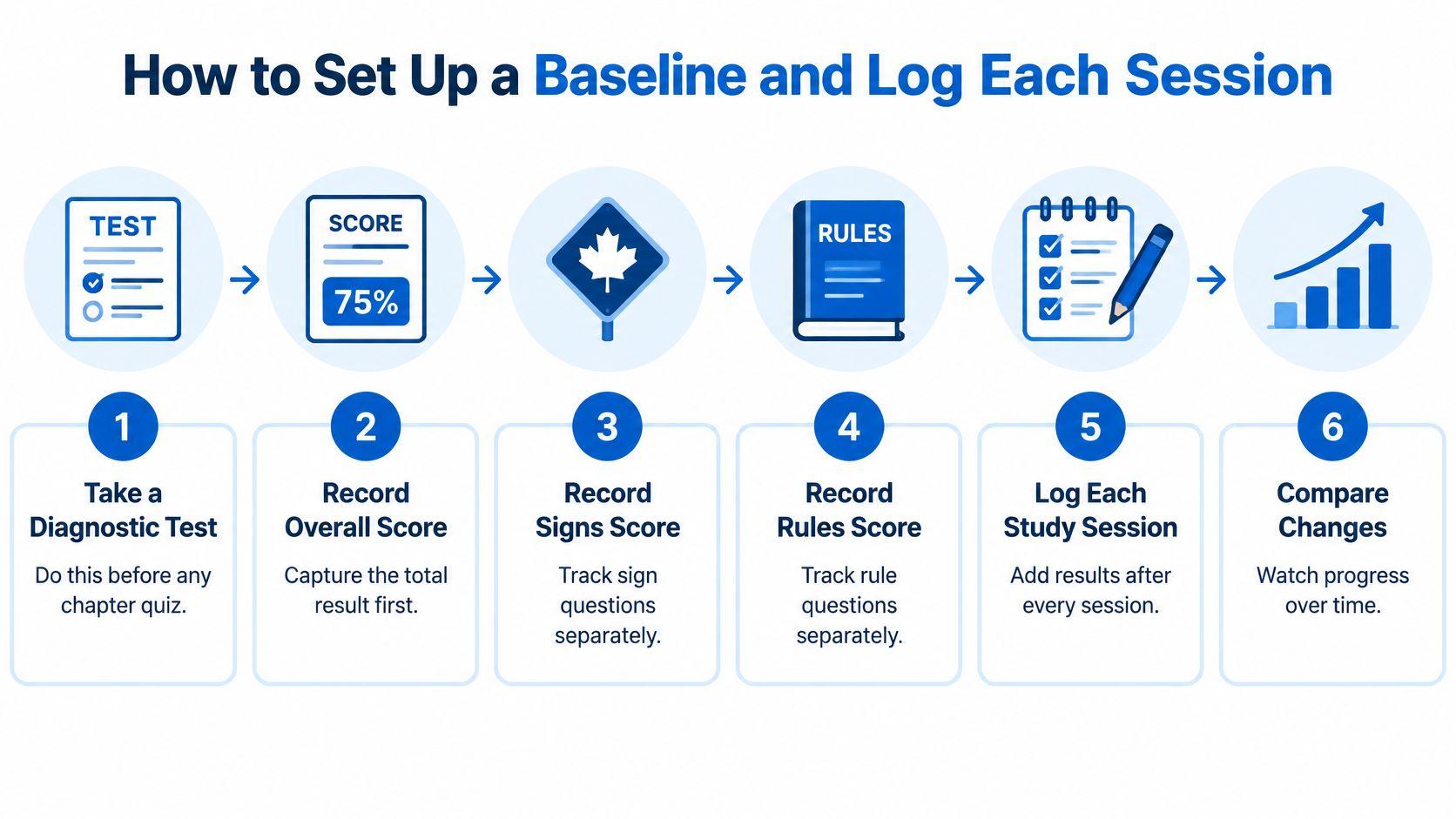
How to Set Up a Baseline and Log Each Session
Take a diagnostic test before any chapter quiz or focused review. Record the overall result, then record signs and rules separately. Keep that original result unchanged, even when you improve, because you need an honest starting point.
Ontario applicants must be at least 16, pass a vision test, and pass a knowledge test covering traffic signs and rules of the road, according to the Ontario driver's handbook. Your tracking system should therefore measure knowledge coverage first, then independent performance under test-like conditions.
Build a log you can actually maintain
A spreadsheet, notebook or phone note is enough. Use consistent labels so you can compare sessions without reconstructing what happened.
- Create a row for each session. Include the date, quiz name, overall score, first-attempt signs accuracy, first-attempt rules accuracy, topics missed, error type and average time per question, because results are only comparable when you know the conditions. Keep unresolved concepts in a separate notes column.
- Classify every incorrect answer. Mark it as recall, interpretation or careless reading, because forgetting a rule needs a different fix from misunderstanding a scenario. Write the specific issue, such as confusing who yields when vehicles arrive together, rather than writing intersections.
- Treat guesses as unmastered. Preserve the quiz's displayed score, but mark guessed answers separately and count them as misses in your mastery record. Otherwise, a lucky selection can hide something you still need to learn.
- Set a stable study threshold. Use 90% correct across two consecutive mixed quizzes as your personal mastery target, not an official pass mark. This prevents a single unusually strong result from becoming your booking decision.
- Finish with an independent simulation. Take a timed, mixed-topic quiz without hints or immediate feedback, and give it its own log row. Separating simulation results from supported practice keeps assistance from inflating your readiness assessment.
Keep learning results separate from assessment results
A supported practice attempt tells you what you're learning. An independent first attempt tells you what you can retrieve. Both are useful, but they answer different questions.
Don't average every attempt together. Repeatedly answering familiar questions can improve that average while the same misunderstood rule remains unresolved. Retain your first-attempt result, latest result and outstanding concepts so improvement doesn't erase the evidence you need.
What Your Progress Numbers Actually Tell You
An overall percentage can conceal a weak category. In a hypothetical session, you might score 75% overall while managing only 40% in a particular rules category. Studying more signs because they feel comfortable won't fix that gap.
Read each metric alongside your original diagnostic result. A higher total is encouraging only when you can identify what improved and whether you achieved it independently.
Progress metrics and the targets to aim for
These are study targets, not a statement of Ontario's official passing requirements. In particular, the section target below is a learner-set checkpoint. Confirm current Ministry of Transportation requirements before relying on any practice number.
Metric What it tells you Target to aim for First-attempt accuracy Your true baseline on questions you have not seen before Rising across sessions, reaching 90% or higher Signs and rules split Whether one section is dragging the total down 16 of 20 or better in both sections Delayed-retention accuracy Whether answers stick after a day or more At or above your overall baseline Corrected retention Independently correct answers divided by all scheduled reviews Rising each week, with guesses counted as misses Error frequency by topic Which rule keeps coming back No topic missed more than twice Consecutive sessions at threshold Whether mastery is stable or a one-off Two or more in a row before booking Time per question Pace under pressure Steady, and not rushed when you are unsure
First-attempt accuracy is most useful on unseen questions or delayed checks. Retakes can demonstrate learning, but they mustn't replace the original result. Keep both so you can distinguish improvement from recognition.
The signs-versus-rules split tells you where to allocate study time. Delayed retention tells you whether that study lasted beyond the session. Topic errors show what needs attention, while consecutive qualifying sessions help you judge consistency.
Read the conditions with the score: A strong result with hints isn't equivalent to the same result without assistance.
Time per question needs context too. Faster isn't automatically better if you've started overlooking qualifications in the wording. After each session, check the signs-versus-rules split and first-attempt accuracy before celebrating the overall percentage.
Using Diagnostics to Target Your Weakest Topics
A learner misses 8 right-of-way questions, reviews the topic, then misses 3 on a comparable follow-up set. That pattern gives a clearer view of progress than an overall score rising from 62% to 82%, because it shows whether a specific weakness is improving. The comparison is useful only when both sets cover similar material at a similar difficulty.
Start with your recent sessions, sorted by topic rather than overall score. A G1 diagnostic exam can provide a structured starting point. For each topic, record incorrect answers alongside the number attempted. A high error count means less if that topic appeared far more often than others.
Error patterns, likely causes and fixes
Error pattern What it usually means Fix before retesting Wrong after reading the rule summary Recall gap Review the rule, then test yourself on the topic the next day Right answer, but unsure why Unmastered guess Count it as a miss and explain the rule aloud Wrong on scenario questions, right on rule questions Interpretation gap Practise the rule with different wording Wrong on questions already known Careless reading Read the full question and every option before answering Same topic missed twice Recurring misconception Put the topic into targeted review Strong signs, weak rules Topic imbalance Give rules more study time until delayed retention matches your baseline
Match the correction to the error. If you forgot a rule, retrieve it from memory after reviewing it. If you misread a scenario, practise the same rule in a differently worded question or road situation.
A correct answer after reading an explanation is a starting point, not evidence of mastery. Close the explanation, then answer a new question on the concept without help. Move a topic into targeted review if the same misconception recurs or your delayed results show that the rule has not stuck. Focused quizzes let you work on that specific weakness before returning to mixed questions.
Scheduling Reviews Around Your Progress Data
Repeating a quiz immediately can measure recognition rather than lasting knowledge. Put every missed or guessed item into a review queue, then explain its governing rule in your own words before scheduling an independent check.
Use the queue to decide what comes next instead of choosing whichever quiz feels easiest. A G1 study plan should leave room for these delayed checks, not just new material.
Review schedule and mastery checks
Treat this as a practical study schedule, with intervals counted from the original learning session.
Review When What to check Counts as mastered when Initial review Next day Every missed or guessed item Answered correctly and explained in your own words Second review About three days later Same items plus one new mixed quiz Correct without hints Third review About one week later Full topic set Correct and answered with confidence Mixed retest Two consecutive sessions Mixed quiz with no feedback 90% or higher each time
Corrected retention means independently correct answers divided by all scheduled review items. In a worked example, 18 correct answers out of 24 scheduled items gives 75%. Guesses remain unmastered, and unfinished scheduled items shouldn't disappear from the denominator.
Record confidence alongside correctness. A confident wrong answer deserves particular attention because you need to correct the reasoning, not merely strengthen recall.

Keep the dashboard honest
Watch for these misleading patterns:
- Feedback dependency: Hints and explanations help during learning, but leave them off during retention checks.
- Recency bias: Compare the latest result with recent independent attempts instead of treating it as your entire trend.
- Topic imbalance: Keep signs and rules visible separately so familiar material doesn't conceal weak understanding elsewhere.
Your dashboard only needs rolling first-attempt accuracy, delayed-retention accuracy, error frequency by topic and the count of consecutive threshold sessions. For a short mobile session, aim to make the queue manageable in about 15 minutes. If it won't fit, divide it by topic rather than rushing through every item.
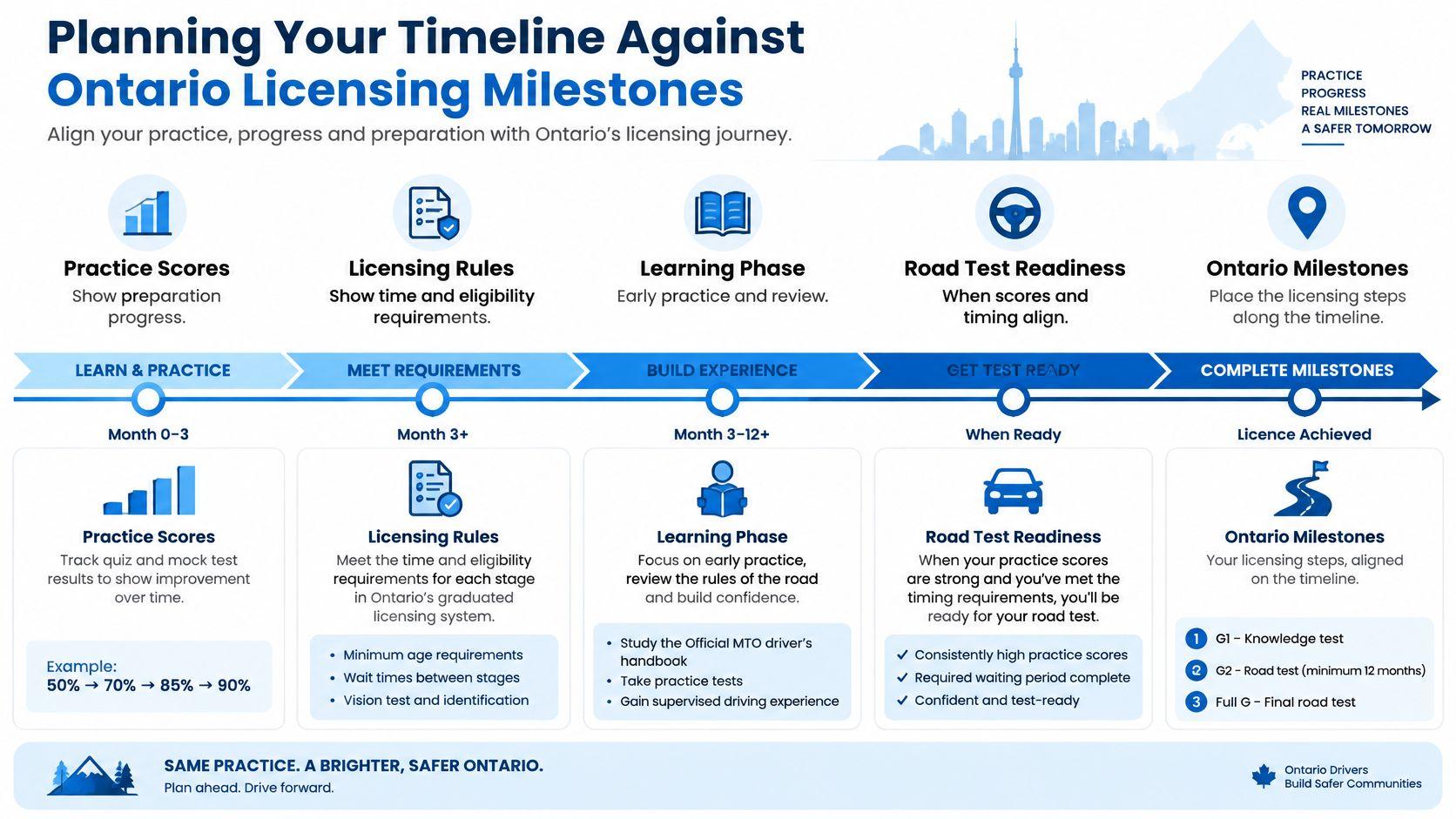
Planning Your Timeline Against Ontario Licensing Milestones
Practice scores measure preparation. Licensing rules determine eligibility and compliance. Keep those in separate columns so a good mock result never becomes a substitute for a required waiting period.
The licensing overview describes the normal 12-month G1 period, reduced to 8 months after approved beginner-driver education, in its discussion of Ontario's graduated licensing framework. The cited version of Ontario's novice-driver regulation sets out the 365-day default advancement requirement and five-year validity framework; the approved-course reduction is an exception to the normal G1 waiting period, not an additional wait.
Ontario G1 milestones and how to track them
Milestone Rule Tracking note Minimum age for G1 16 years old Record your eligibility date as the start line G1 to G2 waiting period Normally 12 months Count days from the G1 issue date Reduced waiting period 8 months after an approved beginner-driver course Confirm the course is approved before planning around it Minimum time before advancing At least 365 days holding a valid G1 or G2 licence, subject to applicable exceptions Mark the earliest advancement date for your situation G1 licence validity Generally five years Note the expiry date in the log Zero blood alcohol Required at all times Track as a compliance check, not a quiz score
Record your age eligibility date before applying, then use the G1 issue date as the start of your learner-licensing calendar. Add the knowledge-test and vision-test requirements to your application checklist, rather than treating quiz completion as completion of the application process.
Verify the date before making plans
Use a graduated driver's licence guide to organise the stages, and verify current provincial requirements before committing to a road-test date. Confirm that the beginner-driver course qualifies for the reduced waiting period before building your calendar around it.
A passing mock score is evidence of preparation, not proof of legal eligibility.
Keep knowledge readiness and road-test readiness distinct too. Strong quiz results don't demonstrate observation, vehicle control or safe decisions in traffic. Your calendar should leave room for supervised driving development alongside the legal milestones.
Sharing Progress with Instructors and Parents
Share a weekly summary with four entries: first-attempt accuracy, signs and rules scores, the most frequent error topic, and the count of consecutive sessions at your mastery threshold. Give an instructor, parent or teacher that summary rather than every log row. Agree on who reviews it and when, so support doesn't become surveillance.
An instructor can use it to identify concepts to discuss before supervised practice. They still need to assess practical driving separately; a knowledge score can't establish that you're ready for a particular road or traffic situation.

Include restrictions in the conversation
Ontario's new-driver licensing guide requires a qualified accompanying driver with at least four years' driving experience and a blood-alcohol concentration below 0.05. It also sets out the G1 driver's zero blood alcohol requirement, passenger seatbelt requirements, the restriction on driving between midnight and 5 a.m., and restrictions on 400-series highways and high-speed expressways such as Highway 401, the QEW and the Gardiner Expressway, subject to the guide's instructor-related exception.
Use those as categories for discussion: supervision, alcohol, passenger safety, nighttime driving and highway access. Record misunderstandings as learning needs, not as reasons to shame the learner.
- Review together: Ask the learner to explain the rule behind a recurring mistake before offering the answer.
- Judge the trend: Discuss sustained independent improvement rather than rewarding or criticising a single score.
- Keep permission separate: A passing practice score is a step towards readiness, never permission to drive alone.
Confirm Readiness Before You Book the Test
Use a checklist to make the decision. Feeling calmer is welcome, but you need independent results, retained knowledge and no unresolved pattern of mistakes before treating preparation as complete.
Tick each item using your actual log, not your memory of how practice felt.
- Section coverage: Signs and rules both meet your personal target on the latest mixed quiz, 16 of 20 or better in each.
- Stable mastery: You've achieved 90% or higher across two consecutive mixed quizzes.
- Recurring errors: No topic appears more than twice in the current readiness-cycle error log, and older recurring misconceptions have been independently resolved.
- Independent simulation: You've passed a timed mixed simulation against your study target without hints.
- Delayed recall: Delayed-retention accuracy is at or above your overall baseline.
- Review workload: Your review queue is empty or nearly so, with no unresolved safety-critical concept.
If an item fails, return to the diagnostic cycle: identify the gap, choose the appropriate fix and retest independently. Don't book to force yourself to study, and don't let unlimited retakes turn familiar wording into apparent mastery.
At G1ready.ca, our practice tests are free and don't require signup. Activity history is stored automatically, and statistics show which answers you got wrong; after finishing a test, you can review results, identify areas for growth and repeat tests as necessary.
Confirm your practice trends against current official test requirements before making arrangements. Book when the checklist holds for two sessions in a row, not after one good day.
Visit G1ready.ca to take a free practice test without signing up and establish an honest baseline. Review your results and stored activity history, then use the answers you missed to choose your next focused study session.