
Yes, you can turn right on a red light in Ontario, but only after making a complete stop and ensuring no sign prohibits the manoeuvre. You must also yield to pedestrians and other road users before turning.
You're sitting at a red light, the lane beside you is moving, and a gap appears on the cross street. The car behind you may seem to expect you to go, but a G1 question is testing more than whether a right turn is generally allowed. It's testing whether you can recognise the complete stop, sign check, yield, and safe-turn requirements that make the manoeuvre legal.
For a nervous learner, the safest approach is to treat right-on-red as a decision, not a reflex. You're allowed to wait for green whenever the intersection is confusing, crowded, or difficult to see.
The Core Rules for Turning Right on Red
You approach a red light in the right lane. A sign does not appear to ban the turn, but pedestrians are near the crosswalk and traffic is approaching from the left. The correct response isn't to squeeze through the first available gap. You need to complete the legal sequence before deciding whether to turn.
Ontario's official driver's handbook guidance on traffic lights establishes three central conditions. A driver may turn right on red unless a sign specifically prohibits it, but only after coming to a complete stop and confirming that the way is clear.
The three-part G1 checklist
- Permission: Check whether the intersection permits a right turn during the red phase. A posted restriction overrides the general permission.
- A complete stop: Stop fully before moving. If there's a stop line, stop at it. If there isn't one, the MTO handbook directs drivers to stop at the crosswalk, the sidewalk edge, or the edge of the intersection, in that order of relevance.
- Yielding and safety: Look for pedestrians, cyclists, vehicles crossing your path, and other lawful road users. You can turn only when the way is clear and the manoeuvre can be completed safely.
The full stop matters because rolling slowly through a red light doesn't satisfy the rule. Your vehicle must stop before you assess the intersection. A pause that leaves the wheels creeping forward can create both a safety problem and a poor test answer.
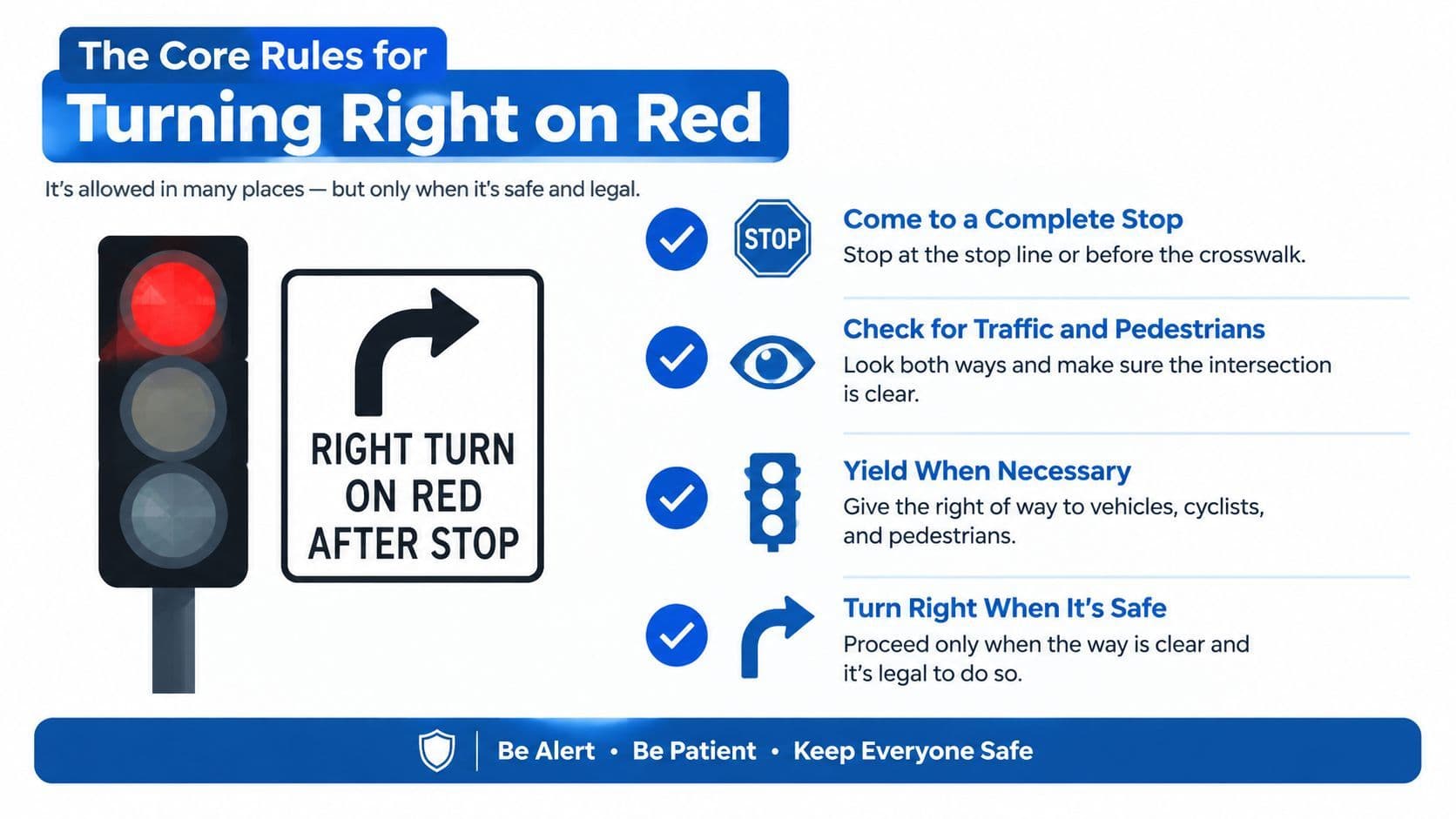
Practical rule: Stop first, look for restrictions, yield to anyone with the right of way, and turn only when you're certain the path is safe.
The turn is also optional. If a pedestrian is approaching, a truck blocks your view, or traffic is moving unpredictably, you may remain stopped until the light turns green. The MTO guidance makes this distinction important for learners: the law allows the turn under specific conditions, but it doesn't require you to use that permission.
Understanding the Legal Basis and Exceptions
The easiest way to avoid confusion is to separate Ontario's default red-light rule from the right-on-red exception. The Highway Traffic Act requires a driver facing a circular red traffic signal to stop and not proceed until a green indication is shown, as set out in the Ontario statute governing traffic signals.
That statutory baseline means a red light normally tells you to stop and wait. The right turn isn't a general licence to proceed through the intersection. It operates as a conditional exception to the ordinary stop-and-wait rule.
Default rule versus conditional permission
Think of the law as two layers:
Situation Correct response You face a circular red signal Stop and don't proceed until green, unless the lawful right-on-red conditions apply A right turn is otherwise allowed Stop completely, check for a prohibition, yield, and turn only when safe A sign prohibits the turn Remain stopped and wait for a permitted movement The intersection is unclear or unsafe Wait for green
This structure explains why a test answer saying “you may always turn right on red” is wrong. The word always removes the conditions that make the turn legal. An answer saying “you must turn right if the road is clear” is also wrong because the manoeuvre is optional.
For focused review of related topics, use this G1 road right-of-way rules guide to practise the difference between permission, obligation, and yielding.
Why the distinction matters in real driving
At a busy intersection, waiting is often the more sensible decision even when a turn is technically available. You may have a clear view of traffic but no clear view of the sidewalk, or you may be unsure whether a vehicle approaching from the opposite direction will turn across your path.
A new driver sometimes treats a green light as the only situation in which movement is legal, then swings to the opposite mistake and treats right-on-red as automatic. Neither approach is accurate. Ontario's rule requires you to combine the signal, signage, road position, and behaviour of other road users before moving.
The safest mental question is not “Can I turn?” It's “Have all the conditions for a legal and safe turn been met?” If you can't answer yes, keep the vehicle stopped.
Recognizing Prohibitive Signage and Lane Rules
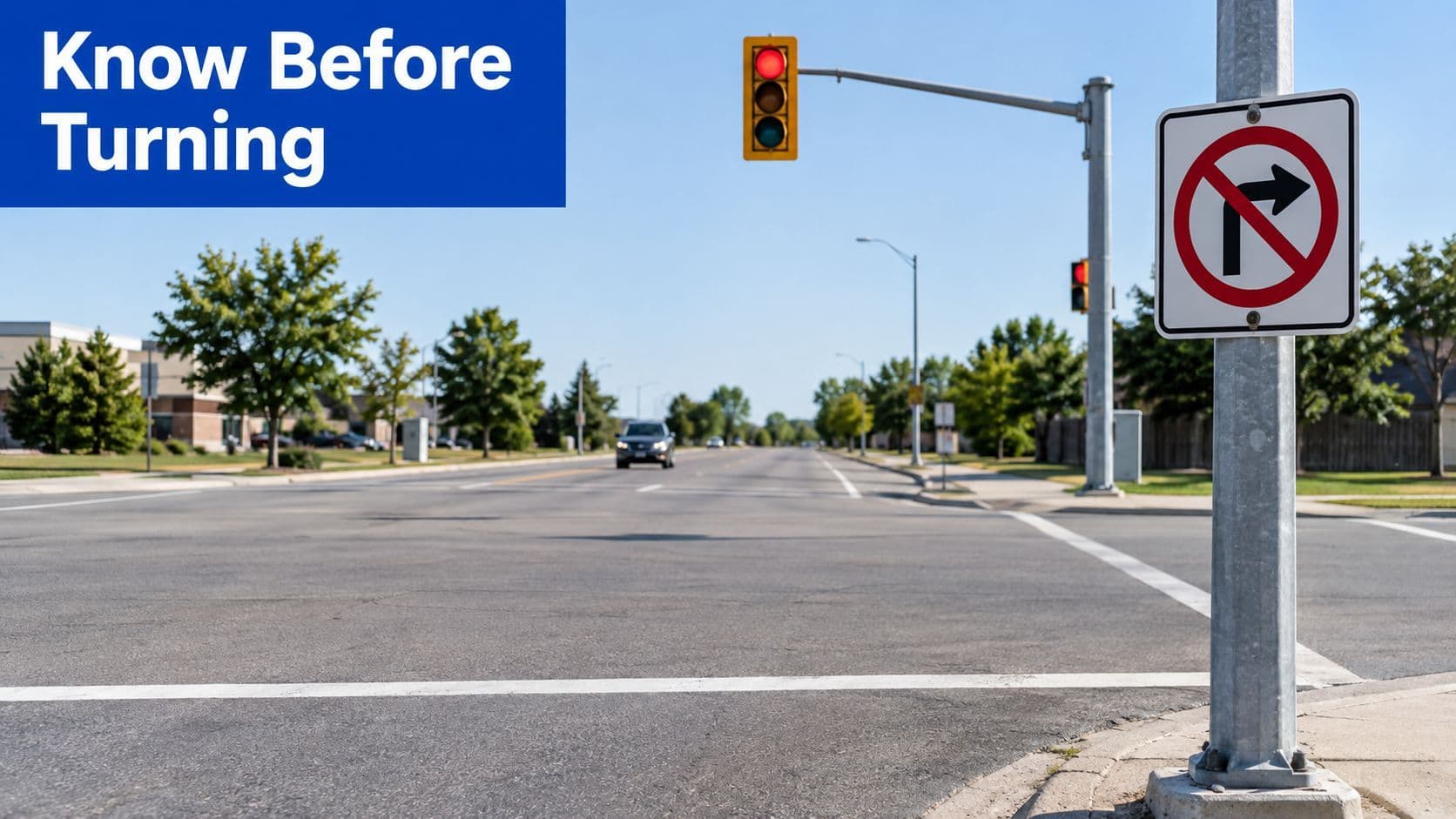
A red light doesn't tell the whole story. Look beyond the signal for a regulatory sign that changes what would otherwise be permitted. Ontario uses the NO RIGHT TURN ON RED sign, identified in the Ontario Traffic Manual as Rb-79R, to show that a right turn during the red phase is prohibited. The Ontario Traffic Manual sign guidance states that this sign is used where a right turn that would otherwise be legal is banned.
Read the sign before judging the gap
An intersection with no prohibitive sign may permit the turn, provided you stop and yield. An intersection with a clearly posted restriction does not. In the second situation, a large gap in traffic doesn't change the answer.
What you see What it means No sign banning the manoeuvre A right turn may be possible after the required stop and checks NO RIGHT TURN ON RED sign Don't turn during the red phase Marked right-turn lane Use the designated lane and complete the turn correctly Unclear lane markings Slow down, remain stopped if needed, and follow the visible markings
Don't confuse a sign that prohibits right-on-red with a sign that indicates lane direction, destination, or general traffic movement. If you're studying sign recognition, this Ontario information signs guide can help you separate informational signs from regulatory instructions.
Lane geometry controls the turn
The permission to turn doesn't remove lane discipline. Ontario guidance applies the rule to a marked or designated right-turn lane, but the vehicle must turn into the corresponding rightmost lane. You can't begin in the wrong lane, sweep across receiving lanes, or finish in a lane that doesn't correspond to the turn.
For example, suppose two lanes approach an intersection and only the right lane is marked for right turns. A driver in the adjacent through lane shouldn't cut across the right-turn lane because the signal is red and the road appears open. The driver must use the lane designated for that movement.
The same principle applies after the turn. If the road you're entering has multiple lanes, complete the manoeuvre into the appropriate rightmost receiving lane rather than drifting across traffic. A legal right-on-red permission can still lead to an unlawful movement if the driver ignores the lane markings.
Lane discipline prevents a legal permission from becoming an illegal manoeuvre.
At unfamiliar intersections, reduce speed early enough to identify arrows, lane lines, and signs. If the markings are hidden by snow, glare, construction, or heavy vehicles, waiting is a reasonable choice.
Safety Protocols and Pedestrian Considerations
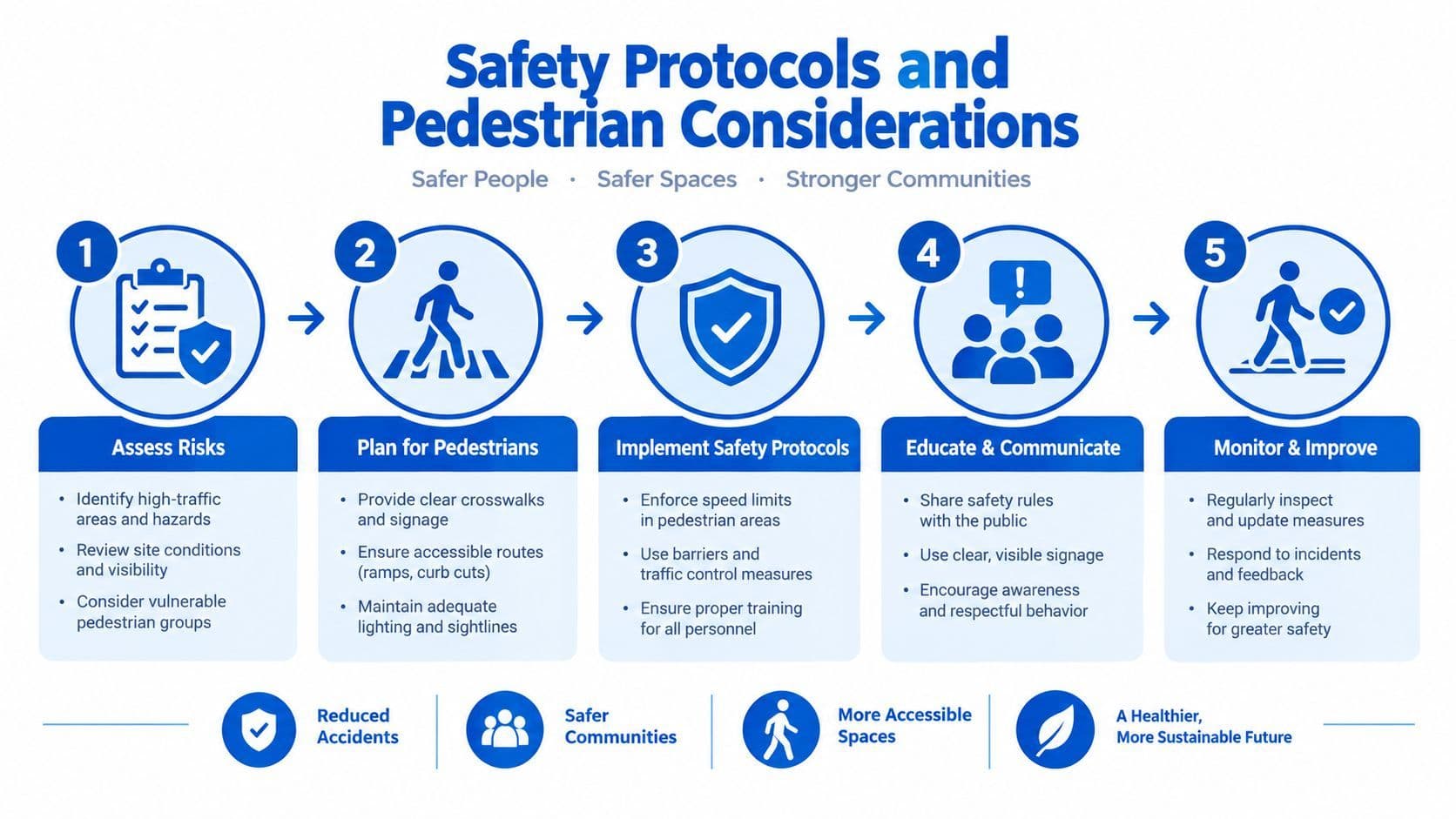
The most important person at a red-light turn may be outside your vehicle. A pedestrian can enter the crosswalk while you're focused on the traffic gap, and a cyclist can approach along the curb where a quick mirror check won't reveal the whole picture.
Start by slowing smoothly and stopping at the correct location. Keep the crosswalk clear, then scan the sidewalk and crossing area. Look left for vehicles, but also look right and ahead for pedestrians and cyclists who may cross the road you intend to enter.
A careful approach in a busy intersection
Use this sequence at the light:
- Approach: Reduce speed early and identify the stop line, crosswalk, and right-turn lane.
- Stop: Bring the vehicle to a complete stop in the required position.
- Scan: Check the sign, crosswalk, sidewalk, left-side traffic, and the receiving lane.
- Yield: Let pedestrians, cyclists, and other road users with the right of way proceed.
- Decide: Turn only when you have a clear, safe path. Otherwise, wait.
A parked van, bus, snowbank, or large truck can hide someone near the curb. Don't treat an obstructed view as an empty view. You may need to wait, adjust your observation position while remaining stopped, or let the light change before moving.
A vehicle from the opposite direction may also change the situation. Someone turning left, making a U-turn, or moving around an obstruction can enter the space you planned to use. Watch the entire intersection rather than locking your attention on one approaching car.
The following video can support visual review of intersection awareness and pedestrian-focused decision-making:
For more detailed review, study these Ontario pedestrian crossing rules. The same habit helps on the G1 test and behind the wheel: a gap in vehicle traffic isn't enough if a pedestrian still has priority or your view is incomplete.
How Right-on-Red Appears on the G1 Knowledge Test
G1 questions often become difficult because a familiar rule is written with one missing condition. The Ontario Highway Traffic Act requires every driver facing a circular red traffic signal to stop and not proceed until a green indication is shown. That statutory baseline is the foundation on which the handbook's right-on-red exception operates, as shown in the Ontario Highway Traffic Act text.
Watch for words that change the answer
Read each option slowly, especially when it contains an absolute word.
- “Always” usually makes an answer too broad because signs and safety conditions can prohibit the turn.
- “Must” suggests an obligation. Right-on-red isn't mandatory, so this wording should make you cautious.
- “Unless” often introduces the key exception, such as a sign that bans the manoeuvre.
- “Complete stop” is stronger than “slow down.” A rolling stop doesn't meet the requirement.
- “Yield” means you can't move merely because the signal allows a possible turn. You must let pedestrians and other lawful road users proceed first.
A typical question may ask what you should do when facing a red light and intending to turn right. The strongest answer will include the complete sequence, not just the permission. Look for an option that says you stop completely, check for a prohibitive sign, yield, and turn only when safe.
Separate legal permission from practical judgement
Another question may present a busy intersection with limited visibility. The correct answer may be to wait, even if no sign bans right-on-red. The test isn't asking you to prove that every possible turn must happen. It's checking whether you understand that safety determines whether you should use the permission.
A helpful way to practise is to change one fact at a time. Start with an open intersection, then add a prohibition sign. Remove the sign and add a pedestrian. Remove the pedestrian and obscure the crosswalk. Each change should prompt a fresh decision, not a memorised response.
Before selecting an answer, ask:
- Is the signal circular red?
- Has the vehicle stopped completely?
- Does a sign prohibit the turn?
- Have pedestrians and other road users been given the right of way?
- Is the destination lane clear and appropriate?
If any condition is unresolved, the option telling you to turn immediately is unlikely to be correct.
Common Mistakes and Final Preparation Tips
The biggest mistake is assuming that a clear road creates a duty to turn. It doesn't. Ontario guidance treats right-on-red as a conditional privilege, not an obligation, and that principle also applies when the vehicle is positioned in a designated right-turn lane, as discussed in this explanation of Ontario right-on-red restrictions.
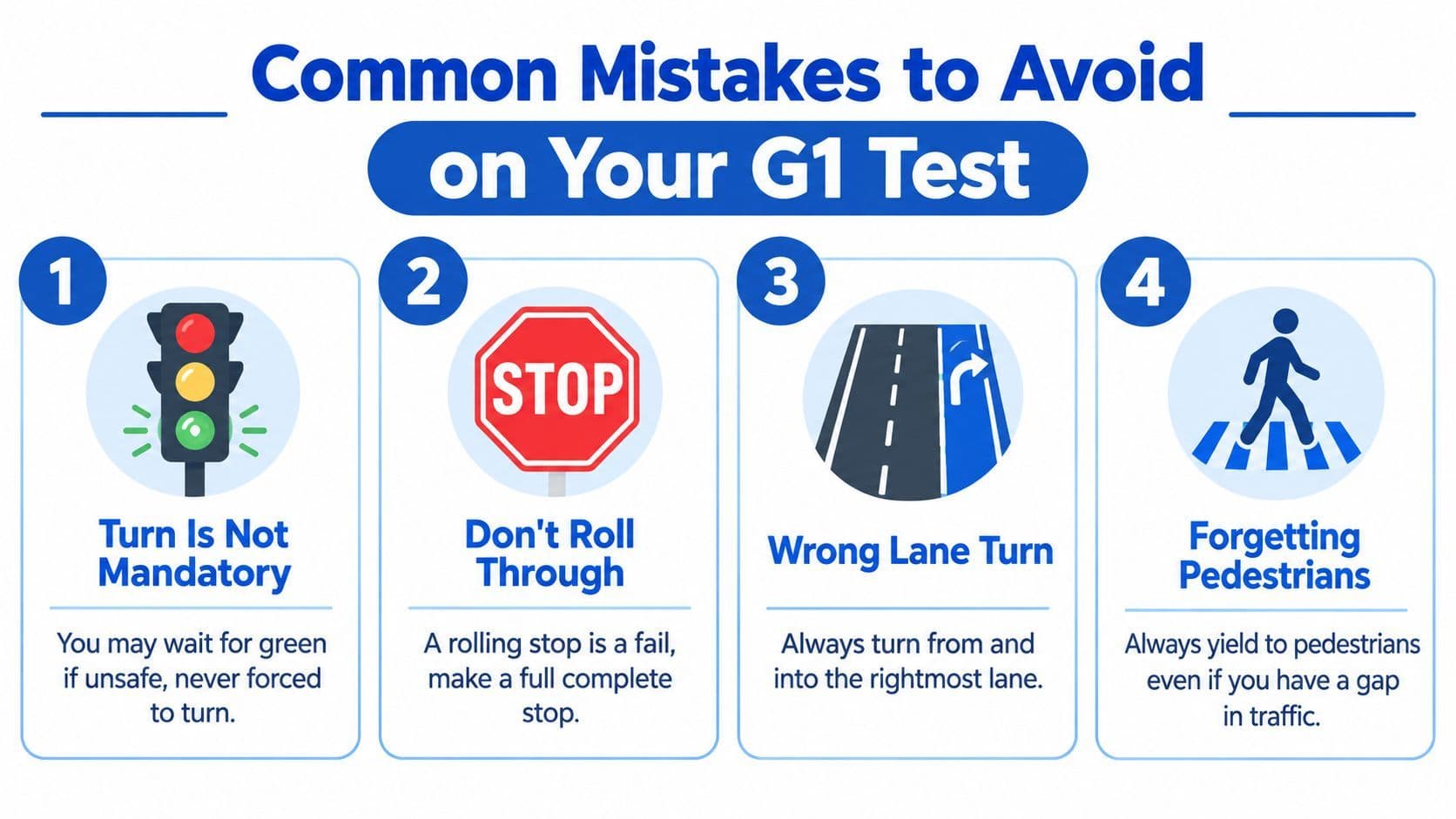
Four errors to remove from your routine
- Turning is not mandatory: You may wait for green when visibility, traffic, or pedestrian activity makes the manoeuvre uncomfortable or unsafe.
- Rolling through the light: Slow movement isn't a complete stop. Stop decisively before checking the intersection.
- Using the wrong lane: Begin from the lane designated for the turn and enter the corresponding rightmost lane.
- Forgetting pedestrians: A vehicle gap doesn't cancel a pedestrian's right of way. Check the crosswalk and sidewalk before moving.
Practise the rule in short scenarios rather than memorising one sentence. Ask yourself what changes when a sign appears, when the stop line is set back, when a cyclist is approaching, or when lane markings direct traffic differently. This method builds the judgement needed for questions that include distracting details.
A final study routine should include targeted quizzes on traffic lights, right of way, signs, and pedestrian rules, followed by mixed practice that forces you to switch between topics. G1ready.ca offers free, registration-free practice exams, targeted quizzes, mixed tests, diagnostic practice, marathon sessions, and an exam simulator, with explanations and hints that help you review errors as you go.
Return to the core habit whenever you feel uncertain: stop completely, check the sign, yield, confirm the lane, and turn only if safe. If the answer is unclear at an intersection or on the test, waiting for green is the safer and more accurate choice.
Use G1ready.ca to practise Ontario traffic-light and right-of-way questions with targeted quizzes, explanations, and mixed G1 tests. Review every missed answer, then repeat the scenarios until the complete-stop, signage, yielding, and lane rules feel automatic.


