

You've read the Ontario handbook, taken several practice quizzes, and still find yourself missing questions you thought you knew. One session goes well, the next exposes confusion between similar signs, right-of-way rules, or wording such as “must” and “may.” That experience is common, but the solution isn't another unplanned marathon of questions.
A useful G1 plan connects what you study, what you miss, and what you do next. It separates road-sign recognition from rules-of-the-road reasoning, uses short spaced sessions, and changes focus when your mistake pattern changes. The foundation should always be the current Official MTO Driver's Handbook, which was first published on November 28, 2016 and updated on August 26, 2022. The handbook says it's only a guide, so checking your notes against the latest government version matters.
Why Most G1 Study Approaches Fall Short
A learner often starts with good intentions. They read the handbook from the first page to the last, highlight familiar passages, and then take random practice tests until the questions look recognizable. After a few decent scores, they book the test, only to discover that recognition during practice isn't the same as recalling a rule under pressure.
I've seen this with students who studied hard but couldn't explain why an answer was correct. They remembered the appearance of a sign but confused its meaning with a similar sign. They knew a general right-of-way principle but missed the question because they rushed past one key word. More practice alone didn't solve those problems because the practice wasn't diagnosing the cause of each error.
Familiarity can create false confidence
Reading the same handbook page repeatedly feels productive because the material becomes familiar. Familiarity, however, can hide a weak ability to retrieve the rule without visual prompts. Random quizzes create a similar problem. They tell you that you missed something, but not necessarily whether the cause was poor knowledge, sign confusion, misreading, or careless timing.
Generic timelines also fall short for newcomers and first-time learners who may not share the same background knowledge as someone who has already driven in Ontario. Broad advice such as “study the handbook and take practice tests” doesn't tell you which topic deserves attention after a repeated error.
Practical rule: Don't count study time as progress unless you can identify what improved and what still causes mistakes.
The province's licensing framework adds another planning consideration. Ontario's graduated licensing system moves novice drivers through two steps, including Class G1, with mandatory time periods at each level and required road tests described on the official graduated licensing information page. Your immediate goal may be the knowledge test, but the process rewards organised preparation rather than a single burst of memorisation.
The Three-Stage Learning Workflow That Actually Works
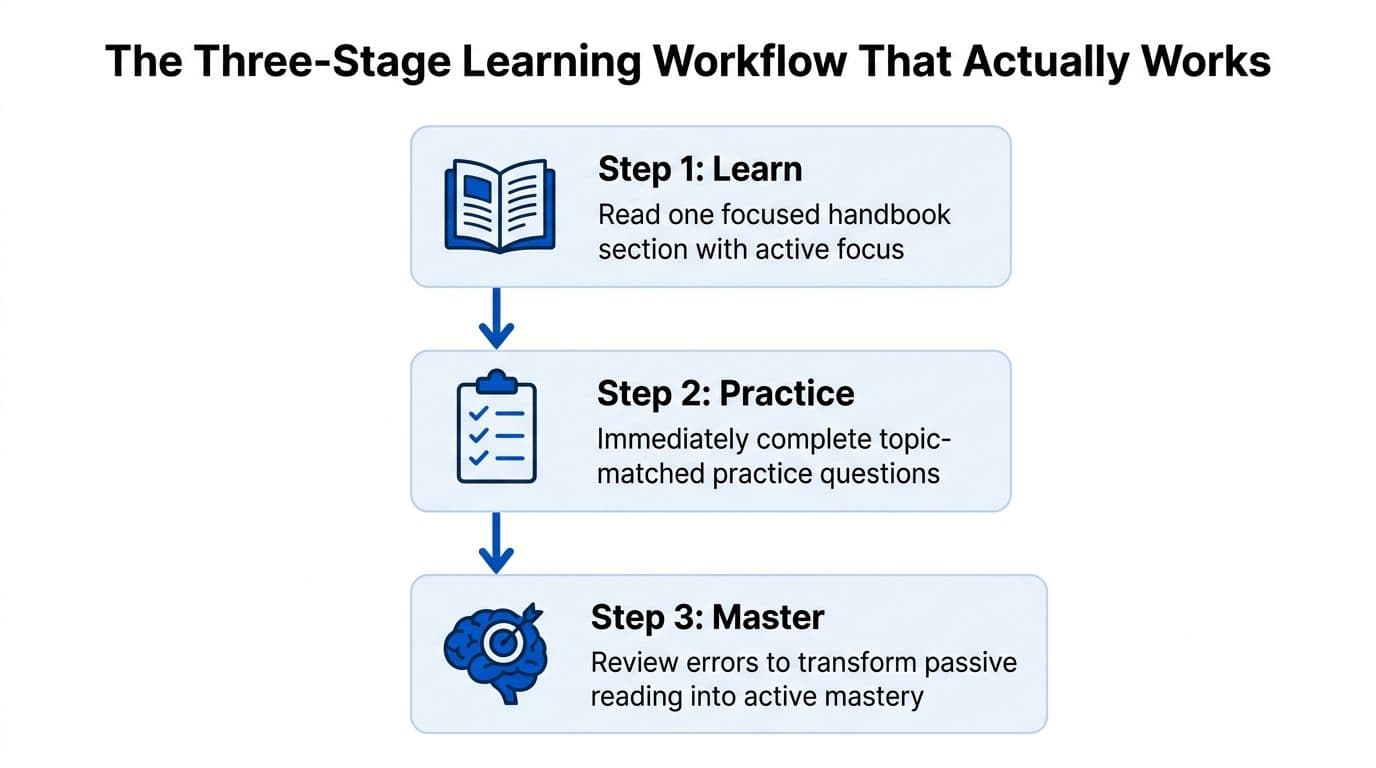
Use the same cycle for every topic: learn, practise, master. The cycle is simple, but the order matters because it forces you to connect the handbook rule with the kind of question you'll need to answer.
Learn one focused section
Start with one manageable handbook section, not an entire study area. For example, choose regulatory signs or right-of-way at intersections. Read actively, looking for the action the driver must take, the condition that changes the rule, and words that impose an obligation.
Close the handbook and write the rule in plain language. If you can't explain it without copying the wording, you haven't finished the learning stage. A short handwritten note such as “At this type of intersection, check who arrived first and who has priority under the stated conditions” is more useful than a page of highlighted text.
Practise with matched questions
Immediately complete questions on that same topic. Don't mix every subject at the beginning, because a topic-matched set tells you whether the section you just studied transferred into recall.
Signs and rules require different mental work. Sign practice asks you to identify visual features and connect them to meaning. Rules practice asks you to interpret a situation, notice conditions, and choose the correct action. Mixing both too early can make it difficult to tell which skill needs repair.
Master every miss
For each wrong answer, return to the handbook and record three things:
- What I chose: Write the answer that seemed plausible.
- Why it was wrong: Note the misunderstood feature, condition, or word.
- The governing rule: Rewrite the correct principle in plain language.
A mistake log should track repeated weaknesses, not every detail you've ever read. If you repeatedly confuse stopping rules, review that section and retest it later. Don't reread the entire handbook because one category is weak. A topic-based Ontario G1 study resource can help you pair focused reading with targeted questions, but the handbook remains the authority.
Keep each block between 20 and 60 minutes, as recommended in Ontario-focused G1 preparation guidance. Short, consistent blocks make it easier to return to difficult material after a delay, which is more useful for retention than cramming one huge session.
Aligning Your Plan With the Actual Test Structure
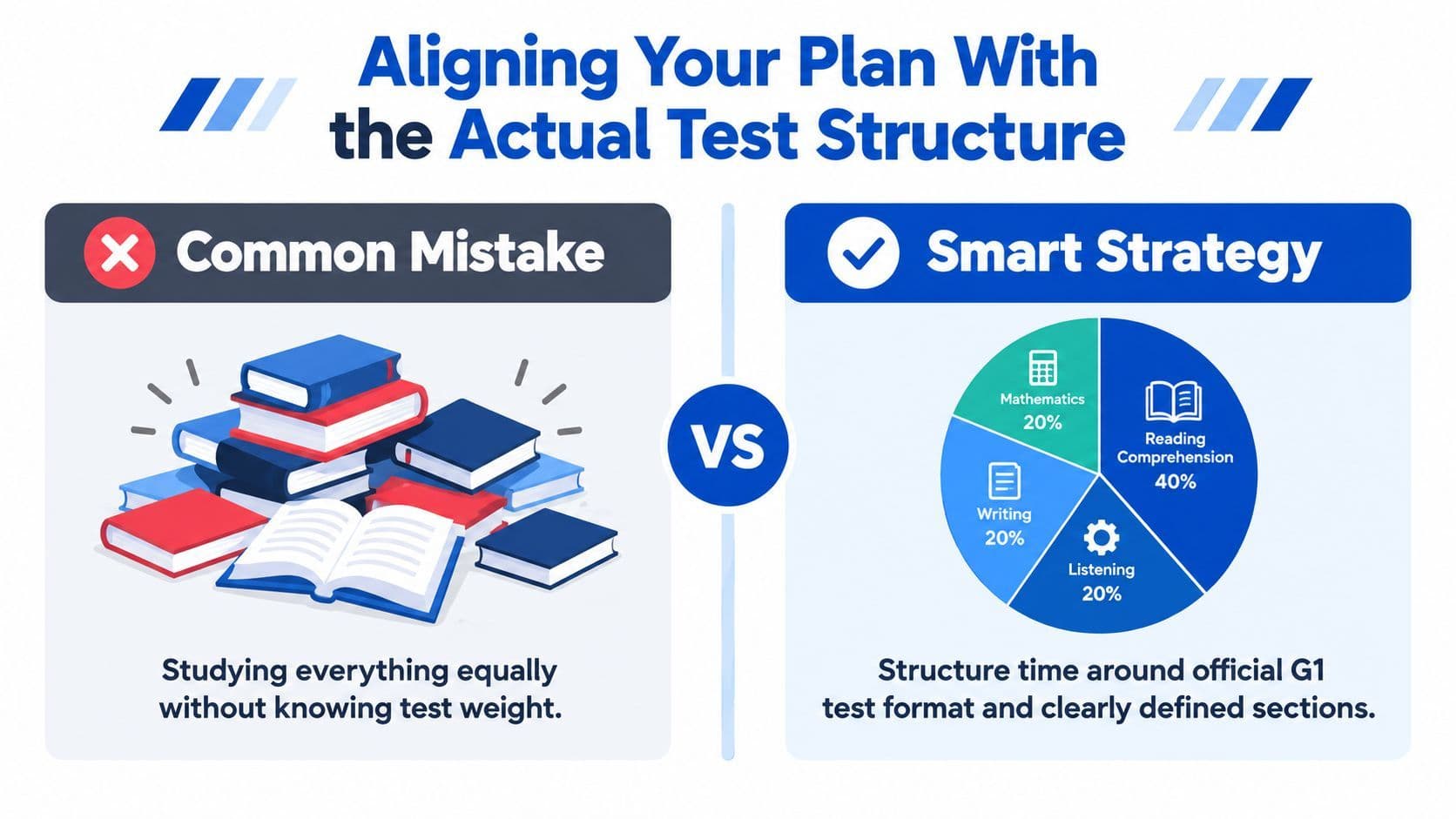
A study plan should reflect the test's knowledge categories. One Ontario G1 guide identifies 14 sign questions and 14 rules questions, so dividing your preparation between these two areas is more purposeful than treating the handbook as one undifferentiated block. You can find a practical explanation of the Ontario G1 test format and question categories.
Give signs and rules separate attention
Begin with separate study blocks. A signs block might cover sign shapes, colours, symbols, and meanings. A rules block might focus on intersections, lane use, stopping, passing, or sharing the road. This separation helps you see whether you're failing at recognition or reasoning.
A balanced plan doesn't mean every individual topic receives identical time. It means both major sections get deliberate attention before your mistake log determines where extra time belongs. If signs are strong but right-of-way errors keep recurring, maintain signs with brief retrieval practice while assigning more focused work to rules.
Use the right practice at the right time
Early study should use short, topic-specific sets. They reveal misunderstandings while the handbook section is still fresh. Full-length timed practice makes more sense after you've worked through the main material, because it tests switching between categories and managing the pace of a complete session.
Use practice scores as evidence, not proof. Ontario-focused guidance recommends continuing until performance is consistently around 80 to 85% on both major sections, rather than treating one strong result as readiness. That benchmark appears in Ontario G1 test study guidance, but the more important word is “consistently.” You should be able to explain missed answers and reproduce the rule later.
Recognition remains a trap here. A familiar sign may look easy when shown alone, yet a question can still expose confusion with a similar sign. Likewise, a rule may seem obvious until the wording changes the situation. Mix timed tests with targeted review, and return to the weakest chapters instead of repeating complete tests without analysis.
Building a Realistic Weekly Schedule That Sticks
A workable plan fits around school, work, family, and energy. Canadian study-habits research supports regular preparation rather than last-minute cramming. Statistics Canada defined strong study habits among 15-year-olds as at least three hours per week combined with effective control strategies, while a Canadian university-student survey found that 68% began exam preparation at most one week in advance, 50% reported good study habits, and 43% said they didn't give themselves enough preparation time. These findings are reported in the Canadian study-habits research paper.
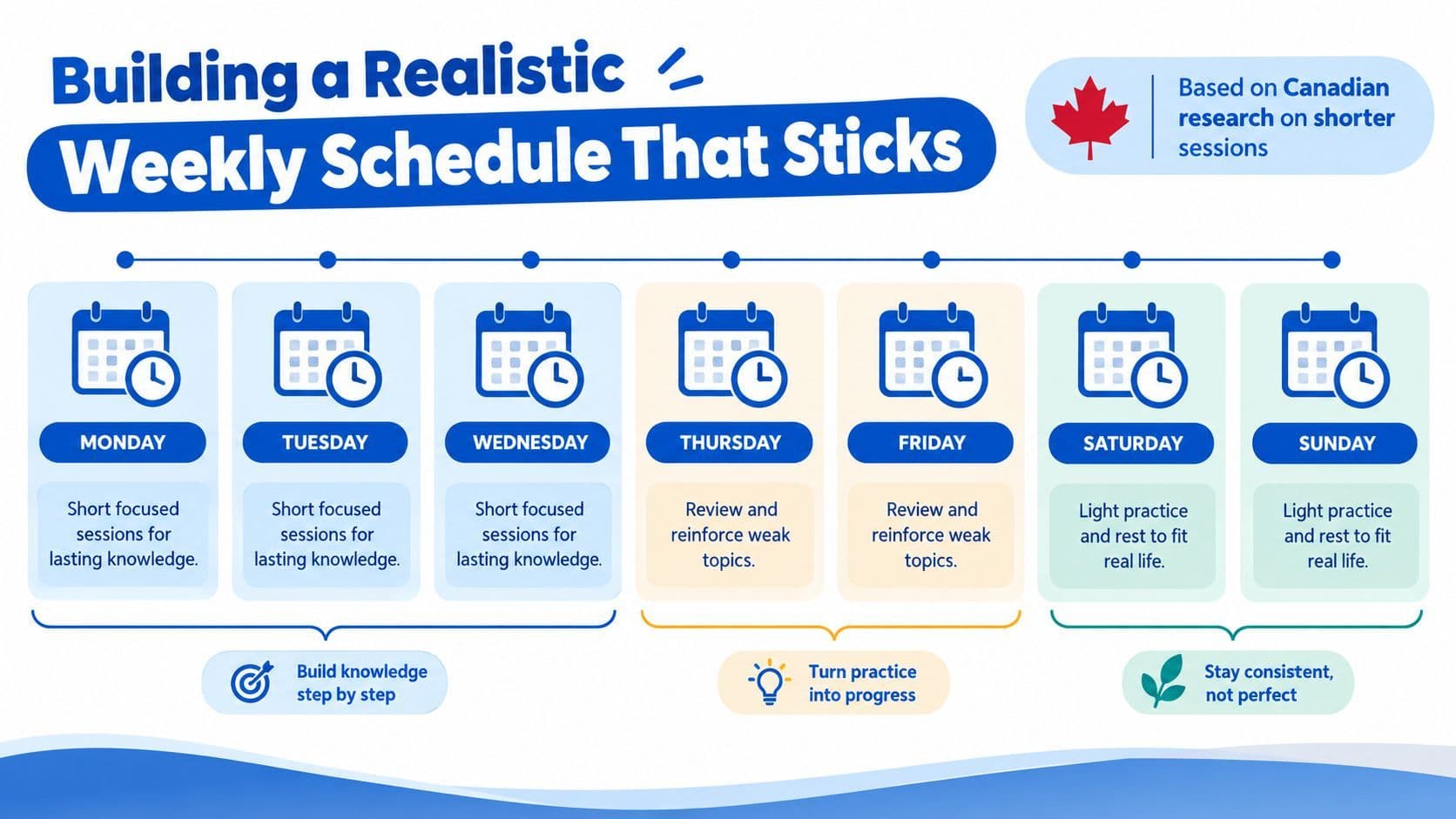
The practical lesson is to spread your work across the week. You don't need every day to look identical, but each study day should have a defined job.
A repeatable weekly pattern
Use this structure and adjust the length of each block:
- Monday to Wednesday: Study one focused handbook section, then complete matched questions and log mistakes.
- Thursday and Friday: Re-test earlier topics, concentrating on errors that repeated or remained unexplained.
- Weekend: Complete light mixed practice, review your notes, and leave room for rest or a missed weekday session.
A learner with a job might use a short evening block on weekdays and a longer weekend review. Someone balancing school could place the most demanding rules work during their best concentration period and use a lighter signs review after a busy day. The schedule works because it protects continuity without requiring every session to be identical.
Adjust the plan to your timeline
With two weeks available, avoid trying to read everything repeatedly. Use the first part of the period for separate signs and rules coverage, the middle for targeted correction, and the final days for mixed, timed practice plus calm review of the mistake log.
With two months, give yourself more room for delayed retesting. Cover a focused section, revisit it after other topics, and then test it again without looking at your notes. Longer timelines are useful only when you use the space between sessions. If a day collapses, move the task to a buffer period rather than doubling the next session and creating a new problem.
Diagnosing and Fixing Your Specific Mistake Patterns
Retaking the same practice test until the score rises isn't a study plan. You may remember the answer position or recognise the question, while the underlying rule remains uncertain. The better question is not “How many questions did I complete?” but “What kind of mistake did I make?”

Label the error before choosing the remedy
Use categories such as:
- Wording error: You missed an absolute or conditional word, so practise slowing down and restating the question before choosing.
- Look-alike sign error: You confused similar signs, so compare them side by side and write the action associated with each.
- Rule gap: You didn't know the governing principle, so return to the handbook and explain it without prompts.
- Rushing error: You understood the rule after reviewing the question but selected too quickly, so add a deliberate pause to your practice routine.
- Application error: You knew the rule in isolation but couldn't apply it to the described situation, so practise explaining the sequence of decisions.
A mistake log should include the topic, error type, corrected rule, and a later retest date. The date matters because immediate repetition can create the illusion of learning. If the same error appears again after a delay, keep that topic in the active rotation.
Change the schedule as weaknesses change
Suppose you initially miss regulatory signs because their symbols look similar. Your plan should first compare those signs, then test recognition without notes, and later include them in mixed practice. Once that pattern stops repeating, move the topic into maintenance review and give the freed time to right-of-way or stopping rules.
A diagnostic set can help establish that starting point. The G1 diagnostic exam is one option for identifying areas to prioritise, while the official handbook remains the source to consult when an answer needs verification.
A higher score is useful only when you know why it improved.
Tracking Progress and Adapting Your Plan Over Time
Track performance by category and error type, not only by an overall score. A single result can rise or fall because of question selection, attention, or timing. Several sessions give you a clearer picture of whether a weakness is persistent.
Use a simple review table:
What you track What it tells you What to do next Signs accuracy Whether recognition is becoming reliable Compare similar signs and retest later Rules accuracy Whether you can apply handbook principles Return to the relevant rule and practise scenarios Repeated error type Why you keep missing questions Change the method, not just the question set Explanation quality Whether you understand the answer Explain the rule without viewing notes
Keep weak categories in regular rotation until you can answer correctly and explain the reasoning after a delay. Strong categories don't need endless rereading. Use occasional maintenance questions so your time goes toward unresolved gaps.
DriveTest provides knowledge tests on behalf of Ontario's Ministry of Transportation, and official provincial information explains that appointments can be booked for G1 knowledge or written tests through the public testing system. Confirm the current booking details through DriveTest's official service information before arranging test day.
In the final days, reduce experimentation. Review your mistake log, complete controlled mixed practice, and check uncertain rules against the current handbook. Confidence should come from repeated, explainable performance, not from exhausting yourself with one more random quiz.
G1ready.ca offers free, registration-free practice exams, targeted quizzes, diagnostic testing, mixed tests, progress tracking, and explanations aligned with the Ontario G1 handbook. Visit G1ready.ca to turn your mistake log into a focused daily practice routine before test day.


