
You're sixteen, staring at a DriveTest booking screen, or perhaps you're a parent wondering when your new driver can practise alone. If you've recently moved to Ontario, you may also be comparing this process with a licence system that uses one written test and one road test. Ontario works differently. Its graduated driver licensing system moves you through G1, G2, and full G, giving you time to build judgement before you receive every driving privilege.
The stages can feel complicated at first, especially when questions about highways, passengers, night driving, alcohol, residency, and test timing start to overlap. The simplest way to understand the program is to see each stage as a learning layer. You aren't expected to master independent driving in one appointment. You earn more responsibility as your experience grows.
Why Ontario Uses a Graduated Drivers License System
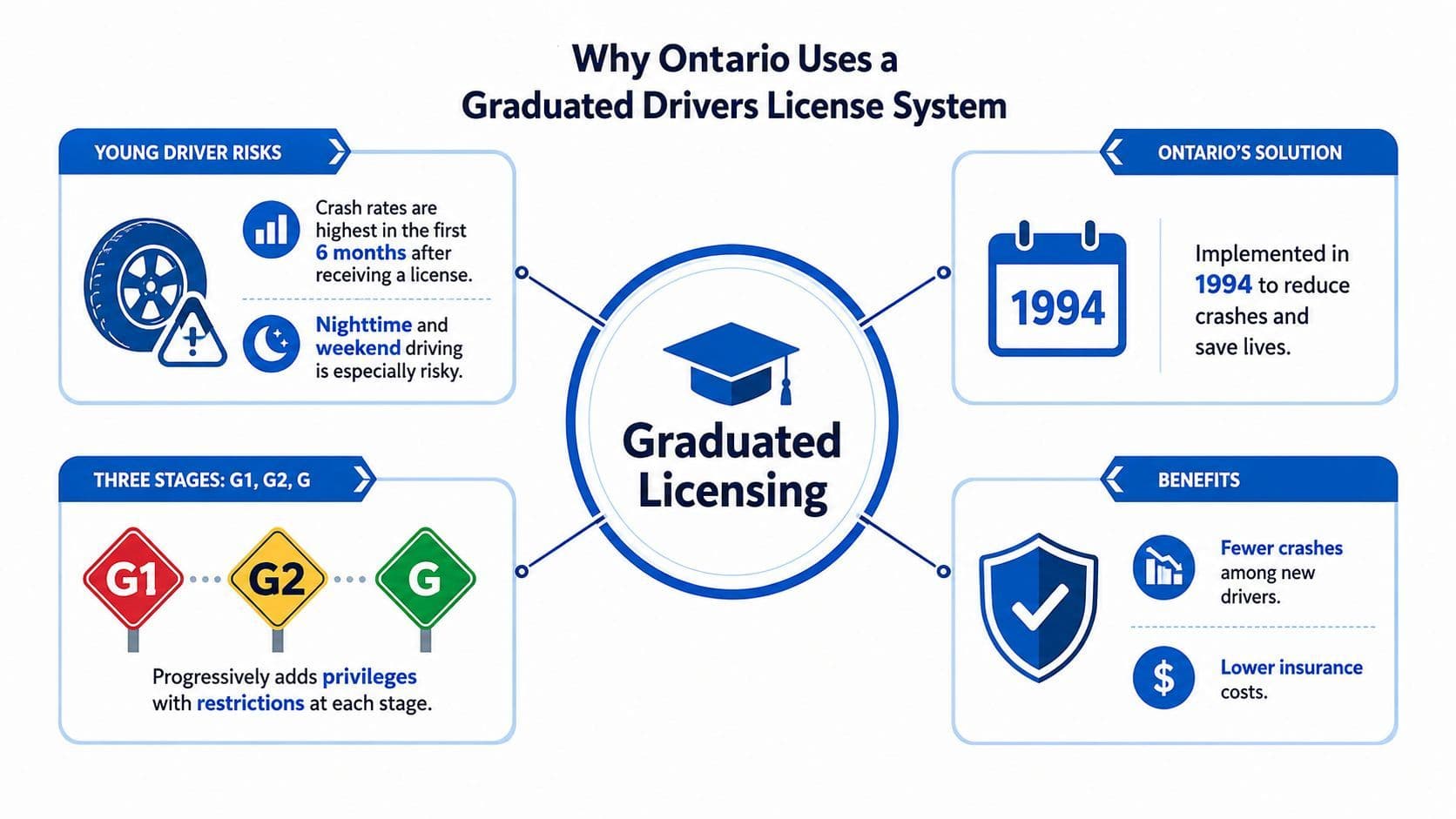
Ontario introduced its graduated licensing system in 1994. The program uses three stages, G1, G2, and full G, instead of treating licensing as a single pass-or-fail event. New drivers must be at least 16, pass a vision test and a knowledge test, complete supervised practice, and pass two road tests before reaching full privileges, as outlined in the official Ontario licensing pathway.
That sequence serves a practical purpose. A learner first develops basic control with an experienced supervisor beside them. The driver then gains solo experience under restrictions, where mistakes can be addressed before full independence. Skills such as hazard recognition, speed judgement, safe following distance, and night-time scanning develop through repeated exposure, not by memorising a handbook alone.
Why restrictions matter early
Graduated licensing evaluations support the idea of adding restrictions early in licensure. A peer-reviewed evaluation found that basic GDL laws were associated with an 8% to 14% lower fatal-crash involvement rate for drivers aged 16 and 17, while another synthesis reported a 41% reduction in fatal-crash rate and a 22% reduction in overall crash rate where programs were implemented more thoroughly. These findings are discussed in the peer-reviewed GDL evaluation.
The same research identifies the kinds of exposure that restrictions are meant to manage, including nighttime driving, passenger loads, and alcohol exposure. Young drivers remain particularly vulnerable during the early learning period, so Ontario's system places experience between the learner and full independence.
Practical rule: Treat every restriction as a training aid, not a punishment. The safer question is, “What skill is this stage helping me practise?”
Families can also prepare for the administrative side by learning how Ontario handles demerit points and novice drivers. A clean record matters because serious violations can interfere with progression, even after a driver has moved beyond G1.
The Three Stages from G1 to Full G
Ontario's pathway is built around G1, G2, and full G. The province says the process takes at least 20 months in total, with 12 months at G1 and at least 12 months at G2. An approved driver education course can shorten the G1 waiting period to 8 months, but the full pathway still requires the necessary road tests and qualifying time.
G1 builds supervised experience
G1 begins after the applicant meets the minimum age, completes the vision screening, and passes the knowledge test. At this stage, the driver can practise only with a qualified fully licensed supervisor seated beside them. The purpose is controlled exposure, where the learner can work on observation, steering, lane position, turns, and decision-making without carrying the full responsibility of solo driving.
The G1 stage also introduces the learner to Ontario's road environment. A first drive might stay on familiar local streets, followed by busier intersections and more complex traffic situations as confidence improves. The supervisor should gradually vary conditions rather than repeating the same easy route.
G2 adds independence with a safety net
After the G1 road test, the driver enters G2. A G2 driver can drive without an accompanying supervisor, and many G1 restrictions lift. The driver can now experience commuting, shopping routes, changing traffic conditions, and highway travel while the zero-alcohol rule and novice-driver consequences remain important safeguards.
G2 is not a graduation ceremony. It's the stage where the driver must prove that good decisions continue when no experienced adult is sitting in the passenger seat.
Full G completes the graduated pathway
The second road test, commonly called the G2 exit test, leads to full G privileges when passed. Ontario's licensing information confirms that a driver generally needs to spend at least 12 months at G2 before taking this test. Full G ends the graduated system, but it shouldn't end careful practice or responsible decision-making.
Stage Minimum wait before next test Key purpose What you unlock G1 12 months, or 8 months with approved driver education Supervised learning and foundational control Practice with a qualified supervisor G2 At least 12 months Independent driving with probationary safeguards Solo driving and broader road access Full G No further graduated stage Demonstrated independent driving Full G privileges
Drivers have up to five years to complete the G1, G2, and full G pathway. That matters if work, school, health, relocation, or another interruption affects your schedule. Check the expiry date on your licence rather than assuming the timeline pauses automatically.
G1 and G2 Restrictions Compared
The difference between G1 and G2 is easiest to understand by separating restrictions that lift from restrictions that continue. G1 is supervised by design. G2 removes the accompanying-driver requirement, but it doesn't remove the responsibility to drive cautiously or the consequences attached to novice-driver violations.
A G1 driver must have a fully licensed accompanying driver with at least four years of driving experience seated in the front passenger seat. The G1 driver must also maintain zero alcohol and follow the permitted driving hours. G1 driving is generally limited to the period between 5 a.m. and midnight, with limited exceptions that require the appropriate fully licensed companion and documentation.
Highway access is another common source of mistakes. A G1 driver can't drive on 400-series highways, the Queen Elizabeth Way, or toll expressways such as Highway 407. Towing a trailer is also prohibited.
What changes at G2
G2 allows solo driving and highway use. There's no general passenger-count cap of the type associated with G1, but passengers still create distraction and pressure, especially during the first independent months. A parent may choose a stricter family rule than the legal minimum, such as limiting late-night trips or asking the driver to avoid carrying several inexperienced passengers at once.
The zero-alcohol rule doesn't disappear. Ontario requires drivers who are 21 or under, or who hold a G1, G2, M1, or M2 licence, to have no alcohol and no drugs in their system when driving. Ontario also states that the general impaired-driving charge threshold is a blood alcohol concentration of 0.08 or more, but a novice driver shouldn't treat that general threshold as permission to consume alcohol.
Rule G1 G2 Accompanying driver Required, with a qualified fully licensed driver in the front passenger seat Not generally required Alcohol and drugs No alcohol or drugs in the system No alcohol or drugs in the system Driving alone Not permitted Permitted Highway driving Restricted from 400-series highways, the QEW, and toll expressways Permitted Night driving Generally limited to 5 a.m. to midnight, subject to exceptions Permitted, but risk management remains essential Trailer towing Prohibited The driver must still follow applicable vehicle and licence rules Novice-driver penalties Strict consequences apply Strict consequences continue during the probationary stage
The safest habit is to check the rule before a trip, not after a police stop. If you're unsure about an exception, confirm it through Ontario's current licensing information or ask a qualified instructor.
Testing Requirements at Each Stage
A first visit to a DriveTest centre usually begins with identification, vision screening, and the G1 knowledge test. The knowledge test has 40 multiple-choice questions, divided into two sections of 20. You need at least 16 correct answers in each section, so a strong score in one section can't compensate for missing the threshold in the other.
If you fail the G1 knowledge test, Ontario permits one same-day retest attempt. That makes preparation worthwhile. A learner who misses questions about signs should review signs specifically rather than repeatedly taking random tests and hoping the result changes.
From written test to road tests
After gaining supervised experience and meeting the waiting requirement, the learner books the G1 road test. This test checks whether the driver can manage the vehicle and interact safely with traffic. The later G2 road test assesses more advanced independent driving, including the ability to handle more complex routes and higher-speed roads.
Road tests are judged against a ministry checklist rather than a simple public points total. Observations, signalling, lane changes, turns, right-of-way decisions, speed control, and vehicle control all matter because the examiner is looking for a safe driving pattern.
Examiner's perspective: A technically correct manoeuvre can still become unsafe if the driver doesn't observe properly, signal in time, or yield when required.
Your booking date depends on availability and waitlists at the selected centre. Bring the documents required by Ontario, use a roadworthy vehicle for the road test, and confirm the centre's current fee information before attending. For practical booking guidance, review this Ontario driving test appointment guide.
Test Format Pass mark Retest rule G1 knowledge test Two multiple-choice sections, 20 questions each 16 correct in each section One same-day retest attempt after a failure G1 road test Practical assessment using a ministry checklist Safe performance across required skills Rebook according to available appointments G2 road test Practical assessment with broader independent-driving demands Safe vehicle control, observation, traffic interaction, and manoeuvres Rebook according to available appointments
A G1 exit road-test result can be used within the applicable five-year licensing window. If your licensing process is interrupted, check your licence status and Ontario's current requirements before booking again.
What Happens After Supervision Ends
Many families assume the biggest safety improvement happens the moment a driver leaves G1. That assumption is risky. Ontario conviction data reported for G1 and G2 holders show 1,577 speeding convictions among G1 holders and 24,273 among G2 holders. The same summary reports that speeding convictions represented 0.2% of all G1 holders and 3.1% of all G2 holders. The figures don't mean every G2 driver is unsafe, but they do show why G2 deserves active coaching rather than automatic trust. See the underlying Ontario driving statistics summary for the reported comparison.
G2 removes supervision, and that changes the driver's environment. A learner who once had a parent correcting speed, scanning intersections, or questioning a risky gap must now make those decisions alone. The first independent months can expose habits that were hidden during supervised practice.
What parents and instructors should monitor
Use the G2 period to observe behaviour, not just test results.
- Passenger choices: Ask who the driver carries and whether passengers encourage speeding, showing off, or sudden route changes.
- Late-night decisions: Discuss whether the driver is tired, rushed, or driving because friends expect a lift.
- Phone discipline: Make the no-phone habit automatic before the driver starts travelling alone.
- Speaking up: Practise clear responses such as, “I'm not driving if you've been drinking,” or, “I'm pulling over because this isn't safe.”
- Speed judgement: Review why a road's posted limit doesn't guarantee that the same speed is safe in poor visibility, congestion, or unfamiliar surroundings.
Ontario's G2 stage is the final probationary layer. Serious convictions can bring escalating consequences and delay progression, so a clean record is part of the licensing plan, not an afterthought.
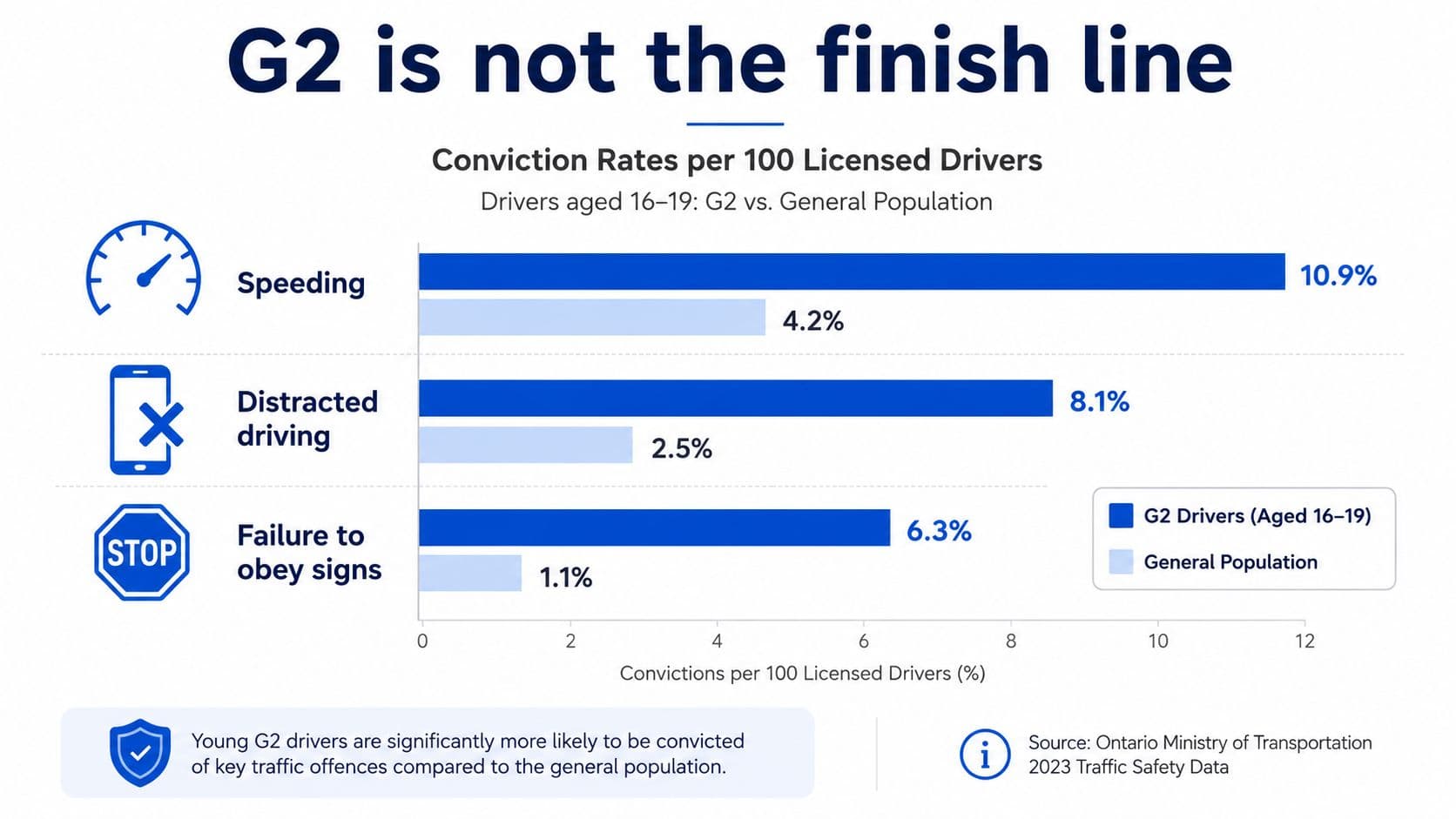
The central lesson is simple: G2 means more freedom, not automatic safety. Continue supervised conversations even when you're no longer required to sit beside the driver.
Using G1ready.ca to Prepare at Every Stage
Preparation works better when each study activity has a specific job. For G1, start with the Ontario Driver's Handbook, then use targeted practice to check whether you can recall rules without looking at the page. A chapter quiz can expose a weakness in signs, right-of-way rules, or safe driving practices before that weakness appears in a mixed test.
G1ready.ca's free G1 practice tests can be used in a staged routine rather than as endless repetition. Begin with chapter quizzes, move to mixed tests, and use the diagnostic option to identify the areas that need the most attention.
A practical study sequence
First, learn the rule. Read the relevant handbook section and explain it in your own words. If you can't explain when a restriction applies, you probably don't yet know it well enough to rely on memory.
Next, practise retrieval. Use road-sign and rules questions without checking the answer first. Immediate explanations are useful because they connect a missed answer to the underlying rule instead of letting the same mistake recur.
Then, simulate the appointment. In the final stretch before booking or attending the G1 test, use timed mixed practice. The aim is to stay calm while switching between signs, traffic laws, and safe-driving questions, not to memorise the order of questions.
During G1, shift the focus from written recall to behaviour behind the wheel. A parent or instructor can use a checklist covering mirror and shoulder checks, signals, speed control, turns, right-of-way, lane position, and hazard scanning. Ask the learner to describe what they're checking and why.
At G2, written review still has value, especially for signs and rules that fade after the G1 test. But the main preparation should be practical. Drive unfamiliar routes, practise highway merging when appropriate, review complex intersections, and discuss how fatigue, passengers, and phones affect decisions.
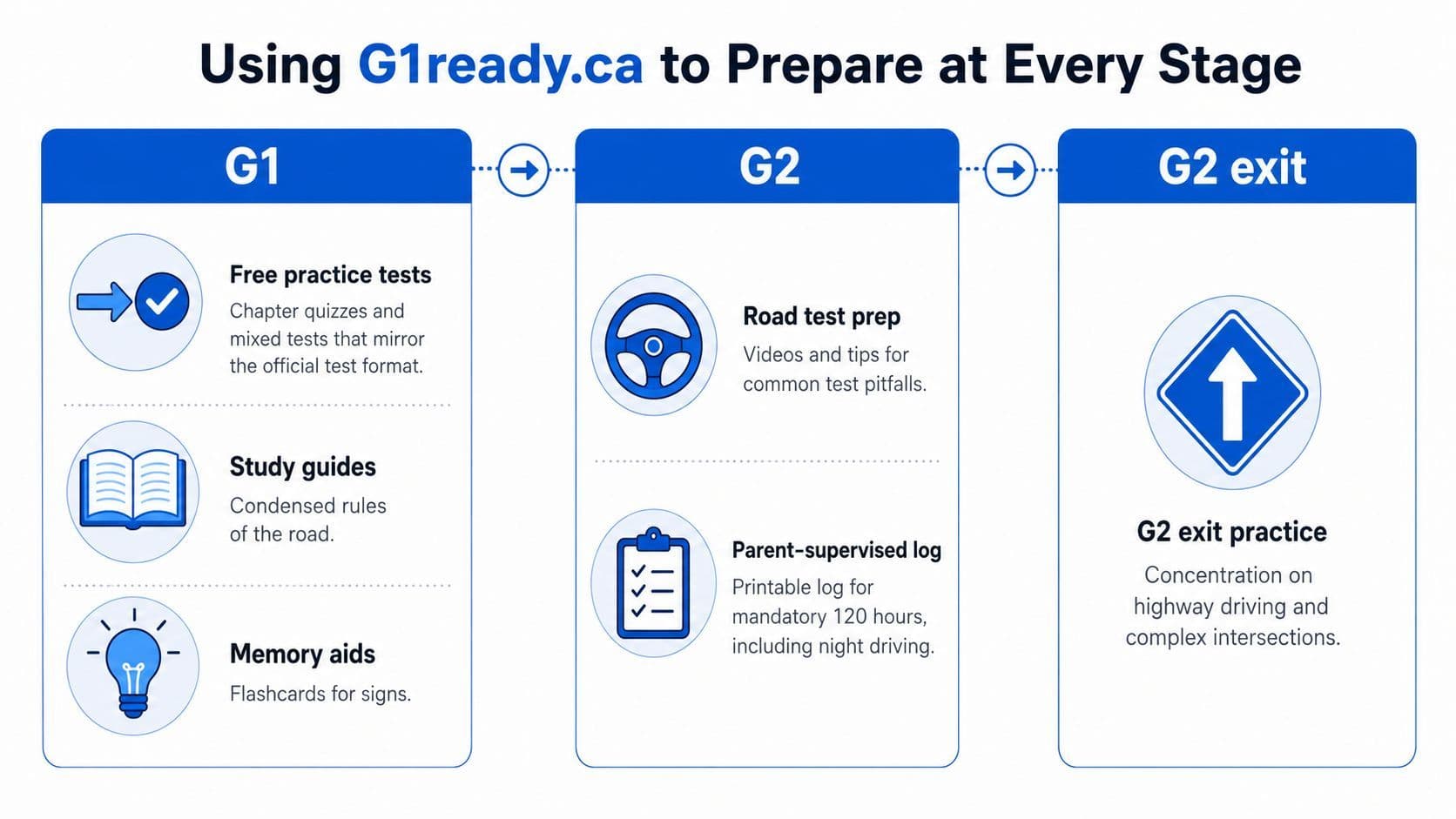
A good routine changes with the stage. G1 asks, “Do I understand the rule?” G1 driving asks, “Can I apply it with supervision?” G2 asks, “Will I still apply it when nobody is correcting me?”
Action Plan and Common Questions
A manageable plan keeps the licensing pathway from becoming a pile of disconnected deadlines.
- Book the G1 appointment: Confirm the required identification and current DriveTest arrangements before attending.
- Pass the knowledge and vision requirements: Study both signs and rules, and remember that each knowledge-test section has its own passing threshold.
- Practise with supervision: Use varied routes and conditions so the learner develops observation and judgement, not just vehicle control.
- Take the G1 road test: Book after meeting the applicable waiting period and prepare with a road-test checklist.
- Use the G2 period deliberately: Continue monitoring speed, passengers, phone use, fatigue, and late-night decisions.
- Complete the G2 waiting period: Keep the licensing timeline and expiry dates visible.
- Protect the record: Avoid convictions that can lead to suspensions, delays, or additional licensing consequences.
Common questions
What residency information may applicants need to provide? Ontario's licensing guidance says that, as of May 11, 2026, applicants for class G or M licences must declare Ontario as their primary residence and declare legal presence in Canada. Newcomers and people applying from outside Ontario should confirm the current documentation requirements before booking.
What happens if my G1 timeline is interrupted? Ontario gives drivers up to five years to complete the G1, G2, and full G process. Check the expiry date on your licence and ask Ontario about the effect of an expired or interrupted application rather than assuming previous steps remain valid indefinitely.
Does the zero-alcohol rule end when I receive full G? The novice and age-based rule applies while a driver is 21 or under and to drivers holding G1 or G2 licences. Ontario's impaired-driving rules still apply after full G, so never drive after consuming alcohol or drugs.
The safest approach is to treat licensing as a continuous learning plan. Pass the test, practise the skill, review the weak point, and keep making conservative decisions when independence arrives.
G1ready.ca offers free practice exams, chapter quizzes, mixed tests, diagnostic practice, and an exam simulator for Ontario learners preparing for the G1 knowledge test. Visit G1ready.ca to build a study routine that supports each step of your graduated licensing journey.


