Are you getting French G1 practice questions wrong because you don't know the driving rule, or because you misunderstood the wording? Those are different problems, and repeating mixed quizzes won't necessarily fix either one.
If you're searching for G1 practice test French resources, start by separating sign recognition, road-rule knowledge, and French terminology. Then check your licensing route before arranging your test, especially if you already hold a licence from outside Ontario.
Ontario G1 Knowledge Test Format at a Glance
The Ontario G1 knowledge test is a multiple-choice assessment covering traffic rules and traffic signs, and it's the mandatory first knowledge-based step towards a Class G1 licence. Applicants must be at least 16 years old, pass a vision test, and demonstrate knowledge of both subject areas, according to the Official Ministry of Transportation Driver's Handbook.
Think about the last question you missed. Did you fail to recognise the sign, or did you recognise it and pick the wrong action? A stop sign question can go wrong in two ways: you misread the shape, or you knew it meant stop but chose an answer that ignored who had the right-of-way next. The first mistake belongs to your signs study; the second belongs to your rules study. They look identical on a score sheet, so the format matters before you interpret any result.
Every question asks for one best answer. An option that sounds sensible fails if it misses a condition in the question, such as the type of vehicle involved or where the situation occurs. This is also where French terminology trips learners: you may know the rule in English yet hesitate over how it's phrased in French.
G1 knowledge test format
Test section Format Road signs Multiple choice, one best answer Rules of the road Multiple choice, one best answer Full test Multiple choice, both subject areas
Practise in the language you'll use
Ontario reported in 2016 that its knowledge test was offered in English, French, and 20 other languages through its DriveTest network. French preparation therefore serves a practical purpose: you learn to interpret questions in the language you'll sit the test in, so a wrong answer reflects a knowledge gap rather than a translation stumble.
Keep two columns in your study log, one for signs and one for rules. A strong signs column can hide a weak rules column, and each column points to a different fix.
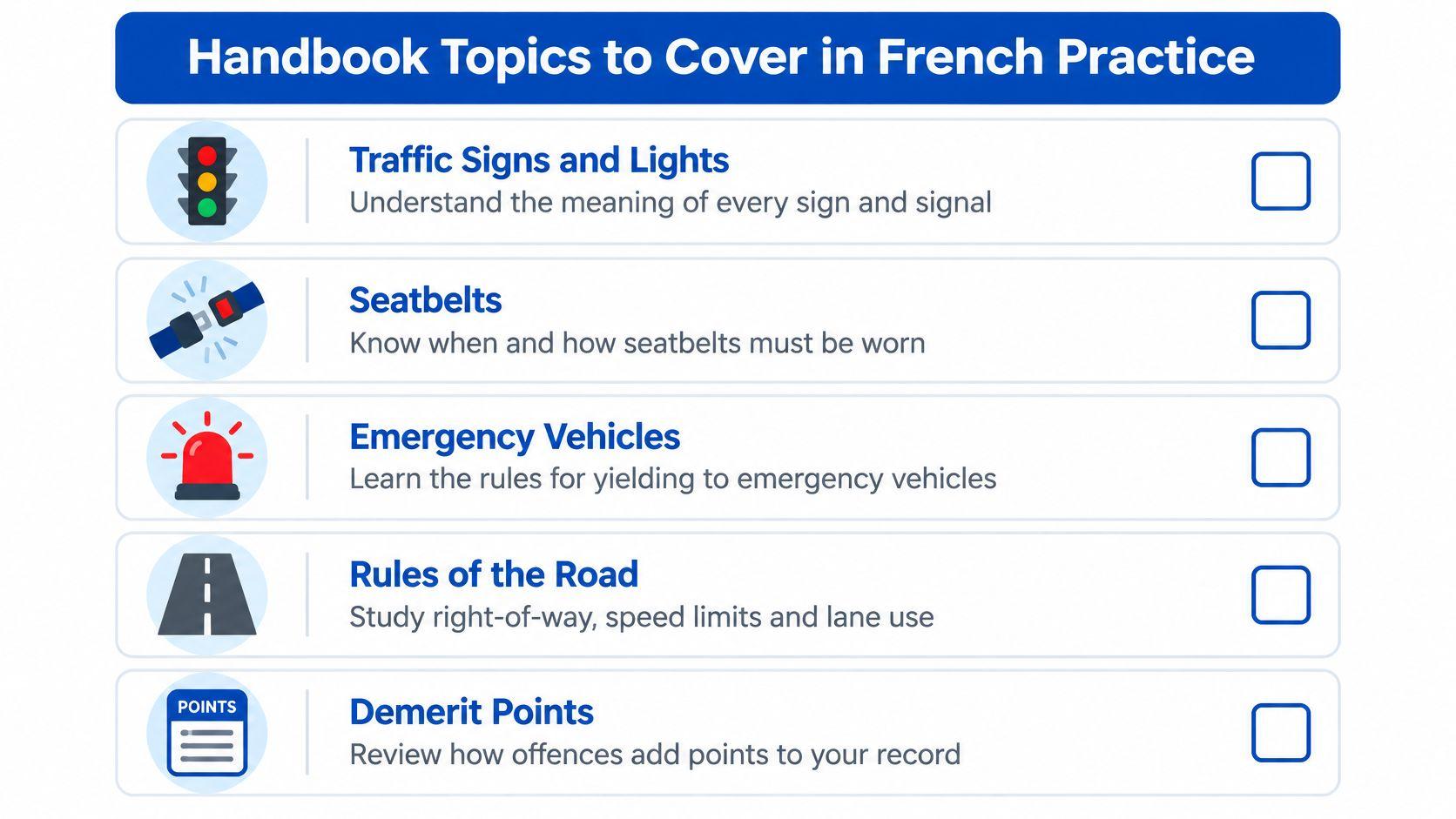
Handbook Topics to Cover in French Practice
Signs and rules are distinct competencies. Signs require you to interpret visual information, while rules require you to apply an obligation to a situation. The MTO handbook's licensing guidance identifies the handbook as the study reference and provides sample multiple-choice questions.
Use the handbook's subject areas to organise your French practice. Don't build your preparation around whichever questions happen to appear most often in a quiz.
Handbook topic areas and what each one tests
Handbook area What the question tests Review cue Traffic signs and lights Shape, colour, and meaning of regulatory, warning, and guide signs Match the sign's shape to its category first Right-of-way and sharing the road Yielding at intersections and around pedestrians and cyclists Identify who must yield before choosing Speed limits and headlights Posted limits and conditions requiring headlights Recheck the condition named in the question Emergency vehicles and school buses Yielding and stopping around flashing lights Learn the separate rule for each vehicle Freeway entry and exit Merging, acceleration lanes, and lane use Explain the manoeuvre as a sequence Collision reporting Conditions requiring a report Identify what triggers the reporting obligation Demerit points and licence suspensions Point values and consequences Keep a handbook-checked list of numbers and conditions
Also include seatbelts, streetcars, passing, and general rules of the road in your coverage checklist. A tidy study plan can still have gaps if you only practise the most familiar topics.
Diagnose the kind of knowledge missing
A learner who recognises signs but struggles with yielding needs scenario practice. A learner who confuses similar-looking signs needs visual comparison. Giving both learners the same mixed quiz makes their revision less focused.
For French terminology, copy unfamiliar wording directly from the French handbook into a vocabulary notebook. Beside it, record the meaning and required action in your own words. Avoid relying only on an English equivalent, which may not capture the full rule.
When reviewing an answer, explain why the other options fail. One might describe the wrong vehicle, another might omit an important condition, and another might describe a safe action that doesn't answer the question.
Before moving on, check that you can:
- Recognise the subject: Identify which handbook topic the question tests.
- Explain the action: State what the driver must do and under what conditions.
- Understand the wording: Interpret the relevant French terms without guessing.
- Reject alternatives: Explain why the remaining options aren't the best answer.
How to Run a French Practice Session Step by Step
A useful practice session produces more than a score. It leaves you with a clear explanation of what went wrong and a manageable task for your next session.
Use a notebook or spreadsheet rather than trying to remember your mistakes. Keep the French wording beside the rule so vocabulary review stays connected to driving decisions.
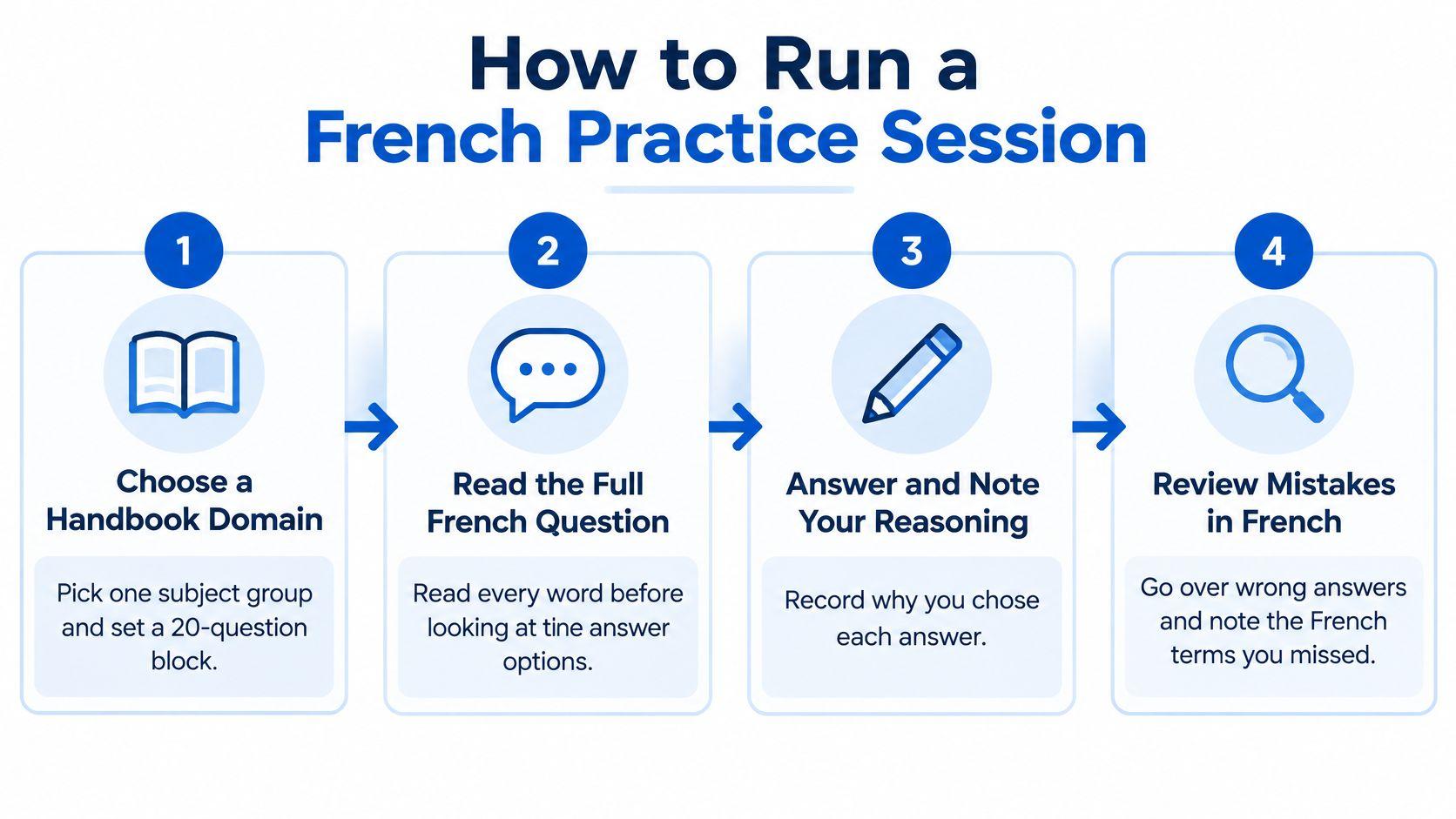
- Choose a handbook domain. Start with a focused block on one subject, such as school buses or traffic signs. For example, you could create a 20-question practice block, treating that as a study choice rather than a statement about the official test's length.
- Read the complete French question. Identify whether it asks you to recognise something or decide what a driver must do. Notice wording that changes the conditions before looking at the options.
- Choose an answer and record your reason. Don't use answer length or familiar phrasing as a shortcut. A brief note about your reasoning helps distinguish knowledge from a lucky guess.
- Review every explanation. Correct answers deserve review too, especially when you weren't confident. Compare the explanation with your reasoning instead of accepting the result.
- Classify each mistake. Mark it as a sign-recognition error, rule error, terminology problem, or reading oversight. If several labels apply, record the one that caused the wrong decision.
- Repair the weak domain before expanding. Revisit its handbook material, explain the rule aloud, and try unfamiliar questions. Don't treat remembering an answer letter as evidence that you understand the topic.
- Schedule a complete practice sitting. Use it to check whether your learning transfers across topics without immediate correction. Compare each section's result with the official requirements you've confirmed.
Make the correction specific
Suppose you miss a school-bus question because you mentally substitute an English term and overlook the French wording. Your correction should include both the French expression and the stopping rule, not a note saying “review buses.”
Practical rule: Write the correction you need to make, not just the answer you should have chosen.
Your routine is working when unfamiliar questions become easier to explain and the same errors stop appearing. A rising total is encouraging, but fewer repeated misunderstandings provide a clearer reason to move forward.
Reading Your Practice Scores by Topic
A strong rules result beside a weaker signs result calls for targeted review, not another round of everything. Your total score can conceal an uneven understanding, particularly when you feel comfortable with familiar questions.
Read your results as a pattern of decisions. The useful question isn't whether you passed a practice set, but what you consistently misunderstood.
- Signs lag behind rules: Compare sign shapes, colours, categories, and meanings. Cover the answer options and explain the sign before checking your response.
- Yielding questions remain weak: Sketch the intersection or road layout. Identify the road users and decide who must yield before reading the possible answers.
- Correct answers require prolonged hesitation: Separate careful reasoning from uncertainty about vocabulary. Practise short, focused blocks without rushing yourself into careless choices.
- Results fall when you switch to French: Revisit the exact terms in each missed question. Check whether you can explain the same rule when it's phrased differently.
- Reporting and licensing consequences cause repeated mistakes: Review the precise conditions and handbook figures. General driving experience isn't a substitute for knowing the relevant obligation.
Work through an uneven result
Suppose a learner answers most road-rule questions correctly but repeatedly confuses signs that look similar. Their next study period should concentrate on side-by-side sign comparisons, with a brief rules check to maintain what they already know.
Another learner may recognise every sign image yet choose the wrong action when reading its French description. More image repetition won't address that problem. They need to connect the wording to the action.
A practice progress tracker can help you organise the review, but the labels you record matter more than the tool. Include the domain, the reason for the mistake, and what happened when you tried a new question on that subject.
A correct answer after rereading an explanation isn't the same as applying the rule independently.
Choose the error pattern that appears most often in your log. Address that pattern before using another complete practice set to measure readiness.
Newcomer Licence Routes Before You Book
Confirm your licence route before treating G1 preparation as your only task. Someone who moves to Ontario from another province, state, or country can usually drive on an existing licence for a limited period before switching to an Ontario one.
That window makes paperwork an immediate concern, even if your driving knowledge is strong. Preparing for a knowledge test and establishing eligibility for a licence exchange are separate jobs, and each has its own timeline.

Newcomer licence situations and what to do
Situation What to do Key deadline or rule First-time applicant with no licence Pass the vision and knowledge tests, then enter Level One Follow the graduated licensing requirements Licence from another Canadian province or territory Confirm transfer eligibility and accepted documents with the Ministry Arrange the Ontario transfer within the permitted arrival period Licence from a country with an exchange agreement Check exchange requirements and eligibility for an Ontario licence An exchange requires document and eligibility checks Licence from a country without an exchange agreement Generally pass the vision and knowledge tests, then complete graduated licensing Check eligibility for foreign-experience credit and the required supporting documents
Separate experience credit from an exchange
Ontario's licensing rules allow eligible applicants to claim credit for foreign driving experience, supported by an original licence and the required authentication documents. The conditions attached to this credit can change over time, so confirm which provisions apply on the date you make your application.
Experience credit isn't the same thing as an automatic licence exchange. Don't assume that years of driving abroad remove the knowledge-test requirement or determine your Ontario licence class. Many experienced drivers still sit the G1 knowledge test, which makes your French practice sessions just as relevant as they are for a first-time applicant.
Use the Ontario driver's licence exchange guide to organise your questions. Then confirm your own requirements with the Ministry, including:
- Licence status: Whether your issuing jurisdiction qualifies for an exchange.
- Experience evidence: Which documents establish your driving history.
- Language requirements: Whether documents need an accepted translation or must be provided in English or French.
- Testing obligations: Which assessments remain necessary for your route.
Find your matching situation before committing to a test date. Gather the documents that establish your route while continuing to build your French terminology and your knowledge of Ontario-specific rules, so the administrative waiting time still moves you toward readiness.
Booking Steps and Test-Day Rules
Settle the administrative questions before you arrive. Confirm your licensing route, gather the accepted identification and supporting documents, and check the DriveTest Centre's current arrangements for knowledge testing rather than assuming every visit requires an appointment.
Ontario's new-driver licensing guidance explains that the examiner isn't permitted to coach you during the test. Ask questions about the process before the assessment starts, not after you encounter an unfamiliar question.
Prepare for the visit
- Confirm French testing arrangements: Make sure the centre can provide your intended test language.
- Check document acceptance: Bring the required originals and any supporting material relevant to your route.
- Understand the process: Clarify payment, vision screening, and testing arrangements beforehand.
- Use your study log: Choose your testing date when your results are stable, not because you've completed a particular number of quizzes.
Passing the knowledge test doesn't mean you're ready to drive independently. Your next task is to understand the conditions attached to your learner's licence and plan supervised driving accordingly.
Under the MTO handbook's graduated licensing guidance, Level One normally lasts 12 months, an approved driver-education course can reduce it to eight months when the required certificate is presented to the Ministry, and the driver must maintain a blood-alcohol concentration of zero while driving.
Keep knowledge-test preparation separate from later road-test preparation. You're demonstrating that you understand the rules now, then developing the practical ability to apply them under the conditions of your licence.
Start Your French G1 Practice Routine Today
Start with a diagnostic practice set and answer without looking up the rules. The purpose isn't to produce an impressive result. It's to discover whether your first study task should involve visual recognition, applying road rules, or understanding French terminology.
Choose the weakest domain and make a correction sheet. Include a question you misunderstood, the relevant handbook topic, and a short explanation of the action required. For terminology errors, add the French expression that changed your interpretation.
Use practice tools for a specific purpose
Our free French practice tests at G1ready.ca mirror the G1 exam format, with separate scoring for signs and rules. You can choose the Road Rules Test, Road Signs Test, 200-Question Test, and Diagnostic Test, moving from diagnosis to focused review and then broader practice.
Don't choose your test date after a single encouraging result. Look for a stable pattern across complete practice sittings, with both sections meeting the official requirements you've checked and weak topics showing independent improvement.
Readiness check: You should be able to explain why an answer is correct when the wording changes.
If you already hold a licence, complete the route and document checks alongside your study. If you're a first-time applicant, focus on building a dependable understanding rather than memorising a question bank.
Arrange your DriveTest visit only when both parts of your preparation are ready: the paperwork is settled, and your practice results are consistently sound.
G1ready.ca offers free practice tests with separate signs and rules scoring to help you focus your French G1 preparation. Visit G1ready.ca, begin with the Diagnostic Test, and use your results to choose your next targeted practice session.