
You've read several pages of the Ontario driver's handbook, taken a practice quiz, and still feel unsure. Your score looks acceptable one day, then drops the next. A parent may ask, “Are you ready to book the test?” while you're still wondering whether traffic signs, emergency vehicles, or freeway rules are the topics holding you back.
That uncertainty is common, but it doesn't have to control your preparation. A progress tracker online can turn scattered quiz results into a clear study path, showing what you've learned, where mistakes repeat, and what deserves your attention next. For Ontario learners, the useful question isn't only “What score did I get?” It's “What should I study now, and how will I know I've improved?”
Moving Beyond the Official MTO Handbook
A nervous learner often approaches the official MTO handbook with good intentions. They read a few pages about traffic signs, move through rules of the road, and highlight anything that seems important. After a while, the handbook starts to feel less like a guide and more like a large wall of information. The learner may recognise the words on the page but still struggle to recall the correct action in a multiple-choice question.
Consider a newcomer to Ontario who has driven in another country. They might understand general road safety but feel less familiar with local rules about streetcars, school buses, licence suspensions, or the demerit point system. A teenager studying for the first time can face a different problem. They may know the basics but overlook a narrow rule because they're reading the material in order instead of studying according to their mistakes.
Practical rule: Reading gives you exposure to the handbook. Practice and review show whether that information has become usable knowledge.
A tracker creates a bridge between those two activities. Instead of treating the handbook as one intimidating booklet, it breaks preparation into manageable milestones. You can study a topic, answer related questions, review the explanation, and record whether the same type of mistake appears again. That process makes your preparation visible without turning every result into a judgement about your ability.
The distinction matters at the DriveTest centre. A single strong practice result can reflect familiar questions or a lucky set of topics. A longer record of practice gives you a more honest picture. If you repeatedly miss questions about headlights, for example, your next action is clear. Return to the relevant handbook material, complete focused practice, and check whether your errors decrease on later attempts.
Ontario also sets a clear eligibility gate. You must be at least 16 years old and pass both a vision test and a knowledge test before entering Level One and receiving a Class G1 licence, according to the official MTO guidance on getting a driver's licence. A progress tracker can't replace those requirements, but it can help you prepare for the knowledge-test part with more structure and less guesswork.
How Online Progress Tracking Works
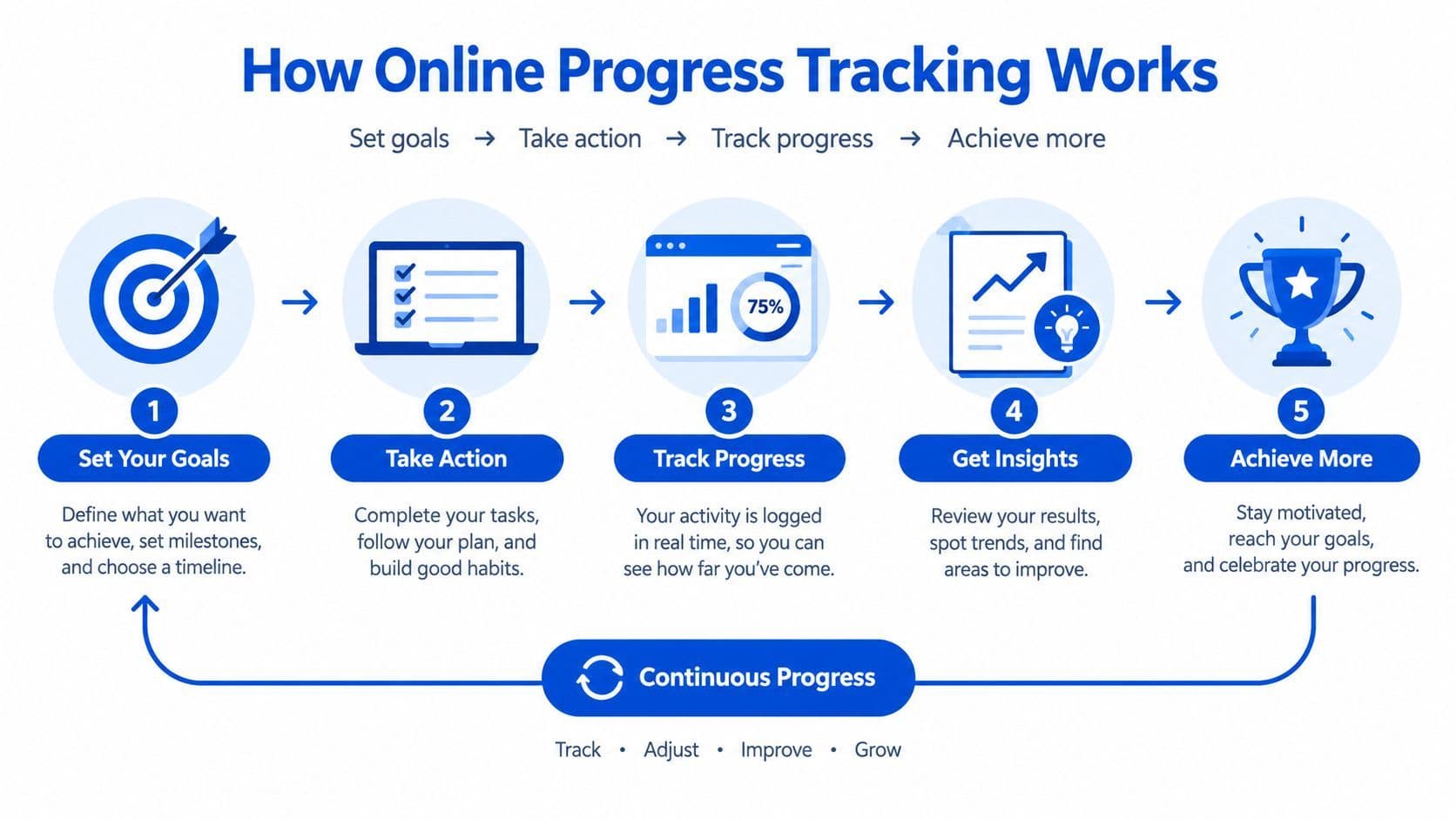
A useful progress tracker online should record learning over time, not just display the result from your latest quiz. It can collect attempts, correct and incorrect answers, time spent, topic-level performance, and activity history. Those details help separate a temporary result from a repeated pattern.
For example, a learner might receive a low result on a mixed practice test. That score alone doesn't explain the reason. The underlying data might show that the learner performs well on traffic signs but consistently misses questions about sharing the road and emergency vehicles. The next study session can then focus on those categories rather than repeating broad practice without a plan.
Ontario already uses online dashboards to make progress visible across public systems. EQAO reports provincial, school-board, and school-level results through interactive dashboards, and its 2024–2025 release covered online assessments in reading, writing, and mathematics across Grades 3, 6, 9, and the OSSLT. In that school year, EQAO reported that 65% of Ontario Grade 3 students met the provincial standard in writing, while 58% of Grade 9 students met the provincial standard in mathematics, presenting the results as a longitudinal snapshot for tracking achievement trends over time. You can review the EQAO assessment results and longitudinal reporting for the provincial context.
The same principle appears in Ontario's housing dashboard. The province set a 2024 target of 125,000 new homes and reported 94,908 new homes created, reaching 75.93% of that target. The tracker also separated the result into 73,617 housing starts, 14,381 additional residential units, 2,278 long-term care beds, 2,807 post-secondary student housing beds, and 1,825 congregate retirement home suites. Its status bands mark 100% or more as green, 80% or more as yellow, and below 80% as red, as shown on Ontario's housing supply progress tracker. The useful lesson is the structure, a target, current result, status, and next action.
A G1 tracker applies that structure to learning. It should help you answer four practical questions:
- What have I attempted? Review quizzes, mixed tests, and previous results.
- Where am I making errors? Group mistakes by handbook topic.
- What should I study next? Direct your attention to the weakest areas.
- Can I verify improvement? Repeat relevant practice and compare the new result with the earlier pattern.
A focused G1 diagnostic exam is useful at the beginning because it gives you a starting profile rather than forcing you to guess which chapters deserve priority.
A dashboard becomes valuable when it changes behaviour. If it only celebrates a score, it's a report card. If it identifies a weak topic, recommends a sensible next step, and preserves the history needed to confirm improvement, it becomes a study tool.
Here's a short visual explanation of that cycle:
Essential Features for G1 Test Preparation
A generic quiz app may tell you that an answer was wrong. A G1-focused tracker should tell you what kind of mistake you made, connect it to Ontario content, and help you practise that area again. The difference is important because broad scores can hide specific knowledge gaps.
The official handbook provides a practical taxonomy for organising those gaps. The written test may cover seatbelts, traffic signs and lights, emergency vehicles, headlights, speed limits, freeway entry and exit, streetcars and school buses, licence suspensions, the demerit point system, passing other vehicles, collision reporting, sharing the road, and general rules of the road, as described in the Ontario driver's handbook topic coverage. A tracker that uses categories like these gives your results meaning.
Match the content to the test
The official sample-test page says that all knowledge-test questions use a multiple-choice format, according to Ontario's sample knowledge-test questions. Practice should therefore help you read a question carefully, compare answer choices, reject unsafe options, and select the rule that applies. Open-response exercises may support learning, but they shouldn't be the only form of practice.
Look for these core features:
Feature Function G1 Prep Benefit Diagnostic assessment Establishes an initial picture of your knowledge Helps you begin with priority topics instead of random revision Topic categories Groups questions by handbook subject Shows whether errors cluster around signs, speed limits, or other rules Weak-area detection Identifies repeated mistakes Turns a disappointing result into a specific study decision Immediate explanations Clarifies why an answer is correct Helps you correct the underlying misunderstanding Performance history Stores earlier attempts and results Shows whether improvement continues beyond one lucky quiz Targeted quizzes Concentrates practice on one topic Reduces unfocused repetition and supports efficient review Multiple-choice practice Mirrors the mechanics of the knowledge test Builds familiarity with realistic answer selection Milestones and readiness indicators Makes progress easier to interpret Gives learners and parents a shared way to discuss preparation
Read the result before taking another test
A common mistake is to respond to a weak result by immediately starting another full quiz. That may feel productive, but it can repeat the same confusion. First inspect the topic breakdown, then return to the handbook material connected to the error.
For example, if collision reporting is a weak category, don't spend the next session answering unrelated questions about traffic lights. Study the rule, write down the part that caused confusion, and complete targeted practice. Use a G1 practice test later to check whether the knowledge transfers into a mixed set.
Parents can support this process without taking over. Ask, “Which topic are you working on today?” rather than focusing only on the latest score. That simple change keeps the conversation centred on action.
Choosing the Right Platform for Ontario Learners
A platform can identify a weak area and still leave the learner stuck. Seeing “streetcar rules need review” is useful, but it doesn't answer the next questions. Which handbook material should you read? Should you practise the same topic immediately? When should you return to a mixed test?
Guidance on online driver education in Ontario commonly emphasises quizzes and tests as ways to identify gaps, while also pointing to the value of a consistent schedule, note-taking, and instructor clarification. The Ontario online driver education guide reflects an important distinction. Diagnosis is only the beginning. A tracker should help convert the diagnosis into a realistic plan.
Compare the study experience, not just the dashboard
Generic apps can be convenient, but they may use rules from another jurisdiction or organise content around broad driving concepts rather than the Ontario handbook. A specialised Ontario platform should make it clear which material it covers and how practice relates to the local knowledge test.
Use these questions when comparing options:
- Does the content match Ontario? Check that the rules, signs, and terminology reflect the provincial handbook.
- Can it isolate weak topics? A mixed score isn't enough if you can't see the categories behind it.
- Does it provide the next step? Look for targeted quizzes, explanations, and a clear path back to the relevant material.
- Is it practical on mobile? A phone-friendly layout helps you use short study periods without sacrificing readability.
- Can you repeat practice? Unlimited retakes can support deliberate review, provided you're studying the explanations rather than memorising answer positions.
- Does it interrupt the learner? Forced registration walls can make it harder to begin, especially for someone who wants to test the platform before committing.
- Can a parent follow the plan? Clear results help families encourage consistency without guessing what needs attention.
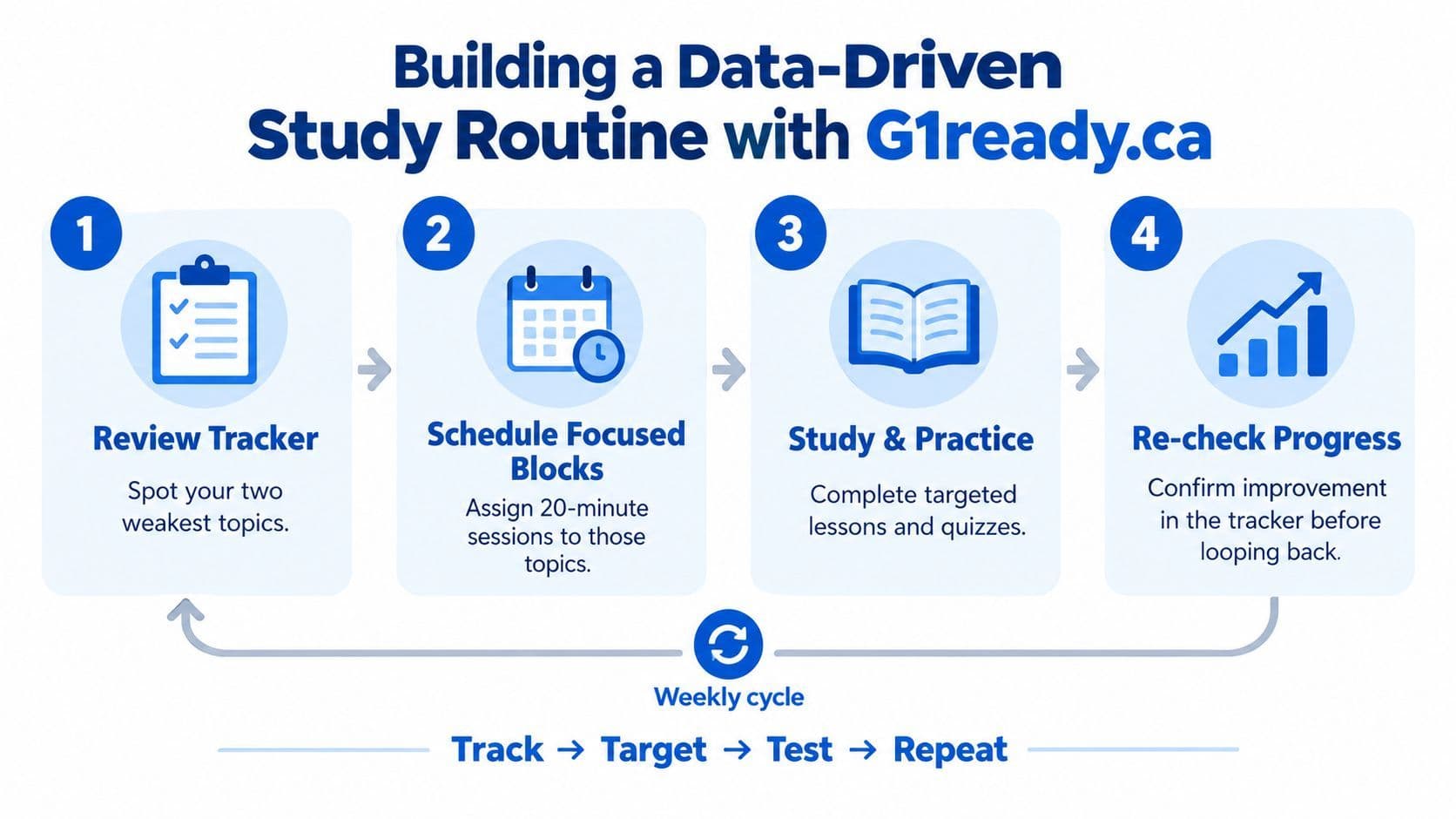
A good routine might look like this. You review your weakest topic, assign it a place in your study schedule, work through the related lesson and quiz, then return to the tracker to confirm whether the pattern has changed. If the result improves, keep the topic in occasional rotation. If it doesn't, slow down and seek clarification rather than just increasing quiz volume.
The platform should support that loop without pretending that data can replace understanding. A readiness indicator is a useful signal, not a guarantee. You still need to read the handbook, understand the rule behind each answer, and ask an instructor or knowledgeable adult about points that remain unclear.
For a teenager, convenience may determine whether the routine happens. For a parent, transparency may matter more. For a newcomer, provincial alignment is essential because familiar driving customs from another country may not match Ontario requirements. The right platform respects all three needs by making the data readable and the next action obvious.
Building a Data-Driven Study Routine with G1ready.ca
A progress dashboard only helps when it becomes part of a repeatable habit. The most effective approach is to treat each result as a planning note, not as a final judgement. You're building a record that tells you where to place your attention during the next study session.
Start with a diagnostic attempt. Don't spend too long trying to create a perfect first result. The purpose is to reveal your current pattern, including topics that feel familiar and topics that need careful review. Save the result, read the explanations, and identify the areas that deserve focused work.
Turn results into a weekly plan
Choose a small number of priority topics from the diagnostic. If the tracker points to freeway entry and collision reporting, schedule separate study blocks for those subjects rather than switching between every handbook chapter. Keep a written note beside each topic, such as “I confuse the conditions for this rule” or “I need to distinguish the sign from a similar one.”
Then follow this cycle:
- Review the tracker. Identify the topics with the clearest need for attention.
- Study the handbook material. Read the relevant rules slowly and make short notes in your own words.
- Complete targeted practice. Answer questions on the selected topics and examine every explanation, including answers you guessed correctly.
- Re-check the pattern. Return to the tracker and see whether the same category remains weak.
- Broaden practice gradually. Once focused work feels stronger, use mixed questions to test whether you can apply the rule without a topic label.
The G1 licence study material can support a more organised preparation routine. The resource should sit alongside the official handbook, not replace it.
Ontario's online learning reporting found that 81% of students taking an online learning course met or exceeded provincial expectations, as reported in the Ontario online course announcement. For G1 preparation, the relevant lesson is not that one learning format guarantees success. It's that tracking becomes actionable when it identifies a gap early enough for the learner to change study behaviour.
Build endurance after targeted review
Focused quizzes are valuable at the start of a cycle, but they shouldn't be the only practice you do. After reviewing weak categories, use mixed practice to check whether you can move between traffic signs, road rules, emergency situations, and other subjects without losing concentration.
A longer practice session can also reveal a different problem from lack of knowledge, such as rushing, changing correct answers, or losing focus late in the test. Record those observations separately. A learner who understands the rules but reads too quickly needs a different adjustment from someone who hasn't studied the topic.
Parents can help by protecting the routine. A quiet, consistent study time is more useful than repeated reminders to “do another test.” Ask the learner to show the topic selected, the note made, and the result after review. That keeps accountability connected to learning rather than pressure.
Tracking Your Path to the Full G Licence
The G1 knowledge test is an important first milestone, but Ontario's licensing path continues through two learning levels, G1 and G2, and two road tests before a driver earns a full G licence. Ontario says the complete graduated process can take up to five years, as explained in the provincial guide to getting a G licence.
That longer timeline changes how you should think about a progress tracker. It isn't a substitute for supervised driving, instruction, or safe decision-making on the road. It's a tool for building the habit of noticing what you know, identifying what needs work, and choosing a sensible next step.
The same approach can help after the knowledge test. You may later record practice goals, note questions for an instructor, and reflect on skills that need more attention before a road test. The details will change, but the learning habit remains useful.
Remember: The tracker is the navigation tool. Consistent, targeted practice is what moves you forward.
If you're nervous, don't wait for confidence to appear before you start. Begin with an honest diagnostic, study one weak topic at a time, and let your history show the improvement that a single quiz can't capture. When you arrive for the knowledge test, quiet confidence should come from preparation you can explain, not from hoping the questions happen to be familiar.
G1ready.ca offers Ontario-aligned practice exams, targeted quizzes, diagnostic practice, mixed tests, marathon practice, and a realistic exam simulator with explanations and progress statistics. Visit G1ready.ca to turn your weak-area results into a structured study routine before test day.


