
You're sitting in the parking lot with the seat adjusted, the mirrors tilted a little more carefully than usual, and the examiner is probably already making you feel like every small habit matters. That feeling is normal. The Full G road test in Ontario is the final gate between G2 and full Class G driving, and the reason it feels heavier than the earlier test is simple, it checks whether you can handle real traffic, real speed, and real judgement on Ontario roads.
The test sits inside Ontario's graduated licensing system, which means it isn't a first lesson or a basic skills check. The Ministry handbook says you need to have held your G2 for at least 12 months before you can take it, and Ontario road-test guidance describes the full path as taking 20 to 24 months end to end in some cases, depending on how you got licensed and how you scheduled your tests Ontario road test guide. That long runway matters because the examiner is looking for highway readiness, steady speed control, good observation, and safe following distance, not just whether you can stay on the road.
One thing many nervous drivers miss is that the Full G test isn't judged in a vacuum. Ontario's test centres produce very different outcomes by location, so local traffic patterns, route complexity, and examiner expectations all affect how the day feels Ontario Full G pass and failure rates. If you're a first-time driver or a newcomer learning Ontario-specific habits, that local reality is part of the test too.
What the Full G Road Test Actually Is
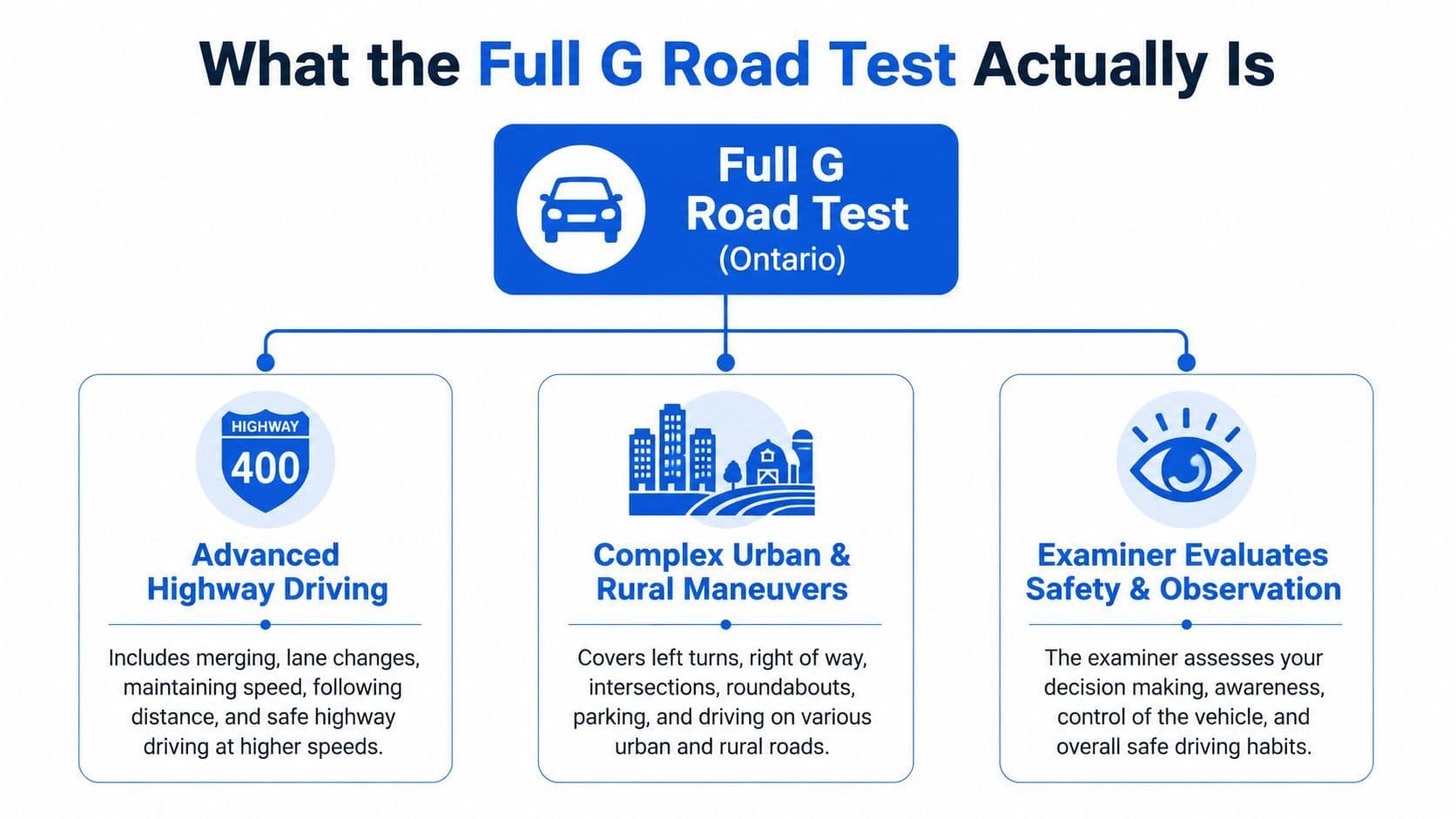
The easiest way to understand the Full G road test is to see it as the exit exam from Ontario's graduated licensing system. You already passed G2, which means the province has already trusted you with independent driving. This final test asks a harder question, can you handle higher-speed roads, more complex traffic, and cleaner decision-making without the safety net of intermediate licensing Ontario Driver's Handbook, Level Two Road Test.
For a lot of candidates, the test day starts with a very ordinary feeling. You're in the lot, checking your phone, rechecking your licence, and trying not to overthink the part where you merge at speed. That's exactly the right moment to remember what the examiner is scoring. The Full G is not about looking calm. It's about showing you can drive in a way that stays predictable, safe, and coordinated with traffic.
The place in the licence ladder
The Full G sits at the end of the G1, G2, and G progression, and it's the point where you move from restricted independent driving to full Class G privileges Ontario Driver's Handbook, Level Two Road Test. The handbook also states that passing the Level Two road test gives you those full privileges, which is why the test feels like a milestone rather than a formality.
What changes in practice is the kind of driving you're expected to perform. The examiner wants to see that you can merge onto faster roads, maintain a safe gap, check mirrors often enough to stay aware, and make lane changes without drifting, braking late, or hesitating in a way that disrupts traffic flow. The published Ontario guidance uses 2 to 3 seconds as the safe following-distance reference and 5 to 10 seconds as the mirror-check rhythm for road testing Ontario road test guide.
Practical rule: if your driving style looks overly tentative, the examiner notices that just as quickly as a bad lane change.
This is also why the Full G feels different from the earlier road test you passed. G2 testing is about proving you can drive independently. Full G testing is about proving you can do that on Ontario's faster roads without becoming a hazard to the traffic around you.
Learn more about Ontario Class G licensing steps
How G1, G2, and Full G Compare
Ontario's licensing stages make a lot more sense when you compare them by freedom, not just by label. G1 is the learning stage, G2 is the independent practice stage, and Full G is the point where the province removes the graduated restrictions. That progression matters because each stage changes what you're allowed to do behind the wheel, what the examiner expects, and how much responsibility you're carrying.
What changes at each stage
The G1 stage keeps a new driver under close supervision. The G2 stage lets you drive on your own, including on highways, while still leaving some rules in place for newer drivers. Full G removes the graduated restrictions and gives you full Class G privileges Ontario Driver's Handbook, Level Two Road Test. The minimum holding period also changes as you move through the system, and the waiting time between G2 and Full G is a fixed 12 months Ontario road test guide.
Ontario Graduated Licensing at a Glance Minimum Holding Period Key Restrictions Test Required G1 12 months, unless shortened by approved driver education Supervised driving only, no independent highway driving Knowledge test G2 12 months before Full G Intermediate conditions still apply, but highway driving is allowed Road test Full G After the G2 waiting period No graduated licensing restrictions Final road test
The practical difference is easier to feel than to memorise. A G1 driver is still learning the rules. A G2 driver is proving they can manage traffic independently. A Full G driver has to show they can do that while sharing faster roads, changing lanes cleanly, and keeping pace without forcing other drivers to react.
Why the comparison matters on test day
A lot of candidates prepare as if the Full G were just a longer version of the G2 road test. It isn't. The earlier test checks whether you can drive safely in ordinary situations. The Full G checks whether that same safety holds up when speeds rise and traffic movements become less forgiving.
If you're comparing your own place in the system, use the test freedom rather than the licence name as your guide. Can you drive alone? Can you drive on highways? Are you still under graduated restrictions? Those answers tell you where you are in the ladder far better than the sticker on the card.
Inside the Test Components and Maneuvers
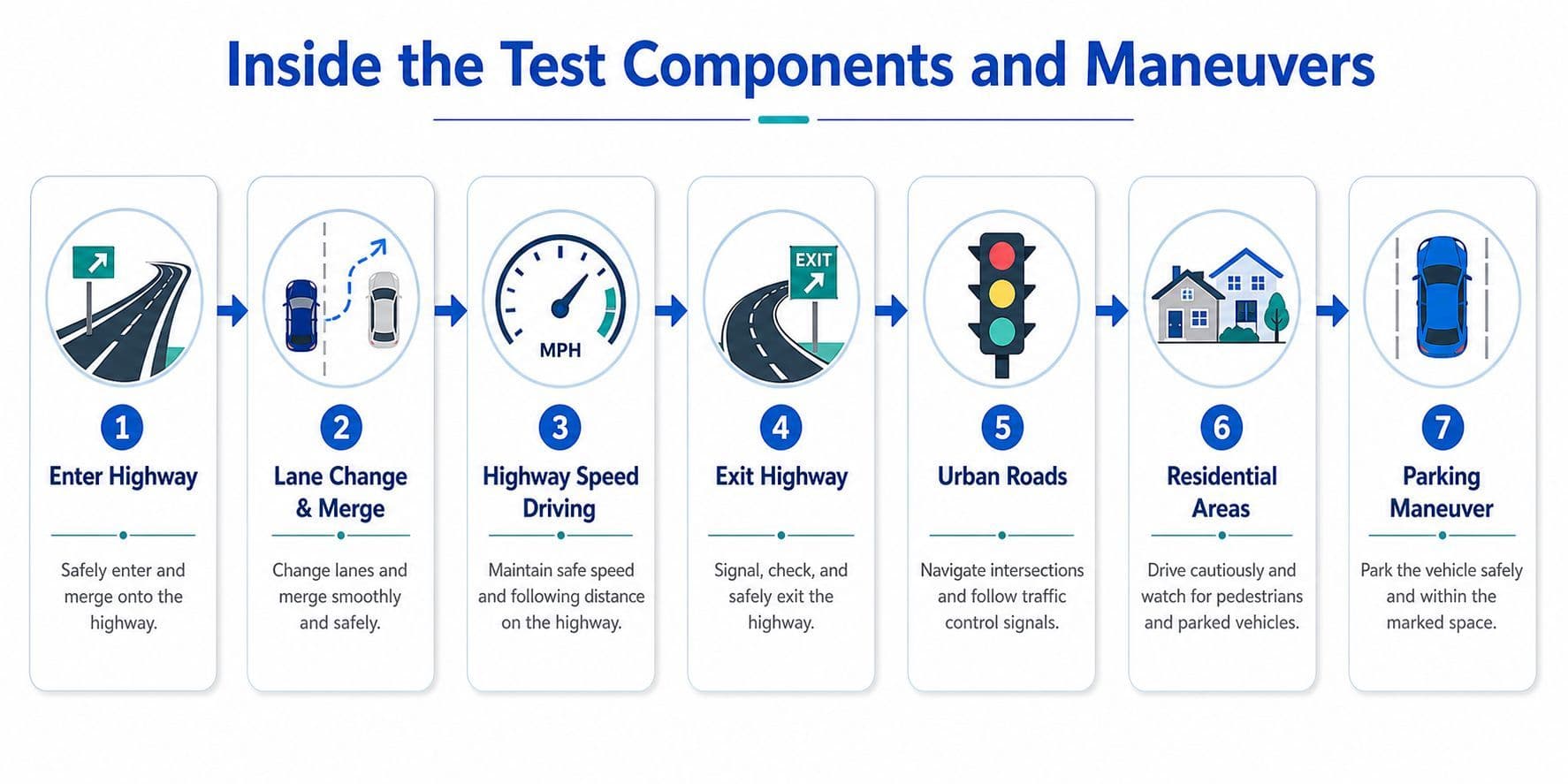
The full G test starts before the car moves. At check-in, Ontario's road-test process asks candidates to declare how many times they've driven on a highway with a speed limit of at least 80 km/h or on a 400-series highway in the last three months, and they must have done that at least five times to qualify DriveTest road tests for cars. That declaration isn't trivia. It tells the examiner whether you've had enough real exposure to high-speed conditions for the highway portion to be fair and safe.
After that, the test becomes a sequence of decisions. You're not being judged on one dramatic moment, you're being judged on a chain of small habits that either support safe driving or undermine it.
What the examiner watches first
The vehicle check and the highway-experience declaration set the tone. If the paperwork is incomplete or your experience doesn't meet the threshold, the examiner can cancel the test Ontario Driver's Handbook, Level Two Road Test. Once the drive begins, the examiner pays close attention to your basic control, how you stop, how you start, and whether you scan your surroundings before moving.
That sounds simple until you're in live traffic. A clean start means your mirrors are adjusted, your shoulders are checked, and your car moves off without hesitation or lurching. A clean stop means you know where to place the vehicle relative to the stop line, crosswalk, or sidewalk edge, depending on what's marked.
The manoeuvres come in real traffic, not on a closed course
The Full G road test can include lane changes, merging onto and exiting a highway, maintaining highway speed, and keeping a safe following distance of 2 to 3 seconds Ontario road test guide. Mirror checks every 5 to 10 seconds are part of that same expected rhythm, because the examiner wants to see continuous awareness rather than one-off glances.
Parking-style elements still matter too. Roadside stops should leave about 30 cm from the curb, and before pulling back into traffic you need a safe 150-metre gap in both directions Road-test checklist for first-time drivers. That gap is easy to underestimate when traffic looks light, so you need to check both directions carefully and not force the move early.
You don't get extra credit for making the examiner wait while you sort out lane position at the last second. Smooth, early decisions usually score better than late corrections.
The best way to think about the sequence is this. The examiner wants to see whether you can move from local streets to highway speed, back to local roads, and finally into a stopping position without breaking your awareness or your control. Every step is there to answer the same question, can you drive at Ontario speed without creating unnecessary risk?
Scoring Rules and Common Reasons for Failure
A nervous driver often assumes the examiner is watching only for big mistakes. The scoring is narrower than that, but it is also less forgiving than many guides suggest. Ontario's Full G pass rates vary sharply by location, and that is the first thing to understand before you treat the test like a simple checklist. In one Ontario dataset, Brampton posted a 57% pass rate and 43% failure rate, while Kapuskasing reached 88% pass and 12% failure Ontario Full G pass and failure rates. Another compilation put Brampton at 47% pass and 53% fail, while Kenora was listed at 93% pass in one Ontario summary and Espanola at 93% pass in another Ontario Full G pass and failure rates. The gap is large enough to change how you practise, because route pressure, traffic flow, and local habits are not the same from one test centre to another.
Why location changes the kind of pressure you feel
A test taken near a busy centre asks for a different rhythm than one taken in a quieter area. That does not change the rules, but it changes the setting in which the rules are judged. A driver who has only practised in one traffic pattern can be startled by heavier lane changes, tighter merges, or drivers who move more decisively around the test route.
The useful response is simple. Practise where your test will happen, and match the road conditions you are likely to face there. If your centre sits in heavier traffic, your practice should include heavier traffic. If it is in a calmer area, you still need the same control and observation, but you need to get comfortable with the pace that place expects.
The failure reason nervous drivers miss
A lot of candidates think failure starts with something dramatic, like rolling through a stop sign or forgetting a signal. Ontario-focused failure analysis says driving significantly below the posted speed limit when conditions do not require it can count as an impeding-traffic error Real reasons for G road test failures. That matters because many anxious drivers try to protect themselves by slowing down more and more, hoping caution will look safer.
It often does the opposite. On an open road, crawling along can make the examiner read hesitation, poor judgement, or a lack of confidence in traffic flow. The pace the examiner expects is steady and matched to conditions, with normal scanning, mirror use, and safe following distance Ontario road test guide. For a clearer breakdown of how errors are counted, the driver test point system guide is a useful reference.
Stopping position and control still count
Stopping rules sound simple until you are sitting at the line with traffic behind you. If there is a marked stop line, stop behind it. If there is no stop line but there is a crosswalk, stop at the crosswalk. If there is neither, stop at the sidewalk edge Road-test checklist for first-time drivers. These are the kinds of details that slip when a driver is tense, because the mind starts looking only at the car ahead and the pressure from behind.
The examiner is not asking for perfect theatre. They are watching for a car that stays controlled, matches traffic sensibly, and avoids the habits that signal poor judgement or hesitation. In Ontario, a clean score comes from showing that you can hold your lane, hold your speed, and hold your nerve without drifting into either reckless speed or unnecessary caution.
Vehicle, Insurance, and Booking Essentials
The vehicle you bring matters as much as your driving. It has to be properly insured and roadworthy, and the examiner will expect it to function cleanly in the basics, including stopping, signalling, and scanning without distraction Road-test checklist for first-time drivers. If the car is not ready, you are starting behind before the test even begins.
Get the paperwork and car condition right
Before you leave home, make sure the G2 licence, proof of insurance, and the vehicle registration are easy to reach. The vehicle should be in safe condition, with working signals, lights, brakes, and mirrors, and it should not have anything in the driver's field of view that causes unnecessary distraction Road-test checklist for first-time drivers.
A clean handoff to the examiner helps too. Pull in with enough room to settle the car, adjust the seat and mirrors, and do a quick brake and signal check before you head out. A rushed start usually shows up later as rushed observation.
Book strategically, not blindly
Ontario road-test guidance says the G road test can be booked through DriveTest, with a booking fee of $91.25 paid by VISA or MasterCard, and appointments can be booked up to 24 hours in advance What is the Full G driving test. That last detail matters because it affects how quickly you can react if your schedule changes or if a better opening appears.
The test centre you choose matters too. The pass-rate spread across Ontario means the booking decision is not just about convenience. It's also about traffic context, route familiarity, and how comfortable you are driving in that area Ontario Full G pass and failure rates.
A morning-of checklist that keeps people calm
Arrive early enough that you are not racing the clock. Anxiety rises when the clock starts winning.
- Warm up the vehicle: Start it early enough to confirm the brakes, signals, and steering feel normal.
- Set the mirrors and seat: If you can't see properly, the rest of the drive gets harder fast.
- Check your paperwork visibility: Licence, insurance, and registration should be ready before the examiner asks.
- Do a quick exterior look: Tires, warning lights, and obvious damage should not be surprises.
- Keep the cabin uncluttered: Anything that blocks sight lines or distracts you is a problem on test day.
Review the Ontario road-test booking process
Building Your Practice Routine With G1ready
A Full G candidate doesn't need more hype, they need cleaner repetition. The rules of the road, traffic signs, and right-of-way logic that show up in G1 study are the same foundation an examiner expects you to apply on the road. A practice platform like G1ready.ca gives you a way to rehearse that foundation with free, registration-free practice exams, diagnostic testing, marathon mode, and immediate explanations after each answer.
Use the platform for rule refreshers, not magic
If you're shaky on signs, lane control, or who goes first at an intersection, those weak spots can spill into road-test driving as hesitation or poor timing. G1ready's diagnostic test helps you spot those gaps, while the immediate feedback turns each mistake into a correction instead of a guess you carry forward. The mobile-friendly layout also makes short study sessions realistic when your week is already packed.
One useful routine is simple. Run a diagnostic, review the missed questions, then retest those topics in short bursts. That keeps your study tied to the problems you have, rather than the ones you hope you don't have.
Keep it practical
Study goal: make the rules automatic enough that your attention stays on mirrors, spacing, and timing during the drive.
The point isn't to turn a knowledge quiz into a road test. It's to keep the rules fresh enough that you don't burn mental energy recalling them under pressure. For nervous drivers, that extra headroom matters.
Targeted Practice Drills for the Week Before
The week before test day should feel organised, not frantic. One candidate I'd trust more is the one who drives a short Ontario-style route, corrects one habit at a time, and stops before fatigue turns practice into noise.
A simple seven-day rhythm
Start with a baseline highway drive that confirms you're comfortable with the kind of exposure the province expects. Then move to mirror and blind-spot drills, timed so you naturally check often instead of only when you remember. After that, practise lane changes on a multi-lane arterial, because that's where hesitation and late head turns show up fastest.
Midweek, rehearse roadside stops and the 30 cm curb spacing, then repeat the move into traffic only when the gap is clearly safe in both directions Road-test checklist for first-time drivers. A separate review session on G1ready can help you clear out any weak signs or rules you found earlier, and the final day should be light, with no new routes and no long sessions.
Check the failure traps before they find you
The under-discussed error is pace. Do a personal speed audit so you're not drifting too slowly and holding traffic back without reason Real reasons for G road test failures. That doesn't mean rushing. It means matching the road and conditions, then staying steady enough that your driving looks confident rather than timid.
Your goal is simple. Arrive at test day with fewer questions in your head and more habits in your hands.
Common Questions About the Full G Road Test
Can the examiner cancel the test for not enough highway experience
Yes. Ontario's handbook says the examiner can cancel the test if you do not have enough highway experience, which is why the highway-experience declaration is a required part of check-in rather than a casual formality Ontario Driver's Handbook, Level Two Road Test.
What happens if I fail
DriveTest guidance in Ontario describes a waiting period of at least 10 days before a retake, and you can book again after that failure window passes Graduated licensing in Ontario. If you miss by one or two mistakes, the fix is usually focused practice, not a total reset.
Is G1ready-style practice useful for a road test
Yes, if you use it for the right reason. Knowledge practice won't teach steering feel or lane timing, but it does keep the rules, signs, and right-of-way logic sharp enough that you can spend more attention on the actual drive. That's especially useful if your confidence drops when you're under pressure.
Does international driving experience count toward the G2 waiting period
Sometimes it can, but it depends on your documented history. Ontario recognises previous driving experience from other jurisdictions, and the exact credit depends on what licence you held and for how long Graduated licensing in Ontario. If you're a newcomer, get your documentation sorted early so DriveTest can assess it properly.
If you want a structured way to keep Ontario rules fresh while you prepare for the road test, G1ready.ca gives you free practice exams, diagnostic feedback, and a mobile-friendly way to drill the basics until they stick. Visit G1ready.ca and use it to tighten the rule knowledge that supports cleaner driving on test day.


